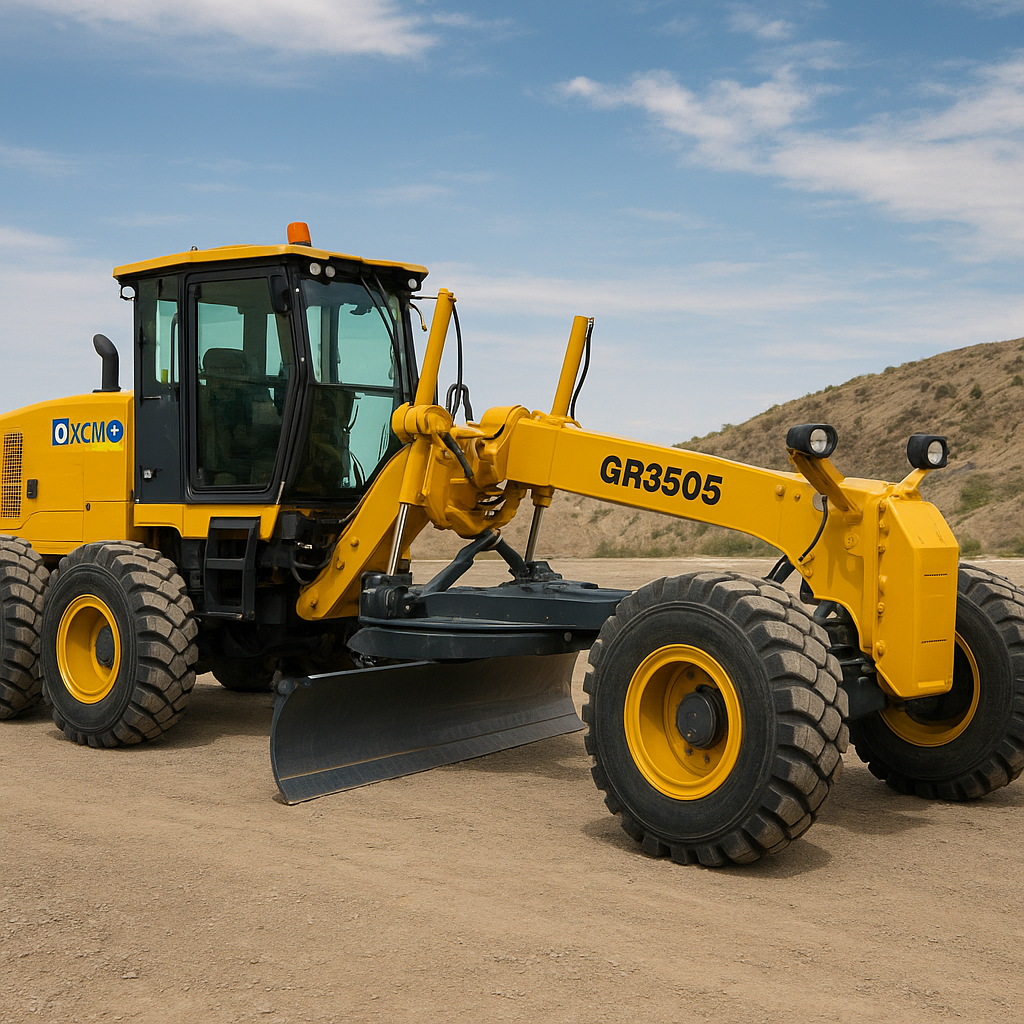
The XCMG GR3505 is a heavy-duty motor grader designed for demanding earthmoving, road construction and maintenance tasks. Built by XCMG, one of the largest construction equipment manufacturers in China, the GR3505 combines robust mechanical components, modern hydraulics and operator-oriented features intended to deliver consistent productivity on large civil engineering projects. This article provides a comprehensive overview of the GR3505, its typical technical characteristics, applications, operational advantages, maintenance considerations and how it fits into contemporary construction workflows.
Overview and design philosophy
The GR3505 represents XCMG’s approach to scaling grader capability into higher power and larger operating weight classes suitable for highways, airports, mining access roads and major earthworks. It is positioned above medium-sized graders and is intended to compete with international models in the roughly 300–400 horsepower category. The machine emphasizes a balance between durability, ease of maintenance and operator comfort, with an emphasis on delivering steady performance in continuous heavy-duty use.
Key elements of the design include a rigid frame layout with a centrally mounted moldboard (blade) and articulated steering options, a heavy-duty front axle to provide stability at high blade loads, and a powertrain engineered to supply sustained torque at low engine speeds for cutting and pushing dense materials. XCMG typically integrates proven engine suppliers (often in-house or well-known Chinese engine manufacturers) and robust transmission systems to ensure reliable performance across a variety of conditions.
Typical technical specifications (approximate)
Exact specifications for the GR3505 can vary by market, configuration and optional packages. Below are representative figures commonly associated with graders in this class and with XCMG’s published data for similar models. Treat the following values as typical ranges rather than certified figures for every unit.
- Engine power: approximately 250–300 kW (≈340–400 hp).
- Operating weight: roughly 28–36 tonnes, depending on configuration and optional counterweights.
- Moldboard (blade) length: around 5.0–5.6 meters (16–18 feet).
- Blade height and thickness: heavy-duty design, with reinforced ends and wear plates for long life.
- Transmission: power-shift or direct-drive gearbox with multiple forward/reverse gears; hydrostatic components for steering and blade control.
- Max travel speed: typically 40–45 km/h (market dependent).
- Hydraulic system: high-capacity, variable displacement pumps supporting simultaneous multi-function operation.
- Fuel capacity: commonly in the 500–700 liter range, intended to support long shifts without refuelling.
- Operating pressure: high-pressure hydraulics suitable for fast blade response and stable ripper operation.
- Cab: climate-controlled, ergonomically designed with sound insulation, adjustable suspension seat, and clear visibility over the blade and front axle.
Manufacturers sometimes offer optional packages such as rear ripper assemblies, circle power-shift upgrades, and third-party grade-control integrations (GPS/laser). The GR3505 is often configured to meet emissions regulations applicable to the destination market—ranging from Tier 3 / Stage IIIA compliance in some regions to Tier 4F / Stage V options where required. Exact engine and emissions packages will vary by country.
Primary applications
The GR3505 is built to address a broad set of heavy grading tasks. Its principal uses include:
- Construction of major highways and interchanges where consistent long-run grading and slope formation are essential.
- Airport runway and apron grading, requiring fine surface finishing and tight tolerances.
- Large-scale mining and quarry road construction where durability under heavy loads and abrasive materials is critical.
- Land reclamation and large earthmoving projects where high material throughput and blade stability are needed.
- Snow removal and runway clearing (with appropriate attachments) in colder climates.
- Maintenance of secondary roads and graded surfaces across rural and industrial sites.
For contractors involved in major civil works, the GR3505 provides a machine capable of handling both high-production rough grading and precision finish passes, reducing the need to switch machines frequently during a project phase.
Key features and innovations
Several features commonly highlighted for graders in this class—and which are expected on the GR3505 or available as options—include:
- Advanced hydraulic control: proportionally controlled circuits for blade lift, tilt, circle rotation and articulation, enabling smooth multi-function operation.
- Heavy-duty circle assembly: reinforced with replaceable wear components to extend service life in abrasive conditions.
- Operator ergonomics: spacious cab, easy-to-reach joysticks, and clear instrumentation to reduce fatigue and improve precision.
- Modular service points: grouped lubrication points, accessible filters and service panels to minimize downtime during maintenance.
- Ripper and rear attachments: multi-shank rippers for breaking compacted layers and optional scarifiers for surface prep.
- Grade-control compatibility: factory- or dealer-installed mounts and wiring for GPS/laser systems to enable semi-automated grading and higher finish accuracy.
- All-wheel braking and transmission locks: enhancing safety on slopes and during transport.
Collectively, these features are aimed at increasing efficiency, reducing life-cycle costs and improving the consistency of surface quality on projects.
Operational performance and productivity
Productivity with a grader such as the GR3505 depends on several variables: ground conditions, blade setup, operator proficiency, and the integration of technologies like GPS grade control. In favorable conditions, a 350-class grader can achieve high material displacement rates when used in tandem with dozers, scrapers or loaders. Key operational considerations include:
- Using the correct moldboard angle and cross-slope to minimize recutting and mixing of unsuitable material.
- Maintaining consistent engine speed and torque for cutting through dense layers without stalling.
- Optimizing tire selection and pressure to match load and surface conditions for traction and flotation.
- Employing grade-control systems for finish passes to reduce rework and survey time.
Fuel consumption is influenced by engine technology, load cycles and duty. For reference, heavy graders in this horsepower class typically consume in the range of 18–35 liters per hour under normal to heavy load—exact consumption will vary. The GR3505 is designed to be competitive in fuel economy through efficient hydraulics and engine tuning, and optional technologies can further reduce fuel use by minimizing unnecessary idling and enabling more precise passes.
Maintenance, reliability and serviceability
Long-term operating cost is strongly affected by maintenance strategy and the accessibility of spare parts. The GR3505’s design typically focuses on:
- Accessible daily service points: easy access to filters, batteries, fluid reservoirs and key inspection areas.
- Robust wear components: heavy-duty cutting edges, replaceable side bits, and durable circle teeth to lower replacement frequency.
- Structured maintenance intervals: recommended service schedules for engine, transmission and hydraulic systems to prevent unplanned downtime.
- Dealer support and parts network: XCMG’s international presence and dealer network can supply parts and technical assistance in many regions; availability may vary by country.
Following manufacturer guidelines for oil, filter and hydraulic fluid changes, as well as monitoring component wear, will maximize service life and preserve resale value. Training operators in proper machine use—avoiding excessive side loading of the blade, preventing material build-up on moving components, and using the correct gear ranges—also extends component life.
Safety and environmental considerations
Modern graders incorporate many safety features to protect operators and jobsite personnel. Expected safety aspects for the GR3505 include:
- ROPS/FOPS certified cab structures to protect occupants in rollover or falling-object incidents.
- Improved visibility through elevated cab position, large glazing areas and mirrors/cameras for rearward visibility.
- Emergency egress paths and clearly marked controls for quick response.
- Engine emissions packages to meet local regulations; exhaust aftertreatment where required for Tier 4 / Stage V compliance.
Environmental performance hinges on emissions control and fuel consumption. For operators working in regulated markets, specifying the appropriate emissions package is essential. Additionally, modern hydraulic systems with closed-center load-sensing pumps help reduce overall fuel use and lower heat generation.
Market position and comparative advantages
XCMG has expanded its presence in global markets through a combination of competitive pricing, broad product range and growing service networks. The GR3505 competes with models from established global brands by offering:
- Cost-effective acquisition price relative to many Western-branded equivalents, providing strong initial capital economics.
- High value in terms of basic capability—robust frame, adequate power and a set of practical features favored in heavy civil works.
- Customizable configurations and optional packages that allow adaptation to specific project requirements.
Some contractors choose XCMG equipment for fleet expansion due to the attractive total cost of ownership when factoring purchase price, usable life and acceptable maintenance costs. Where dealer support is strong, the GR3505 can be a reliable workhorse for large projects. Buyers should evaluate local support, parts availability and resale demand when selecting equipment from any manufacturer.
Attachments and customization
The versatility of a grader is greatly enhanced by attachments. Common options and customizations for a machine like the GR3505 include:
- Rear multi-shank rippers for loosening compacted material.
- Front dozer or snow plough attachments for push work and seasonal operations.
- Scarifiers for breaking surface crusts ahead of blade passes.
- GPS or laser-based grade-control systems for improved finish quality and reduced staking/survey time.
- Heavy-duty light packages and working lamps for night operations.
These attachments increase machine utilization across more tasks, often improving return on investment by enabling work through different seasons and reducing reliance on other specialized machines.
Buying considerations and lifecycle cost
When evaluating the GR3505, contractors should consider several factors beyond sticker price:
- Local dealer competence and spare parts logistics: faster parts delivery and trained technicians reduce downtime.
- Resale market: machines from well-represented brands in a region hold value better.
- Warranty terms and extended support packages available through the manufacturer or dealers.
- Application fit: ensuring the grader’s size and horsepower match the primary uses on current and upcoming projects.
- Total cost of ownership: including fuel, maintenance, tires, attachments and operator training costs.
Deploying telematics (where available) can greatly improve fleet management by tracking fuel use, location, operating hours and maintenance alerts—further reducing lifecycle costs by preventing avoidable failures and optimizing machine utilization.
Training and operator considerations
Operator skill is a major determinant of how effectively a grader performs. Training should focus on:
- Proper blade control and sequence of operations to minimize recuts and fuel consumption.
- Safe transport procedures, including securing the blade and using transport speeds within legal limits.
- Daily inspection routines to detect leaks, wear or mounting issues before they escalate.
- Using grade-control aids (if installed) to reduce operator fatigue and increase accuracy.
Well-trained operators can often reduce fuel consumption, extend component life and finish surfaces faster—making training an important part of the procurement decision.
Summary
The XCMG GR3505 is a purpose-built heavy grader aimed at contractors requiring robust performance for large-scale grading, road construction and maintenance. It offers a combination of substantial engine power, durable structural components, and serviceability features that make it suitable for continuous heavy-duty work. While exact specifications and emissions packages vary by market, the GR3505 is typically positioned to balance power, durability and cost-efficiency, with optional technologies—such as GPS grade control and advanced hydraulics—available to increase precision and productivity.
When considering the GR3505 for a fleet, evaluate local support networks, total lifecycle costs, and how the machine will be used across projects. With the right configuration and maintenance regime, the GR3505 can be a productive asset in demanding environments, delivering reliable performance for major civil and infrastructure projects.
)
)