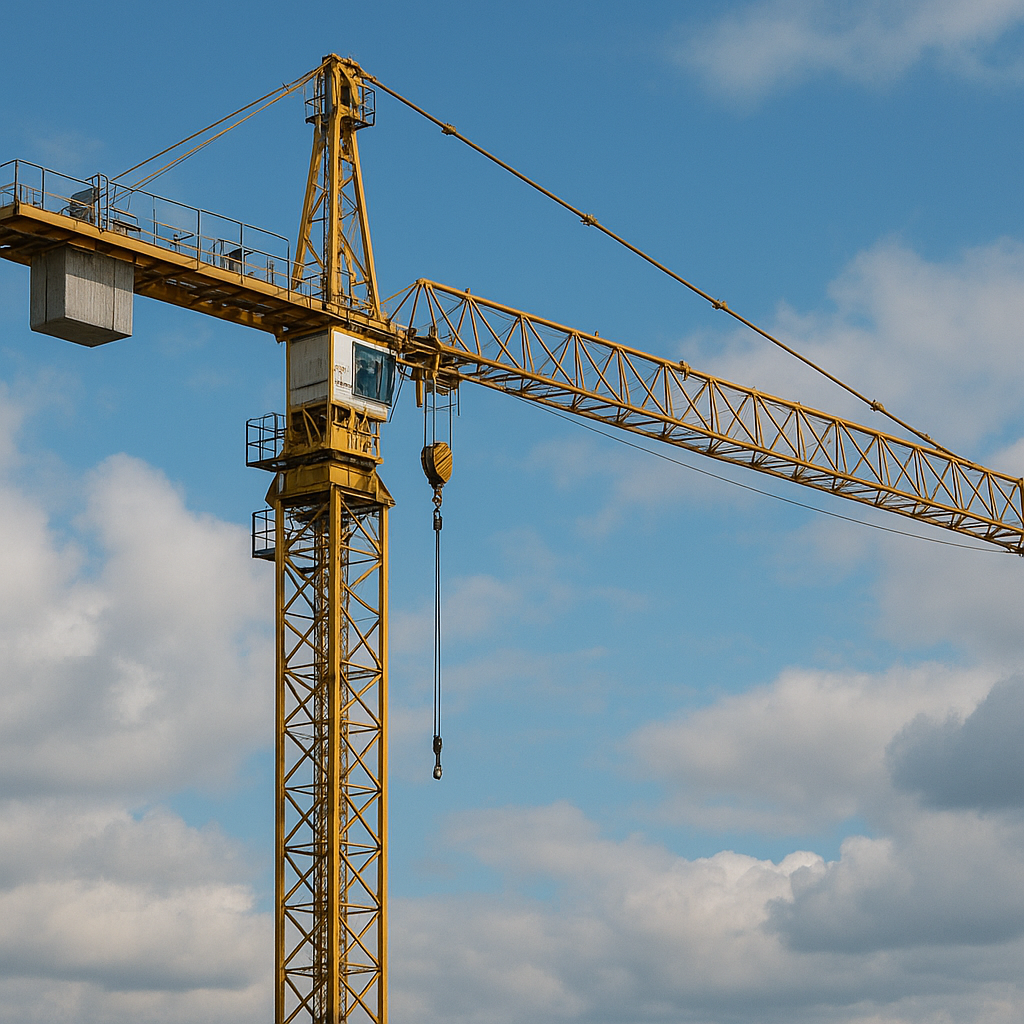
The Wolff 8033cross is a versatile tower crane model from the Wolffkran family designed to serve demanding construction environments where a balance of lifting capacity, flexibility and efficient transportability are required. In this article we examine the machine’s design philosophy, typical technical characteristics, common applications, installation and logistics, operational best practices, safety and maintenance considerations, and the commercial and environmental context in which the 8033cross is typically deployed. The aim is to provide a practical and informative overview for engineers, site managers, procurement teams and crane operators interested in a modern, midsize tower crane solution.
Design and technical characteristics
At its core the Wolff 8033cross is intended as a mid-range, top-slewing tower crane that combines a compact footprint with a capacity profile suitable for medium-to-large building sites. The model name suggests it belongs to Wolffkran’s 8000-series line, which traditionally emphasizes modular components, relatively fast assembly and a range of jib and tower configurations to suit different site constraints. The “cross” suffix commonly denotes a configuration optimized for compact transport and easy installation, although exact nomenclature and options can vary by market and customer specification.
Typical configuration and components
- Jib: Available in several jib lengths—typical ranges for a crane in this class are from about 30 m up to 60 m, depending on customer selection. The jib can be a lattice type with a tapered profile to balance weight and stiffness.
- Maximum lifting capacity: In common mid-size configurations, peak capacity near the mast can range from approximately 6 to 12 tonnes, while the tip capacity (at maximum radius) is often under 1.5 tonnes. Exact numbers depend on jib length, counterweight and mast section configuration.
- Radius: Working radii commonly fall between 3 m minimum (near the mast) and 50–60 m maximum, depending on jib selection and the counterbalancing system installed.
- Mast and freestanding height: The crane can be supplied with varying mast sections to achieve freestanding heights from a few meters up to several dozen meters; the machine can be climbed using standard climbing frames and additional mast sections for higher buildings.
- Counterweight: Modular counterweights are used to tune the crane’s moment characteristics for a particular job. This enables different lifting charts depending on the installed counterweight mass.
- Cab and controls: Modern Wolff models often feature ergonomically designed cabs, digital load moment indicators, and optional remote monitoring/diagnostics packages. Control options include variable-speed drives and fine hoist control for precision handling.
Performance and operating characteristics
The Wolff 8033cross is typically engineered to deliver smooth hoist, trolley and slewing motions with steep safety margins for dynamic loads. Key performance attributes include precise positioning at the load hook, stable slewing under load, and the ability to handle frequent lifts throughout a workday without excessive thermal loading on drive units. The machine’s modularity supports different installation profiles: a short-setup profile for sites with limited crane space and an extended profile where higher reach or greater capacity at radius is desirable.
Applications and industries
The Wolff 8033cross finds application across a broad range of construction sectors where a mid-size tower crane is an ideal match between power and flexibility. Its most common uses include:
- Residential and commercial building projects—handling precast panels, concrete buckets, steel sections, facade elements and mechanical equipment.
- Industrial construction sites—supporting plant erection tasks, setting HVAC units, and lifting modular equipment packages.
- Infrastructure and public works—bridges, railway facility works and similar projects where moderate reach and frequent repositioning are required.
- Renovation and retrofit tasks in dense urban environments—compact assembly variants of the 8033cross allow work in confined sites where larger cranes are impractical.
- Modular and prefab construction where repeated, accurate placements of modules require predictable crane cycles and robust control systems.
Because the 8033cross blends a relatively small transport footprint with a respectable load chart, it often becomes a preferred choice for contractors who rotate cranes between multiple urban sites or who need a crane that can be configured quickly for different job profiles.
Installation, transport and logistics
One of the practical advantages of the Wolff 8033cross is its emphasis on modularity for transport and assembly. Components are designed to fit common trucking dimensions and typically include bolt-together jib sections, stackable counterweights and portable mast segments. This design reduces the number of heavy-lift trucks required for transport and limits the need for auxiliary lifting equipment during erection.
Transport considerations
- Modular jib and mast sections are sized to fit European and international road transport limits, which lowers the logistical cost for multi-site operations.
- Counterweights frequently come in standardized blocks that can be handled with forklifts or small mobile cranes, reducing the dependence on large mobile cranes for on-site assembly.
- Disassembly and reassembly cycles are streamlined to support rental markets where cranes are moved frequently between projects.
Erection and commissioning
Typical site procedures for erecting a Wolff 8033cross include ground anchoring or block foundations, erection of the base and mast sections, installation of the slewing unit and jib, counterweight placement and commissioning of the control and safety systems. Depending on site constraints and availability of a mobile crane, some assembly steps may be undertaken by specialized erection crews using gin-pole methods and the crane’s own auxiliary hoist.
Safety systems and operational best practices
Safety is central to modern tower crane design, and the Wolff 8033cross integrates multiple systems to reduce operational risk and help comply with international standards. These systems include digital load moment indicators (LMI), anti-collision systems when operated in tandem with other cranes, slew and trolley limiters, and crew-access safety provisions. Operator training and site-specific risk assessments are essential complements to the machine’s built-in protections.
- Load monitoring: LMIs provide real-time feedback to the operator, combining hook load, radius and boom angle to prevent overload situations.
- Limits and interlocks: Electronic and mechanical limiters prevent over-travel of trolley and slewing motion, and can enforce safe lifting envelopes determined during site setup.
- Anti-collision: Where multiple cranes operate concurrently, anti-collision systems or site supervision is used to coordinate movement and prevent dangerous interactions.
- Weather monitoring: Wind speed sensors and operational thresholds are used to define safe operating windows—lifting in high winds is restricted per manufacturer recommendations.
- Operator ergonomics: An ergonomically designed cab, good visibility and responsive controls reduce fatigue and support precise operations throughout long shifts.
Maintenance, lifecycle management and reliability
Efficient maintenance practices prolong the useful life of a tower crane and improve availability. The Wolff 8033cross is typically supported by manufacturer or dealer networks offering scheduled servicing, spare parts packages and refurbishment programs. Typical maintenance items include gearboxes, brake systems, slewing bearings, wire rope inspection and replacement, electrical diagnostics, and periodic structural inspections for fatigue or corrosion.
Recommended maintenance practices
- Daily pre-shift inspections: visual checks of ropes, sheaves, brakes and safety devices.
- Periodic lubrication of slewing rings, bearings and gearbox components as per manufacturer intervals.
- Non-destructive testing (NDT) of key structural welds and mast sections at defined service intervals.
- Battery and electrical system maintenance for control electronics and diagnostic modules.
- Record keeping of lift cycles and loads to support predictive maintenance programs and to plan component renewal before end-of-life issues occur.
Modern fleets often include telematics that record operational hours, lift counts and fault codes—data that enables condition-based maintenance and reduces unscheduled downtime. This capability is particularly valuable in rental operations where cranes move frequently between sites.
Economic and environmental considerations
From an economic standpoint the Wolff 8033cross is positioned where purchase and rental costs align with the needs of contractors requiring a reliable, mid-size crane. Total cost of ownership considerations include transport and assembly costs, fuel or electrical power consumption for drives and heaters, maintenance, insurance and depreciation.
- Rental flexibility: The crane’s modularity supports quick redeployment, often making rental a cost-effective option for contractors with intermittent needs.
- Fuel and energy: Modern drive systems and efficient motors reduce energy consumption; electrified drives can be more efficient and offer lower operational emissions compared with less optimized systems.
- Noise and emissions: Cab insulation and quieter drive units reduce site noise; when powered by electric mains or clean generators, the crane’s operational emissions are correspondingly lower.
Environmental best practices include the use of environmentally friendly hydraulic fluids, scheduled oil-capture procedures, and minimizing transport distances by careful logistical planning. Recycling of counterweight blocks and end-of-life recovery of steel components are standard in the industry and support circular-economy goals.
Case uses and practical examples
The Wolff 8033cross is often used in projects that require a balance between reach and local lifting power. Typical examples include:
- Mid-rise apartment buildings in dense urban settings where the crane must be freestanding for weeks or months and must be erected with limited staging area.
- Commercial office towers during facade installation phases when repeated, precise placements of curtain wall elements are required.
- Industrial plant construction where modular skids and heavy equipment must be lifted and accurately positioned within constrained yards.
- Projects with phased concrete pours where the crane is used for both material supply (concrete buckets) and installation of rebar cages and formwork.
In each of these cases the 8033cross’s combination of modular transport, adjustable counterweight, and a comprehensive control system allows it to adapt quickly to changing lift charts and site requirements.
Selection, procurement and rental considerations
When selecting a crane like the Wolff 8033cross, procurement teams should match the crane’s lifting chart to the heaviest lifts and the longest radii that will be required on the project. Important steps include:
- Preparing a lift plan that identifies the single heaviest lift and the distribution of typical lifts across the most used radii.
- Specifying the required freestanding height and whether climbing will be necessary as the building rises.
- Considering site constraints (road access, nearby structures, and underground services) that may impact foundation design and counterweight placement.
- Confirming available options like remote diagnostics, anti-collision systems, and specialized attachment equipment (e.g., spreaders or hooks for specific loads).
For rental users, access to manufacturer-backed service and rapid spare parts delivery are key metrics that affect uptime and overall project cost.
Limitations and considerations
No crane is a universal solution. The Wolff 8033cross will not replace very large, high-capacity tower cranes needed for heavy industrial lifts or very long reaches beyond 60 m without a different model configuration. Additionally, site-specific factors—such as extreme wind exposure, seismic requirements, or unusually high lift frequency—may necessitate alternative crane classes or specialized reinforcement.
- For extremely heavy lifts, mobile crawler cranes or larger lattice-boom tower cranes may be required.
- In locations with very high wind loads or special seismic design criteria, additional engineering and foundation work may be needed.
- Transport permits and road restrictions can affect lead times for assembly and disassembly in some jurisdictions.
Summary and final remarks
The Wolff 8033cross stands out as a practical, adaptable solution for a wide range of construction tasks where a mid-size tower crane is required. Its modular design supports efficient transport and flexible configuration, while integrated safety systems and modern control electronics aid operator productivity and site safety. From residential and commercial buildings to industrial and infrastructure works, the 8033cross is designed to offer a balance of capacity, reach and operational economy.
While exact technical specifications such as specific maximum loads, jib lengths and freestanding heights depend on the chosen configuration, typical cranes in this class offer peak capacities in the single-digit tonne range at short radii and multiple jib lengths up to several dozen meters. For project-specific planning it is recommended to consult the manufacturer’s official load charts and configuration guides to match the crane precisely to job requirements and to ensure compliance with local regulations.
Overall, the Wolff 8033cross represents a modern approach to tower crane design—emphasizing modularity, safety, and operational efficiency—making it a reliable choice for contractors and rental fleets operating in varied and often challenging construction environments.
)
)