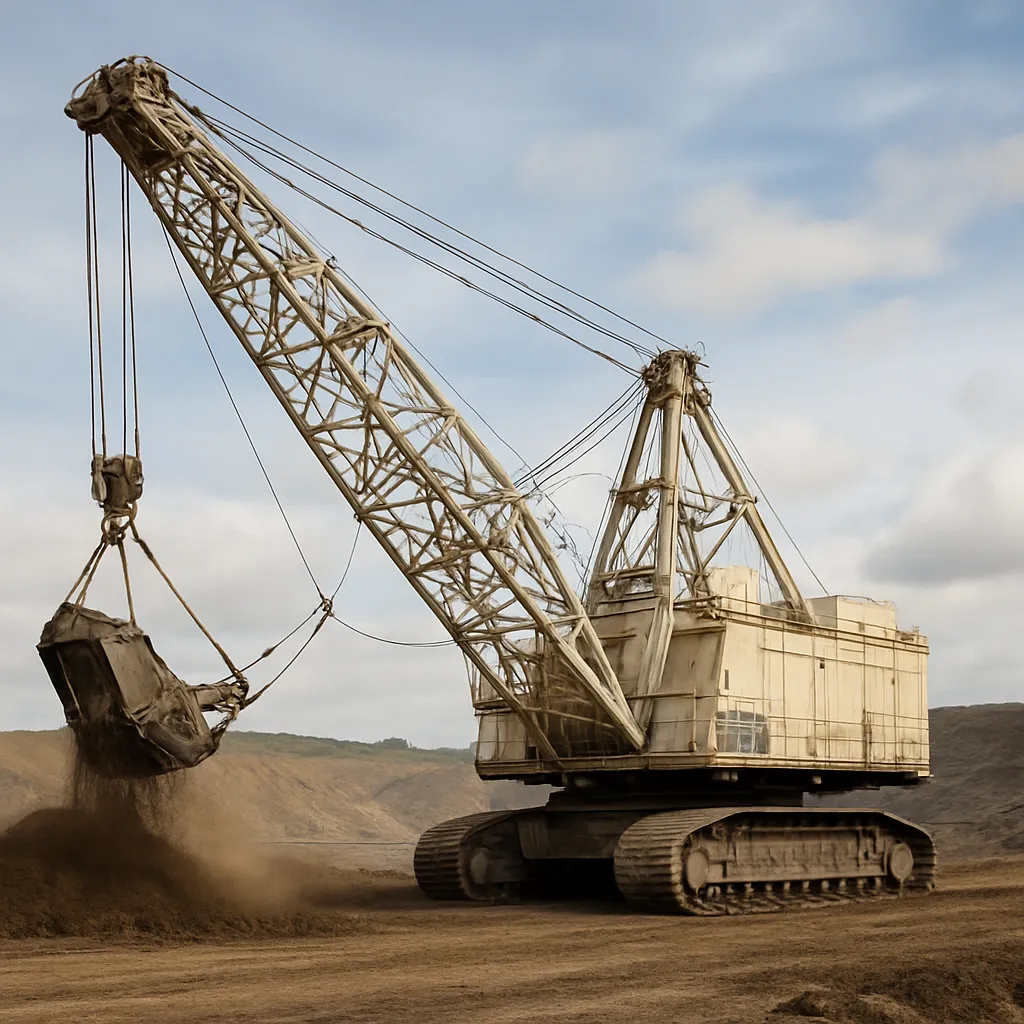
The Walking Dragline 24/96 is a heavy-duty excavation machine used primarily in large-scale surface mining and major earthmoving projects. Characterized by a large suspended bucket, a long boom, and a unique “walking” undercarriage, this class of dragline combines reach, lifting capacity and mobility to move vast quantities of material efficiently. This article explores the machine’s design, applications, operational characteristics, typical specifications and the practical, environmental and economic considerations that surround its use.
Design and Key Components
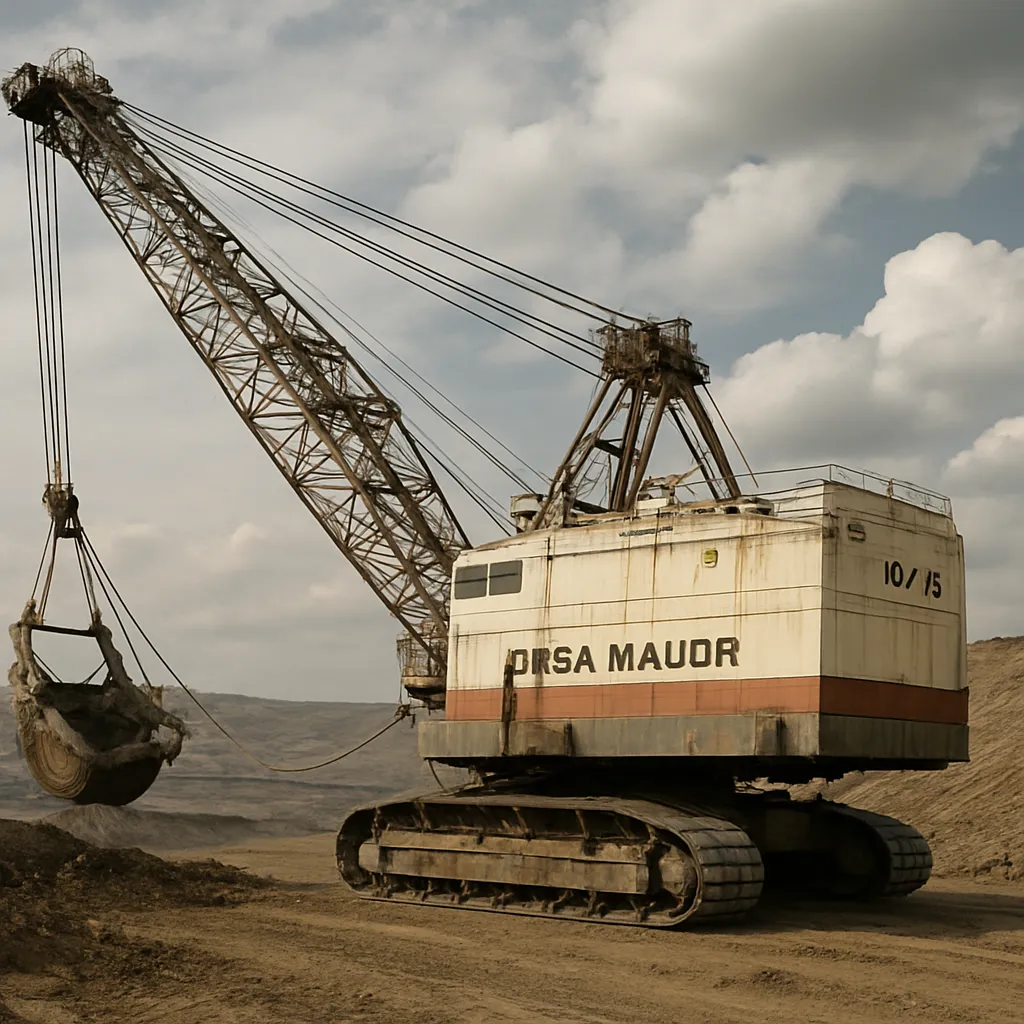
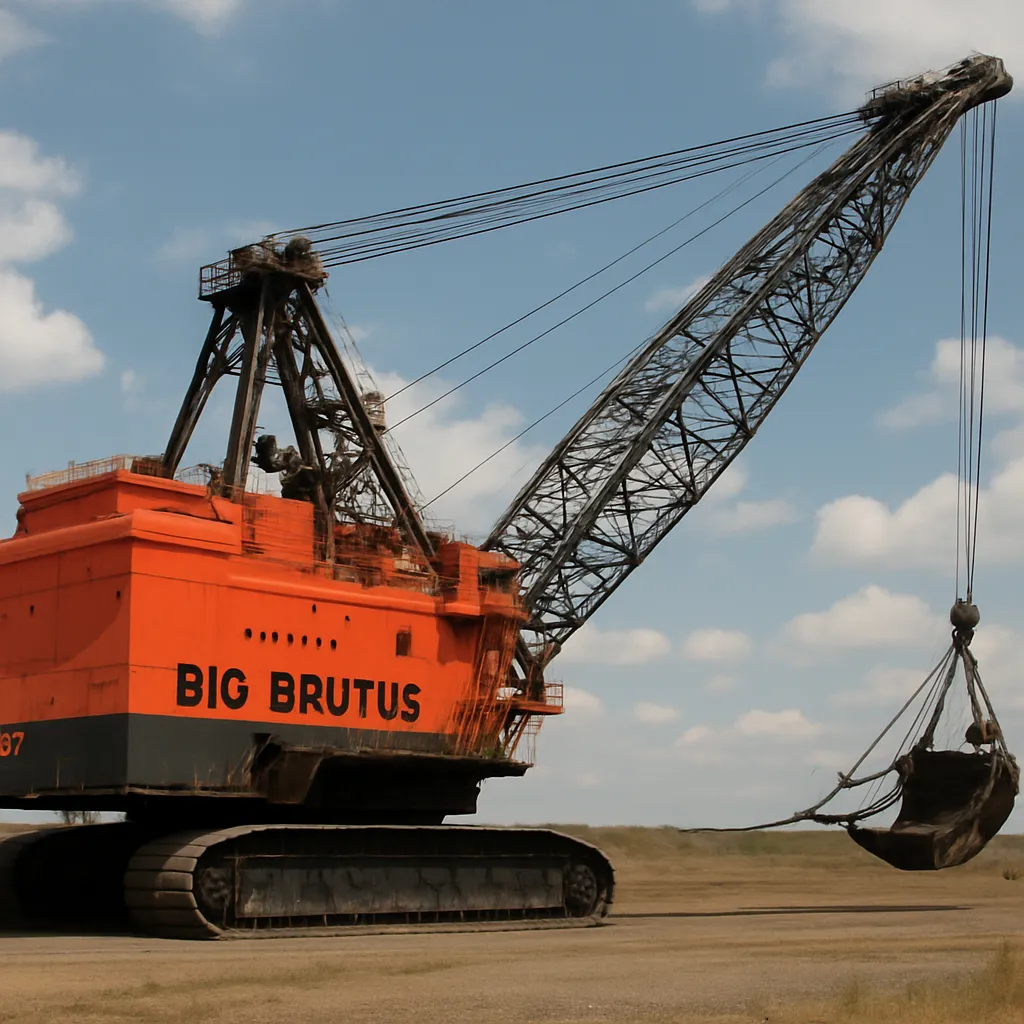
At the heart of the Walking Dragline 24/96 are several unmistakable elements: the working boom, the suspended bucket (dragline bucket), the hoist and drag winches, the superstructure and the specialized walking undercarriage. Each component contributes to the machine’s capacity to remove material over a wide radius with minimal repositioning.
Boom and Bucket
The designation 24/96 typically refers to the bucket capacity and an associated boom dimension—commonly a bucket of roughly 24 cubic yards (≈18.35 m³) paired with a boom length in the region of 96 feet (≈29.3 m). The boom provides reach and is engineered to resist bending moments and fatigue while lifting heavy loads. Booms for machines of this class are constructed from high-strength steel and are often lattice-type to combine stiffness with reduced weight.
The bucket is designed to be filled by dragging it across surface material using a dragline cable. The bucket’s geometry and the tooth configuration are optimized for efficient penetration into overburden or soil and for rapid filling.
Winches, Ropes and Motors
Two principal winch systems control bucket movement: the drag system (which pulls the bucket toward the machine) and the hoist system (which lifts the bucket). Large electric motors drive these winches through gearboxes; rope diameters and strengths are sized for the loads and cycle demands. Typical rope diameters, drum sizes and motor ratings vary by manufacturer and configuration, but machines in this class rely on industrial-grade steel wire rope and multi-megawatt electrical power sources for sustained operation.
Walking Undercarriage
Unlike tracked excavators, a walking dragline relocates by a series of controlled “steps” executed by its undercarriage. The walking mechanism may use hydraulic rams and pads or mechanical cams and jacks that raise the machine and shift it forward in increments. This approach reduces ground pressure and allows the machine to reposition without the need for rails or heavy transportation equipment. The walking motion is slow but enables large draglines to move within a pit safely and with minimal site preparation.
Superstructure and Operators’ Cabin
The rotating superstructure houses winch systems, motors, operator stations and control systems. Operator cabins are equipped for precision control of drag, hoist and crowd functions; modern units include remote monitoring, automated assistance features and diagnostics to maximize uptime and efficiency.
Primary Applications
The Walking Dragline 24/96 is designed for tasks that require long reach, high bucket capacity and economical movement of large volumes of surface material. Key application areas include:
- Surface coal mining: Removing overburden to expose coal seams is the classic role for draglines. Large draglines can move the thickness of overburden in continuous operations and are often central to open-pit coal operations.
- Strip mining and pit expansion: Draglines efficiently strip layers of soil and rock over wide swaths, minimizing the number of repositionings needed compared with other equipment.
- Bulk earthmoving and civil engineering: Construction of dams, levees, canals, large excavations and harbour works where long reach and bulk handling are advantageous.
- Reclamation and environmental restoration: Draglines are used to reshape spoil piles and return cache material to landforms during reclamation phases.
- Dredging in specific contexts: With adaptations, the dragline can be used for near-shore dredging and sediment removal where swing reach rather than mobility is the priority.
Performance, Typical Specifications and Example Calculations
Exact specifications for a given 24/96 walking dragline depend on the manufacturer and configuration, but several approximate figures help illustrate performance potential. Below are representative parameters and conservative example calculations intended to provide realistic scale rather than manufacturer guarantees.
Representative Specifications
- Bucket capacity: approximately 24 cubic yards (≈18.35 m³).
- Boom length: commonly around 96 feet (≈29.3 m), though some units may have slightly longer or shorter booms depending on design.
- Operating (installed) power: system electric motors in the hundreds of kilowatts to multi-megawatt range, aggregated depending on hoist and drag requirements.
- Machine mass: varies significantly—machines of this bucket class typically weigh from several hundred to over a thousand tonnes in operating condition depending on structure, counterweights and undercarriage.
- Rope diameters, drum capacities and winch line pull rated to handle maximum bucket loads plus dynamic factors.
Example Production Estimates (Illustrative)
Production from a dragline depends on cycle time, fill factor, material density and travel distances. Using conservative assumptions:
- Bucket volume: 24 yd³ (≈18.35 m³).
- Material bulk density: variable—typical overburden might range from 1.6 to 2.0 tonnes/m³ (1.3–1.6 t/yd³). For calculation assume 1.8 t/m³.
- Bucket fill factor: 0.85–1.0 (how fully the bucket is filled during a drag).
- Cycle time assumption: 60–90 seconds per cycle (full drag, lift, swing and dump). Real cycle times vary with operator, material and pit layout.
With 60-second cycles and a 0.9 fill factor: effective material moved per cycle = 24 yd³ × 0.9 ≈ 21.6 yd³ (≈15.9 m³). Cycles per hour = 60. Hourly volume ≈ 1,296 yd³ (≈954 m³). Using 1.8 t/m³ density, hourly mass ≈ 1,717 tonnes. With a 90-second cycle, hourly mass would be roughly two-thirds of that (≈1,145 tonnes/hour). These figures are illustrative; actual field productivity is influenced by site layout, haulage logistics and the interaction between dragline and other mining equipment.
Availability and Utilization Metrics
In large surface mines, draglines are planned as long-life assets; availability rates in well-managed operations can exceed 85–90% on a sustained basis, but achieving that requires rigorous maintenance regimes and spares management. Typical working lives for major structural components exceed 20–30 years with proper refurbishment cycles, and some draglines remain in service for several decades with periodic overhauls.
Advantages and Limitations
The walking dragline offers a combination of benefits that make it attractive for suitable applications, but also carries constraints that affect when and where it is the best choice.
Advantages
- High-volume bulk handling: A single dragline can move enormous volumes of material per shift, often at lower unit cost than fleets of smaller excavators and trucks.
- Long reach: The boom enables excavation and dumping at distances that reduce the need to reposition the machine frequently.
- Low ground disturbance when moving: The walking undercarriage distributes weight and reduces soil compaction compared with frequent truck traffic and road-building.
- Longevity: Major capital investments in draglines pay off over decades when used in continuous bulk excavation contexts.
Limitations
- Mobility speed: Walking is slow and unsuitable for rapid redeployments across long distances without disassembly and transport.
- Initial capital and complexity: Purchase and commissioning costs are high, and costs for specialized maintenance and heavy spares must be budgeted.
- Site constraints: Draglines require space for swing radius and dumping; tight urban or constrained sites are often impractical.
- Operational inflexibility: Draglines excel at planar stripping; selective excavation of narrow benches or complex orebody geometries is less efficient.
Maintenance, Reliability and Life-Cycle Considerations
Maintenance strategy is central to dragline performance and life-cycle cost. Preventive maintenance, condition monitoring and planned refurbishments minimize unplanned downtime and preserve structural integrity.
Key Maintenance Areas
- Wire rope inspection and replacement: Ropes endure cyclic loading and abrasion and are a critical safety and availability concern.
- Winch and gearbox servicing: Bearings and gears must be monitored for wear and lubricated according to heavy-duty schedules.
- Structural inspections: Fatigue cracks can develop in booms and superstructure; nondestructive testing is routinely used to detect early issues.
- Walking mechanism upkeep: Hydraulic systems, pads and jacking components are subject to heavy loads and require rigorous service intervals.
Reliability Strategies
Modern draglines increasingly incorporate condition-based monitoring (vibration analysis, oil analysis, thermal imaging) and remote diagnostics. These systems support predictive maintenance and help maintain high availability. Replacement parts lead-times can be long due to specialization; therefore, strategic stocking and strong supplier relationships are important to maintain uptime.
Safety, Environmental and Regulatory Aspects
Safety in operation and environmental stewardship are major considerations for sites deploying walking draglines.
Safety
Operating a dragline requires skilled crews and stringent procedures:
- Clear exclusion zones for swing radius and bucket travel reduce risk to personnel.
- Rigorous lockout/tagout, hoist controls and emergency-stop procedures are mandatory.
- Training for walking sequences and emergency lowering procedures mitigates hazards associated with the undercarriage.
Environmental
Draglines can reduce truck traffic and associated emissions by moving large volumes with a single machine, but they still have environmental impacts:
- Large-scale land disturbance is inherent; reclamation planning is essential to restore landforms and watercourses.
- Noise, dust and power consumption require management through mitigation measures—dust suppression, acoustic planning and energy-efficient drives where possible.
- Water management and spoil placement strategies must meet regulatory requirements to avoid erosion and contamination.
Historical Context and Manufacturers
Draglines have a long history in surface mining. Early cable-operated excavators date from the late 19th and early 20th centuries; the walking dragline concept and the large-scale machines familiar today emerged mid-20th century in response to growing demand for bulk surface mining equipment.
Notable Manufacturers and Evolution
Prominent companies historically associated with large draglines include Bucyrus (later part of Caterpillar), P&H (now part of Komatsu), Orenstein & Koppel (O&K), and several European ship/industrial builders who designed specialized cranes and draglines for mining and civil works. Over the decades, designs have evolved toward higher-strength materials, improved electrical drive systems, and more advanced control and monitoring packages.
Economic Considerations and Project Planning
From an economic perspective, the decision to deploy a walking dragline like a 24/96 model depends on project scale, material characteristics and expected mine life.
Cost Drivers
- Capital expenditure for the dragline and commissioning.
- Power costs and site electrical infrastructure—draglines require stable and often high-voltage electrical supply.
- Maintenance, spares and specialized labor costs.
- Reclamation and environmental compliance costs integrated into project life-cycle budgeting.
Business Case Considerations
A dragline becomes attractive when the throughput requirements and mine geometry allow continuous, high-volume stripping over multiple years. Cost per tonne removed versus alternative shovel-and-truck fleets, considering fuel, labor and haul-road maintenance, is a common comparative metric. Draglines often deliver favorable unit costs when applied in the right context.
Operational Case Examples and Field Practices
Field practices for a Walking Dragline 24/96 emphasize careful pit layout, sequencing and cooperation with haulage and material placement operations. Typical best practices include:
- Designing spoil placement and return sequences to minimize rehandle and ensure stability of dump slopes.
- Synchronizing dragline cycles with ancillary equipment to prevent bottlenecks at dumping sites.
- Implementing staged walking plans and ground preparation to manage settlement and bearing capacity during repositioning.
- Using telematics and real-time monitoring to adjust operating parameters for efficiency and reduced wear.
Summary and Outlook
The Walking Dragline 24/96 represents a class of machines tailored to high-volume surface excavation where reach, bucket capacity and durable operation are decisive. When matched to appropriate mining geometries and supported by disciplined maintenance and environmental management, such draglines can be cornerstone assets that deliver efficient, long-term bulk movement of material.
Future developments likely to influence dragline design and operation include improvements in remote operation and automation, more energy-efficient electric drive systems, advanced materials to reduce structural weight while increasing fatigue life, and enhanced condition monitoring to further improve reliability and lower life-cycle costs. For any operation considering a dragline, careful feasibility analysis that includes productivity modelling, power infrastructure assessment and reclamation planning is essential to maximize the return on investment and meet modern regulatory and community expectations.
)
)