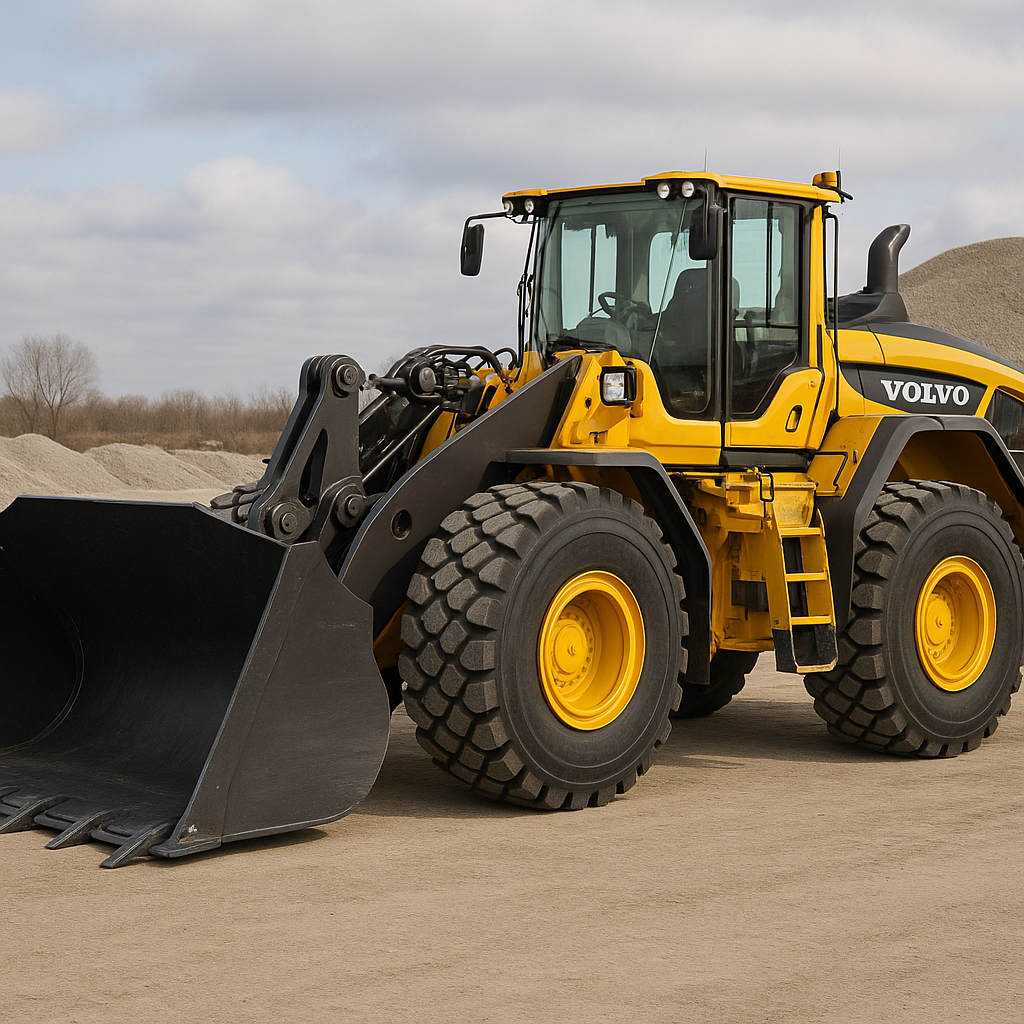
The Volvo L260H is a heavy-duty wheel loader designed for demanding earthmoving, mining, quarrying and large-scale construction applications. Combining Volvo’s decades-long experience in heavy equipment engineering with modern emissions-compliant engines, robust drivetrains and operator-focused features, the L260H aims to deliver consistent performance, high uptime and low operating costs across a wide variety of tasks. This article explores the machine’s design philosophy, typical use cases, technical characteristics, operational benefits and practical considerations for owners and operators.
Overview and design philosophy
The L260H is part of Volvo Construction Equipment’s H-series wheel loader family, engineered to offer a balance of power, durability and operator comfort. Its design reflects priorities common to large loaders: a strong but serviceable frame to withstand heavy loading cycles, an efficient drivetrain to transfer engine output to the wheels with minimal losses, and a hydraulic system tuned for fast, controlled attachment movements. The machine is intended to operate for long shifts in harsh environments while minimizing downtime through accessible service points and robust component selection.
Key elements of the machine’s design include a reinforced articulation joint, heavy-duty axles, a torque-converter or lock-up transmission adapted for both high tractive effort and fuel economy, and an engine package that meets current regional emissions standards without sacrificing torque delivery under load. The cab layout is designed to keep the operator productive and focused on the task, with good all-around visibility, intuitive controls and climate control for comfort.
Technical characteristics and typical specifications
Specifications for the L260H vary by market and optional configuration, but typical technical characteristics include:
- Engine: a robust diesel engine from Volvo’s family of construction equipment powerplants, tuned to provide a combination of continuous torque and rated horsepower suitable for heavy loading cycles. Typical gross power is in a range that supports high productivity without overbuilding the machine for most quarry and heavy construction tasks.
- Operating weight: a heavy-class wheel loader in the upper tens of thousands of kilograms, designed to provide stability and traction when handling large bucket loads and during travel on uneven terrain.
- Bucket capacity: offered with a range of standard and heavy-duty buckets to match three primary roles—material handling, loading high-capacity haul trucks and direct digging of stockpiles. Capacities are selectable to optimize cycle times and payload for different materials (aggregates, crushed rock, overburden, etc.).
- Hydraulics: a high-flow hydraulic system with proportional controls for smooth, predictable attachment movement, rapid bucket cycle times and adaptable control schemes for different operator preferences.
- Tires and axles: large-diameter tires and heavy-duty axles are specified to transmit the loader’s tractive effort efficiently, resist punctures and provide long service life in abrasive environments.
Because configurations differ, many OEM and dealer resources provide comprehensive spec sheets for particular market versions. In general, the L260H is positioned to offer a combination of capacity and controllability that makes it suitable for large-scale operations where throughput and reliability are key.
Primary applications and industry use cases
The L260H is employed across industries where material volumes, density and the need for heavy-duty performance make smaller loaders inefficient. Typical applications include:
- Quarrying and aggregate production: loading haul trucks, feeding crushers, stockpile management.
- Mining (surface/open-pit): secondary loading tasks, reclaiming, and site maintenance—particularly where a robust wheel loader can achieve competitive cycle times against small excavators.
- Civil engineering and large infrastructure projects: moving large volumes of earth, clean-up of demolition sites, construction of embankments and bulk material handling.
- Ports and terminals: handling bulk materials like coal, ore, fertilizers and other commodities when wheel loaders provide faster, more flexible handling than fixed conveyors or mobile bulk handlers.
- Waste and recycling facilities: managing heavy, mixed waste streams when heavy-duty buckets and waste-spec tires are fitted.
In each of these roles, the L260H is typically selected when cycle times and single-pass payloads significantly affect project economics. Adjusting bucket size, tire choice and optional counterweights lets fleet managers tune the loader for material density, truck match and maneuvering constraints.
Performance, productivity and metrics
Performance evaluation for a loader like the L260H typically centers on a few core metrics: cycle time, horsepower-to-weight ratio, breakout force, bucket fill factor and fuel consumption per tonne moved. Manufacturers and fleet managers often track productivity in tonnes per hour for a given task and material.
Some practical observations about performance for heavy loaders of this class:
- Cycle time is influenced by hydraulics, operator technique and attachment selection. A responsive hydraulic system and a powertrain that provides smooth, high torque at low speeds reduce the time for bucket filling and truck loading.
- Breakout and tear-out forces determine how effectively the loader moves compacted material. Reinforced linkage geometry and heavy-duty tilt cylinders improve digging into dense stockpiles.
- Bucket selection directly affects both productivity and fuel efficiency: bigger buckets reduce cycle counts but can increase rolling resistance and fuel burn if they exceed the truck payload match point. Selecting the right bucket capacity for the task maximizes tonnage per litre of fuel.
- Modern engine management and gearshift strategies provide intelligent shifts and torque distribution to keep the machine moving efficiently under changing load conditions.
Operators and fleet managers using the L260H often see the machine perform best when maintenance is disciplined, tire choice suits the terrain, and operator training focuses on techniques that maximize effective bucket fill and minimize empty travel.
Attachments and versatility
Although wheel loaders are often pictured with general-purpose buckets, one of their strengths is versatility. The L260H can be equipped with a range of factory and third‑party attachments to expand its capabilities:
- General purpose and multi-purpose buckets for loading and material handling.
- Heavy-duty rock buckets for quarry and mining applications, featuring reinforced lips and wear plates.
- Light-material buckets for low-density materials where volume rather than weight is primary.
- Grapples for handling large, irregular items such as logs or scrap.
- Brooms, snow ploughs and pallet forks for site maintenance and seasonal duties.
- Quick-couplers to reduce downtime when changing tools in the field.
Attachment choice not only changes the loader’s physical capability but also influences fuel use, cycle times and wear patterns. Well-matched attachments help the L260H deliver efficient, repeatable performance in varied environments.
Cab, ergonomics and operator aids
Operator comfort is a practical productivity factor. The L260H cab is designed to reduce fatigue and improve control precision through features such as:
- Spacious layout with good forward and side visibility to reduce the need for repositioning and to allow safe operation around personnel and trucks.
- Adjustable seat and controls—joystick or lever arrangements depending on specification—to match different operator preferences.
- Climate control, sound insulation and vibration damping to keep operators comfortable during long shifts and in extreme climates.
- Optional camera systems and proximity sensors to improve awareness in tight yards or when maneuvering around trucks and other equipment.
- Integrated displays that provide machine status, diagnostics and performance indicators to support efficient and safe operation.
These features contribute to lower operator fatigue, fewer mistakes and better throughput per shift—especially important in continuous operations such as quarries and mines where operators run extended hours.
Safety systems and structural integrity
Safety is integral to the loader’s design. Structural elements such as rollover protective structures (ROPS) and falling-object protective structures (FOPS) are standard on heavy loaders, and the L260H incorporates reinforced pillars and cab mounts to enhance protection. Additional safety features often include:
- Automatic park brake interlocks and travel-limit modes to prevent unexpected movement during maintenance or when the bucket is raised.
- Wheel slip management and traction control to maintain stability on soft or uneven ground.
- Emergency shut-off systems and well-located service points to enable rapid action during faults or accidents.
- Visibility aids: mirrors, cameras and lighting packages for low-light operation.
Manufacturers also emphasize structural durability—reinforced frames, heavy-duty pins and bushings, and wear-resistant materials in high-load areas—to prolong life and improve safety by preventing sudden component failure.
Maintenance, serviceability and uptime
Uptime is commercially critical. The L260H’s design typically emphasizes ease of service to keep maintenance fast and predictable. Common uptime-focused features include:
- Accessible service points: grouped inspection points, ground-level access to daily check locations and wide-opening engine compartments.
- Long-life components and extended service intervals where feasible, reducing downtime and cost-per-hour.
- On-board diagnostics and modular components that simplify troubleshooting and parts replacement.
- Dealer support networks and parts availability programs to shorten repair lead times.
Proactive maintenance strategies—regular greasing, filter changes, inspection of high-wear items like tires, bucket edges and hydraulic hoses—are essential. Many owners reduce lifecycle costs by following manufacturer-recommended preventive maintenance schedules and leveraging telematics (see next section) to monitor machine health.
Telematics, fleet management and data-driven operation
Modern Volvo wheel loaders, including the L260H, are often fitted with telematics systems that transmit data on fuel use, idle time, location, load cycles and diagnostic faults. Fleet managers use this information to:
- Optimize routes and assign machines based on location and utilization.
- Monitor fuel consumption trends and identify opportunities to improve operator behavior or machine configuration.
- Schedule maintenance proactively when certain thresholds or fault codes appear, reducing unplanned downtime.
- Track productivity and match equipment to shifting project requirements.
Data-driven operation helps maximize lifecycle value and provides the transparency needed for leasing, rental or multi-site fleet management.
Environmental considerations and fuel economy
Large loaders consume significant fuel, so manufacturers and operators pay close attention to emissions and efficiency. The L260H incorporates modern engine technology and aftertreatment systems to meet emissions regulations (e.g., Stage V, Tier 4 Final in many markets). Fuel economy is affected by:
- Engine calibration and transmission programming that balance power with economy—features like automatic gear selection and torque management reduce wasteful revving.
- Hydraulic system efficiency; variable-flow pumps and electronically controlled hydraulics minimize parasitic losses.
- Operator technique: well-trained drivers using smooth control inputs and avoiding excessive idle times can reduce consumption substantially.
- Matching bucket size and tire type to job requirements to avoid overspecification that increases rolling resistance and fuel use.
Many operators calculate fuel consumption per tonne moved as a key performance indicator. Reducing idling, planning efficient truck routes and using telematics to detect inefficient patterns are common ways to improve fuel economy.
Acquisition, lifecycle costs and resale considerations
When evaluating total cost of ownership for an L260H, buyers consider acquisition price alongside expected fuel, maintenance, parts, insurance and resale value. Factors that affect lifecycle cost include:
- Operating environment: abrasive materials and harsh climates increase wear rates and parts consumption.
- Utilization pattern: high-cycle, continuous operation accelerates component wear compared to intermittent use.
- Maintenance discipline: adherence to OEM schedules preserves resale value and prevents catastrophic failures.
- Attachment matching: over- or under-sized attachments affect fuel use and component stress, altering long-term costs.
Resale value is influenced by build configuration, maintenance records, machine condition and hours. A well-documented service history and certified refurbishment can significantly improve the trade-in/resale position for a heavy loader.
Practical tips for operation and fleet managers
To get the most from an L260H, practical steps include:
- Document baseline performance metrics (fuel per hour, tonnes per hour, cycle time) to measure improvements after changes.
- Match bucket sizes to truck payloads and material density to minimize short-loading and sluggish cycles.
- Use telematics to identify high-idle machines and coach operators toward more efficient behavior.
- Plan preventative maintenance during scheduled downtimes to avoid production impact.
- Train operators on advanced techniques: optimal attack angle for filling, load-and-carry strategies, and ground-condition awareness to reduce slippage.
Known statistical ranges and benchmarks
Exact specifications for the L260H depend on configuration, but typical benchmark ranges for a heavy-class wheel loader of this size are useful for comparison. These ranges should be confirmed against the factory specification for the exact machine purchased:
- Gross engine power: commonly in the high-hundreds of horsepower range (hundreds of kW), providing strong low-end torque for loading cycles.
- Operating weight: in the range that provides a stable platform for large buckets and high tractive effort—typically several tens of tonnes.
- Bucket capacities: selectable from medium to very large volumes to match applications—capacity options cover a broad range to optimize for mass or volume tasks.
- Fuel tank capacity and hydraulic oil volumes: sized to allow long shifts without refuelling while balancing weight distribution and machine balance.
Because regional emissions equipment, axle choices, tire sizes and bucket options affect these numbers, owners should consult local Volvo dealers for exact specification sheets and performance curves relevant to their intended use case.
Conclusion
The Volvo L260H is designed as a versatile, heavy-duty wheel loader for industries that require consistent, high-throughput material handling. Its combination of durability, operator-focused cab design, flexible attachment options and telematics-enabled fleet management support make it a compelling choice for quarries, mines, ports and large construction sites. Maximizing the machine’s value depends on careful selection of configuration, disciplined maintenance, operator training and data-driven fleet management. When matched correctly to application demands and maintained proactively, the L260H can deliver strong productivity, predictable lifecycle costs and dependable performance in the most demanding environments.
)
)