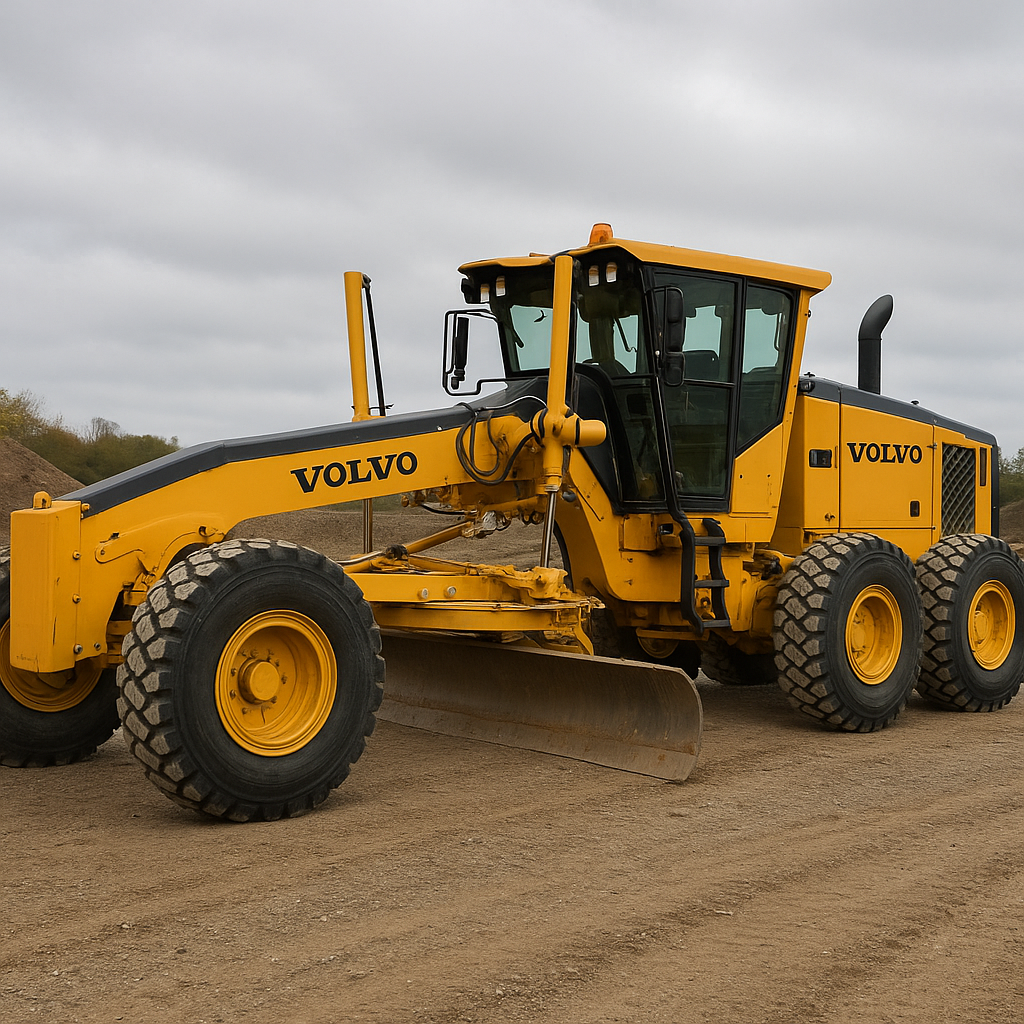
The Volvo G976 motor grader is a heavy-duty earthmoving machine designed for precision grading, road construction, and a wide range of civil engineering tasks. Combining robust mechanical systems with operator-focused ergonomics, this model represents the capabilities expected from Volvo Construction Equipment in medium-to-large grader classes. In the following sections you will find an overview of its design, typical applications, technical characteristics (including commonly quoted statistics), maintenance and operational advice, attachment options, and considerations for procurement and resale.
Design and core features
At the heart of the Volvo G976 is a design philosophy that balances durability with precision. Motor graders must deliver consistent, accurate results over long operating hours, and the G976 is built to meet those demands through a combination of a rigid frame, responsive hydraulics and an adjustable moldboard system. Key structural components — frame, circle, and articulation joint — are engineered to resist torsional stresses encountered in grading operations.
Powertrain and driveline
The G976 typically uses a turbocharged diesel engine coupled to a robust transmission designed for smooth torque delivery at variable speeds. The driveline is optimized to provide good traction and controllability at both low speeds for grading precision and higher speeds for traveling between job sites. Modern versions may include electronic engine management to improve fuel efficiency and emissions control.
Blade and circle assembly
The central tool on any grader is the moldboard (blade). The G976’s moldboard is engineered for accurate lateral and vertical positioning, with hydraulic controls to adjust pitch, angle and side-shift. The circle drive and locking mechanism aim to reduce backlash, improving contouring of surfaces and minimizing the need for rework. The blade edge and cutting edges are typically made from wear-resistant steel to increase service life.
Operator environment
Volvo places emphasis on operator comfort and visibility. The cab is designed to reduce vibration and noise, provide ergonomic control placement, and give a wide field of sight over the blade and surroundings. Features commonly found include adjustable seats, climate control, intuitive joysticks or levers for blade control, and electronic displays showing machine status and diagnostics.
Applications and where it’s used
The Volvo G976 is a versatile machine used across many sectors where precise surface grading and material distribution are required. Typical applications include:
- Road construction and maintenance — from building base layers to finishing wearing courses.
- Airport runway and taxiway shaping — where tolerances and smooth finishes are critical.
- Mining and quarry roads — performing grading on haul roads and pit ramps to improve safety and drainage.
- Land development and landscaping — preparing large sites for building pads, land reclamation and stormwater channels.
- Snow removal and municipal works — fitted with snow wings or V-blades for clearing operations.
Because of its precision, the G976 is often used where quality of final surface and grading accuracy are priorities. It can also function as a support machine during paving operations, fine-grading before asphalt placement or restoring existing gravel surfaces.
Technical specifications and typical statistics
Exact specifications for the Volvo G976 can vary by model year, region and optional configurations. Below are typical or commonly reported values for graders in the G9xx class which are useful as a reference point. Treat the values as representative ranges rather than absolute factory numbers unless confirmed for a specific serial number and build option.
- Operating weight: typically in the range of approximately 18,000 to 26,000 kg (40,000–57,000 lb), depending on attachments and ballast.
- Engine power: commonly quoted between ~140 kW and 250 kW (190–335 hp) depending on emission stage and tuning.
- Blade length (moldboard): standard lengths often range from 3.6 to 4.5 meters (12–15 feet).
- Maximum travel speed: approximately 40–50 km/h (25–31 mph) in travel mode.
- Hydraulic system pressure: working pressures typically around 200–260 bar (2,900–3,800 psi) for blade and articulation functions in comparable machines.
- Fuel capacity: fuel tanks commonly hold between 300 and 600 liters, depending on configuration and whether auxiliary tanks are fitted.
- Fuel consumption: a wide range based on load and duty cycle — typical working-cycle consumption can range from 15 to 30 liters/hour; heavy, continuous push or ripping operations may increase this figure.
Additional measurable performance metrics include blade penetration, circle rotation torque, and hydraulic cycle times; these are often provided in technical manuals for each year’s configuration. For precise planning—transport, lifting, fuel logistics or regulatory compliance—always verify the exact machine plate data for the unit in question.
Attachments and versatility
One strength of motor graders is adaptability. The Volvo G976 can be equipped with a variety of front and rear attachments to broaden its operational envelope. Standard and optional attachments include:
- Rippers and scarifiers for breaking compacted material.
- Snow wings, V-plows and front blades for snow removal duties.
- Rear-mounted winches for specialized operations.
- GPS and laser-guided control systems for automated precision grading.
- Extended moldboards and bolt-on cutting edges for different types of material.
- Tire and ballast configurations for optimized flotation or traction.
Integration with machine control and guidance systems (GNSS, laser) is increasingly common, allowing contractors to reduce rework, increase productivity and achieve design tolerances with fewer passes.
Operation, maintenance and lifecycle costs
Effective operation and maintenance practices determine the overall lifecycle cost of a grader. The G976, like other Volvo graders, is engineered for serviceability: grouped service points, easy-access filters, and modular components simplify routine tasks. Key practices include:
- Scheduled oil and filter changes following manufacturer intervals to protect engine longevity.
- Regular inspection of moldboard cutting edges, circle wear surfaces, and articulation bearings for wear and accurate geometry.
- Hydraulic fluid and hose checks to prevent leaks and maintain control responsiveness.
- Tire rotation and correct inflation to optimize traction, flotation and fuel economy.
- Using genuine parts and manufacturer-approved lubricants to maintain warranty and resale value.
Lifecycle cost drivers include fuel consumption, replacement costs for wear items (cutting edges, tires, hydraulic pumps), and downtime. Investment in operator training and telematics can reduce fuel burn and unscheduled maintenance by encouraging best practices and enabling predictive maintenance.
Safety and operator considerations
Working with large graders requires attention to site safety, operator training and machine configuration. The G976 incorporates features to improve safety such as good all-around visibility, integrated lighting packages, rear-view cameras and rollover protection in the cab structure. Operational safety tips include:
- Ensuring operators are trained on blade control, articulation behavior and terrain assessment.
- Using lock-out procedures during maintenance and following proper lifting points when transporting the machine.
- Maintaining clear communication with other site machines and following traffic management plans when operating near roadways.
- Configuring the machine with appropriate tires or chains for winter conditions and fitting guards where required for gravel or quarry work.
Advanced safety systems, such as slope alarms and machine-stability aids, can be options that further reduce risk on steep or irregular ground.
Market considerations and resale value
Volvo graders usually command strong resale value due to brand reputation for reliability and world-wide spare parts availability. Factors that influence resale price include total hours, maintenance history, presence of added technology (GPS, telematics), and condition of wear parts. When sourcing a G976 or similar grader, consider:
- Matching machine size to expected work: oversizing increases fuel and operating cost; undersizing reduces productivity.
- Checking service records and verifying any structural repairs — frame or circle welds can be expensive to remedy.
- Looking for units with factory-installed machine control systems if high-precision grading is required; these retain value and reduce retrofit costs.
Environmental impact and efficiency
Modern graders are subject to emissions regulations that influence engine choices and aftertreatment systems (DOC, DPF, SCR). Volvo has aimed to improve fuel efficiency and reduce emissions through engine tuning, better hydraulics, and control strategies that reduce idle time. Efficient grading practices — optimized pass planning, correct blade settings and regular maintenance — all help lower the machine’s carbon footprint by reducing fuel use across a project.
Operator tips and best practices
Experienced grader operators apply several practical techniques to improve productivity and reduce wear:
- Maintain steady ground-engaging speed and avoid high-slip conditions which increase track/tire wear and fuel consumption.
- Use blade pitch and angle smartly to reduce the number of passes required for desired finish quality.
- Pre-plan cut-and-fill operations to minimize repositioning time and unnecessary material movement.
- Keep moldboard and circle well-lubricated and address small play before it becomes major backlash affecting accuracy.
Pairing the machine with experienced operators and modern guidance systems provides the best return on investment for accuracy-critical projects.
Summary
The Volvo G976 is representative of a class of motor graders that combine power, precision and operator-focused design to meet the demands of road construction, site preparation, mining road maintenance and snow control. While exact specifications depend on year and configuration, graders of this size typically feature substantial operating weights, robust diesel engines, and versatile blade systems. Prioritizing maintenance, operator training, and appropriate attachments will maximize the machine’s productivity and resale value. For any procurement or technical planning, always verify the serial-number-specific specification sheet from the manufacturer or the dealer to ensure compliance with local regulations and site requirements.
)
)