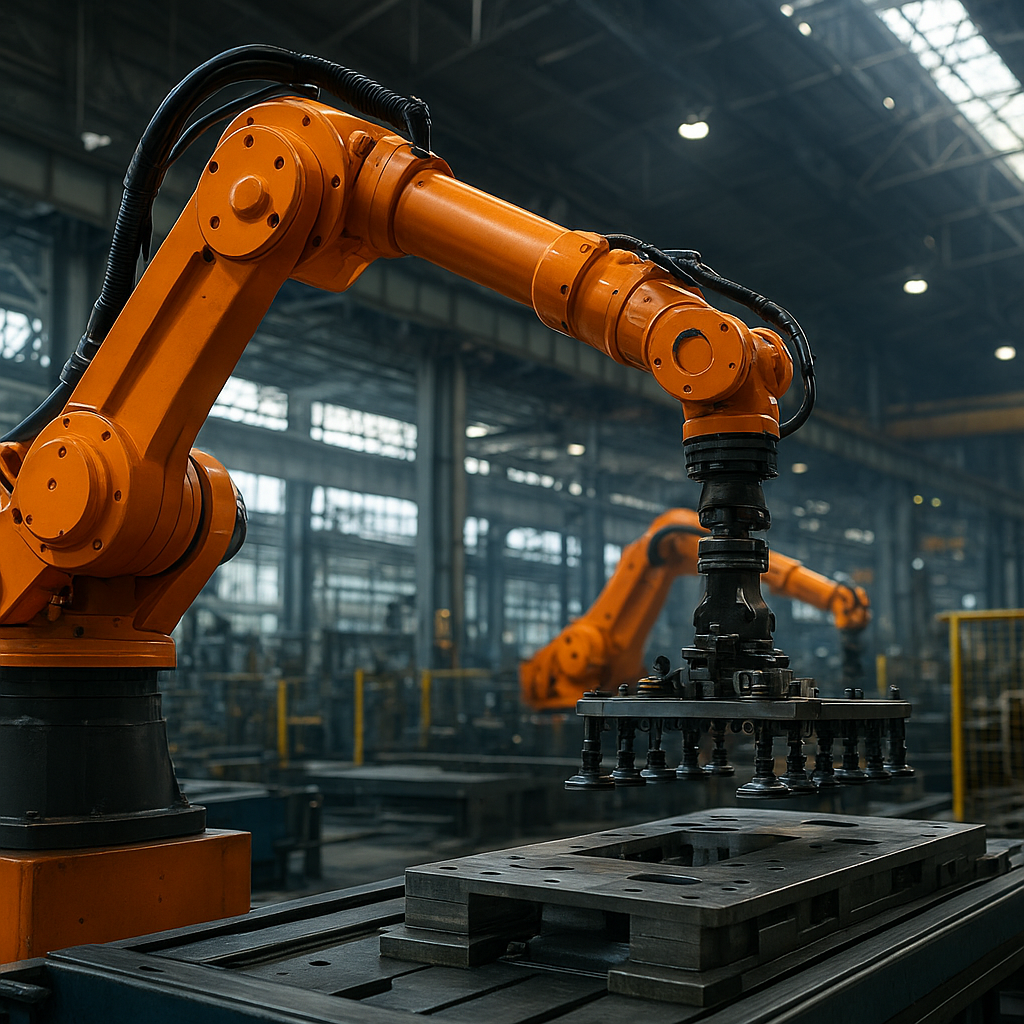
The World’s Largest Industrial Robots in Operation explores the sheer scale and transformative potential of today’s most advanced machinery. This article delves into the engineering marvels that define modern production lines, examines real-life applications across key industries, and highlights emerging trends shaping the next wave of technological breakthroughs. From massive robotic arms that handle multi-ton payloads to fleets of automated guided vehicles (AGVs) operating in synchrony, these systems embody the intersection of mechanical power and digital intelligence.
The Rise of Industrial Robotics
The journey toward widespread automation began in the mid-20th century when early robotic arms demonstrated basic pick-and-place capabilities. As manufacturing demands grew, so did the complexity of robotic systems. Today’s giants are not only capable of moving heavy loads but also of executing tasks requiring sub-millimeter precision. Advances in sensor technology, machine vision, and artificial intelligence have enabled robots to adapt to changing environments, recognize objects, and collaborate safely with human operators.
- Engineering breakthroughs in actuation and control systems have allowed the construction of robots exceeding 10 meters in reach.
- Enhanced materials such as high-strength alloys and composites provide structural integrity for machines that must endure continuous operation under extreme loads.
- Software platforms integrating real-time analytics and cloud connectivity facilitate remote monitoring, predictive maintenance, and fleet coordination.
With these developments, companies in automotive, aerospace, shipbuilding, and heavy equipment sectors have adopted custom-designed machines tailored to specific tasks. Some of the world’s largest industrial robots can weld entire car bodies, maneuver shipping containers weighing over 40 tons, or apply precise layers of thermal insulation on aircraft fuselages. Their exceptional efficiency and reliability have redefined expectations for manufacturing throughput and product quality.
World’s Largest Industrial Robots in Operation
Several flagship projects showcase the pinnacle of large-scale robotics. Each of these installations represents years of collaborative research between manufacturers, software developers, and end users seeking to push boundaries.
Heavy-Duty Welding Arm at AutoForge
- Reach: 12 meters
- Payload Capacity: 2,500 kilograms
- Cycle Time: Under 30 seconds per weld
This colossal industrial welding station handles the chassis assembly of heavy trucks. Equipped with advanced arc sensors, the robot adjusts welding parameters on-the-fly to compensate for material variances. Integrated cameras provide 3D scanning of joint surfaces, ensuring consistent bead morphology and structural integrity.
Container Handler at PortOps Terminal
- Span: 15 meters from rail-mounted base
- Lift Capacity: 50 metric tons
- Operational Modes: Automated stacking and retrieval
At one of the world’s busiest ports, an automated stacker crane orchestrates the movement of shipping containers with remarkable precision. A combination of GPS, laser alignment, and inertial guidance systems allow the robot to locate and transport containers at speeds exceeding manual operations by 200%. The system’s scalable architecture accommodates expansion to manage fluctuating cargo volumes.
Composite Layup Robot at AeroFab Industries
- Arm Reach: 8 meters
- Payload: 1,200 kilograms
- Accuracy: ±0.1 millimeter
Used for constructing large composite structures such as aircraft wings, this high-precision robot automates fiber placement at various angles. Real-time material monitoring ensures consistent resin distribution, reducing defects and waste. The integrated software platform enables offline programming, allowing engineers to simulate complex tool paths before deploying on the shop floor, enhancing innovation and safety.
Applications across Sectors
Large-scale robots have found applications far beyond traditional manufacturing, driving transformation in logistics, construction, and even renewable energy.
Logistics and Warehousing
- Automated Guided Vehicles (AGVs) transport pallets weighing up to 5 tons across vast distribution centers.
- Robotic cranes manage high-bay storage systems, enabling dense stacking and rapid retrieval of goods.
- Collaborative mobile robots work alongside forklift drivers, forming mixed fleets that optimize material flow.
By orchestrating diverse robotic assets through centralized control systems, companies achieve unprecedented throughput rates. Automated sorting and handling not only accelerate order fulfillment but also reduce workplace injuries by relegating heavy lifting to machines.
Construction and Infrastructure
- Gantry robots print large concrete panels for modular housing units.
- Robotic arms install pre-fabricated steel sections on high-rise buildings, minimizing on-site labor requirements.
- Automated tunneling machines excavate and line subterranean passages for transportation and utilities.
The use of robotics in construction addresses labor shortages and safety concerns. High-capacity machines can operate continuously, facilitating rapid project completion and supporting sustainable building practices through precise material usage.
Renewable Energy
- Wind turbine blade assembly robots apply protective coatings and perform non-destructive testing.
- Solar panel cleaning units traverse fields of photovoltaic modules, optimizing energy output.
- Large-scale robotic manipulators assist in the maintenance of hydroelectric turbine components.
These applications exemplify how automation contributes to the global transition toward cleaner energy sources. By ensuring continuous, high-quality maintenance, robots enhance the operational life and performance of renewable installations, bolstering overall system resilience.
Future Trends and Challenges
As industries demand ever-greater capacity and flexibility, several trends are poised to shape the next generation of large industrial robots.
- Integration of 5G and edge computing for ultra-fast, deterministic communication between robots and control centers.
- Adoption of advanced AI algorithms enabling autonomous decision-making and adaptive task planning in dynamic environments.
- Development of modular robotic architectures permitting rapid reconfiguration to accommodate shifting production needs, increasing scalability.
- Implementation of augmented reality (AR) interfaces providing real-time visual guidance for maintenance crews and remote experts.
- Enhanced safety systems leveraging multi-sensor fusion to detect and mitigate potential hazards, facilitating more collaborative human–robot interactions.
Despite these advancements, challenges remain. Large-scale robots require substantial capital investment and specialized infrastructure, limiting their adoption among small and medium enterprises. Additionally, the integration of complex robotic systems often demands new skill sets, prompting a need for targeted workforce training. Cybersecurity also emerges as a critical concern, as networked robots present potential entry points for malicious actors.
Nevertheless, the drive toward complete digitalization and smart manufacturing ensures that large industrial robots will continue to evolve at a rapid pace. By fostering partnerships between equipment suppliers, software innovators, and end users, the industrial landscape is moving toward a future defined by innovation, sustainability, and unparalleled productivity.