The assembly of high-speed trains represents a pinnacle of modern industrial capability, combining advanced methodologies, cutting-edge equipment, and meticulous planning. This article delves into the world of machines at work within train manufacturing plants, exploring core technologies that drive efficiency, precision, and reliability in the creation of these engineering marvels.
Design and Engineering Innovations
Before any physical component is produced, a comprehensive design and engineering phase sets the foundation. Specialized software tools and virtual models enable engineers to refine every aspect of a train’s structure and systems.
Computer-Aided Design and Simulation
- 3D modeling platforms generate accurate blueprints for car bodies, mechanical parts, and interior fittings.
- Finite Element Analysis (FEA) simulations identify stress points, ensuring structural integrity under high-speed conditions.
- Thermal and aerodynamic simulations optimize energy consumption and passenger comfort.
Modular Architecture
Embracing a modularity approach, manufacturers divide train sets into interchangeable modules—bogies, cabins, propulsion units, and more. This strategy offers several benefits:
- Parallel production streams reduce lead times.
- Standardized interfaces accelerate on-site installation.
- Future upgrades become simpler, allowing capacity or performance enhancements without full redesigns.
Automated Assembly Lines
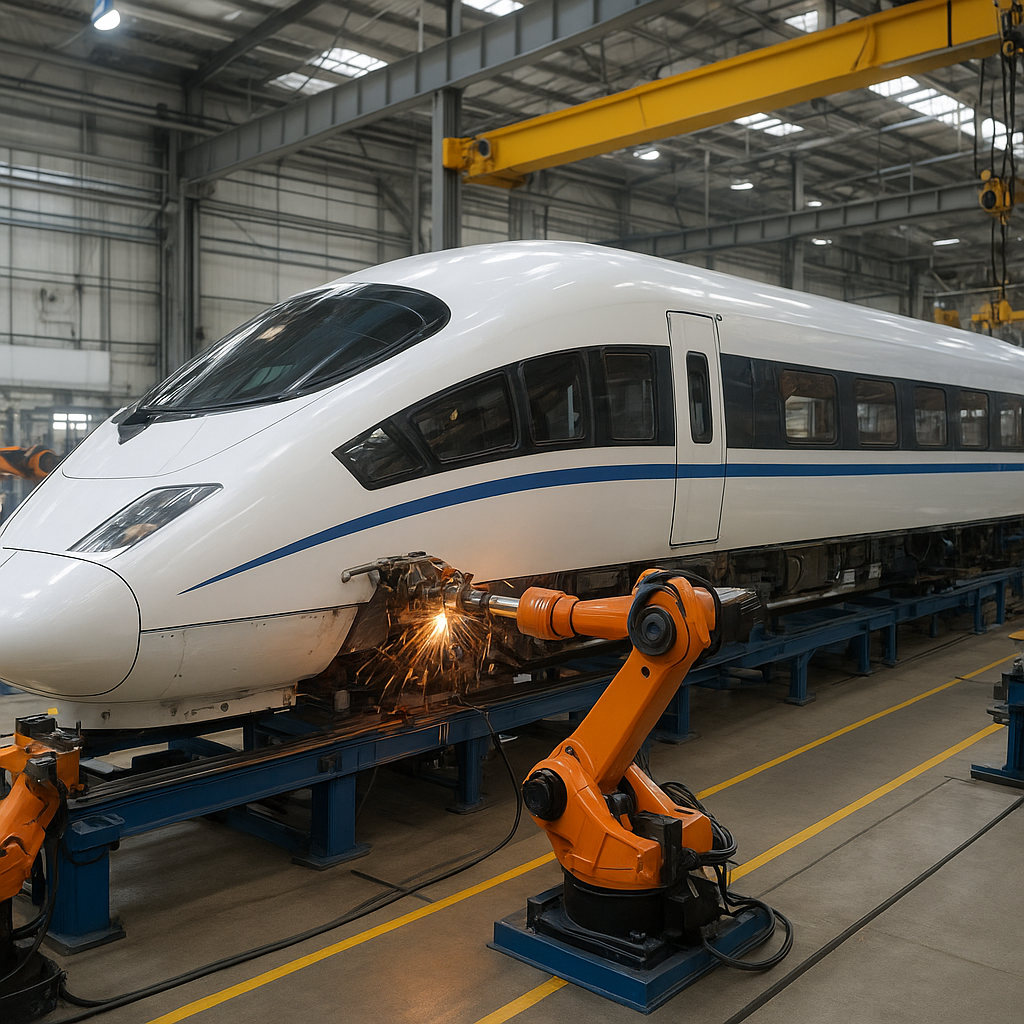
Once design specifications are finalized, state-of-the-art factory floors spring into action. Robotics and automated machinery handle large-scale tasks with unmatched precision and speed.
Robotic Welding and Drilling
Industrial robots equipped with laser-guided tools perform welding, drilling, and joining operations on steel and aluminum frames:
- Consistent weld quality reduces micro-fractures and enhances fatigue resistance.
- Automated drilling stations ensure exact hole placements for rivets and fasteners.
- Safety enclosures protect human workers from sparks and fumes.
Automated Guided Vehicles (AGVs)
AGVs transport heavy modules across the production line, navigating via embedded floor markers or LiDAR-based mapping:
- Load balancing algorithms optimize traffic flow among multiple vehicles.
- Dynamic rerouting prevents bottlenecks during peak assembly phases.
- Energy regeneration systems recover braking energy for improved efficiency.
Precision Machining Centers
CNC machining centers carve out complex parts—gear shafts, bogie components, and suspension elements—with micron-level accuracy:
- Multi-axis milling heads adapt rapidly to varied geometries.
- High-speed spindles maintain consistent tolerances across thousands of cycles.
- Tool condition monitoring prevents unexpected downtimes and ensures reproducible results.
Quality Control and Testing
Quality assurance is ingrained at every stage of production, from raw materials to final integration. Advanced inspection systems and rigorous testing protocols guarantee that each train meets stringent safety and performance criteria.
Non-Destructive Testing (NDT)
- Ultrasonic scanners detect tiny cracks in weld seams without disturbing the structure.
- X-ray and CT imaging uncover internal defects in composite panels and cast components.
- Magnetic particle inspection reveals surface irregularities on ferromagnetic parts.
Dynamic Performance Validation
After assembly, trainsets undergo exhaustive dynamic tests on specialized tracks or looped circuits:
- Acceleration and braking trials measure traction system capabilities.
- Noise and vibration sensors evaluate ride comfort under various speeds.
- Real-time data acquisition platforms log thousands of parameters per second.
Integrated Sensor Networks
Embedded sensors continuously monitor key metrics—temperature, pressure, stress, and alignment—throughout the assembly line and during initial test runs. These networks feed centralized dashboards where AI-driven analytics flag anomalies, prioritize corrective actions, and refine maintenance schedules.
Support Infrastructure and Maintenance
A fully equipped factory supports complex production through auxiliary systems that ensure uninterrupted operations and long-term performance.
Environmental Control Systems
- Climate-controlled enclosures maintain stable humidity and temperature for composite curing processes.
- Air filtration units reduce particulate contamination during painting and bonding stages.
- Energy management software balances power consumption across heavy machinery and support equipment.
Supply Chain Integration
Digital platforms connect suppliers of electronics, steel, and advanced materials directly to production schedules. Real-time inventory tracking and predictive ordering algorithms eliminate stockouts and minimize on-site storage requirements. This integration enhances overall efficiency while reducing working capital tied up in spare parts.
Predictive Maintenance and Digital Twins
Factories deploy digital twin models of critical machines, mirroring real-world behavior in a virtual environment. By analyzing sensor data streams, AI systems forecast wear patterns, schedule preventive interventions, and optimize spare parts logistics. This predictive approach maximizes uptime and extends equipment life.
Future Directions and Emerging Technologies
As demand for even faster, greener trains rises, manufacturers explore next-generation solutions to boost performance, lower costs, and reduce environmental impact.
Additive Manufacturing for Complex Parts
3D printing using metal powders or high-performance polymers opens new possibilities for lightweight, intricate geometries that traditional methods cannot achieve. Customized brackets, heat exchangers, and cabin fixtures become possible with minimal tooling changes.
Collaborative Robotics
Human-machine collaboration areas feature robotics designed to work safely alongside technicians. These cobots handle repetitive lifting or alignment tasks, freeing skilled workers to focus on fine adjustments and inspections.
Green Propulsion Systems
Advances in hydrogen fuel cells, battery energy storage, and hybrid powerpacks are under development to minimize carbon footprints. Assembly plants adapt to handle new subcomponents, incorporating dedicated lines for high-voltage battery modules and fuel cell stacks.
Augmented Reality and Remote Assistance
Technicians wear AR headsets that overlay installation guides, wiring diagrams, and torque specifications directly onto real-world components. Remote specialists can view live feeds and direct on-site staff through complex procedures, ensuring innovation spreads rapidly across global facilities.