Bridge construction projects often push the boundaries of modern engineering, demanding machines that can handle unprecedented weights and heights. Among these, the cranes that perform the heaviest lifts stand out as true marvels of industrial power. This article explores the world of the strongest cranes ever used in bridge construction, examining their key features, real-world applications, and the technological breakthroughs that made them possible.
Heavy Lifting Titans: A Glimpse into Extreme Crane Capabilities
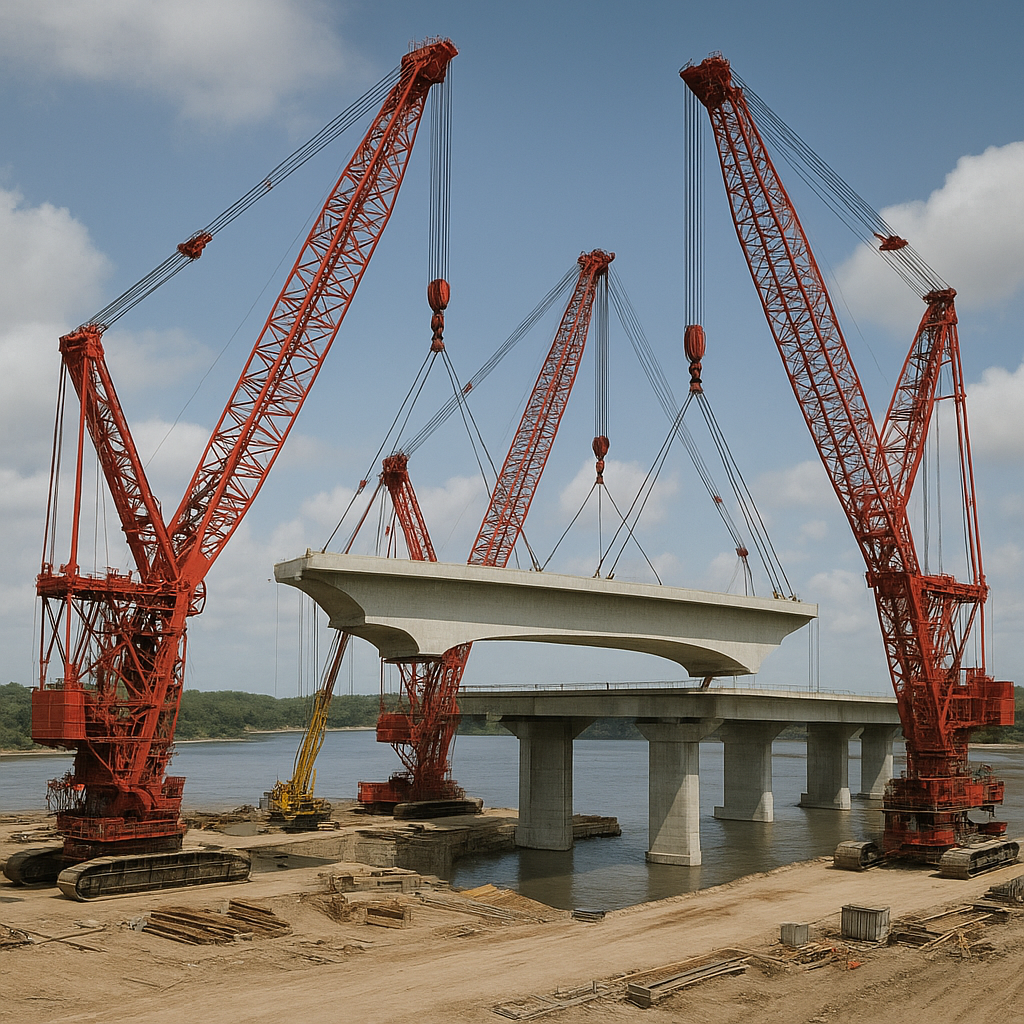
The cranes that take part in massive bridge builds must blend capacity with incredible stability and precise control. These machines vary from crawler cranes on land to floating cranes at sea, each tailored to overcome specific site challenges.
Classifications of Heavy-Duty Cranes
- Crawler cranes: Mounted on tracks for better traction and ground pressure distribution.
- Floating cranes: Deployed on barges to lift large segments over water.
- Gantry cranes: Span piers or riverbanks to hoist entire bridge girders.
- Lattice-boom cranes: Use a network of steel sections to achieve great heights and reach.
Key Performance Metrics
- Maximum lifting capacity (tonnes)
- Maximum boom length and height (meters)
- Operational radius and reach
- Stability margin under wind and dynamic loads
- Setup time and site adaptability
For a crane to be deemed among the strongest, it often exceeds performance benchmarks by delivering lifts well beyond 1,000 tonnes. Some of the most remarkable models feature modular counterweight systems, powerful diesel-electric drives, and advanced hydraulic circuits that enable ultra-smooth movements.
Mega Project Cranes in Iconic Bridge Construction
Throughout history, record-breaking bridges have relied on equally extraordinary cranes. Below are a few landmark examples:
The Taisun Crane – Yantai, China
Installed at the Yantai Raffles Shipyard, Taisun boasts a staggering 20,000-tonne lifting capacity, making it the heaviest-lift crane in the world. It was instrumental in assembling massive mega-structures offshore before transporting them to bridge sites. Key attributes include:
- Vertical lift height of up to 80 meters
- Gigantic movable counterweights totalling over 10,000 tonnes
- Enhanced precision remote-control systems for safety
Thialf Semi-Submersible Crane Vessel – North Sea Operations
Operated by Heerema Marine Contractors, Thialf features two cranes, each rated at 7,000 tonnes, and a combined capacity of 14,000 tonnes. It has played a vital role in constructing long-span bridges over challenging waters by:
- Floating stability ensured by semi-submersible pontoons
- Dynamic positioning to counter waves and currents
- Onboard monitoring systems for safety and environmental compliance
Tadano CC 8800-1 – Queensferry Crossing, Scotland
One of the largest land-based crawler cranes ever built, the CC 8800-1 has a maximum capacity of 3,200 tonnes. During the Queensferry Crossing project, it handled enormous concrete segments and steel deck sections. Highlights include:
- Modular boom configurations exceeding 150 meters in length
- Computerized load chart management for optimal efficiency
- Enhanced hydraulic damping to reduce oscillations
Hercules Series – Germany
The Hercules 10 and Hercules 6 models from Mammoet have been deployed in several European bridge projects. Their adaptability allows them to switch between lattice booms and superlift frames, providing:
- Multiple lifting modes for versatility
- Counterweight systems adjustable in 250-tonne increments
- On-the-fly boom length adjustments without dismantling
Technical Innovations and Future Outlook
To meet ever-growing demands, crane manufacturers continue to introduce cutting-edge innovation in materials, electronics, and design. Below are key trends:
Advanced Materials and Structures
- High-strength, low-alloy steels for reduced boom weight
- Composite reinforcement in critical load-bearing elements
- Finite element analysis to optimize structural durability
Digital Control and Automation
- Real-time load monitoring through sensor networks
- Automated safety interlocks to prevent overload
- GPS and laser-guidance systems for pinpoint positioning
Environmental and Safety Enhancements
- Hybrid power units combining diesel and electric drives
- Noise and emission reduction technologies
- Comprehensive training simulators for operator skill development
The synergy of safety, precision, and robust design continues to redefine what’s possible on the world’s greatest bridge-building sites. As demand grows for longer spans and higher clearances, cranes will evolve to deliver ever more impressive feats of mechanical prowess, ensuring that the next generation of bridges stands as enduring monuments to human innovation and engineering excellence.