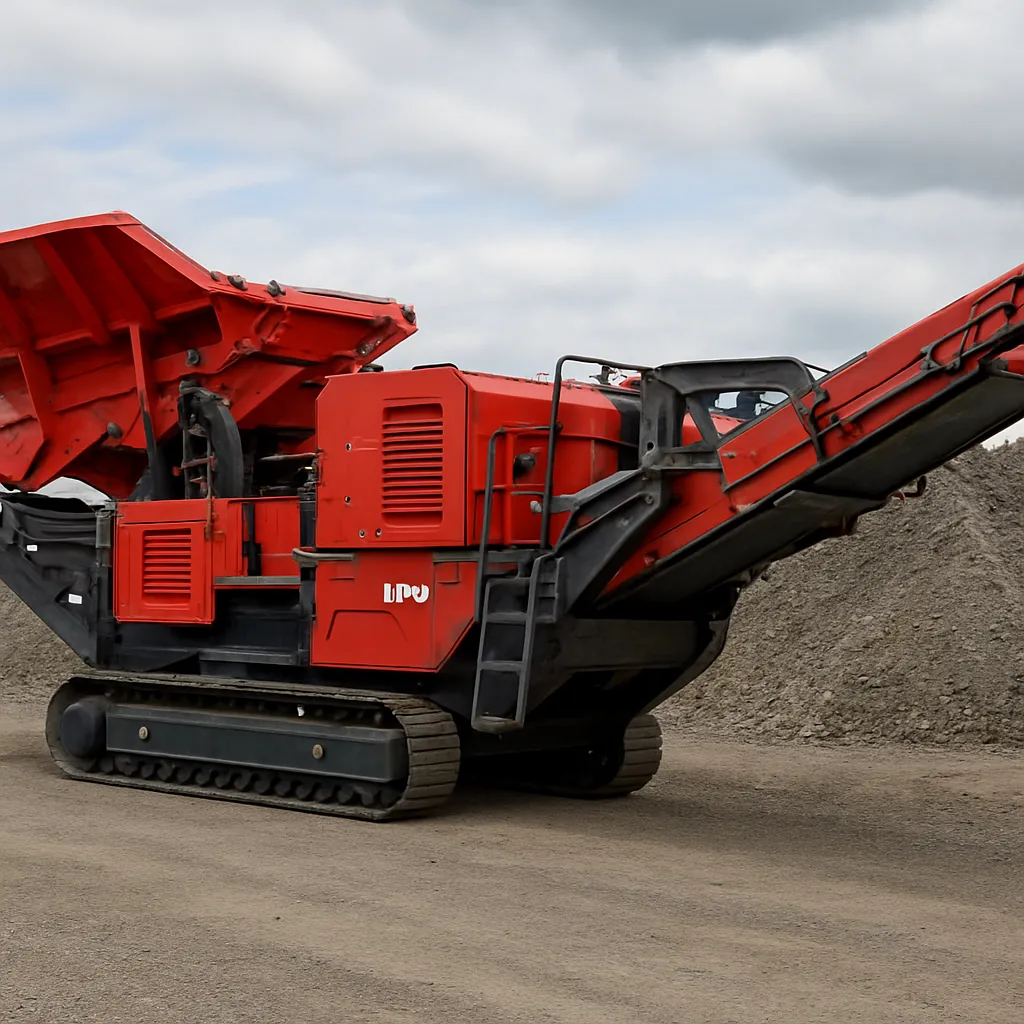
The Terex Finlay I-140 is a high-capacity, track-mounted mobile impact crusher designed for the most demanding recycling, quarrying and mining applications. Combining robust construction with user-friendly controls and high mobility, the I-140 has become a popular choice for contractors who require a flexible crushing solution that can be moved quickly between sites. In this article we examine the machine’s design, typical applications, operational advantages, technical considerations and market-relevant information to give a comprehensive view of what makes the I-140 a widely used piece of heavy equipment.
Overview and key design features
The Terex Finlay I-140 is built around a horizontal shaft impact (HSI) crusher unit that delivers a fine cubical product ideal for asphalt, concrete, aggregates and recycling operations. Its tracked chassis provides excellent mobility on-site and between work locations, while the plant layout has been optimized to allow for rapid setup and minimal downtime. The combination of a robust impact chamber, hydraulic adjustments, and optional screening or recirculation systems makes the I-140 a flexible machine for many production scenarios.
Main structural and functional components
- Impact crusher chamber — Provides the primary crushing action with adjustable blow bar configurations to control product shape and gradation.
- Feed hopper and apron feeder — Designed to accept dump trucks or excavators, with wear-resistant liners to handle abrasive materials.
- Vibrating grid or pre-screen — Optional for reducing fines and improving crusher efficiency by removing unwanted smaller material prior to crushing.
- Recirculating conveyor and sizing screen (on I-140RS configurations) — Allows closed-circuit operation and improved product control.
- Track-mounted undercarriage — Ensures safe movement across rugged terrain and easy repositioning within a jobsite.
- Operator control cabin / remote-control options — For safe, precise machine adjustments and monitoring.
Design priorities
The I-140’s design emphasizes several priorities: reliability under heavy load, ease of maintenance, operator safety, and the ability to produce consistent product gradation. Modular components and standardized parts reduce service times, while wear parts such as blow bars and aprons are engineered for relatively straightforward replacement. The machine also integrates safety features like emergency stops, guarded nip points and clear access platforms for inspections.
Applications and use cases
The Terex Finlay I-140 is versatile and well-suited to a wide range of industries and tasks. Its ability to process different materials and to produce cubical aggregates makes it particularly common in the following areas:
- Quarrying — Producing primary and secondary aggregates such as crushed stone, limestone and dolomite for construction and road-building.
- Recycling — Processing construction and demolition waste, concrete, asphalt and reclaimed materials to produce re-usable aggregates and reduce landfill dependency.
- Mining operations — Breaking down material for secondary processing or producing roadbase and site aggregates on remote sites.
- Road building and infrastructure projects — On-site production of graded aggregates, sub-base material and recycled mixes to save transport costs.
- Specialty materials production — When a cubical particle shape or specific gradation is required for concrete or asphalt mixes, or landscaping materials.
Because the I-140 can be configured with pre-screening or recirculating systems, it is frequently chosen where product control and consistency are critical. Closed-circuit setups (I-140RS) allow contractors to meet strict specification requirements without adding multiple plants to a single site.
Performance, capacity and typical specifications
Exact capacity and specifications vary by model, year and optional equipment, but general performance figures help place the I-140 in context against other machines in its class. The following figures represent typical ranges and should be verified with the latest manufacturer data for any specific unit or configuration.
Typical performance metrics
- Throughput — Depending on material type, feed size and configuration (open or closed circuit), the I-140 commonly achieves production rates in the range of approximately 150 to 350 tonnes per hour. Hard, abrasive stone and larger feed sizes will be at the lower end of this range; softer material and optimized feed will be at the higher end.
- Feed size — The feed opening and apron feeder accept large feed sizes but performance depends on the selected blow bar profile and rotor speed. Typical maximum feed sizes are in the order of several hundred millimeters.
- Rotor and impact mechanics — The rotor design and blow bar configuration are critical to the crushing action. Operators can choose different blow bars (cast carbon steel or high-manganese steel alternatives) to match material characteristics and desired product shape.
- Operating weight — The I-140 series machines generally fall in the mid-to-high tens of tonnes range when fully equipped; exact operating weight varies with options but is commonly quoted in the high thousands of kilograms (approx. mid-30s to low-40s tonnes depending on configuration).
- Engine power — Onboard diesel power units typically range from roughly 200 to 300 kW depending on model and emissions stage. Power must be sufficient to drive the crusher, conveyors and any ancillary systems.
Bear in mind that site conditions, feed grading, operator settings and maintenance status all strongly influence actual output. Careful matching of rotor speed, blow bar profile, and pre-screening can dramatically improve productivity and reduce wear costs.
Operational considerations and best practices
To maximize performance and minimize downtime with an I-140, operators and site managers should follow established best practices that reflect both safety and efficiency concerns.
Feed management and screening
- Maintain a consistent feed that avoids large spikes of oversize material which can overload the chamber.
- Where possible, use a pre-screen or grizzly to remove fines and reduce recirculation, which increases throughput and reduces wear.
- In closed-circuit configurations, monitor screen apertures and adjust recirculation rates to meet product specifications without overworking the crusher.
Wear part management
Wear components such as blow bars, anvils and side liners are central to operational costs. Implementing an inventory strategy for replacement parts and tracking consumption rates can reduce downtime and ensure consistent output. Selecting the correct blow bar material and hardness profile for the processed material extends component life and improves durability.
Maintenance and safety
- Schedule routine inspections of hydraulic systems, belts, bearings and the rotor assembly to detect issues early.
- Keep service points clean and accessible — the Finlay layout prioritizes straightforward access but routine cleaning is still essential.
- Ensure operators are trained in emergency procedures and that guardings, lock-out/tag-out processes and safety interlocks are used consistently.
Environmental, fuel and noise considerations
Modern iterations of mobile crushing plants, including the I-140, place emphasis on reducing environmental impact. While quantities vary by engine and local regulations, the following considerations are commonly relevant:
- Emissions — Diesel engines should meet applicable Tier or Stage emissions requirements (Tier 3/4 or Stage IIIA/IV depending on the market and model year). Select units with after-treatment systems where needed to comply with local regulations.
- Fuel consumption — Fuel use depends on crushing intensity, load factors and auxiliary systems (screens, conveyors). Efficient operation, idle reduction and optimized feed management reduce fuel draw.
- Noise and dust — Dust suppression systems (water sprays, misting) and site layout minimize airborne particulates. Acoustic enclosures and careful machine orientation help manage noise for urban or noise-sensitive projects.
Variants, upgrades and configuration options
The I-140 is available in multiple configurations to meet different operational needs. Common variants include the standard I-140, the I-140RS (with re-screening/recirculating systems), and special packages that include bespoke conveyors, additional conveyors for stockpiling, or integrated magnetic separators for recycling applications.
Common options
- Recirculating screen and additional conveyors — For closed-circuit processing and improved particle size control.
- Hydraulically adjustable curtains and aprons — To alter product gradation and protective settings quickly on site.
- Different blow bar materials and profiles — For adapting to abrasive or non-abrasive feedstocks.
- Remote monitoring and telematics — Allowing fleet managers to monitor operating hours, fuel consumption and fault codes from afar.
Market position and statistical context
In the mobile crushing market, the Terex Finlay I-140 occupies a position as a reliable mid-to-high capacity impact crusher with strong adaptability for recycling and aggregate production. While precise sales figures vary by region and year, a few general observations are widely supported by industry reporting:
- Impact crushers like the I-140 are particularly popular in recycling sectors because they can produce cubical aggregates suitable for reuse in asphalt and concrete mixes.
- Mobile plants have grown in demand as contractors prefer on-site production to reduce transport costs and logistical complexity.
- Models with integrated screening (I-140RS) command a premium due to their ability to operate in a closed circuit, reducing the need for additional machinery.
For specific statistical data (number of units sold, regional market shares or exact OEM production figures), manufacturer sales reports and industry market analyses are the recommended sources. Those reports typically reflect annual trends showing increased uptake of mobile crushers in regions with high infrastructure investment and strong recycling mandates.
Advantages and limitations
Understanding the strengths and constraints of the I-140 helps in selecting the right machine for a job.
Advantages
- Versatility — Can handle a wide range of materials and deliver adjustable product gradations.
- High mobility — Track-mounted design allows rapid deployment and repositioning on job sites.
- Integrated options — Screening and recirculation enhance product control without extra plants.
- Robust construction — Designed for continuous, heavy-duty operations common in quarries and recycling yards.
Limitations
- Impact crushers can produce higher wear rates than compression crushers when processing very abrasive rock; therefore, material selection and blow bar specification are crucial.
- Fuel consumption and noise levels can be significant under heavy loads — mitigation measures may be required for sensitive sites.
- Throughput is highly dependent on operator skill in feed management and maintenance routines; inexperienced operation can lead to suboptimal performance.
Purchasing, rental and lifecycle considerations
Deciding between purchasing and renting an I-140 depends on project duration, expected utilization and capital availability. For short-term projects or trial use, rental can be cost-effective and allows access to the latest models. Purchasing is advantageous for contractors with consistent demand and long-term operations where the machine’s cost can be amortized over extensive use.
Total cost of ownership factors
- Initial capital outlay versus rental rates and expected utilization.
- Wear part consumption and inventory costs — especially blow bars, liners and screen media.
- Fuel and maintenance expenses — scheduling preventive maintenance reduces the risk of catastrophic failures.
- Resale value and market demand for used units — well-maintained machines from established brands retain higher resale value.
Conclusion
The Terex Finlay I-140 is a proven mobile impact crusher that blends productivity, flexibility and practical features for quarrying, recycling and construction applications. Its capacity to be configured for specific tasks — from open-circuit primary crushing to closed-circuit recirculation with screening — makes it a versatile asset for modern aggregate producers and contractors. While exact performance depends on material, configuration and operator practice, the I-140’s combination of robust design and modular options explains its widespread adoption in markets prioritizing on-site production, product quality and operational agility.
)
)