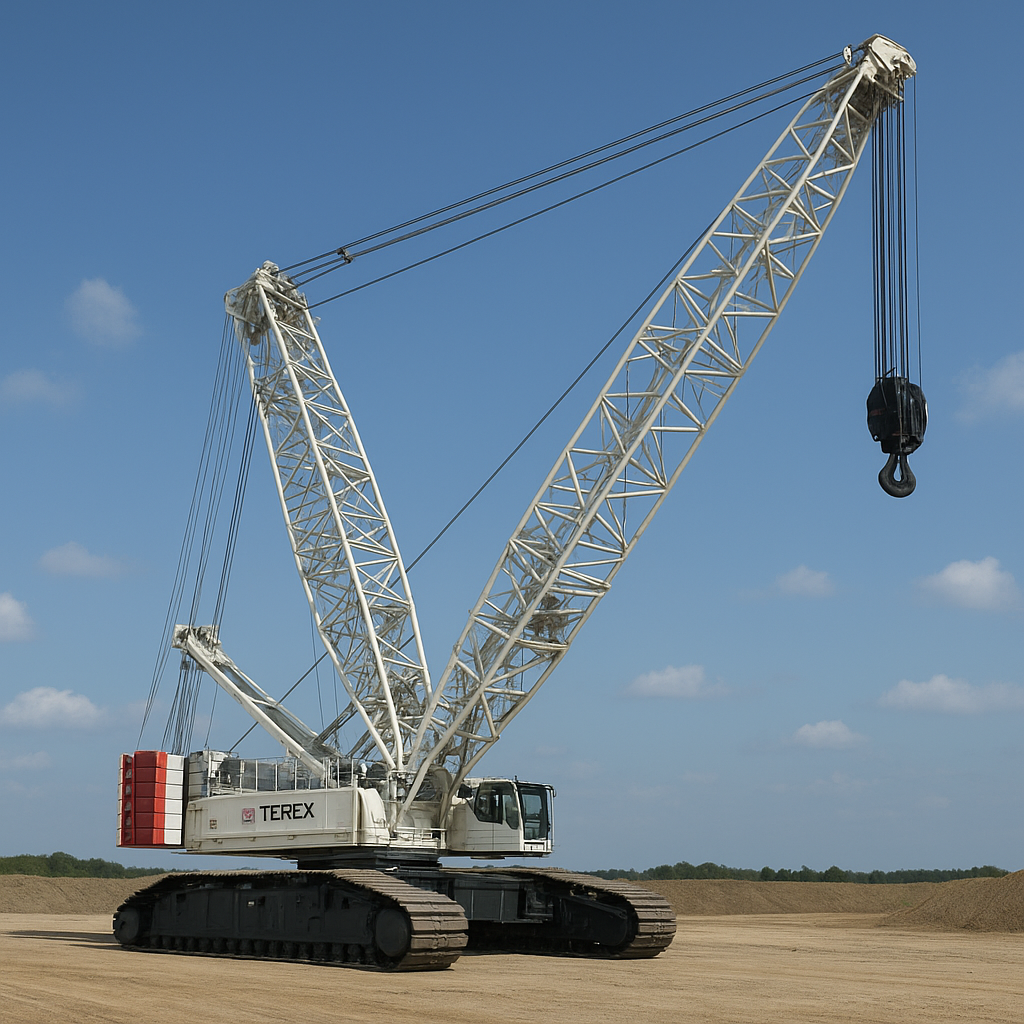
The Terex Demag CC 8800-1 is one of the most remarkable pieces of equipment in the world of industrial lifting. Designed for the heaviest and most complex lifts, it represents a pinnacle of engineering in the crawler crane segment. This article explores the CC 8800-1’s core design, common applications, operational and logistical considerations, safety features, and the economic and environmental aspects connected to deploying such a mammoth machine on modern construction and industrial sites. Throughout the text you will find practical insights into how this crane is used in real-world projects and what makes it stand out in the global market for heavy lifting.
Technical overview and design features
The CC 8800-1 was developed as a high-capacity crawler crane intended to manage exceptionally heavy loads in varied and often constrained jobsite conditions. At the heart of its appeal is a combination of sheer lifting power and a modular architecture that allows the crane to be configured to the specific requirements of each lift. Its reputation as one of the largest crawler cranes derives from its maximum rated lifting capacity, which reaches up to 3,200 tonnes in specific configurations, placing it among a very short list of cranes capable of handling multi-thousand-tonne lifts.
Modularity and boom systems
The CC 8800-1 features a highly modular boom and superstructure system. Typical configurations include a long lattice main boom, various luffing jib options, and derrick counterweight systems for ultra-heavy lifts. These modular components can be assembled in different combinations to optimize reach, height, and capacity. Modular design also simplifies transport because large elements can be split into segments that fit standard transport constraints.
- Modular lattice sections form the main boom and jib.
- Standard and extreme lift configurations use different counterweight systems.
- Winch and hoist arrangements are designed for heavy-duty continuous operation.
Tracks, chassis and mobility
Mounted on crawler tracks, the CC 8800-1 can operate on soft or uneven ground with appropriate ground preparation. The crawlers provide excellent stability compared to wheeled counterparts, which is critical when executing large moment lifts. The crane’s mobility makes it suitable for jobs where the lift position may shift over the course of a project, such as module installation in petrochemical yards or staged bridge assembly.
Powertrain and control
The crane uses multiple diesel engines and robust hydraulic systems to power winches, slewing systems, and track drives. Modern iterations and upgrades often include advanced electronic control and monitoring systems, enabling precise load handling, automated interlocks, and remote diagnostics. These systems reduce operator workload and increase safety by providing real-time feedback on load, radius, boom angle, and other key parameters.
Primary applications and industries
The CC 8800-1 is designed for environments where conventional cranes either cannot reach the required capacity or where jobsite conditions demand a crawler solution. The crane is commonly used in several heavy industries:
Power generation and large rotating equipment
Installation of steam generators, nuclear reactor vessels, gas turbine modules, and large transformers often requires lifts in the multi-hundred to multi-thousand-tonne range. The CC 8800-1 is well-suited for placing large components into foundations, containment buildings, and supporting structures where precision and safety are essential.
Oil, gas and petrochemical modules
Offshore platform topsides and onshore process modules are frequently built as large prefabricated units. These modules can weigh thousands of tonnes and are moved and placed by heavy crawler cranes during hook-up and commissioning phases. The CC 8800-1’s ability to take on very large single lifts reduces the need for breaking modules into smaller segments, which saves time and diminishes onshore and offshore assembly risks.
Shipbuilding, shipyard heavy lifts and manufacturing
In shipyards and large fabrication facilities, the CC 8800-1 is used to lift block assemblies, engine houses, and other oversized structures. Its mobility and high capacity are ideal for aligning and placing heavy hull sections where multiple cranes would otherwise be required.
Bridge construction and infrastructure
For long-span and heavy bridge section placement, the CC 8800-1 is able to lift and lower long girders, precast deck segments, or gantry units into place. It is particularly valuable when lifting large preassembled sections over obstacles or into confined foundations.
Nuclear and decommissioning projects
Nuclear projects often require lifts of large, highly sensitive components with stringent safety margins. The CC 8800-1 is used both for installation of new plant components and for decommissioning tasks that call for careful, slow, and highly controlled lifts of heavy vessels or shielding elements.
Site planning, logistics and assembly
Deploying a CC 8800-1 is a major logistical undertaking. Detailed preparation is required long before the crane arrives on site. Transport planning, ground preparation, crane assembly sequencing and load-out of counterweights are all critical activities that determine the success of a heavy-lift operation.
Transport and mobilization
Because the CC 8800-1 is modular, it can be shipped in sections using road, rail, and sea transport. However, the sheer number of transport units, their weight, and the site access requirements mean mobilization can take weeks to months. Specialized trailers, clearance permits, and route surveys are typically part of the mobilization phase.
- Segmented components allow international transport using standard heavy-haul carriers.
- Mobilization windows must be coordinated with local authorities and project schedules.
- Experienced rigging teams are required for assembly and disassembly operations.
Foundation and ground support
Preparing the crane foundation often involves substantial earthworks, piling, or the installation of temporary working platforms. Spreading loads with heavy-duty cribbing, mats, and steel plating reduces ground pressure and prevents excessive settlement. For ultra-heavy lifts, a specially designed crane mat system is engineered to safely distribute vertical and lateral forces into the subsoil.
Counterweights and ballast
To achieve its maximum capacities, the CC 8800-1 uses large volumes of counterweight and ballast. Counterweights may total several thousand tonnes and are brought to site as modular blocks. The design and placement of counterweights are carefully calculated to produce the necessary restoring moment for the intended lift while maintaining stability under dynamic conditions such as wind or load sway.
Safety systems, operator training, and risk management
Given the scale of loads handled by a CC 8800-1, safety is paramount. Manufacturers and operators implement multiple layers of protection to ensure safe lift execution.
Electronic and mechanical safety features
Typical safety systems include load moment indicators (LMI), anti-two-block devices, automatic limiters, alarm systems, and redundant braking arrangements. Modern cranes often have integrated control systems that restrict operations outside certified load charts and configuration envelopes. These systems help prevent operator error and mechanical overload.
Planning and simulation
Heavy lifts are almost always preceded by extensive planning sessions using computer simulations, finite element analysis of crane structures and the load, and step-by-step lift procedures. Digital modeling helps teams understand center-of-gravity behavior, dynamic effects, and the interaction between crane, load, and environment. Lift rehearsals and dry runs without load can further reduce risk.
Training and certification
Operators of the CC 8800-1 require advanced certification and substantial experience with large crawler cranes. Training programs typically cover crane systems, load chart interpretation, rigging practices, communication protocols, and emergency procedures. Supervisory personnel and signalers/riggers are also trained in the specific nuances of ultra-heavy lifting operations.
Economic considerations and market role
Investing in a crane like the CC 8800-1 is justified by projects that need single lifts of exceptional mass or height. Because such cranes are expensive to own and operate, they are frequently operated by specialist rental companies that provide crane and crew as a package.
Costs and hiring model
Owner-operators and rental companies calculate costs based on mobilization/demobilization, crane hours, personnel, permits, insurance, and maintenance. While buying such a crane represents a mult-million-dollar capital expense, the rental market allows end-users to access extreme capacity for the limited durations that demand it without the need to purchase and maintain their own unit.
Project efficiency and schedule impacts
Using a single crane capable of handling a large module or component in one piece often reduces the number of lifts, on-site assembly, and alignment tasks that would otherwise be needed. That can shorten project schedules, minimize interface risks, and reduce the cumulative man-hours required, delivering tangible savings that offset the crane cost.
Environmental and sustainability considerations
Large crawler cranes require substantial fuel and resources, and their operations can have environmental impacts that must be managed. Best practices emphasize minimizing emissions, optimizing fuel consumption, and reducing the footprint of crane assembly areas.
- Use of newer engines and emissions control systems lowers greenhouse gas output.
- Efficient sequencing reduces idle time and unnecessary crane moves.
- Re-usable crane mats and careful ground restoration reduce long-term site damage.
Case examples and emblematic lifts
While every project is unique, the CC 8800-1 has been used in a variety of emblematic heavy-lift scenarios, illustrating its flexibility and power. Typical assignments include:
- Placement of reactor vessels and steam generators at power plant sites.
- Setting prefabricated offshore topsides and heavy modules into position.
- Installation of major bridge segments and long-span girders.
- Shipyard block lifts for newbuild hull assembly.
These lifts demonstrate the crane’s role in reducing project complexity by enabling large pre-assembled components to be moved and installed in a single operation, which often increases precision and safety while reducing time on critical paths.
Maintenance, lifecycle and technological evolution
Maintenance of a CC 8800-1 is a continuous and highly specialized endeavor. Periodic inspections, lubrication regimes, winch servicing, and structural checks for fatigue are standard. Lifecycle management for a crane of this class also includes updated control software, retrofitting of emissions-compliant engines when regulations demand, and modernization of safety systems.
Upgrades and digitalization
Many heavy cranes are retrofitted with digital monitoring systems that track component health and usage patterns in real time. Predictive maintenance, based on analytics gathered from sensors, can reduce downtime and prevent costly failures. Remote diagnostics and telematics are becoming standard for cranes that operate in international and remote locations, enabling specialists to advise on servicing without immediate travel.
Final observations — why the CC 8800-1 matters
The Terex Demag CC 8800-1 occupies an important niche in the world of heavy industry. With a maximum rated lifting capacity that can reach up to 3,200 tonnes, and with a modular, adaptable platform built for the most demanding lifts, it enables projects that would otherwise be impractical or require far more time and risk. Its use in power generation, petrochemical, shipbuilding, and infrastructure projects shows how a single, well-planned heavy lift can create efficiencies and safety improvements across an entire construction sequence.
Operators and project planners considering the CC 8800-1 must weigh the benefits of single-lift capability against the significant logistics of mobilization, on-site preparation, and specialist staffing. When applied in the right context, however, the crane’s combination of power, precision and adaptability make it a defining tool for modern heavy lifting.
Key words emphasized: Terex Demag CC 8800-1, crawler, 3,200 tonnes, heavy lifting, modular, counterweight, boom, cranes, offshore, safety.
)
)