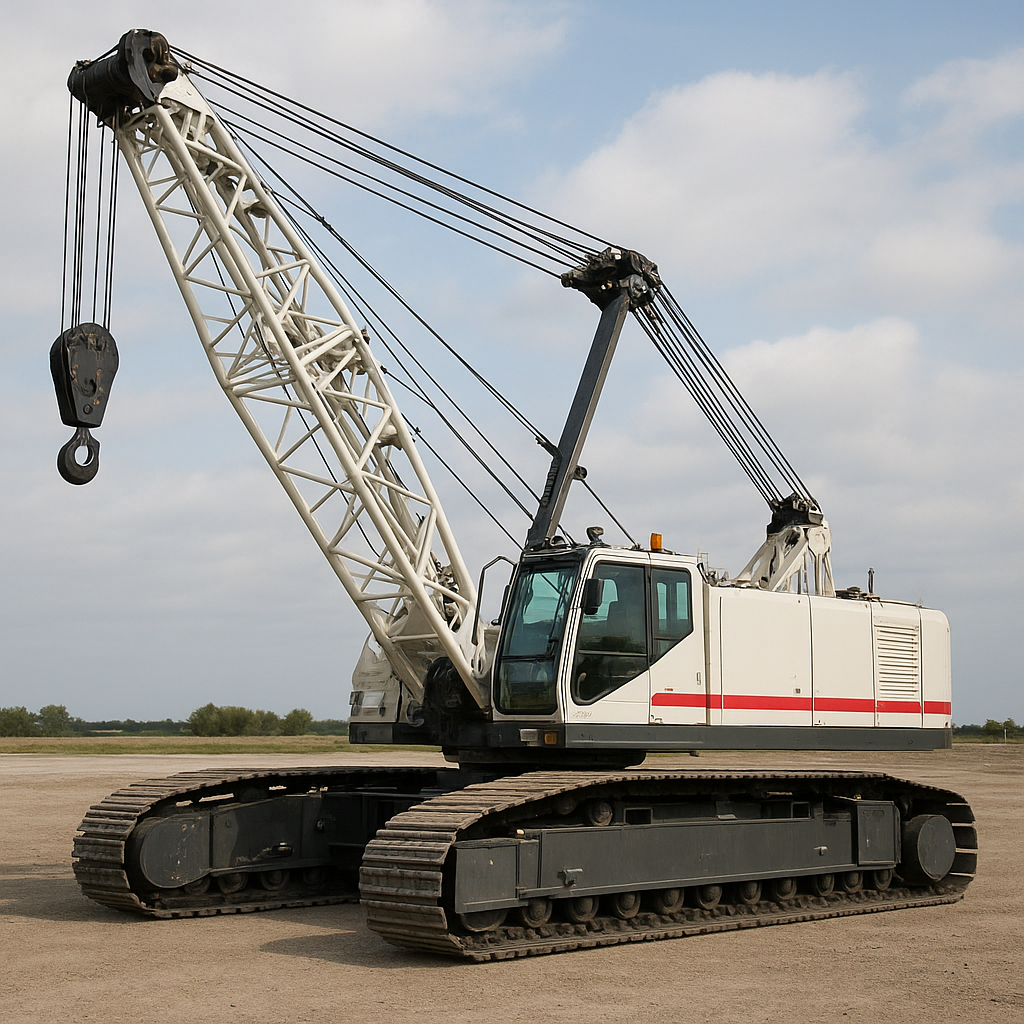
The Terex CC 2400-1 is a heavy-duty crawler crane designed for demanding lifting tasks in large-scale industrial, energy and infrastructure projects. Combining a modular lattice-boom system with robust undercarriage engineering, the CC 2400-1 offers versatility on challenging sites where stability, mobility and high lifting capacity are essential. This article explores the machine’s design, typical applications, operational considerations, safety features, maintenance needs and market role, providing a comprehensive view for owners, operators and project planners.
Overview and purpose
The Terex CC 2400-1 occupies a place in the class of large lattice-boom crawlers intended for heavy lifting and precise load placement. Built with a focus on modularity and transportability, these cranes are commonly deployed where fixed or truck-mounted cranes cannot offer the necessary combination of reach, capacity and site adaptability. While exact lifting charts depend on configuration, counterweight and boom arrangement, the CC 2400-1 is engineered to handle substantial loads and long reach tasks found in sectors such as wind energy, petrochemical construction, bridge building and offshore module installation.
Design and technical features
The engineering of the CC 2400-1 prioritizes structural strength, reliability and the flexibility to adapt to multiple lifting scenarios. Key elements of its design include the lattice-boom system, the crawler undercarriage, powertrain and hydraulic controls, as well as a modular counterweight and ballast arrangement.
Lattice-boom system
The crane uses a lattice-type main boom and optional luffing or fixed jib sections to achieve long outreach while minimizing self-weight. The lattice structure allows for extended lengths without excessive bending moment, giving the machine the capacity to place heavy components at considerable radii. Modular sections mean that boom length and configuration can be tailored to project needs, optimizing both lifting capacity and transport logistics.
Crawler undercarriage and mobility
A robust crawler track system provides excellent ground-bearing distribution, enabling operation on soft or uneven surfaces with greater stability than wheeled machines. The undercarriage is designed for site mobility, allowing the crane to reposition under its own power within confined project areas. Track gauge and pad options are often configurable to match ground conditions and transport constraints.
Powertrain and controls
Power management integrates diesel engines with hydraulic systems to control hoisting, slewing and travel. Modern variants offer electronic load-moment limiting and integrated crane management systems that assist the operator with real-time data on load, radius and boom configuration. Ergonomically designed operator cabins with clear instrumentation and good visibility aid precision work under load.
Counterweight and stability
Stability is achieved through carefully calculated counterweight systems that can be assembled in modular blocks to suit varying lift requirements. This modular approach makes it possible to reduce transport weight for some moves and assemble only the required ballast on site. In addition to counterweight, the crane’s footprint and track position greatly influence achievable capacities at different radii.
Typical applications and industries
The CC 2400-1 is used where heavy and precise lifting is required. Common industries and applications include:
- Wind energy — erection of towers, assembly and placement of nacelles and blades, especially for onshore and nearshore wind projects that require long-reach lifts and high stability.
- Petrochemical and refinery construction — lifting and placing heavy process modules, columns and reactor vessels that can weigh hundreds of tonnes.
- Power generation — installation of turbines, generators, and heat recovery steam generator modules in combined-cycle plants.
- Bridge construction and civil engineering — lifting girders, precast segments and large structural sections with precision.
- Shipbuilding and offshore platforms — assembly and installation of topsides, modules and heavy equipment in shipyards and jack-up platforms.
- Industrial relocations and heavy manufacturing — moving large presses, transformers, and other heavy machinery.
Operational performance and load considerations
Performance of the CC 2400-1 depends on configuration: boom length, jib type, counterweight quantity and track setup. Load charts provided by the manufacturer specify allowable lifts for combinations of radius and boom arrangement. Operators and planners must consult those charts for exact capacities. In general terms:
- Lifting capacity decreases as radius increases; long jibs and higher reaches require more counterweight.
- Shorter boom configurations enable higher maximum capacities at closer radii.
- Site ground conditions and track setup influence permissible loads — mats or craneways may be required to distribute loads.
Because the CC 2400-1 is intended as a heavy-lift machine, it is engineered to sustain increased structural and component stresses and undergo rigorous testing and inspection schedules suitable for high-risk lifts.
Transport, assembly and site setup
A major advantage of this class of crawler crane is modular transportability. Components such as lattice boom sections, crawler frames, counterweight blocks and winches are designed to be disassembled to sizes and weights suitable for road and sea transport. Site assembly follows a planned sequence to ensure safety and efficiency.
Transport planning
Transport planning is a critical part of project logistics. Elements to consider include:
- Road permits for oversized loads and route surveys for bridges and low clearances.
- Staging areas for assembly and storage of components and counterweights.
- Coordination with heavy-haul contractors and local authorities.
Assembly and commissioning
Assembly requires certified crane riggers and often specialized auxiliary equipment like mobile cranes for initial pick-and-place of heavy sections. Commissioning includes functional tests, calibration of load measurement systems and confirmation of track and boom alignment. A careful check of ground preparation, anchor points (if used) and safety systems is mandatory before commencing lifts.
Safety systems and operator aids
For machines performing critical lifts, safety systems are comprehensive and may include:
- Load-moment indicators (LMI) and overload protection to prevent lifting beyond rated capacities.
- Integrated stability monitoring, including boom angle sensors and radius detectors.
- Redundant braking and hoist interlocks to control descent in case of failure.
- Clear visual and audible alarms, plus remote monitoring for site managers.
- Rigging guidelines and mandatory use of certified slings, shackles and spreader beams for multi-point lifts.
Operator training and certification are essential; heavy-lift projects often require crane operators with documented experience on similar machines, along with rigging supervisors and lifting engineers to prepare lift plans and risk assessments.
Maintenance, lifecycle and parts support
Proper maintenance ensures reliability and extends the lifecycle of these capital-intensive machines. Recommended practices include:
- Scheduled inspections of structural components for cracks, corrosion and fatigue.
- Regular hydraulic system checks, filter replacements and fluid analysis.
- Track and undercarriage inspections to monitor wear on shoes, rollers and pins.
- Preventive replacement of critical wear parts and systematic record-keeping of maintenance events.
Manufacturers and authorized dealers typically provide parts support, technical documentation and retrofit options. Owners often invest in service agreements that include rapid access to spare parts and field service technicians to minimize downtime on large projects.
Environmental and logistical considerations
Using large crawler cranes like the CC 2400-1 has environmental and logistical implications. Noise and emissions from diesel engines are considerations near populated areas, and site preparation can impact ground ecology. Mitigations include:
- Using modern engines and exhaust aftertreatment to reduce emissions.
- Implementing noise abatement strategies during night works.
- Careful planning of ground mats and craneways to minimize site disturbance and protect soils.
- Optimizing logistics to limit the number of heavy transports and reduce overall project carbon footprint.
Market position, resale and economic factors
Crawler cranes in this class represent significant capital investments. Buyers and contractors weigh rental versus purchase depending on project pipelines. Some considerations:
- Rental markets exist for short-term projects; for developers with long-term or recurring heavy-lift needs, ownership may be more economical.
- Resale values depend on machine hours, maintenance history and market demand for heavy-lift equipment.
- Availability of manufacturer support and spare parts in the region influences total cost of ownership.
Financing, insurance and specialized transport costs must be included in project budgets when planning for use of such cranes. Effective project planning reduces idle time and improves return on investment.
Notable operational considerations and best practices
Large lifts with the CC 2400-1 require a team approach and meticulous planning. Best practices include:
- Developing detailed lift plans and method statements with engineering verification for every critical lift.
- Using independent lift supervisors and third-party verification where loads exceed standard working limits or present unusual risks.
- Conducting pre-lift meetings with all stakeholders — riggers, signalers, operators, site managers and safety officers.
- Maintaining clear communication lines and establishing a single point of control for signal and radio communications during lifts.
- Documenting environmental conditions, such as wind speed limits for specific configurations and establishing go/no-go criteria.
Technological trends and future developments
Advances in crane technology are influencing heavy-lift crawler design. Areas of development that affect machines like the CC 2400-1 include:
- Improved telematics and remote-monitoring systems that allow real-time performance tracking and predictive maintenance.
- Enhanced control systems for smoother hoist and slewing motions, improving precision and safety.
- Materials engineering that reduces self-weight of boom sections while maintaining strength, improving transportability and capacity.
- Hybrid power systems and alternative fuels to reduce emissions and operating costs in sensitive environments.
Case study examples (typical uses)
While specific project names are not provided here, the CC 2400-1 is typically involved in:
- Onshore wind farm construction where turbines require high-reach lifts and the ability to traverse soft ground between turbine pads.
- Industrial module installations where pre-assembled process units of several hundred tonnes must be lifted into place with millimeter precision.
- Bridge segment placement for long-span bridges where repetitive heavy lifts demand both endurance and precise alignment.
Purchasing and rental guidance
For organizations considering the CC 2400-1, the following guidance can help in decision-making:
- Match the crane’s configuration to the maximum anticipated lift: over-specifying increases costs; under-specifying risks project delays.
- Ensure access to certified operators and rigging crews experienced with large lattice crawlers.
- Factor in transport, assembly and disassembly time and costs — these often represent a significant portion of project logistics expenses.
- Consider rental as a flexible option for one-off projects; purchase can be cost-effective when utilization is high.
Summary
The Terex CC 2400-1 is a purpose-built heavy-lift crawler crane designed for demanding industrial and infrastructure projects. Its modular lattice-boom architecture, robust undercarriage and configurable counterweight system make it well suited for tasks that require long reach and high stability. Key advantages include adaptability to a range of applications, strong safety systems and the ability to operate on challenging ground conditions. Successful use depends on careful planning, certified crews, adherence to manufacturer load charts and proactive maintenance. For large-scale lifting projects in sectors such as wind energy, petrochemical construction and bridge erection, cranes of this class remain indispensable tools for achieving precise, heavy placements efficiently and safely.
)
)