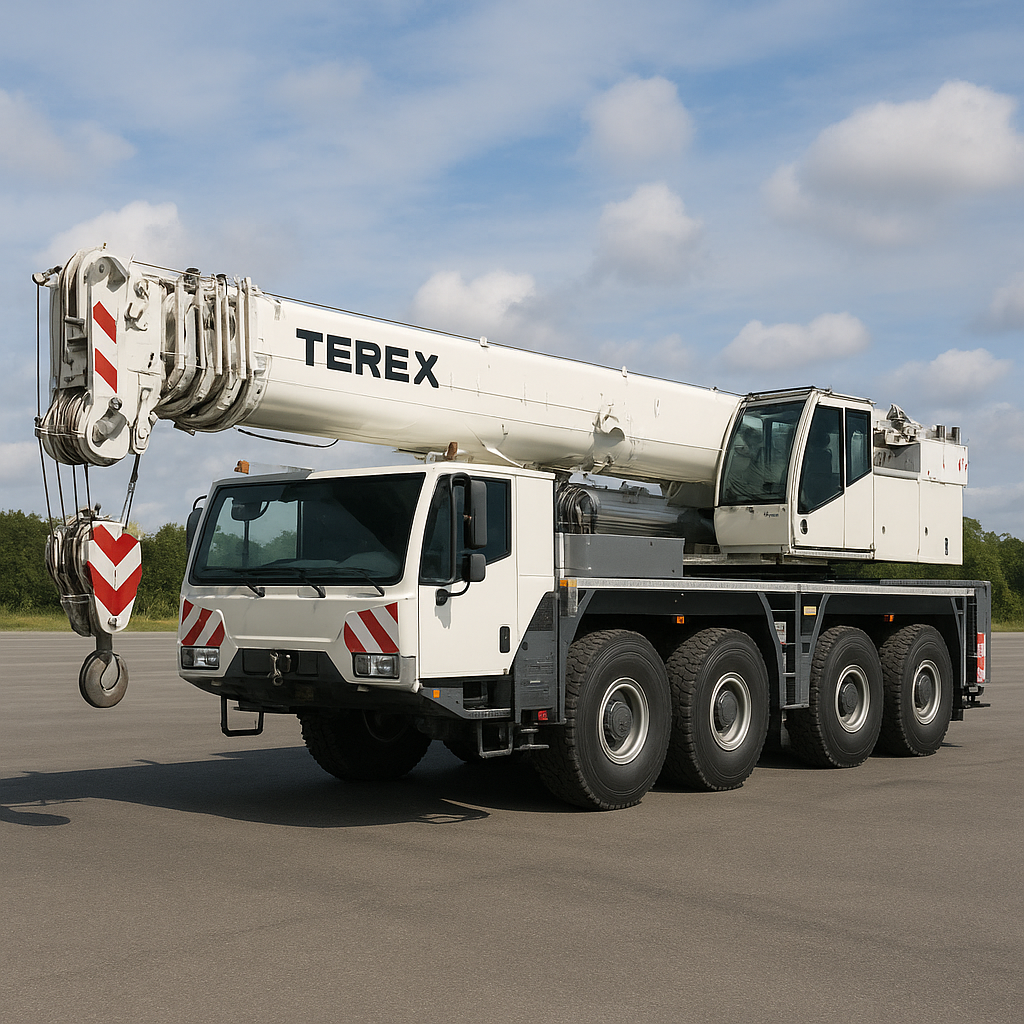
The Terex AC 350-6 is a purpose-built, high-capacity all-terrain crane designed to combine impressive lifting capacity with on-road mobility and site versatility. As part of Terex’s lineup of large mobile cranes, the AC 350-6 is intended for projects where heavy lifts, fast setup and flexible reach are required without sacrificing transportability between sites. Below you will find a detailed exploration of its key characteristics, typical applications, operational features, safety and maintenance considerations, and how it stands in the market compared with similar machines.
Overview and design philosophy
The Terex AC 350-6 is engineered around the principle of delivering maximum performance in diverse working conditions. With a nominal maximum capacity of 350 tonnes and a six-axle carrier, this crane is aimed at sectors that need heavy lifting combined with long-distance highway travel. Its design emphasizes a compact transport footprint for its capacity class, a robust telescopic boom system for variable reach, modular counterweight options to adapt to different site constraints, and an operator environment tuned for precision and productivity.
Key design goals for this class of crane typically include rapid rigging and derigging, flexible reach via boom and jib combinations, and advanced control systems to ensure that powerful lifts are also safe and repeatable. Terex has focused on delivering a platform that both rental companies and heavy-industry operators can deploy across a wide variety of assignments, from urban construction to industrial maintenance.
Technical characteristics and statistics
Below are the main technical highlights and typical statistics associated with the AC 350-6 platform. Some values vary with optional equipment and configuration choices; exact figures should be confirmed from current Terex documentation for specific builds.
- Lifting capacity: nominal maximum of approximately 350 tonnes (approx. 386 US tons).
- Carrier configuration: 6-axle chassis providing a balance of on-road compliance and off-road capability.
- Telescopic boom: multi-section boom with reach typically in the range of 40–60 meters (130–197 ft) depending on the number of sections and options.
- Jib options: swing-away and lattice jib configurations are usually available, extending reach and tip height significantly (in many setups extending reach to well over 80 meters with lattice jib combinations).
- Counterweight system: modular counterweights allowing operators to tailor ballast to site lift charts and road-transport limits.
- Engine and drive: diesel power unit sized to meet road regulations and site power needs; typical power output class for this crane category is in the several hundred kW range (varies with market engine options).
- Axle load and transport: designed for highway travel with axle loads complying with European and North American norms when configured within legal transport limits.
- Operational systems: advanced load moment indicators (LMI), stability monitoring, and intuitive operator controls for precision handling.
Because cranes of this capacity are offered with many optional configurations, published lifting charts differ by boom length, jib arrangement, and counterweight. A typical chart will show full 350 t capacity only at minimal radius and with full counterweight; capacity decreases with radius as usual for telescopic cranes.
Primary applications and industries
The AC 350-6 finds employment in many heavy-lift contexts where both reach and capacity are required along with road mobility. Common sectors include:
- Commercial and civil construction: erection of steel frames, precast concrete units, and heavy structural elements in mid- to high-rise projects.
- Energy sector: installation and maintenance of wind turbines (nacelles and towers), deployment of transformers and heavy substation modules, and work on oil & gas platforms onshore.
- Industrial maintenance and plant shutdowns: lifting heavy rotating equipment, heat exchangers, reactors and pressure vessels during scheduled outages.
- Infrastructure projects: bridge segment placement, installation of large utilities, and work on portside cargo and shipbuilding tasks where heavy lifts are frequent.
- Rental fleets: the crane’s blend of capacity and transportability makes it a popular machine for rental companies serving diverse clients across regions.
Its ability to combine highway travel with powerful lifting makes it particularly attractive for multi-site contractors or rental firms that must move cranes between jobs without the time and cost of disassembling large lattice-boom units.
Mobility, setup and site logistics
All-terrain cranes like the AC 350-6 are built to be driven on public roads and to work off-road on prepared surfaces. The six-axle carrier provides:
- Improved gross vehicle weight distribution for legal road transport.
- Multiple steering modes to improve maneuverability in confined urban sites and on narrow access roads.
- Robust suspension and driveline components for a balance between road speed and off-road capability.
Outrigger systems are designed for quick deployment and a variable footprint to adapt to restricted spaces. Operators can configure the outriggers and counterweights to match the required lifting chart and minimize overall setup area. This is especially useful in congested urban environments or on industrial sites where ground conditions and space are limiting factors.
Operational systems and safety features
Modern all-terrain cranes integrate a range of electronic and hydraulic safety systems. The AC 350-6 includes or is commonly ordered with:
- Load Moment Indicator (LMI): a real-time monitoring system that warns the operator about approaching capacity limits and prevents dangerous lift configurations.
- Stability monitoring: systems that factor in outrigger position, slope and ground firmness.
- Brake and steering aids: multi-mode steering and fail-safe braking improve safe maneuvering on site and road.
- Emergency descent and backup systems: to protect personnel and load in case of power or hydraulic failures.
- Operator ergonomics: climate-controlled cabs, clear instrumentation and remote-control options for certain operations.
Regular safety checks, operator certification and adherence to manufacturer lift charts remain essential. The crane’s electronics enhance safety but do not replace sound engineering judgement, competent rigging and site risk assessments.
Maintenance, lifecycle costs and uptime
Maintenance planning for a crane like the AC 350-6 should factor in the following cost and lifecycle drivers:
- Preventive maintenance: routine servicing of engine, hydraulic systems, slewing bearings and boom sections to avoid unplanned downtime.
- Wear parts: ropes, sheaves and hydraulic seals are high-use items that require scheduled replacement.
- Counterweight logistics: moving heavy ballast between sites can add logistical cost; modular systems reduce this burden but do not eliminate it.
- Fuel consumption: varies widely with duty cycle—traveling on road consumes less than heavy lifting operations; budgeting fuel and transport costs is important for job costing.
- Spare parts availability: for rental fleets, access to quick parts supply and factory support reduces downtime and improves effective utilization.
Operators should plan for scheduled major overhauls (e.g., after a certain operating hours threshold or years in service) that include inspection of critical structural elements. Properly maintained, cranes in this class can provide reliable service for decades, but lifecycle economics are strongly influenced by utilization rate, maintenance discipline and the frequency of heavy lifts.
Operational examples and case uses
Some illustrative examples of how an AC 350-6 might be used in the field include:
- Installation of a pre-assembled bridge span over a short working window where quick travel between jobs and fast setup reduce traffic disruption costs.
- Assembly of a wind farm’s medium-to-large turbines where boomed reach and lifting capacity allow the crane to erect nacelles and tower sections in one mobilization.
- Large-scale industrial maintenance: removing and replacing heavy steam turbine generators or heat exchangers during a plant turnaround.
- Urban high-rise façade modules: lifting prefabricated floor elements where precise positioning and smaller radii lifts are required in congested sites.
These examples highlight the crane’s role as a flexible asset that can be redeployed across many specialized tasks without investing in site-specific lifting infrastructure.
Comparisons and market position
Within its class, the AC 350-6 competes with other manufacturers’ 300–400 tonne-range all-terrain cranes. Buyers typically compare machines on the basis of:
- Transportability: how quickly and cheaply the crane can be moved between jobs.
- Setup speed: time required to rig outriggers, extend the boom and be ready for lift.
- Reach and lifting charts: how performance scales with boom length and jib options.
- Operating costs: fuel efficiency, maintenance requirements and parts availability.
- Resale value and brand support: manufacturer warranty, service network, and fleet popularity in rental markets.
Competitors often include large brands known for all-terrain cranes, and the AC 350-6 is positioned as a value-for-money alternative with strong service support in regions where Terex has established dealer networks.
Operator training, regulations and environmental considerations
Operating a 350-tonne-class crane legally and safely requires certified crane operators and riggers, compliance with national and local regulation, and strict adherence to manufacturer lift charts. Training typically covers:
- Understanding and interpreting load charts under different configurations.
- Correct outrigger set-up and ground bearing calculations.
- Emergency procedures and use of onboard safety systems.
- Efficient fuel- and motion-management to reduce emissions and operating costs.
Environmental considerations are increasingly important. Operators may apply low-idle policies, selective engine shutdowns and route planning to limit fuel consumption and emissions during relocations. For sensitive sites, noise-reduction measures and staged lifts are often required.
Buying, renting and economic considerations
Deciding whether to buy or rent an AC 350-6 (or equivalent) depends on utilization forecasts and the range of jobs a firm expects to serve. Key points to consider:
- High utilization: purchase may be justified if the machine will be heavily used for several years.
- Variable demand: rental provides flexibility and avoids the capital expense and maintenance burden when lifts are irregular.
- Resale and residual value: reputable models in common demand areas often retain value better.
- Financing and insurance: large cranes require appropriate financing structures and insurance premiums that reflect the value and operational risks.
Rental companies often stock AC 350-6-class cranes precisely because they fill a versatile niche for customers who need substantial capacity without committing to a very large lattice crawler or a full heavy-lift specialist fleet.
Concluding remarks
The Terex AC 350-6 is a representative example of modern all-terrain crane engineering: marrying substantial lifting capacity with road mobility and flexible configurations to meet a wide range of construction, industrial and energy-sector needs. With a nominal 350-tonne capacity, modular counterweights, telescopic booms and jib options, it offers a practical and cost-effective solution for contractors and rental houses who must balance on-site performance with transport and operational efficiency.
When planning to use or procure such a crane, stakeholders should examine detailed manufacturer lift charts for the specific configuration they intend to use, plan for appropriate maintenance and operator training, and evaluate total lifecycle costs including transport, fuel, and spare parts to ensure the best return on investment.
)
)