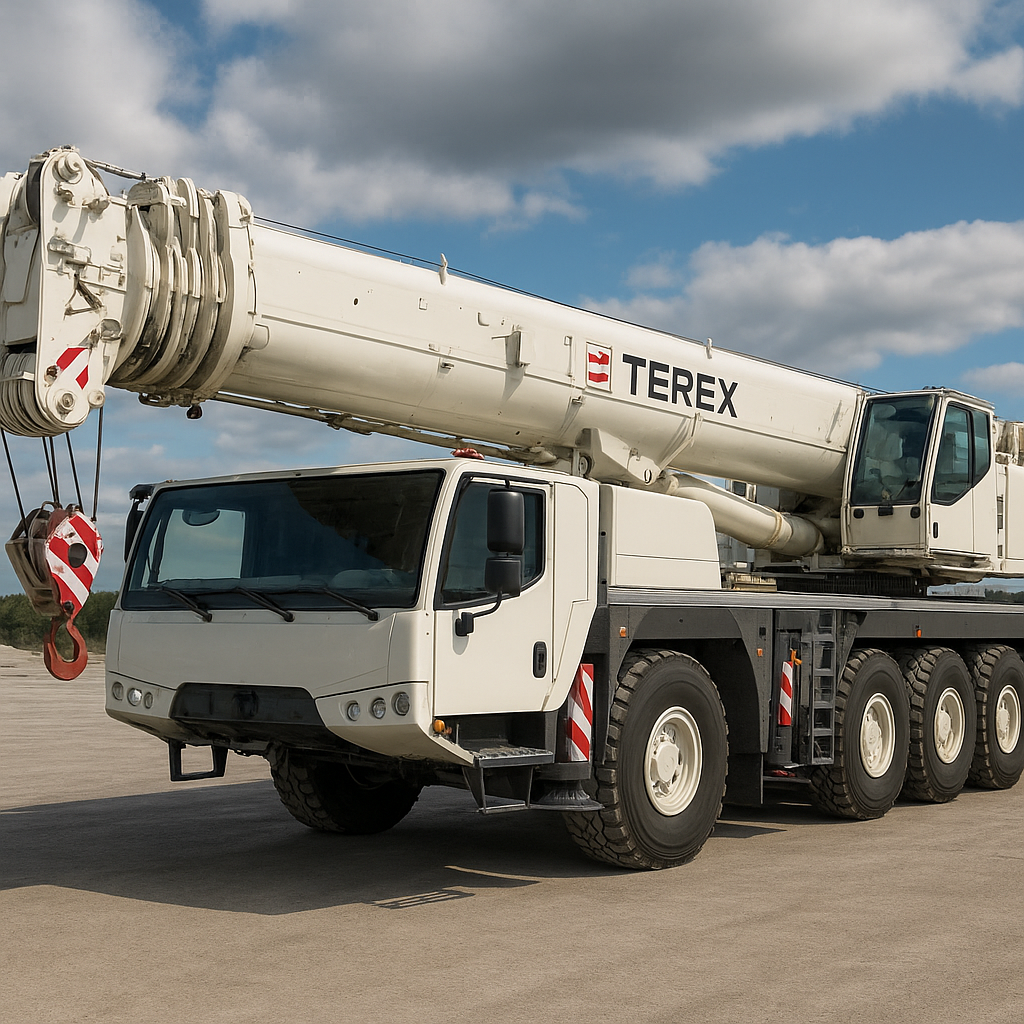
The Terex AC 1000 is a flagship example of a modern all-terrain heavy crane designed to combine on-road mobility with powerful off-road lifting capability. Built to perform the most demanding lifts in industries where single-point lifting power and flexible mobility are essential, this machine is valued for its combination of robust mechanical systems, modular rigging options and adaptability to complex project sites. In the sections below, we examine its design, technical features, typical applications, operational considerations and economic aspects, as well as practical tips for planning lifts with a machine of this class.
Design and Technical Characteristics
The Terex AC 1000 belongs to the class of cranes often referred to as 1,000-tonne all-terrain cranes. Its design philosophy centers on delivering very high lifting capacity while retaining the ability to travel on public roads between job sites without the need for specialized transporters for every move. Key design elements include a multi-axle carrier chassis, a heavy-duty superstructure with powerful hoists, a telescopic boom combined with lattice jib options, and a modular counterweight system.
Carrier and Mobility
- The carrier typically features multiple axles with hydraulic suspension and steering systems to ensure maneuverability and stability both on highways and rough jobsite terrain. This allows the crane to be driven between sites under its own power as a legal transport unit in many jurisdictions.
- Chassis design focuses on balancing load distribution with road-legal axle loads; steering systems on the axles reduce turning radius for large vehicles and ease positioning in confined sites.
Superstructure, Hoists and Winches
- The superstructure contains the engine(s), hydraulic systems, winches and operator cab(s). Winches are designed to provide high line pull for heavy loads and often include multiple drum configurations for different reeving arrangements.
- Hydraulic and electronic control systems govern smooth, coordinated movement of boom, hoists and slewing. Modern machines include advanced load-sensing hydraulics and redundant safety measures.
Boom and Jib Systems
The AC 1000-style cranes are commonly equipped with a heavy telescopic boom that may be extended in several stages, complemented by a lattice jib (fixed or luffing) to add reach and height. This hybrid boom concept provides flexibility for:
- High-capacity, relatively short-reach lifts using the telescopic boom.
- Very high lifts or long reaches using combinations of telescopic sections and lattice jib/superlift assemblies.
Counterweights and Stability
To manage the enormous moments generated by heavy lifts, a modular counterweight system is used. Counterweights are typically transported and assembled on site as blocks, allowing the crane to adapt its ballast to the specific lift. Outriggers expand the effective footprint of the crane; their proper deployment and ground-support planning are crucial elements of lift safety.
Electronics and Safety Systems
Modern heavy cranes include comprehensive electronic safety features such as load moment indicators (LMI), anti-two-block systems, automatic limiting systems, and in many cases remote diagnostics and telematics. These systems help operators work within safe operating envelopes and allow planners to simulate lifts with high precision.
Typical Applications and Industries
The Terex AC 1000-type crane is targeted at sectors where extremely heavy components must be lifted, positioned and installed with a combination of capacity, reach and mobility. Typical fields of application include:
Power Generation and Heavy Industry
- Installation of turbines, generators and boilers in thermal, nuclear and hydroelectric power plants.
- Assembly and replacement of heavy process vessels and reactors in petrochemical and chemical plants.
Offshore and Oil & Gas
- Lifting and load-in of topside modules, jackets and large components at onshore marshalling yards prior to offshore installation.
- Pre-assembly of platforms and heavy modules where a combination of reach and ground mobility is needed.
Wind Energy
- Installation of large onshore wind turbine nacelles and tower sections where lifts often approach several hundred tonnes when transport fixtures are included.
- Assembly operations for multi-megawatt turbines increasingly call for cranes with significant capacity and reach to speed up installation and reduce project risk.
Infrastructure and Civil Engineering
- Placement of large bridge segments, pre-cast concrete elements and heavy steel girders in bridge construction projects.
- Movements of heavy machinery and prefabricated structures in urban construction environments where road travel between sites is an asset.
Heavy Machinery Erection and Salvage
- Setting large industrial presses, extrusion lines and heavy manufacturing equipment.
- Salvage operations and lifting of derailed or capsized industrial modules where high capacity and site adaptability speed recovery.
Operational Planning and Site Preparation
Operating a crane in the 1,000-tonne class requires meticulous planning. A successful lift depends not only on the crane’s technical capabilities but on detailed logistical and engineering preparation.
Lift Planning and Engineering
Lifting plans are produced by qualified engineers and include:
- Detailed load charts considering boom length, angle, counterweight configuration and reeving.
- Ground bearing capacity analysis and outrigger pad design—heavy-duty crane mats or supporting grillage are commonly required to distribute loads safely.
- Clearance and route planning for transit to the site (overhead lines, bridge limits, turning radii, local permits).
Assembly, Transport and Mobilization
Even though all-terrain cranes can travel on their own chassis, many components—especially counterweights, jibs and extension booms—are transported as separate modules. Mobilization includes sequencing of counterweight assembly, boom extensions and securing a certified rigging crew with certified slings, shackles and spreader beams for the planned lift.
Weather and Environmental Considerations
Wind is a key limiting factor. High winds can drastically reduce permissible loads, especially when jibed or with long boom configurations. Cold weather affects hydraulic fluids and metal behavior; hot weather can affect engine cooling and operator comfort. Environmental constraints, such as working near waterways or in protected areas, may impose additional mitigation measures.
Maintenance, Training and Safety Culture
Keeping a crane like the Terex AC 1000 in safe and efficient operating condition requires a formal maintenance program, regular inspections and investment in skilled operators and rigging personnel.
Maintenance Regime
- Routine daily and weekly inspections focusing on wire ropes, sheaves, hydraulic lines, brake systems and structural checks.
- Scheduled major inspections that include nondestructive testing (NDT) of load-bearing components and structural welds.
- Spares strategy for high-wear items such as hoist drums, ropes and hydraulic components to minimize downtime on critical projects.
Operator and Rigging Training
Operators must hold appropriate certifications and undergo recurrent training, including simulator-assisted training where available. Rigging crews must be competent in modern slinging methods, use of spreader bars and multimodal lifts that distribute loads across multiple crane picks if required.
Safety Culture
Organizations operating cranes in this class adopt comprehensive safety management systems: job safety analyses, permit-to-work processes, near-miss reporting and a clear chain of command during lift execution. Use of spotters, tag lines and redundant communication systems (radio, visual signals) is standard practice.
Economics, Lifecycle and Market Considerations
Purchasing, hiring and operating a 1,000-tonne class all-terrain crane involves significant capital and operating expenses. Fleet owners, rental companies and large contractors weigh the following factors:
Capital and Operating Costs
- New units represent a substantial capital investment; rental markets are often the pragmatic solution for contractors that have periodic need for ultra-heavy lifts.
- Operating costs include fuel, transport for counterweights and accessories, specialized crew, insurance and ongoing maintenance.
Utilization and Return on Investment
Maximizing utilization requires access to projects that need high-capacity lifting. Rental companies often position these cranes in strategic geographic hubs near energy, petrochemical, heavy industry and infrastructure project pipelines.
Residual Value and Secondary Market
High-capacity cranes maintain value due to limited global supply and the specialized nature of their work. Lifecycle value depends on maintenance history, hours of operation, and the condition of critical components such as booms, winches and electronic control systems.
Practical Examples and Notable Uses
Cranes in the 1,000-tonne class, including Terex AC 1000-type machines, have been used on landmark projects around the world. Common scenarios include:
- Installing the central rotor and generator sections in power plants where lifts of several hundred tonnes are routine.
- Assembly of heavy offshore modules on portside quays for subsequent transport and installation.
- Bridge segment placement where individual precast elements exceed the capacity of smaller cranes.
- Wind farm projects featuring large nacelles and hub assemblies where a single crane reduces logistics complexity and accelerates installation.
Key Technical Statistics and Practical Figures
Some high-level numbers are useful to understand the scale and planning implications of such machines. The model designation itself highlights the primary figure:
- Rated capacity: nominally around 1,000 tonnes in the optimal configuration.
- Modular counterweights: typically amount to several hundred tonnes of ballast that can be configured to suit a lift—transported to site in multiple truckloads.
- Reach and height: the telescopic boom with lattice jib combinations can commonly achieve boom-and-jib reaches and tip heights in the range of tens to well over a hundred metres depending on setup; specific configurations vary by job.
- Transport and mobilization: although road-mobile, full mobilization can require dozens of truck transports (counterweights, jib sections, mats) and several days to assemble and rig on site.
Note: exact numerical specifications such as maximum boom length, engine power, axle count and gross vehicle weight vary by production year and factory configuration. For precise technical data it is recommended to consult the official manufacturer specification sheets or the crane’s serial-numbered documentation held by the equipment owner.
Strengths, Limitations and Decision Criteria
Choosing a crane like the Terex AC 1000 for a project comes down to matching its strengths to project needs and mitigating its limitations.
Strengths
- High single-crane lifting capacity reduces the need for multi-crane lifts and complex synchronization.
- Road mobility simplifies logistics between sites compared with crawler cranes that need dedicated transporters.
- Modularity allows tailoring of reach and ballast to the lift, making the machine versatile across projects.
Limitations
- High mobilization costs for counterweights and assembly—cost-effective when utilization and lift criticality justify the expense.
- Site footprint constraints: despite outriggers, heavy lifts require significant ground preparation and space for counterweight and setup.
- Weather sensitivity—long-reach lifts are often curtailed by wind and other environmental conditions.
Conclusion
The Terex AC 1000-class all-terrain crane represents a crucial asset for projects that require exceptional lifting capability combined with site mobility. Its role in energy, infrastructure, heavy industry and offshore projects is defined less by daily routine tasks and more by critical, high-value lifts where a single machine can deliver speed, safety and certainty. Successful deployment depends on thorough lift engineering, experienced crews, careful site preparation and a robust maintenance program. While the economics of owning versus renting such a crane demand careful evaluation, the machine’s capabilities make it indispensable for a certain tier of industrial projects worldwide.
)
)