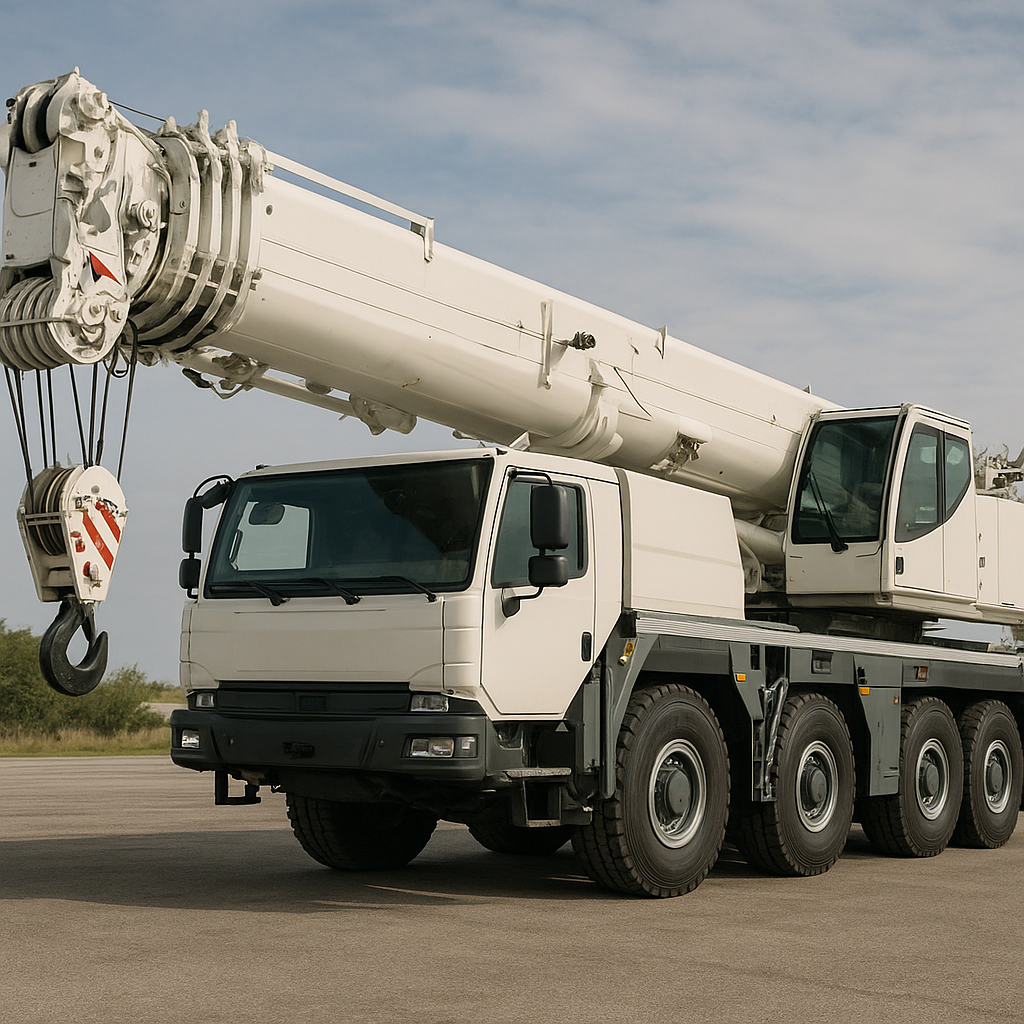
The Tadano ATF 220G-5 is a versatile all-terrain crane that combines road mobility with powerful lifting capability, designed to serve a wide range of industries from heavy construction to wind farm erection. Built on a multi-axle carrier with a telescopic superstructure, the ATF 220G-5 is engineered for efficiency in transport, rapid site setup and reliable performance in challenging environments. The following article explores its design, capabilities, typical applications, operation and maintenance considerations, and other noteworthy information that will interest fleet managers, crane operators and project planners.
Overview
The Tadano ATF 220G-5 belongs to Tadano’s family of mobile all-terrain cranes intended for mixed on-road travel and off-road site work. The model designation indicates a nominal maximum lifting capacity of approximately 220 tonnes. As a multi-axle all-terrain unit, it offers a balance between the maneuverability required for road travel and the stability needed for heavy lifts on uneven ground. Typical ATF-class machines are chosen when projects demand the flexibility to move between sites frequently while still lifting very heavy loads.
Key characteristics that define the ATF 220G-5 include a robust telescopic boom, an agile multi-axle carrier chassis, hydraulic outrigger systems for rapid stabilization, and operator-centric cab layouts that improve visibility and control. The model is commonly configured with multiple jib options to extend reach and height, enabling it to handle a wide variety of lift profiles without need for additional specialized equipment.
Technical specifications and performance
Exact specifications can vary with optional equipment and regional configurations, but the ATF 220G-5 typically features the following performance-related attributes:
- Lifting capacity: nominally 220 metric tonnes at close radius. Capacity decreases as working radius increases according to the crane’s load chart.
- Carrier: multi-axle (commonly five axles), giving a good compromise between axle load limits for on-road transport and mobility for off-road positioning.
- Telescopic boom: a telescoping main boom that commonly reaches up to around 60 meters in standard configuration; telescopic stages allow fast, precise length adjustment.
- Jib options: lattice or telescopic jibs available to increase maximum hook height and outreach for specialized applications such as wind-turbine components or tall structure work.
- Diesel engines: carrier and hoist engines tuned to provide sufficient tractive power and hydraulic flow for lifting operations; region-specific engines and emissions controls are often available.
- Hydraulic system: high-capacity hydraulics for winches, boom extension, and slewing with smooth control and responsive modulation.
- Stability: wide outrigger footprint with variable extension patterns to maximize safe lifting capability on constrained sites.
- Slewing and hoist: powerful hoist winches combined with a robust slewing mechanism to manage heavy loads with precision.
Manufacturers’ load charts are essential for safe operation and show permissible loads at given radii and boom/jib configurations. For example, the crane can lift its maximum rated 220 tonnes only at short radii; at extended radii (e.g., 30–50 m), the permissible load falls to tens of tonnes depending on counterweight and boom setup. Operators must consult the machine’s load charts and safety systems prior to each lift.
Design features and innovations
Tadano’s ATF series emphasizes practical innovations that reduce setup time and improve operator efficiency. Notable design features of the ATF 220G-5 include:
- Compact carrier design with a layout optimized for road travel and turning performance, allowing easier relocation between job sites.
- Advanced outrigger system that permits independent extension and positioning to accommodate uneven terrain and confined working areas.
- Automated crane control systems that integrate load moment indicators, anti-two-block protection and electronic monitoring to assist operators and enhance safety margins.
- Ergonomic operator cab with enhanced visibility, climate control and modern instrumentation to reduce fatigue and improve precision handling.
- Modular counterweight packages enabling quick adjustment of ballast to match plannedLift requirements and transport constraints.
- Efficient hydraulics and drive systems designed to reduce fuel consumption during travel and stationary operations, while maintaining required lifting performance.
These features collectively reduce the time to set up, increase utilization rates, and help control operating costs — critical factors for rental fleets and contractors working under tight schedules.
Applications and industries
The ATF 220G-5 is suitable for many sectors where medium- to heavy-duty lifting is required combined with the need to move between sites frequently. Typical applications include:
- Construction: placing precast concrete elements, steel structures, and building services modules in tight urban or suburban sites.
- Infrastructure: bridge components, viaduct segments, and heavy civil works where mobility and lifting power are required.
- Energy: erection and maintenance of wind turbines (especially for smaller turbine components), substation transformer installation and replacement, and work at hydroelectric sites.
- Industrial maintenance: heavy plant lifts, equipment replacement and installation inside factories and processing plants.
- Ports and logistics: handling heavy machinery, oversized cargo and assisting in loading/unloading where reach and lifting capacity are both necessary.
- Emergency and recovery: highway or rail recovery operations where a mobile heavy-lift crane is needed to clear wreckage or reposition vehicles safely.
Because the ATF 220G-5 blends off-road capability with road-legal travel, it frequently serves rental fleets where flexibility across diverse job types maximizes utilization.
Operation, setup and transport considerations
One of the ATF 220G-5’s strengths is its ability to be driven between sites under its own power, avoiding the logistics and costs of special transport for many moves. However, operators must still plan around:
- Permits and route planning for oversized loads or restricted axle weights depending on regional regulations.
- Set-up area requirements: adequate space for outriggers and safe swing radius. The machine’s modular outriggers and ballast options help adapt to confined sites.
- Time to deploy: modern ATF cranes are engineered to reduce setup time — hydraulically extended outriggers and automated systems can cut preparation time compared with older designs.
- Transport weight: while road-mobile, careful planning is needed for crossing bridges or traveling through low-clearance zones with boom stowed.
In practice, a crew of trained operators can have an ATF 220G-5 on the road and ready for a moderate lift within an hour or less on a well-planned site; complex lifts with extended jibs and large counterweights will require more time for assembly and planning.
Safety systems and operator assistance
Safety is central to modern crane design. The ATF 220G-5 incorporates electronic safety aids that reduce the risk of overload, instability and operator error:
- Load Moment Indicator (LMI) and rated capacity indicators that continuously monitor load, radius and boom angle.
- Anti-two-block systems to prevent the hook block from colliding with the boom head.
- Automatic locking and braking systems for hoists and slewing mechanisms.
- Camera integration and sensors to improve visibility around blind spots during complex lifts.
- Diagnostic systems that alert service crews to hydraulic, electrical or mechanical faults before they lead to downtime.
These systems, combined with thorough operator training and adherence to manufacturer load charts, are essential to safe, predictable lifting operations.
Maintenance, lifecycle and costs
Owning and operating an ATF-class crane such as the 220G-5 entails routine maintenance planning to ensure availability and safe operation. Important maintenance and economic points include:
- Scheduled service: hydraulic oil and filter changes, engine maintenance, wire rope inspection and replacement, and periodic NDT of critical components.
- Wear items: hoist ropes, sheaves, slewing ring lubrication and braking systems represent typical consumables that require attention and replacement on predictable intervals.
- Downtime planning: predictive maintenance supported by onboard diagnostics can reduce unexpected stoppages and provide data to plan service windows.
- Resale value: reputable manufacturers and well-maintained machines normally retain higher resale values in the rental and secondary market.
- Total cost of ownership: while acquisition cost is substantial, high utilization, efficient fuel consumption and low downtime help justify investment for contractors with frequent heavy-lift needs.
Fuel consumption depends on travel distance, idling time on site and load cycles. Operators can reduce fuel use through efficient travel planning, matching counterweight to lift requirements and using modern engine-management features where available.
Training, certification and workforce considerations
The complexity and lifting power of the ATF 220G-5 make operator training a priority. Accredited training programs covering rigging, load chart interpretation, signalman coordination and advanced crane-control features are necessary. Organizations using this crane should consider:
- Providing certified operator training and refresher courses at regular intervals.
- Implementing rigging and lift-planning procedures that include certified riggers and supervisors for critical lifts.
- Using digital lift-planning tools and checklists to capture site conditions, lift parameters and contingency plans.
Because modern ATF cranes may include advanced control systems, ongoing training for telematics, diagnostic interpretation and electronic safety features is increasingly part of a rigorous operator competency program.
Market position and fleet use
The ATF 220G-5 fills a mid-to-upper segment in the all-terrain market where 200–250 tonne-class cranes are in demand. This class is popular in rental fleets because it covers a broad array of job types while remaining transportable without the extraordinary logistic costs associated with larger crawler or modular cranes. Typical buyers include general contractors, specialized lifting companies and rental houses servicing infrastructure, energy and industrial sectors.
While specific global fleet numbers for the ATF 220G-5 are proprietary and vary by region, the 200+ tonne all-terrain segment remains one of the most commonly rented categories for heavy lifts under 300 tonnes. Buyers often weigh the benefits of an all-terrain unit — which offers rapid road mobility and flexible deployment — against the higher lifting capacity of lattice-boom crawlers that require disassembly and transport.
Environmental and regulatory considerations
Increasingly, buyers and operators must weigh environmental and regulatory factors when choosing heavy equipment. Points relevant to the ATF 220G-5 include:
- Emissions standards: engines that meet regional emissions regulations (e.g., EU Stage V, EPA Tier) are important for legal operation and to reduce environmental impact.
- Noise levels: modern engines and refined hydraulic systems help reduce site noise, which is significant in urban projects.
- Sustainable practices: operators increasingly use lower-carbon fuels, route planning and idling reduction strategies to shrink the crane’s operational footprint.
Manufacturers continue to optimize drivetrains and hydraulic efficiency to lower fuel consumption, and telematics allows fleet managers to monitor and reduce emissions by optimizing machine use.
Conclusion — practical considerations for procurement and use
For contractors and fleet managers seeking a versatile, road-travel-capable crane with substantial lifting power, the Tadano ATF 220G-5 represents a strong option. Its typical 220-tonne rating, multi-axle carrier, telescopic boom and modular counterweight system make it suitable for diverse assignments, from urban construction to industrial plant maintenance. The machine’s modern safety aids, hydraulics and operator ergonomics improve both productivity and safety, while efficient design features help control operating costs.
When evaluating the ATF 220G-5 against alternatives, consider the types of lifts most common in your portfolio, average travel distances, site access constraints and the availability of certified operators. Properly specified and maintained, this class of all-terrain crane can deliver high utilization, retain resale value, and serve many roles across an organization’s projects.
Key words emphasized: all-terrain, 220 tonnes, telescopic boom, outriggers, counterweight, safety systems, hydraulic, stability, mobility, lifting capacity.
)
)