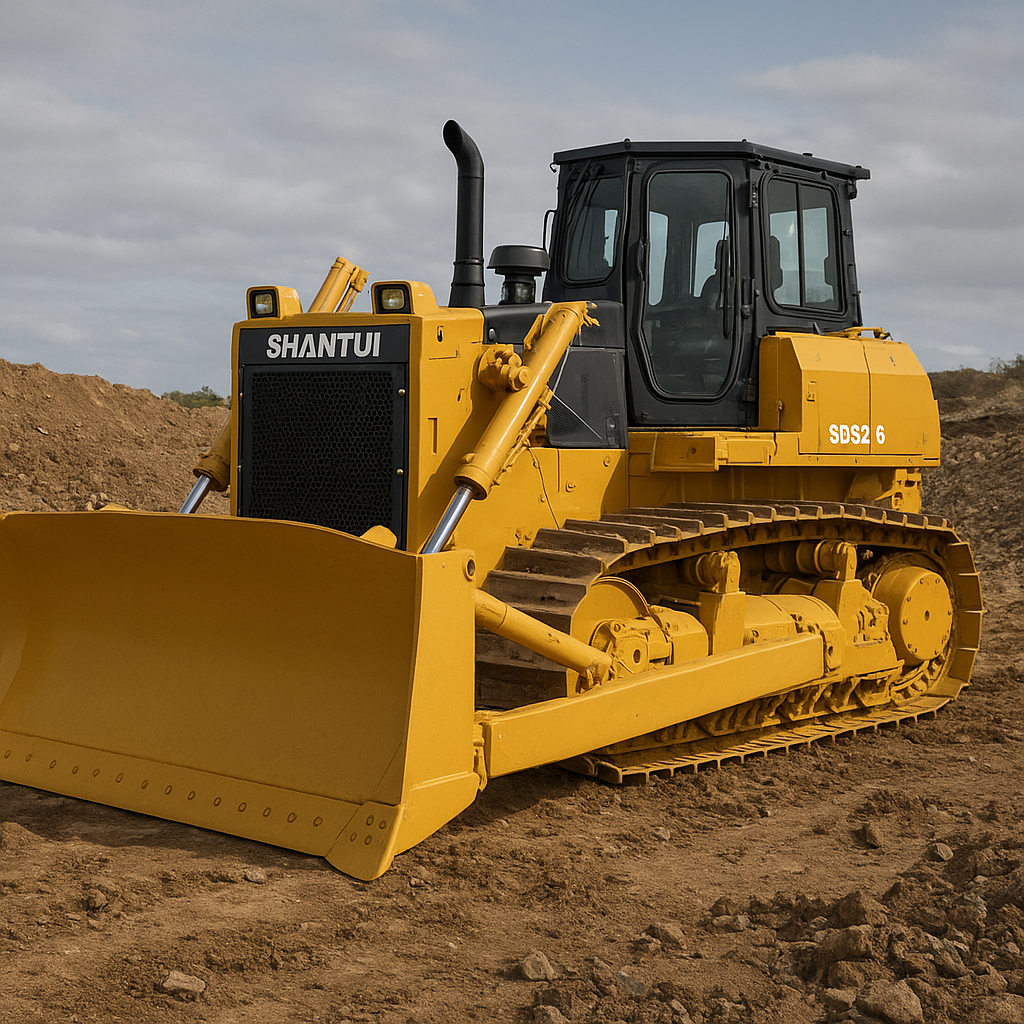
The Shantui SD52-5 is a heavy-duty crawler dozer designed for demanding earthmoving tasks where reliability, traction and power are essential. Built by Shantui, one of the largest manufacturers of construction equipment in China, the SD52-5 targets large-scale projects such as mining, quarrying, bulk earthmoving, large civil works and heavy infrastructure construction. This article examines the machine’s design, typical applications, technical characteristics, operational advantages, maintenance considerations and market context to provide a comprehensive view of the SD52-5’s role on modern worksites.
Description and design philosophy
The Shantui SD52-5 follows a design philosophy focused on balancing durability, operator comfort and serviceability. As a crawler dozer, it integrates a powerful propulsion system, a robust undercarriage, and a heavy-duty blade to move large volumes of material efficiently. The machine is intended to operate continuously in harsh environments — rocky quarries, wet clay sites and large cut-and-fill operations — which drives design priorities toward corrosion-resistant components, reinforced structures and easily replaceable wear parts.
Hull and frame
The main frame and track frames are constructed from high-strength welded steel for torsional stiffness and long-term durability. Critical stress areas are often reinforced and fitted with replaceable wear plates. The design emphasizes simplified access to the powertrain and hydraulic systems to reduce downtime during routine inspections and repairs.
Cab and controls
Modern variants of the SD52-5 provide an ergonomically arranged operator station with improved visibility, climate control and shock/vibration reduction systems. Controls are typically a mix of pilot hydraulic joysticks and electronic displays that present engine, hydraulic and diagnostic information. Enhanced operator ergonomics contribute to higher productivity and lower operator fatigue in long shifts.
Blade and attachments
The SD52-5 is available with different blade types — straight blade (S-blade), universal blade (U-blade) and semi-universal or combination blades — depending on the intended use. Rippers, winches and rear counterweights are common optional attachments for improving productivity in specific tasks such as trenching, ripper-assisted rock breaking or pushing heavy loads on soft ground.
Applications and industries
The SD52-5 finds use in a wide variety of heavy earthmoving scenarios. The machine’s characteristics make it particularly well-suited to tasks where continuous, high-power pushing and grading are required.
- Mining and quarrying — bulk material redistribution, access road construction, tailings handling and waste removal.
- Large civil works — dam construction, airport works, land reclamation and large-scale leveling.
- Road and railway construction — subgrade preparation, embankment building and rough grading ahead of precision graders.
- Pipeline and energy projects — right-of-way clearing, backfilling and bank stabilization.
- Landfill and waste management — compacting cover material and redistributing waste cover in large facilities.
Because of its traction and mass, the SD52-5 is often used in applications where smaller dozers would be inefficient and larger specialized equipment would be uneconomical. In short, it occupies a niche for high-volume push and rough grading tasks.
Technical overview and typical specifications
Exact specifications for the SD52-5 vary depending on market, optional equipment and final configuration. The figures below are presented as typical ranges and reference points rather than absolute guarantees. Always consult the manufacturer’s datasheet for configuration-specific numbers.
Powertrain and performance
- Engine: turbocharged diesel engine with electronic fuel injection; engines used by Shantui are frequently sourced from established diesel manufacturers and tuned for heavy-duty duty cycles.
- Rated power: commonly in the medium-to-high power band for large dozers — approximate range 250–400 kW (335–540 hp) depending on configuration.
- Transmission: planetary power shift or torque converter drivetrain with multiple forward/reverse speeds optimized for traction under heavy load.
- Travel speed: typically up to 10–12 km/h in high gears; low-gear creep speeds are used for pushing and ripper work.
Weight and dimensions
- Operating weight: SD52-5 class machines generally occupy a range that can be described as heavy — typically in the 40,000–55,000 kg range (approximate values depending on blade & ripper attachments).
- Ground pressure: designed to balance traction and flotation — expected to vary with blade type and track shoe width, often in the range 0.08–0.13 MPa.
- Blade capacity: ranges commonly found for this class are 7–12 m3 depending on blade type (U-blade holds more material than straight blades).
Hydraulics, undercarriage and attachments
- Hydraulic system: closed-center or load-sensing systems may be used to control blade pitch, tilt and other attachments; priority flow for steering and blade circuits.
- Undercarriage: heavy-duty tracks with sealed rollers, lifetime-lubricated idlers and sprockets designed for long service intervals; track shoe widths are selectable for varied ground pressure and traction needs.
- Ripper: multi-shank parallelogram rippers are typical options to handle frozen ground or lightly bedrock conditions.
Fuel consumption and operating costs
Fuel consumption for large crawler dozers is influenced by load profile, ground conditions and operator technique. Typical on-site consumption for machines in this class can range from 25 to 80 liters per hour under varying loads, with average operational figures often landing in the 30–45 L/h band for mixed duty cycles. Cost of operation should be evaluated using life-cycle costing that includes fuel, consumables, wear parts, operator labor and downtime.
Key features and advantages
The SD52-5 offers several practical advantages that make it attractive for contractors and owners focused on productivity and total cost of ownership.
- Reliability: reinforced chassis components, proven driveline technologies and robust undercarriage elements contribute to predictable service life in harsh conditions.
- Serviceability: accessible daily maintenance points, centralized filters and modular components reduce routine maintenance time and simplify repairs.
- Versatility: available blade types, rippers and optional attachments allow the machine to be adapted for a variety of tasks across projects.
- Traction and stability: heavy weight combined with wide tracks ensures strong traction for pushing and grading tasks and good stability on slopes and uneven ground.
- Operator comfort: improved cabs with HVAC, sound insulation and ergonomic controls reduce fatigue and can enhance productivity over long shifts.
Operation, maintenance and reliability
Maintaining high uptime for a heavy crawler dozer like the SD52-5 requires a disciplined approach to preventive maintenance and attention to consumable wear. Key practices include:
- Daily checks — fluid levels, air filters, track tension, visual inspection of wear parts and hydraulic hoses.
- Scheduled servicing — adherence to oil and filter change intervals, periodic inspection of final drives and undercarriage components, and cooling system maintenance.
- Wear part management — proactive replacement of track shoes, sprockets, rollers and cutting edges based on measured wear to avoid cascading damage.
- Operator training — skilled operators reduce fuel consumption, minimize undue component stress and extend service life by using appropriate gear selection and avoiding aggressive maneuvers.
Modern units may offer telematics support for remote monitoring of hours, fuel use, fault codes and location. Telematics data can be leveraged to optimize maintenance schedules and reduce unplanned downtime, which is an important factor in total life-cycle cost.
Safety and environmental considerations
Safety and environmental performance are increasingly important for heavy equipment. The SD52-5 incorporates several relevant characteristics:
- Visibility — large windows, optional camera systems and well-placed mirrors help reduce blind spots during operation.
- Compliance — engines can be configured to meet different regional emissions standards; selecting the appropriate engine package is important for regulatory compliance.
- Noise and vibration control — cab insulation and damping reduce operator exposure to noise and whole-body vibration.
- Spill and containment — routed fluid systems and drip trays can reduce environmental risk from leaks; good practices include secondary containment for on-site refueling and proper disposal of used oils and filters.
Economic and market considerations
Purchasing or renting an SD52-5 should be evaluated against expected productivity gains, operating costs and resale value. Important economic factors include:
- Productivity — larger dozers reduce cycle times for large cut-and-fill projects and achieve economies of scale for bulk material movement.
- Capital cost vs rental — high acquisition costs can be offset by rental alternatives for short-term projects; long-term owners should calculate payback based on utilization rates.
- Parts availability — Shantui’s global parts network makes replacement parts relatively accessible in many markets, but lead times vary by region.
- Resale market — dozers from established brands tend to retain value based on condition, hours and service history; robust maintenance records improve resale prospects.
Comparison with peers
When considering the SD52-5, contractors typically compare it with other large crawler dozers from global manufacturers. Key comparison points include:
- Initial price — Shantui machines are often positioned competitively on price, appealing to buyers seeking lower capital outlay.
- Service and parts — global brands may offer broader dealer networks in some regions; however, Shantui has expanded its international presence significantly.
- Feature set — operator comfort, cab electronics and optional equipment vary by manufacturer and model; match configurations to operational priorities.
- Fuel efficiency — engine and hydraulic system tuning plays a major role; evaluate measured fuel consumption under comparable loads whenever possible.
Practical tips for procurement and operation
For companies considering an SD52-5, practical steps can improve long-term satisfaction and return on investment:
- Specify the machine with blade and undercarriage options suited to your dominant ground conditions to reduce unnecessary wear.
- Negotiate warranty and preventive maintenance packages as part of the acquisition to secure predictable service costs.
- Invest in operator training focused on best practices for fuel-efficient operation and minimizing wear on transmissions and tracks.
- Implement telematics and fleet management tools early to track utilization and schedule maintenance proactively.
- Plan for consumables and wear parts inventory based on projected operating hours to minimize downtime from parts shortages.
Environmental sustainability and future trends
The heavy equipment industry continues to move toward lower-emission technologies and greater operational efficiency. While the SD52-5 is fundamentally a diesel-powered machine, there are several avenues for improving its environmental footprint:
- Engine upgrades — tuning and after-treatment systems reduce NOx and particulate emissions to meet stricter regional standards.
- Fuel efficiency measures — improved hydraulic controls, eco-modes and operator training reduce fuel consumption and CO2 output.
- Hybrid and electrification trends — while full electrification of large dozers is in early stages, hybrid systems and electrified attachments are emerging in the industry and may influence future SD-series designs.
- Lifecycle thinking — promoting remanufactured parts, recycling of steel components and proper disposal of fluids reduces total environmental impact.
Concluding observations
The Shantui SD52-5 is a capable heavy crawler dozer geared toward high-volume earthmoving tasks where power, traction and robust durability are essential. Its competitive positioning in cost and the manufacturer’s expanding service network make it an attractive option for a wide range of contractors and owners. Practical deployment of this machine benefits from careful specification to match site conditions, disciplined maintenance, operator training and the use of telematics for proactive fleet management.
When evaluating the SD52-5 for a project, stakeholders should compare total ownership costs — including acquisition, fuel, maintenance and downtime — rather than focusing solely on purchase price. Properly matched and maintained, the SD52-5 can deliver strong performance in the most demanding pushing and grading applications.
)
)