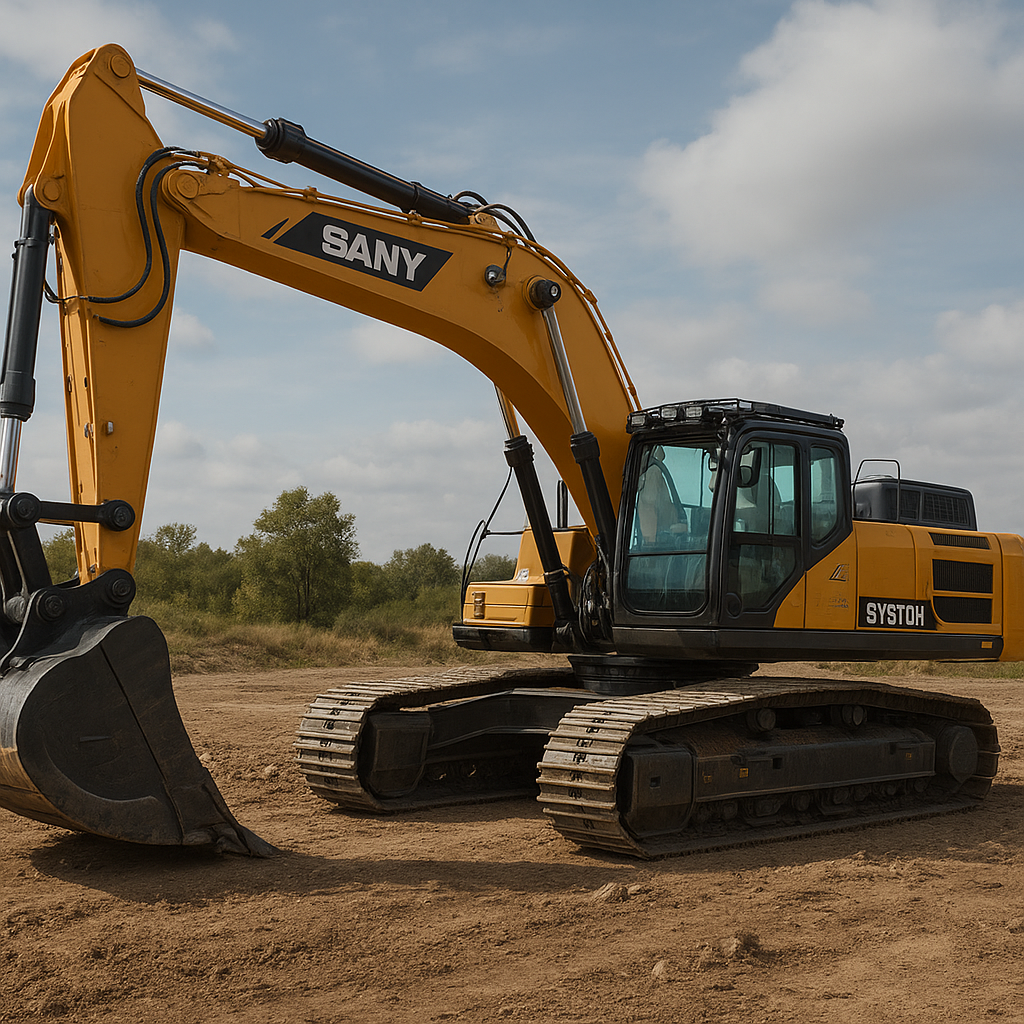
The SANY SY870H is a large-class hydraulic excavator designed for demanding earthmoving and material-handling tasks in mining, quarrying, large civil engineering projects and heavy infrastructure construction. Combining reinforced structures, powerful hydraulics and contemporary operator ergonomics, this model aims to deliver high levels of productivity, long-term durability and lower life-cycle costs in intensive working environments. In the following sections we will explore the machine’s main characteristics, typical applications, technical data (where publicly known or reasonably estimated), operating advantages and practical considerations for buyers and fleet managers.
Overview and positioning
The SANY SY870H sits in the upper segment of SANY’s excavator range. It was developed to answer the needs of customers who require a large, stable machine with high digging forces, a resilient undercarriage and a powerful powertrain for continuous heavy-duty operation. The SY870H is commonly used as a primary production excavator in open-pit mining and large earthworks, as well as for loading heavy trucks, bulk material handling at ports and quarries, and complex foundation excavation.
Key characteristics that define the SY870H include a robust structural frame, a high-capacity hydraulic system, and an operator station focused on visibility and comfort. SANY has integrated modern control electronics and serviceability features to reduce downtime and simplify maintenance, which are critical for machines in this size class that operate around the clock in tough conditions.
Technical characteristics and performance (typical figures)
Manufacturers sometimes offer multiple configurations for machines like the SY870H (different stick/boom lengths, bucket sizes, and option packages). The figures below are representative ranges for an excavator in this class and reflect the kind of performance you can expect from the SY870H. Where exact public specifications vary by market or year, values are given as approximate.
Weight and dimensions
- Approximate operating weight: 80–90 tonnes (about 80,000–90,000 kg), depending on configuration and attachments.
- Transport dimensions and width depend on track gauge and boom/arm geometry; transport planning usually requires partial disassembly or special permits in many regions.
Engine and power
- Engine power: typically in the range of 350–430 kW (roughly 470–580 hp) at rated speed, depending on the installed engine option and emissions package.
- Compliant with applicable emissions standards for the region (stages or tiers may vary); models intended for strict-emissions markets may include selective catalytic reduction (SCR) or other aftertreatment.
Hydraulic system and performance
- High-flow hydraulic pumps and main control valves designed to provide strong lifting and digging performance; the system supports rapid cycle times and good bucket fill factors.
- Typical hydraulic pressure: high-pressure systems in this class often operate around 320–350 bar for certain circuits; exact values vary with configuration.
- Breakout force (bucket): representative figures for large excavators of this class are in the range of 250–400 kN, depending on boom/arm geometry and bucket.
Working envelope and capacities
- Bucket capacity: commonly between 3.5–6.5 m³ for standard digging buckets; higher capacities are available for bulk handling shovels.
- Maximum digging depth: typically around 8.5–10.5 m, depending on arm length chosen.
- Maximum reach at ground level: often in the 12–13.5 m range for standard sticks; specific reach increases with long-arm options.
- Swing speed, travel speed and lifting capacities will vary with selected packages; these machines prioritize torque and stability over high travel speeds.
Fuel consumption and efficiency
Fuel consumption depends strongly on duty cycle, material type, climate and operator technique. For heavy continuous digging in mining it is common to see specific fuel consumption that reflects the high power output—operators and fleet managers typically evaluate fuel economy per heaped cubic metre moved. SANY’s design emphasis for this class is on matching hydraulic flow to engine output to avoid wasted fuel while maintaining productivity.
Primary applications and industries
The SY870H’s size and capability make it suitable for a broad array of heavy applications. Typical areas where this machine excels include:
- Open-pit mining: primary loading of haul trucks, bench digging, and overburden removal.
- Quarrying: high-capacity loading of crushers and trucks, bench face maintenance, and handling abrasive rock.
- Large civil engineering projects: deep foundation excavation, demolition of large structures, and mass earthworks for dams, tunnels and highways.
- Ports and bulk handling: loading bulk carriers, stockpile management and reclaiming operations when equipped with appropriate attachments.
- Heavy infrastructure: assembly and support for bridge and power-plant construction where high lifting and reach capacities are required.
Because of the machine’s weight and footprint, the SY870H is most economical when used in environments where continuous high production offsets its operating and transport costs. For smaller or urban projects with constrained access, smaller machines in the SANY range may be a better fit.
Design features and technological highlights
SANY’s heavy excavator design emphasizes structural strength, hydraulics tuned for both power and efficiency, and operator-centric features that improve cycle times and reduce fatigue. Notable design and technology elements often included on the SY870H or available as options:
Structural durability
- Reinforced boom and arm structures with optimized stress distribution to withstand heavy loads and abrasive materials.
- High-strength castings and forged components in critical joints to extend service life under high-cycle conditions.
- Heavy-duty undercarriage with wide track shoes and robust rollers for stability and long wear life.
Hydraulics and control
- Multiple hydraulic circuits and selector functions for attachments (e.g., hammer, rotating grabs, tilt-rotators, and clamshells).
- Sophisticated electronic control for smoother operation, automatic control modes and anti-stall logic to protect the engine and pump under heavy loads.
- Options for hydraulic regeneration circuits that recover energy during boom lowering or swing braking to improve efficiency.
Operator environment and safety
- Cabin designed for long shifts with improved visibility to the work area, ergonomic seats, and layout to reduce operator fatigue.
- Advanced monitoring displays provide real-time engine, hydraulic and diagnostic data; many models include camera systems for blind-spot reduction.
- Safety features like ROPS/FOPS-certified cabins, load monitoring systems and emergency shutdown functions help protect personnel and equipment.
Digital services and telematics
SANY offers telematics and fleet-management tools for remote monitoring, fault diagnosis and preventive maintenance scheduling. These platforms typically collect data on operating hours, fuel usage, location, and critical fault codes, enabling reliability improvements and faster workshop planning. Integration with third-party fleet systems is often supported via APIs or standardized data export formats.
Attachments and specialized configurations
The versatility of the SY870H is expanded by a wide array of attachments and configuration choices. Common options include:
- Different bucket types: heavy-duty rock buckets, high-capacity bulk buckets, and trenching buckets for specific tasks.
- Hydraulic breakers, crushers and pulverizers for demolition and secondary crushing.
- Rotating grabs and clamshells for material handling at ports and recycling centers.
- Long-reach booms and sticks for deep excavation or demolition reach.
- Quick couplers and hydraulic thumb options to accelerate attachment changes and broaden job-site utility.
Operation, maintenance and life-cycle considerations
Effective operation and maintenance practices have a large impact on the total cost of ownership for large excavators like the SY870H.
Maintenance accessibility and service intervals
- Service points are typically grouped to simplify daily checks and reduce downtime. Easy access to filters, oil sampling ports and electrical diagnostics improves technician efficiency.
- Typical preventive service intervals vary (daily checks, weekly greasing, engine oil and filter changes according to hours and operating conditions). Following SANY’s recommended maintenance schedule helps secure warranty coverage and longevity.
Parts availability and dealer network
SANY has grown its global dealer and parts network significantly in recent years. For major markets, genuine parts and certified service are available through authorized dealers, which reduces machine downtime and supports resale value. Buyers should confirm local dealer capabilities for heavy-class models and the availability of support for specialized attachments.
Operator training and productivity optimization
- Operator training programs that emphasize efficient bucket fill, correct swing patterns and idle-minimizing practices can reduce fuel use and increase daily output.
- Monitoring telematics data helps identify training opportunities and detect suboptimal operating behaviour that increases wear.
Economic and environmental aspects
When evaluating a large excavator purchase, owners balance capital expenditure versus productivity, fuel costs, maintenance and resale. The SY870H is positioned to offer competitive lifecycle economics when used in high-production roles.
Residual value and total cost of ownership
- Initial acquisition cost for machines in this class is significant; however, strong productivity and a good dealer support network help sustain resale values.
- Fleet operators often calculate cost per tonne moved or cost per hour of operation; improvements in hydraulic efficiency and serviceability reduce those metrics over time.
Fuel efficiency and emissions
- Modern engine controls and hydraulic matching are intended to reduce excessive fuel consumption. Auxiliary functions (e.g., automatic idle control, ECO modes) further improve economy in mixed-duty cycles.
- Compliance with emissions regulations is achieved through engine selection and aftertreatment; the owner’s location determines the emissions package required.
Market performance, statistics and comparisons
While exact sales figures by model are not always publicly disclosed, SANY has grown to become one of the world’s largest equipment manufacturers by volume, and its heavy excavator lineup competes directly with established brands from Japan, Korea and Europe. In many markets, SANY’s value proposition emphasizes a lower acquisition cost combined with acceptable operating economics and broad dealer coverage.
Some rough comparative observations for the SY870H class:
- Compared to older-generation European and Japanese 80–90 tonne excavators, the SY870H often offers competitive digging force and comparable hydraulic performance at a lower list price.
- In sectors where dealer support is solid, fleet operators have noted quicker payback when the machine is used for continuous high-volume tasks.
For operators considering this class of excavator, it is important to review third-party performance tests, in-field productivity trials and long-term operator feedback. Independent measures like fuel consumption per hour, cubic meters moved per hour and maintenance hours per 1,000 operating hours are the best way to quantify machine economics.
Practical buying tips and configuration choices
To maximize value from an SY870H purchase, consider the following points:
- Specify the boom and arm geometry that match your primary application (long-arm for reach/depth, standard for general loading, short-arm for heavy breakout force).
- Choose buckets sized for the desired truck payload to minimize cycle counts (match bucket capacity to haul-truck bin volume).
- Consider heavy-duty undercarriage and sealed components if working in abrasive, rocky environments to increase service life.
- Confirm local dealer support for heavy-class machines and availability of critical spares like pins, bushings, pumps and engine parts.
- Validate telematics capabilities and whether they integrate into your existing fleet-management systems to optimize scheduling and prevent breakdowns.
Real-world use cases and examples
Large SANY excavators, including models in the 80-ton class, are often used in situations such as:
- A mine face loading fleet where a single large excavator loads 100–200 tonne haul trucks with high daily production requirements.
- A quarry where the machine handles both primary loading and bench maintenance, equipped with wear-resistant buckets and reinforced undercarriage.
- Infrastructure projects where one excavator alternates between excavation, rock breaking and fill handling, demonstrating the value of multi-attachment compatibility.
Case studies from global operations frequently cite the importance of proper matching of the machine to the job and highlight that operator skill and maintenance discipline are as important as the machine’s inherent capabilities.
Conclusion
The SANY SY870H is a purpose-built heavy excavator intended for high-production environments where durability, hydraulic power and operator comfort determine the success of large-scale earthmoving and material-handling tasks. With robust structural design, configurable hydraulic and attachment options and modern telematics support, it is a competitive choice for mining, quarrying and major civil projects. Prospective buyers should verify the exact configuration and local dealer support, compare field performance data against alternatives, and plan for long-term maintenance to realize the best return on investment. For fleets making heavy daily usage a priority, the SY870H combines the essential elements—strength, power, efficiency and reliability—to serve as a cornerstone asset.
)
)