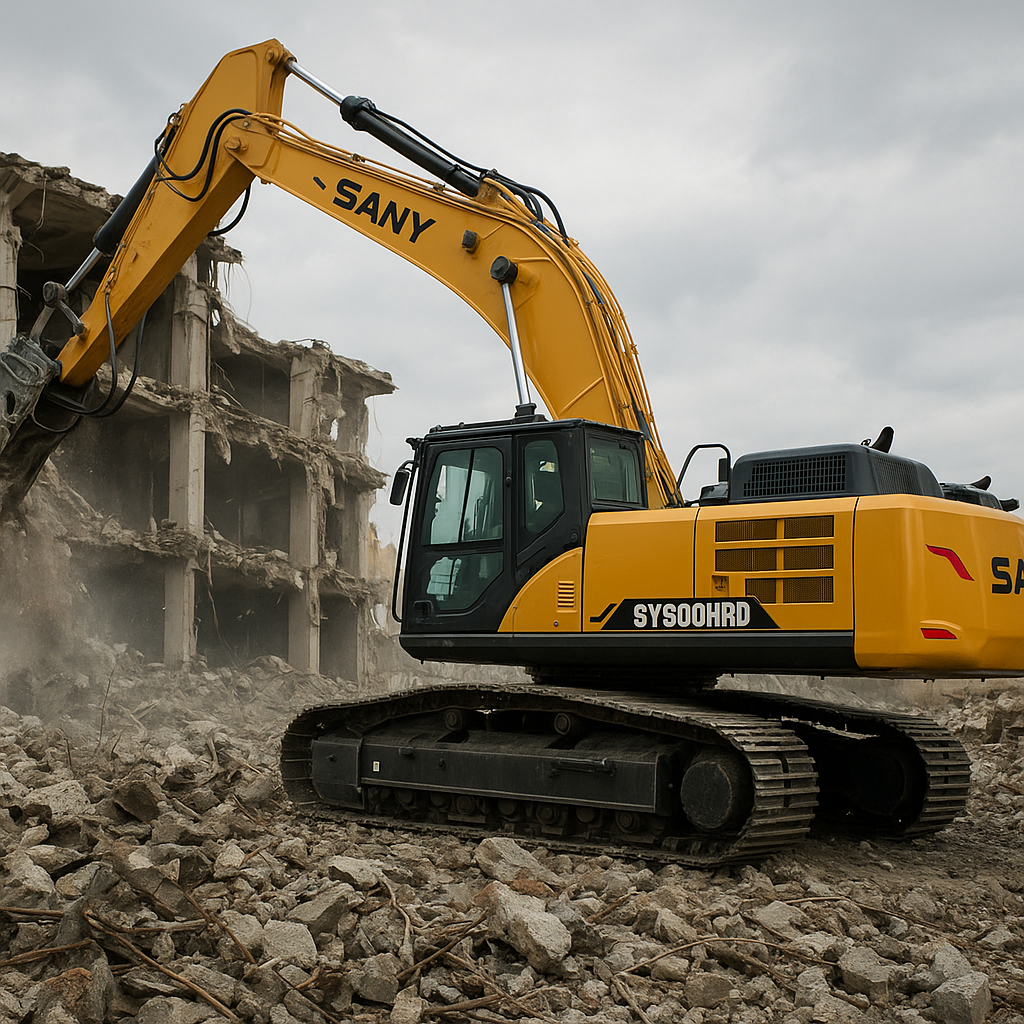
The SANY SY500HRD represents a class of purpose-built demolition excavators designed to tackle the most demanding SANY demolition projects. Combining robust structural design, powerful hydraulics and a flexible attachment system, the SY500HRD is used where controlled dismantling of tall structures and heavy material handling are required. This article examines the machine’s design, typical applications, operational considerations, maintenance needs and market context, and provides practical information for owners, operators and project managers considering the SY500HRD for demolition work.
Design and core technical characteristics
The SY500HRD is a derivative of SANY’s medium-to-large excavator family engineered specifically for demolition work. Its architecture prioritizes stability, reach and operator protection. Demolition variants like the SY500HRD generally use reinforced upper structures, extended booms and specialized counterweights to safely reach high elevations while maintaining balance and control.
Key structural and mechanical features
- SANY reinforced boom and stick assemblies optimized for high-reach tasks, often with modular extension sections so reach and working envelope can be configured for specific jobs.
- Heavy-duty undercarriage with wide tracks and optional track pads to increase ground bearing and reduce subsidence risk on prepared surfaces.
- Robust cab protection systems: demolition guards, polycarbonate or laminated glazing, and falling-object protective structures (FOPS) for enhanced safety.
- Hydraulic circuits configured for high-flow, low-pressure operation to drive large attachments while ensuring responsive control.
- Counterweight systems that can be changed or augmented to match required reach and attachment weight for stability.
Powertrain and hydraulics
Demolition excavators in the 40–60 ton class typically use engines in the 300–400 kW range; such machines prioritize torque and continuous power delivery for heavy-duty attachment operation. The SY500HRD’s hydraulic system is tuned to supply steady flow and pressure for crushing, shearing and grappling tools, with auxiliary hydraulic circuits and quick-coupler compatibility to minimize downtime when changing attachments.
Modern SANY units emphasize fuel-efficient electronic engine management and hydraulic load-sensing systems to improve efficiency while maintaining the high torque necessary for demolition attachments. Typical features include hydraulic oil filtration systems, multi-stage cooling and electronically controlled pump outputs to match power delivery to task demands.
Applications and attachments
The primary role of the SY500HRD is controlled dismantling of buildings and structures, but its versatility allows it to be adapted to a range of heavy civil, industrial and infrastructure tasks. With the right attachment package, it can perform selective demolition, material sorting, structural stripping, and heavy lifting.
Common applications
- High-reach demolition of multi-story reinforced concrete and steel-framed structures.
- Industrial plant dismantling and decommissioning where precision and protection of nearby assets are critical.
- Bridge and overpass removal where height, reach and counterbalance must be carefully managed.
- Material handling and sorting in demolition recycling yards—feeding crushers, conveyors and loaders.
- Selective dismantling in urban environments where controlled, low-vibration demolition reduces risk to adjacent buildings.
Typical attachments and their roles
- Hydraulic breakers: for concrete and rock breaking during initial structure penetration.
- Concrete crushers and pulverizers for cutting and reducing reinforced concrete elements into transportable sizes.
- Hydraulic shears for cutting structural steel and rebar, often used in industrial demolition.
- Grapples and sorting thumbs for material handling and separation—essential for recycling operations.
- Multi-processor heads that combine crushing, shearing and pulverizing for compact and efficient dismantling.
- Magnetic and vacuum attachments for handling scrap and separating ferrous materials on-site.
Operational considerations and safety
Operating a high-reach demolition excavator such as the SY500HRD requires rigorous planning and attention to safety, because the machine commonly works near pedestrians, adjacent structures and utilities. Key operational areas include setup, operator training, monitoring and hazard mitigation.
Site setup and stability
- Assess ground bearing capacity and prepare a stable working platform. Wide undercarriage and optional track extensions reduce ground pressure but cannot substitute poor site preparation.
- Counterweight configuration must be verified against attachment weight and maximum outreach to avoid tip-over risks.
- Establish exclusion zones and fall-protection radii suitable for falling debris and attachment swing.
Operator training and controls
Operators should be trained specifically on high-reach demolition techniques, including progressive dismantling from the top down, controlled sequencing and use of specialized attachments. Many SY500HRD operators benefit from simulator training and manufacturer-supported certification programs so they understand load charts, dynamic stability indicators and emergency procedures.
Monitoring and health & safety systems
- Onboard cameras and proximity sensors improve visibility when working at height or in constrained urban sites.
- Telematics and remote monitoring systems provide fuel consumption, operating hours and hydraulic pressure data useful for predictive maintenance and productivity metrics.
- Routine safety checks—inspection of hydraulic hoses, pins and bushings, structural welds and protective guards—are mandatory before each shift.
Maintenance, lifecycle and total cost of ownership
Demolition machines operate in punishing conditions—abrasion from concrete dust, heavy cyclic loads and intermittent high-horsepower usage. Effective maintenance extends the life of a SY500HRD and reduces total cost of ownership through predictable uptime and lower repair costs.
Planned maintenance practices
- Strict hydraulic oil change intervals and filtration maintenance to protect pumps and valves from abrasive contamination typical of demolition environments.
- Frequent inspection and lubrication of boom, stick and attachment pivots to prevent accelerated wear.
- Track and undercarriage monitoring: links, rollers and sprockets must be examined for wear because undercarriage costs are significant over the machine lifecycle.
- Structural inspection for hairline cracks or weld fatigue—especially important on extended booms and adapter interfaces used in high-reach work.
Parts availability and aftermarket support
SANY’s global service network provides parts and technical support in many markets, but owners should plan logistics for critical spare parts (hydraulic pumps, control valves, pins and bushings) to minimize downtime. Telematics-assisted diagnostics are increasingly used to detect anomalies in hydraulic cycles and powertrain performance ahead of failure.
Residual value and lifecycle economics
When properly maintained, demolition-specific excavators retain value because the specialized nature of the machine limits competition in the used market. Total lifecycle cost must factor in fuel, attachments, frequent wear items and transport costs (since high-reach machines often require disassembly for road movement due to height and weight). Efficient attachment selection and operator skill significantly affect productivity and cost per ton of demolished material.
Environmental and regulatory considerations
Modern demolition projects are subject to environmental regulations that affect machine selection and operation. The SY500HRD and similar machines can be part of an environmentally responsible demolition strategy when managed properly.
Emissions and fuel consumption
Engines meeting current stage/ tier emissions standards reduce NOx and particulate outputs. Fuel-efficient hydraulic control strategies and engine idle management lower consumption—important both for meeting emissions goals and reducing operating expense. Reported fuel consumption in this class of machine varies with attachment and workload; typical demolition applications might average several dozen liters per hour under heavy load, with significant variability depending on work intensity and operator technique.
Dust, noise and material handling
- Dust suppression measures—water sprays, misting systems and staged dismantling—are essential in urban environments to mitigate airborne particulates.
- Noise attenuation through mufflers, acoustic barriers and restricted working hours helps meet local regulations and community expectations.
- Efficient on-site sorting and recycling of concrete and metal reduce landfill use and can provide revenue from recovered materials. Attachments like crushers and magnets support this circular approach.
Market context and performance statistics
SANY has expanded rapidly over the past two decades, offering competitively priced machines with growing global support. The SY500HRD fits into an expanding market niche for specialized demolition equipment driven by urban renewal, bridge replacement and industrial decommissioning.
Performance metrics and productivity
- Typical cycle productivity for high-reach demolition depends on attachment type and reach. For instance, a concrete crusher on an extended boom may process between several to tens of cubic meters per hour, while selective hand-held shearing and grappling of steel structures is slower but more precise.
- Utilization metrics for demolition excavators are highly project-dependent. On sustained projects, productive operating hours may range from 6–10 hours per shift factoring in repositioning and attachment changes.
- Telematics data from SANY and other OEMs often show that preventive maintenance and operator coaching can reduce unplanned downtime by 20–30% when consistently applied.
Adoption trends
Demand for high-reach demolition machines correlates with investment in infrastructure renewal and urban redevelopment. Regions with dense urban centers or aging industrial facilities show higher demand for specialized demolition excavators. SANY’s competitive pricing and expanding service footprint have enabled firms to access larger demolition machines with lower initial capital outlays compared with some established competitors, accelerating adoption in emerging markets.
Case studies and practical examples
Real-world use of machines like the SY500HRD demonstrates both capabilities and constraints. Below are generalized examples illustrating how such a machine is typically deployed.
Urban multi-story building removal
- Scenario: Controlled dismantling of an 8–12 story reinforced concrete apartment block in a dense urban area.
- Approach: Install SY500HRD with extended high-reach boom and concrete crusher. Work from the roof down, removing façade elements and structural slabs in sequenced segments. Use water suppression and exclusion zones to protect the public.
- Outcome: Faster removal of upper stories and reduced need for perimeter scaffolding compared with manual methods. Improved safety via operator cab protection and remote surveillance.
Industrial plant decommissioning
- Scenario: Dismantling of a steel-framed processing hall with integrated piping and machinery.
- Approach: Equip the machine with shears and grapples to cut and remove steel elements. Use magnetic attachments for sorting ferrous scrap. Coordinate with structural engineers to sequence removal for stability.
- Outcome: Efficient separation of materials for recycling; minimized crane usage and lower overall project cost.
Practical purchasing and leasing considerations
When evaluating the SY500HRD for procurement, consider duty cycle, attachment compatibility, transport logistics and local service availability. Leasing can be advantageous for short-term projects or to evaluate machine performance before committing capital expenditure.
- Compare effective hourly cost including fuel, operator, transport and attachment wear rather than just purchase price.
- Verify that local dealerships can supply critical spares and trained technicians for hydraulic and structural repairs.
- Consider modular boom packages that allow the same base machine to serve multiple roles—reducing idle time between projects.
Summary and outlook
The SY500HRD is designed to meet specialized demolition demands where reach, power and operator protection are essential. With robust hydraulic systems, reinforced structures and a suite of compatible attachments, it offers a flexible solution for urban demolition, industrial decommissioning and infrastructure removal. Effective planning, operator training and preventive maintenance are critical to realize the machine’s potential and to control total lifecycle costs. As environmental and regulatory pressures increase, machines like the SY500HRD that can combine productivity with lower emissions and better material separation will be increasingly valuable in the demolition marketplace.
SY500HRD deployments emphasize the interplay of efficiency, safety and maintenance—factors that ultimately determine performance and return on investment in complex demolition projects.
)
)