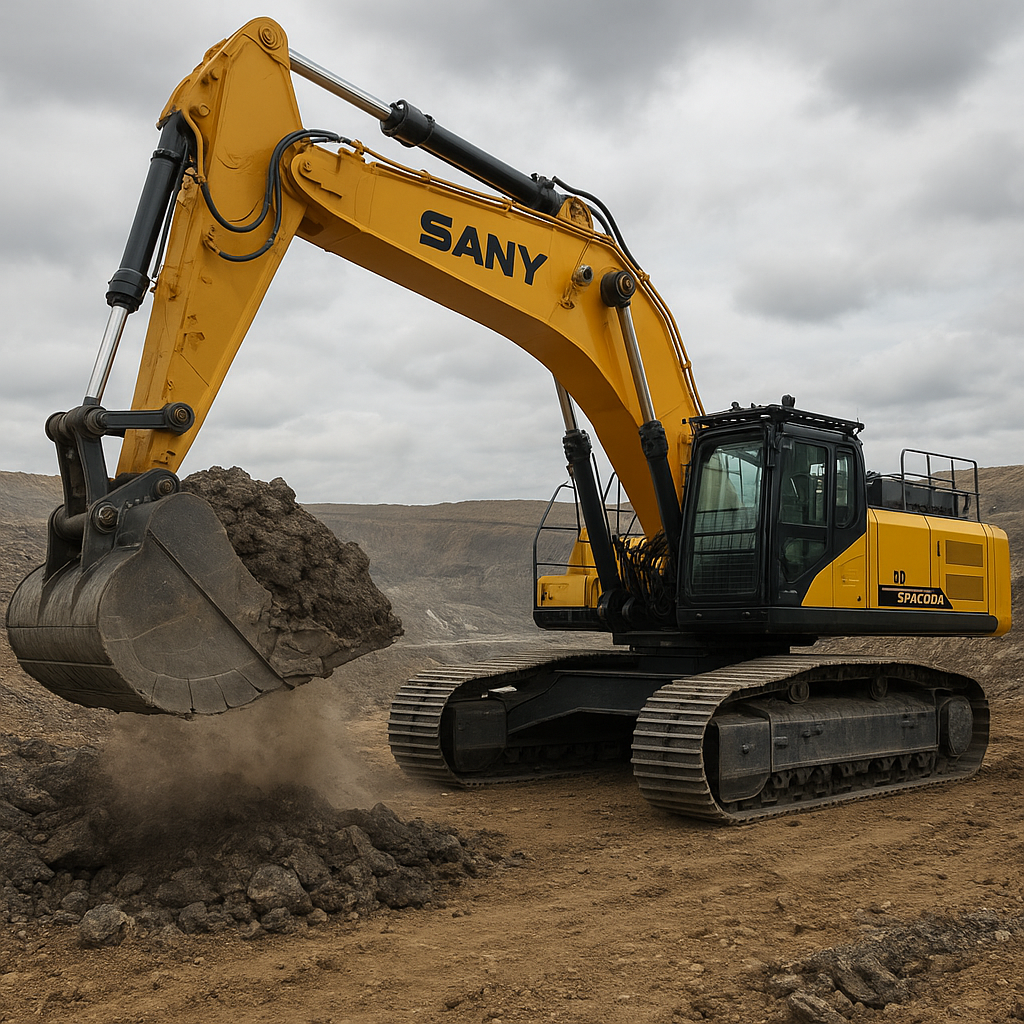
The SANY SY1200H represents a class of heavy hydraulic machines designed for demanding mineral extraction and bulk-material handling environments. Built to bridge the gap between medium and ultra-large excavators, this model combines robust mechanical design, advanced hydraulics and operator-focused features to deliver consistent performance in open-pit mining, quarrying, and large earthmoving projects. Below is a comprehensive look at its design, applications, operational statistics, economic impact and other notable information relevant to mining professionals, fleet managers and technical decision-makers.
Design and Technical Overview
The SANY SY1200H is engineered to balance digging power with mobility and serviceability. Its platform integrates a heavy-duty undercarriage, reinforced structures in the boom and arm, and a high-efficiency hydraulic system to handle continuous cycles typical of mining operations.
Core structural features
- Reinforced frame and superstructure for extended fatigue life under heavy loading.
- Modular boom and arm designs allowing for different reach and bucket configurations depending on application.
- Heavy-duty undercarriage components (tracks, rollers, idlers) optimized for abrasive and uneven surfaces common in pits and quarries.
Engine and powertrain
The SY1200H is typically fitted with an industrial diesel engine calibrated for high torque at low rpm to deliver consistent digging cycles. Engine configurations may vary by market to meet local emissions regulations and fuel quality. Typical power ratings for excavators in the 120-ton class fall into a range intended to match hydraulic and pump capacity for optimal trenching and loading performance.
Hydraulics and attachments
- Variable-displacement pumps providing responsive boom, arm and bucket actions while optimizing fuel use.
- Advanced control valves and electronic management for smooth multi-function operation and reduced cycle times.
- Wide compatibility with attachments: rigid and hydraulic breakers, thumbs, multi-purpose buckets, and quick couplers for rapid changeovers.
Cabin and controls
Ergonomics are a focus: the cabin typically includes climate control, vibration-damped seating, intuitive joysticks and an information display with diagnostics. Optional packages often add 360° cameras, object detection systems and telematics for remote monitoring.
Applications and Typical Use Cases
The primary arena for the SANY SY1200H is heavy-duty material handling. Its strengths make it suitable for a variety of tasks across the mining value chain, from initial overburden removal to ore loading and stockpile management.
Common applications
- Open-pit mining: removal of overburden and ore extraction; productive in multi-pass digging cycles.
- Quarrying: limestone, granite and aggregate production where continuous loading of haul trucks is required.
- Coal operations: loading high-tonnage trucks and managing stockpiles.
- Bulk handling terminals and ports: ship loading/unloading and conveyor feed operations.
- Large earthworks: dam construction, major reclamation projects and infrastructure excavation.
Operational scenarios and productivity estimates
Productivity depends on bucket size, material density, truck matching and cycle times. Typical example calculations used by mining planners help estimate throughput:
- Example configuration: bucket volume 6.0 m3, material density 1.6 t/m3 → payload per scoop ≈ 9.6 tonnes.
- Assuming an average round-trip cycle time of 30–40 seconds (including swing and fill) yields roughly 90–120 cycles per hour.
- Estimated hourly throughput in this scenario: 864–1,152 tonnes per hour.
These figures are illustrative; actual results vary with operator skill, truck-matching efficiency and site conditions. In high-availability operations with optimized logistics, machines in this class can deliver consistent, high hourly tonnages that directly impact mine-site productivity and project timelines.
Performance, Efficiency and Economics
Decisions to deploy a machine like the SY1200H are driven by lifecycle economics as much as by peak performance. Key considerations include fuel efficiency, operating cost per tonne, maintenance intervals and capital depreciation.
Fuel consumption and efficiency
Fuel burn varies with duty cycle and load factor. For heavy mining excavators in the 100–140 tonne class, typical fuel consumption during productive digging can range broadly, often between 25 and 60 liters per hour depending on load, hydraulic demand and engine tuning. Advances in hydraulic systems and electronic engine management aim to reduce specific fuel consumption (fuel per tonne moved) through smarter power delivery and load-sensing hydraulics.
Operating cost drivers
- Fuel: usually the single largest variable expense.
- Wear parts: buckets, teeth, pins and bushings have predictable lifecycles and are influenced by material abrasiveness.
- Track and undercarriage replacement: significant periodic cost for machines operating on rough terrain.
- Planned maintenance and downtime: preventative service planning keeps availability high and extends component life.
Example cost-per-tonne analysis (indicative)
Using representative figures for planning purposes only:
- Assumed fuel consumption: 40 L/h; diesel price: 1.00–1.20 USD/L → fuel cost ≈ 40–48 USD/h.
- Operator and overhead (wages, onsite support): 30–60 USD/h depending on region.
- Scheduled maintenance and parts amortized: 20–40 USD/h.
- With throughput at 1,000 t/h, direct operating cost could be in the range of 0.09–0.15 USD/t (excluding capital depreciation and indirect costs).
Actual mine-site models incorporate local fuel prices, labor rates and maintenance arrangements; these numbers are intended as a framework to compare relative economics between models and fleet options.
Reliability, Maintenance and Serviceability
Reliability is mission-critical in mining. The SY1200H platform emphasizes accessibility of service points, modular components and diagnostics to minimize downtime.
Design for maintainability
- Grouped daily service points for quick checks (filters, fluid levels, greasing).
- Wide access panels and ground-level maintenance platforms to reduce service time and improve technician safety.
- Centralized lubrication options and extended-life filtration systems to lengthen service intervals.
Common wear items and life extension
Wear on buckets, teeth, pins and bushings is typical; the choice of material (high-chromium, wear-resistant steels) and use of bolt-on wear edges can extend service life. Track shoes and rollers exposed to abrasive ground conditions require scheduled tracking and potential early replacement. Proactive condition monitoring—oil analysis, hydraulic pressure diagnostics and vibration monitoring—helps identify wear trends before catastrophic failure.
Support network and parts availability
SANY’s global dealer network provides spare parts, rebuild services and technical support in many mining regions. Effective lifecycle management depends on local parts availability, preventive maintenance programs and operator training to sustain high utilization rates.
Safety, Operator Experience and Technology
Modern mining excavators prioritize operator safety and situational awareness. The SY1200H typically includes multiple systems that help reduce accidents and increase operational efficiency.
Safety features
- ROPS/FOPS-certified cabin structures to protect operators.
- Integrated cameras and proximity sensors to detect obstacles and personnel near the swing arc.
- Access ladders and anti-slip walkways for safer ingress/egress and maintenance.
Operator productivity tools
Onboard telematics allow fleet managers to monitor machine health, fuel consumption and location in real time. Optional grade-control interfaces, payload monitoring systems and semi-automated cycle-assist functions reduce cycle variability and improve loading consistency.
Environmental Considerations and Emissions
Environmental regulations affect engine options and aftertreatment systems. Machines delivered to markets with strict emissions standards are often equipped with selective catalytic reduction (SCR), diesel particulate filters (DPF) and advanced fuel-management systems to meet Stage V, Tier 4F or equivalent requirements.
Fuel alternatives and electrification
The mining sector is increasingly exploring hybridization and full electrification to reduce emissions and lower operating costs in appropriate mine-site electrical-infrastructure scenarios. Hybrid hydraulic systems, battery-assist for peak loads and electrified platforms for fixed-shaft applications can reduce fuel consumption and greenhouse-gas emissions over the machine lifecycle.
Comparative Market Position and Competitors
The SY1200H competes in the 100–140 tonne class where buyers balance acquisition cost, parts/support network and lifecycle operating cost. Comparable offerings from other OEMs emphasize similar traits—durability, hydraulic efficiency and operator comfort—but differ in warranty, dealership coverage and optional packages. Selection often hinges on total cost of ownership and local service capability rather than headline technical figures alone.
Field Data, Case Examples and Operational Insights
While exact site-level statistics vary widely, aggregated operational insights from mining operations offer useful benchmarks:
- Availability targets for large excavators are often set between 85% and 92% depending on maintenance regime and site complexity.
- Maintenance costs typically represent 12–25% of total operating expense for heavy equipment in abrasive mining contexts; parts and undercarriage replacement are significant contributors.
- Productivity improvements of 5–15% can be achieved through operator training, optimized truck-excavator matching and telematics-driven interventions.
Example operational vignette (illustrative): a medium-sized open-pit operation replacing older 90-ton excavators with a fleet of SY1200H units observed a 10–20% increase in hourly tonnage per shovel due to larger bucket capacities and improved hydraulic performance. The payback period for the capital investment depended heavily on fuel costs and haul truck cycle optimization; in cases where truck queuing was minimized, incremental revenue from faster material movement shortened the return on investment horizon.
Buying Considerations and Fleet Strategy
Procurement decisions should evaluate:
- Total cost of ownership over an anticipated service life (including parts, fuel, maintenance and disposal/resale value).
- Local dealer support, parts inventory and technician training services.
- Compatibility with existing fleet logistics (truck payload matching, pit road gradients and workshop capacity).
- Resilience to local operating conditions (abrasive rock types, seasonal weather impacts, sourcing of consumables).
To maximize return, mines often pair the introduction of larger excavators with changes in haulage strategy, such as deploying higher-capacity trucks, optimizing loading patterns and implementing predictive maintenance. These systemic changes tend to unlock the full potential of machines like the SY1200H.
Final Technical and Operational Notes
Key points to consider when evaluating the SANY SY1200H:
- The model is engineered to provide robust digging and loading capability for large-scale operations while maintaining serviceability through modular components.
- Reliability and on-site support are as important as peak power and capacity for sustaining production and controlling cost per tonne.
- Integration of telematics and advanced hydraulics contributes materially to improved efficiency and reduced unplanned downtime.
- Fleet-wide planning—matching excavators with the right trucks, optimizing cycles and training operators—yields measurable increases in productivity.
- Lifecycle maintenance planning and availability of genuine parts directly affect long-term reliability and resale value.
When specifying a machine like the SY1200H, request detailed manufacturer data sheets that include exact engine model, rated power, hydraulic flow capacities, bucket sizes, operating weight and undercarriage specifications for the configured package. These parameters will provide the definitive inputs for mine-planning models, total-cost-of-ownership calculations and safety assessments tailored to project-specific conditions.
)
)