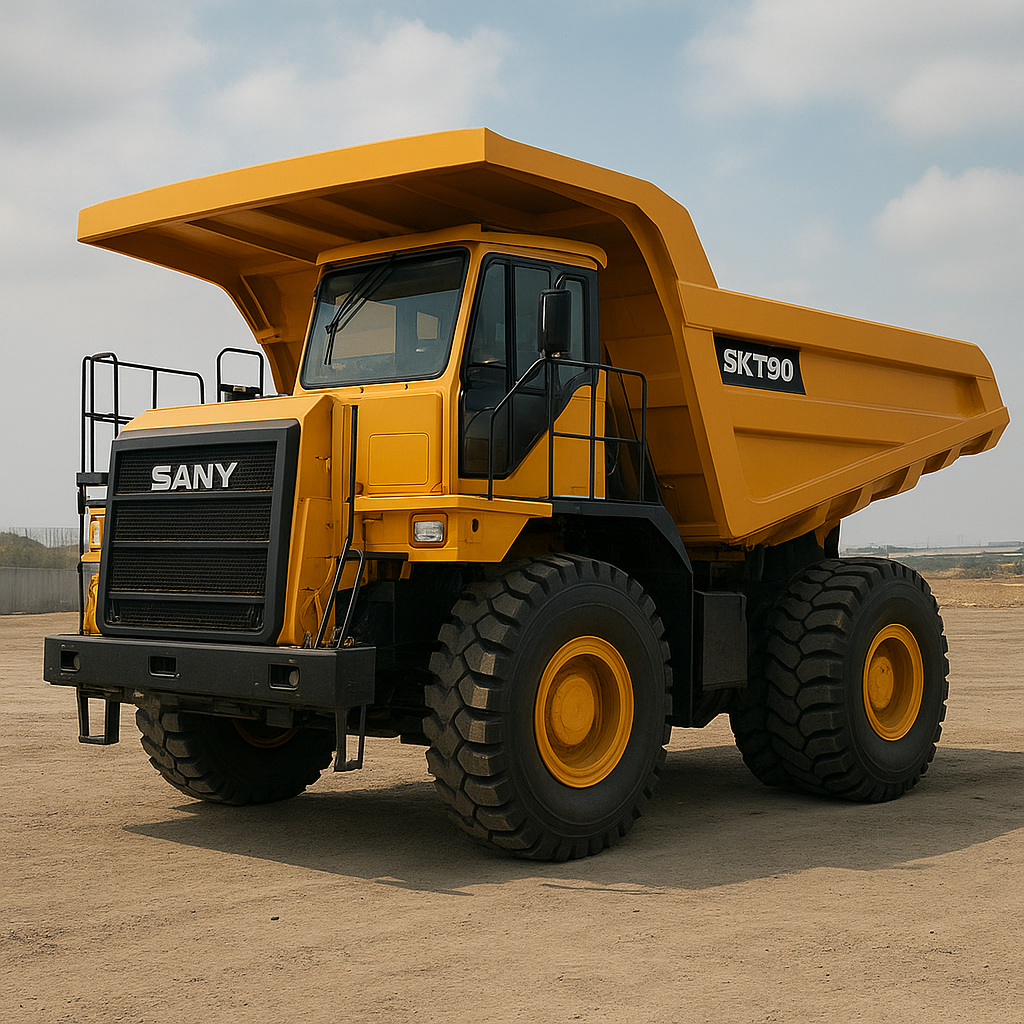
The SANY SKT90 is a heavy-duty rigid-frame haul truck designed for large-scale surface mining and quarry operations. Combining robust construction with modern controls and serviceability, the SKT90 aims to compete in the 90-ton payload class by offering a balance of productivity, durability and manageable operating costs. In the following sections we explore the machine’s design, typical applications, estimated performance data, safety and comfort features, maintenance considerations and its position in the global market.
Design philosophy and core features
SANY developed the SKT90 to meet the demands of opencast mining, large quarries and major earthmoving projects where continuous high-volume material handling is required. The machine’s design emphasizes structural strength, easy access for servicing, and integration of electronics to improve fleet management. Key design aims include maximizing uptime, lowering operating expenses and delivering predictable, long-term performance under harsh conditions.
Structural and drivetrain elements
- Rigid steel frame and heavy-duty chassis engineered to withstand the repeated stress of loaded cycles in mining environments.
- High-capacity dump body with reinforced wear surfaces to resist abrasion from rock and mineral loads.
- Powertrain options typically include high-torque diesel engines in the megawatt-class range connected to either mechanical or automatic transmissions designed for heavy-duty, high-hour operation.
- Robust axles and suspension components sized to carry the nominal payload while maintaining stability on steep ramps and rough surfaces.
Electronics, controls and telematics
The SKT90 integrates modern electronic control modules for engine management, transmission control and braking systems. Most machines in this class offer optional or factory-fitted fleet-management systems, enabling remote monitoring of machine health, fuel use and cycle counts. These electronic packages are intended to support predictive maintenance strategies and improve overall fleet efficiency.
- Onboard diagnostics and fault logging to speed up troubleshooting.
- GPS and telematics packages for location tracking, productivity reports and geofencing.
- Driver-assist features such as overload alarms, load distribution monitoring and optionally automated retarding on descents.
Applications and operational use
The SKT90 is primarily used for bulk material haulage in open-pit mines and large quarries. Its nominal payload capacity positions it between medium-size rigid haulers and the very largest ultra-class trucks, making it a flexible option for operations that need significant hauling capability without the logistics and capital expense of the largest 200+ ton trucks.
Typical use cases
- Overburden removal and waste rock transportation in metallic and non-metallic mines.
- Mined ore hauling from benches to crushers or primary processing areas.
- Large-scale infrastructure projects requiring continuous movement of aggregates and fill material.
- Quarry operations supplying construction aggregates and roadstone at high volumes.
Operators value the SKT90 when they need a balance of productivity and flexibility: the machine can be deployed where a 60–80 ton truck is too small but a 200-tonner would be excessive. It is often chosen for mines that are expanding production but seek to preserve fleet interchangeability and maintenance simplicity.
Performance indicators and approximate specifications
Exact specifications of the SKT90 can vary with market configuration, engine supplier and optional equipment. The values below represent typical figures for a modern 90-ton class rigid haul truck and are indicative of the SKT90’s expected performance envelope.
Approximate specifications (typical for 90-ton class)
- Rated payload: approximately 90 tonnes.
- Operating (gross) weight: typically in the range of 130–170 tonnes depending on body and options.
- Engine power: usually between 600 and 900 kW (approx. 800–1,200 HP), depending on market and emission stage.
- Top speed (unloaded): commonly 60–70 km/h; loaded operational speeds on haul roads are lower and governed by safety and grade.
- Fuel capacity: large tanks sized to support extended shifts—commonly several hundred liters (exact volume depends on configuration).
- Turning radius and dimensions: designed to fit large-scale mining roads; exact dimensions depend on body style and guard packages.
- Service intervals and maintenance schedules: designed for high-hour mining use with common intervals for oil, filter and brake inspection aligned with industry practices.
These numbers are intended as a guide. Specific SKT90 units may be specified with different engines (to meet local emissions regulations), transmissions, braking packages and bodies—each choice will affect weight, fuel use and performance.
Fuel economy and operating productivity
Fuel consumption for trucks in the 90-ton class is significantly influenced by duty cycle: average payload per cycle, haul road grade and condition, cycle length and operator behavior. Typical fuel burn rates vary widely, but fleet managers often focus on the metric of liters per tonne-kilometer or fuel per operating hour. By combining engine calibration, load management and telematics-based coaching, mining operations aim to reduce fuel use and total cost of ownership.
- Modern electronic engine management helps optimize combustion and reduce specific fuel consumption under heavy loads.
- Using the right gearing and transmission settings, plus intelligent retarding strategies on descents, reduces wear on service brakes and improves fuel economy.
Safety, ergonomics and operator environment
Safety is a primary design concern for haul trucks. The SKT90 features structural and electronic systems intended to protect both the operator and the machine in high-risk environments. Attention to operator comfort is also key: a comfortable, well-instrumented cab reduces fatigue and can materially improve productivity and safety.
Safety systems
- Rollover protection structure (ROPS) and falling object protective structure (FOPS) integrated into the cab.
- Advanced braking systems that may combine large service brakes with retarder functions and automatic retardation on steep ramps.
- Visibility aids such as wide-angle mirrors, rear-vision cameras and radar obstacle detection to help with blind spots.
- Audible alarms and visual indicators for overload, engine limits and critical system faults.
Operator comfort and controls
The SKT90 cab typically offers ergonomic seating, climate control, vibration isolation and modern instrument clusters. Intuitive control layouts and adjustable seating aim to reduce operator fatigue and facilitate precise machine operation. Optional extras often include a multimedia interface, advanced HVAC systems and operator data displays for real-time performance feedback, which further enhance safety and operator comfort.
Maintenance, lifecycle management and total cost of ownership
For heavy haul trucks, lifecycle costs—purchase price plus fuel, maintenance, tires and downtime—make up the real metric purchasers evaluate. The SKT90 is positioned to offer competitive total cost of ownership through mechanical simplicity where possible, easy access to service points and telematics that enable condition-based maintenance.
Serviceability features
- Large access panels and grouped service points to reduce routine service time.
- Standardized consumables and modular replacement assemblies to simplify field repairs.
- Onboard diagnostics and remote telematics to identify emerging faults before they cause failures, improving machine reliability and uptime.
Consumables and wear items
Wear parts for haul trucks—tires, brake components, body liners and drivetrain elements—represent a significant portion of ongoing operating expense. Predictive maintenance enabled by telematics can extend component life and schedule replacements at convenient times to minimize unscheduled downtime.
Market context and competitors
SANY’s SKT series competes with mid- to large-capacity haul trucks from established manufacturers such as Caterpillar, Komatsu, Volvo, Hitachi, BelAZ and domestic Chinese producers. Buyers typically weigh purchase price, dealer support network, parts availability and proven performance under local conditions.
Value proposition
- Competitive acquisition cost relative to legacy Western brands combined with modern features helps SANY gain market share in emerging markets.
- Local dealer networks and parts distribution are increasingly developed to support global demands and reduce lead-times for spares.
- Customization options, including different engine suppliers and emission packages, allow the SKT90 to be adapted to a wide range of regulatory environments.
Adoption trends
In many regions, mines and quarries are adopting a mix of fleets—some legacy large trucks and a newer generation of machines offering better telematics and fuel economy. The SKT90 fits into strategies that prioritize operational flexibility and improved data-driven maintenance. As mines embrace electrification, hybrid drivetrains and trolley-assist systems for larger trucks, models like the SKT90 may evolve with hybrid or battery-assisted options in future iterations to reduce fuel consumption and emissions.
Operational best practices and tips
Maximizing the value of an SKT90 in a working fleet depends on operational discipline, preventive maintenance and data-driven management. Below are recommended practices commonly applied across modern haulage operations.
- Use telematics to monitor fuel use, idle time and cycle counts; implement operator coaching to improve fuel efficiency and reduce wear.
- Design haul roads with proper gradients, cambers and drainage to reduce strain on brakes and driveline components.
- Stage maintenance tasks based on condition and usage rather than fixed intervals where possible—this reduces unnecessary downtime and part replacement.
- Keep a strategic inventory of critical spares (filters, belts, major wear items) to avoid long MTTR (mean time to repair).
- Train operators on best-practice loading and unloading techniques to balance load distribution, reduce body wear and improve cycle times.
Environmental considerations
Regulatory and stakeholder pressure increasingly drives mining operations to adopt lower-emission equipment and reduce lifecycle environmental impact. Although the SKT90 is fundamentally a diesel-powered machine, manufacturers are adapting by offering engines that meet progressive emissions stages and by enabling optional features that reduce fuel use.
- Engines can be specified to meet local emission standards; selective catalytic reduction (SCR) and diesel particulate filters (DPF) are common solutions where required.
- Telematics and engine tuning can deliver tangible reductions in carbon intensity per tonne of material moved by optimizing cycles and reducing idle.
- Future product lines in the heavy-haul sector may include hybrid drivetrains or trolley-assist compatibility to enable lower emissions on heavily trafficked ramps.
Summary and outlook
The SANY SKT90 sits in a competitive segment of the mining haul truck market, offering a combination of heavy-duty design, modern electronics and a cost-conscious value proposition. Its approximate 90-ton rated capacity makes it suitable for mines and quarries seeking high-volume haulage without stepping up to the very largest ultra-class machines. Strengths commonly attributed to a machine of this type include robust durability, good service access for maintenance, integrated telematics for lifecycle management, and operator-focused features that enhance safety and productivity.
Like all large mining equipment, the SKT90’s real-world performance depends on correct specification, operator training and a strong support network for parts and service. As mining operations continue to prioritize lower operating costs and tighter environmental controls, manufacturers will likely continue to evolve models such as the SKT90 with improved powertrains, greater electronic integration and new options for emissions reduction—measures that will influence future choices around fleet composition and long-term capital planning.
)
)