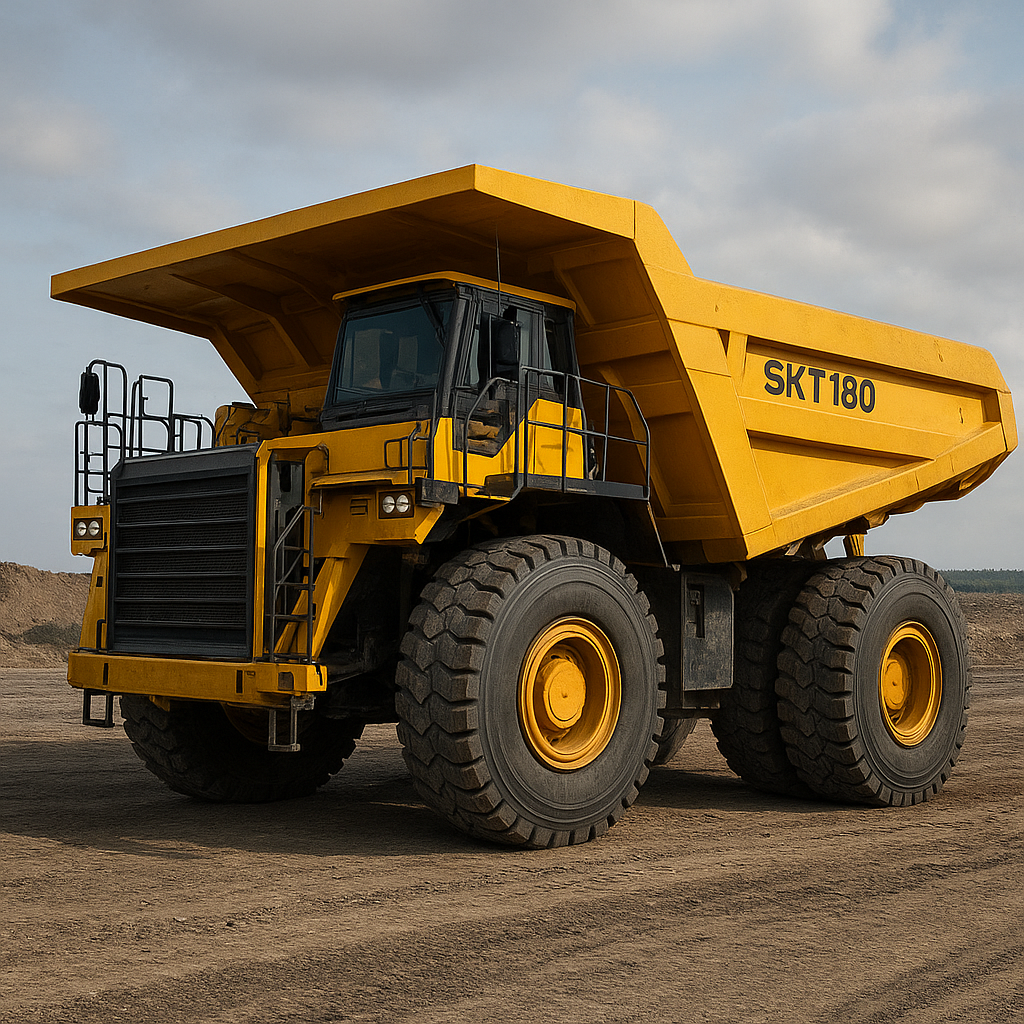
The SANY SKT180 represents a modern entry in the class of large-capacity rigid haul trucks engineered for heavy-duty mining operations. Built by one of the world’s leading Chinese heavy equipment manufacturers, the machine blends robust mechanical design with operator-focused ergonomics and fleet-level connectivity. In this article we will explore the SKT180’s typical applications, technical and operational highlights, maintenance and safety considerations, and the broader role such machines play in contemporary mining and quarrying operations.
Overview and purpose
The SANY SKT180 is purpose-built as a large-capacity mining dump truck intended for open-pit mines, large quarries, and major earthmoving projects. As the model designation suggests, the vehicle is designed around a nominal 180-ton payload class, making it suitable for transporting overburden, ore, and other bulk materials over short to medium haul cycles within a mine site. The SKT180 competes in the same operational space as other rigid-frame haul trucks and aims to deliver a balance of reliability, durability, and total cost of ownership that appeals to both established mining companies and emerging operators seeking value and manufacturability.
Key design features
The SKT180 follows conventional rigid haul truck architecture: a heavy-duty chassis and frame, high-capacity body (dump bed), powerful driveline, large off-road tires, and a protected operator station. Its design emphasizes robustness under cyclical heavy loads, ease of service, and adaptability to different site conditions.
Chassis and body
- The load-carrying body is constructed from wear-resistant steel and engineered to resist the high-impact stresses seen during loading by hydraulic shovels, loaders, or explosives-assisted blasting cycles.
- Reinforced frame sections and stress-relieved welds extend structural life and reduce crack propagation in high-fatigue areas.
Drivetrain and powertrain
- The SKT180 is offered with heavy-duty diesel prime movers matched to robust transmissions and axles suitable for long-duration, high-torque cycles typical of mining haulage.
- Modern variants provide drivetrain layouts that simplify service access and parts replacement, improving uptime and maintainability.
Cab and ergonomics
- The operator cab is designed for long-shift comfort, featuring ergonomic seating, good visibility over the working area, climate control, and vibration isolation.
- Controls and instrumentation are arranged to reduce operator fatigue and facilitate straightforward training for new operators.
Fleet connectivity and controls
- Newer SANY machines, including large haul trucks, are typically compatible with fleet management systems for remote monitoring of machine health, fuel consumption, and productivity metrics.
- Such systems enable predictive maintenance, remote diagnostics, and better allocation of assets across a mine site.
Applications: Where the SKT180 excels
The primary application for the SKT180 is within large open-pit mining operations. Typical use cases include:
- Haulage of ore from pit faces to crushing and processing circuits.
- Transportation of waste rock and overburden during pit development and expansion.
- Bulk material movement in large quarries and infrastructure projects requiring high-volume earthworks.
The machine is particularly valuable on mining benches where cycle times are moderate, and where loading equipment (e.g., rope shovels, electric shovels, hydraulic excavators) can deliver large bucket loads that match the truck’s capacity. It is also useful in contractor fleets supporting mine development, port construction, and large civil works where a high payload per trip reduces operational costs.
Operational performance and productivity
Performance of haul trucks is measured by throughput (tonnes moved per hour), availability (uptime), and fuel efficiency per tonne-kilometer. The SKT180 is engineered to compete on these fronts through a combination of high payload, robust construction, and serviceability. Operators often focus on a few core performance indicators:
- Payload consistency: achieving rated payload on every cycle reduces cost-per-ton.
- Fuel consumption per tonne: fuel efficiency improvements directly reduce operating costs.
- Cycle time: optimized pit logistics (shorter hauls, minimal waiting at crushers) enhances productivity.
- Availability: design choices that allow rapid component replacement and simplified maintenance increase fleet effective hours.
While exact production figures depend on site layout, loading equipment, and operator technique, a well-managed SKT180 fleet can be expected to deliver competitive per-hour tonnage in the 180-ton class when integrated into modern mine operations.
Maintenance, serviceability, and lifecycle costs
One of the primary economic considerations for any large haul truck is the lifecycle cost, which comprises acquisition, fuel, maintenance, tires, and residual value. The SKT180 has been developed with serviceability in mind:
- Modular assemblies and widely used component interfaces reduce downtime for routine repairs and overhaul.
- Access panels and ground-level service points allow technicians to perform inspections and servicing with reduced need for heavy lifting equipment.
- Use of industry-standard parts where possible eases spare parts logistics, especially in remote locations.
- Integration with telematics systems permits condition-based maintenance strategies, preventing unnecessary component replacement and minimizing unplanned failures.
Effective maintenance programs extend component life (engines, transmissions, axles) and lower the total cost of ownership over the machine’s working life, which in mining environments can span many years and tens of thousands of operating hours.
Safety systems and operator protection
Safety is paramount on large mobile equipment. The SKT180 incorporates a suite of features to protect operators and site personnel:
- ROPS/FOPS-certified cab structures to protect occupants in the event of rollovers or falling objects.
- Advanced braking systems and retarder configurations to control descent speeds on production benches.
- Backup alarms, proximity detection options, and camera systems to improve situational awareness around large blind zones.
- Fire suppression systems and engine-room insulation to reduce fire risk from hot surfaces and flammable fluids.
Companies operating the SKT180 typically pair machine-level safety features with site-level controls such as traffic management plans, haul road maintenance, and operator training to reduce accident rates and improve overall site safety culture.
Environmental considerations
Modern mine operators are increasingly evaluated on their environmental footprint. Large haul trucks are a significant source of diesel consumption and greenhouse gas emissions on-site. Manufacturers and mine operators address these concerns in several ways:
- Selection of engines meeting relevant emission standards and adding aftertreatment systems (diesel particulate filters, selective catalytic reduction) where regulation requires.
- Fuel management and driver training programs to reduce unnecessary idling and optimize throttle usage.
- Exploration of alternative powertrains and electrification at both wheel and mine infrastructure levels—such as trolley-assist systems and battery-electric haulage solutions—for lower-emissions operations.
The SKT180 can be configured to meet various regional emissions regulations and is compatible with fuel-saving practices and telematics-driven efficiency programs. In many mines, hybridization and electrification remain longer-term strategies; however, optimizing large diesel rigs today still delivers meaningful reductions in fuel use and emissions.
Market positioning and dealer support
SANY has expanded aggressively in global construction and mining markets. Key advantages the company leverages with models like the SKT180 include competitive pricing, a growing global service network, and the ability to tailor configurations to local customer requirements. Dealer and service support are critical for heavy mining equipment; effective parts supply chains and trained technicians are essential to maintain uptime for high-utilization machines.
- Regional support centers and authorized service providers help reduce lead times for spare parts and major components.
- Training programs for operators and mechanics raise productivity and ensure that machines are used and maintained according to manufacturer guidance.
Typical specifications and notes (generalized)
Specifications may vary by market and configuration. The following list highlights the type of data purchasers and operators consider when evaluating a machine in this class. Exact numbers should be confirmed with the manufacturer or authorized dealer for the specific build and year:
- Nominal payload capacity: approximately 180 tonnes.
- Gross vehicle mass and empty operating weight: depend on configuration, optional equipment, and materials used in body construction.
- Engine options: high-displacement, heavy-duty diesel engines matched to mining duty cycles; local emissions compliance can dictate specific engine packages.
- Transmission and drivetrain: heavy-duty torque converters, planetary axles, and final drives designed for high-load applications.
- Tires: large-diameter, high-section-width off-road tires rated for heavy loads and abrading surfaces.
Purchasers often request site-specific adaptations such as additional lighting packages for 24/7 operations, specialized bed liners for abrasive materials, or reinforced suspension packages for harsh hauling conditions.
Technology trends and future prospects
The mining haul truck sector is undergoing several technology-driven shifts that affect machines like the SKT180:
- Automation: semi-autonomous and fully autonomous haulage systems are being deployed at scale in many large mines, improving safety and productivity. The SKT180 platform may be adapted for integration into autonomous fleets through guidance systems and control interfaces.
- Electrification: as trolley systems and battery-electric concepts mature, rigid haul trucks are increasingly evaluated for electric or hybrid drivetrains to reduce diesel consumption and emissions.
- Predictive maintenance and data analytics: fleet-level telematics are becoming standard, enabling operators to move from reactive to predictive maintenance and thereby reduce unscheduled downtime and spare-part inventories.
These trends suggest that future iterations of the SKT180 and competitors’ offerings will place even greater emphasis on connectivity, energy management, and integration into digital mine planning systems.
Case studies and operational examples
While specific customer deployments of the SKT180 vary, several common themes emerge from real-world use:
- Operators appreciate the balance between payload capacity and maneuverability in benches with constrained loading points.
- Where effective dealer support exists, the machines deliver uptime and component life competitive with established global brands.
- Integration with fleet management software significantly improves the value proposition by enabling better matching of truck cycles to loading equipment and crushers.
In many projects, the total cost of ownership, access to parts and service, and the ability to adapt machines to local logistics and environmental conditions drive purchasing decisions as much as headline payload numbers.
Buying considerations
When evaluating the SKT180 against alternatives, decision-makers typically assess the following factors:
- Supplier support network and availability of spare parts in the operating region.
- Total cost of ownership estimates, including fuel, tires, maintenance, and resale value.
- Compatibility with existing site infrastructure (pit geometry, haul road design, loading equipment capacities).
- Serviceability and local technician training requirements.
- Regulatory compliance for emissions and site safety standards.
Summary
The SANY SKT180 is a competitive offering in the large rigid haul truck market, tailored for heavy mining and large-scale quarry applications. With a nominal 180-ton capacity, emphasis on reliability, and integration-ready features for modern fleet management, it suits operators seeking strong value and scalable support. Key considerations remain the total cost of ownership, dealer and service network robustness, and how effectively the machine can be integrated into the mine’s logistics and maintenance regime. As the industry evolves toward greater automation and lower-emissions operations, platforms like the SKT180 are likely to be adapted with new powertrain and connectivity technologies that further enhance their operational value.
Key terms highlighted: SANY, SKT180, 180-ton, mining, payload, reliability, telematics, fuel efficiency, safety, maintenance.
)
)