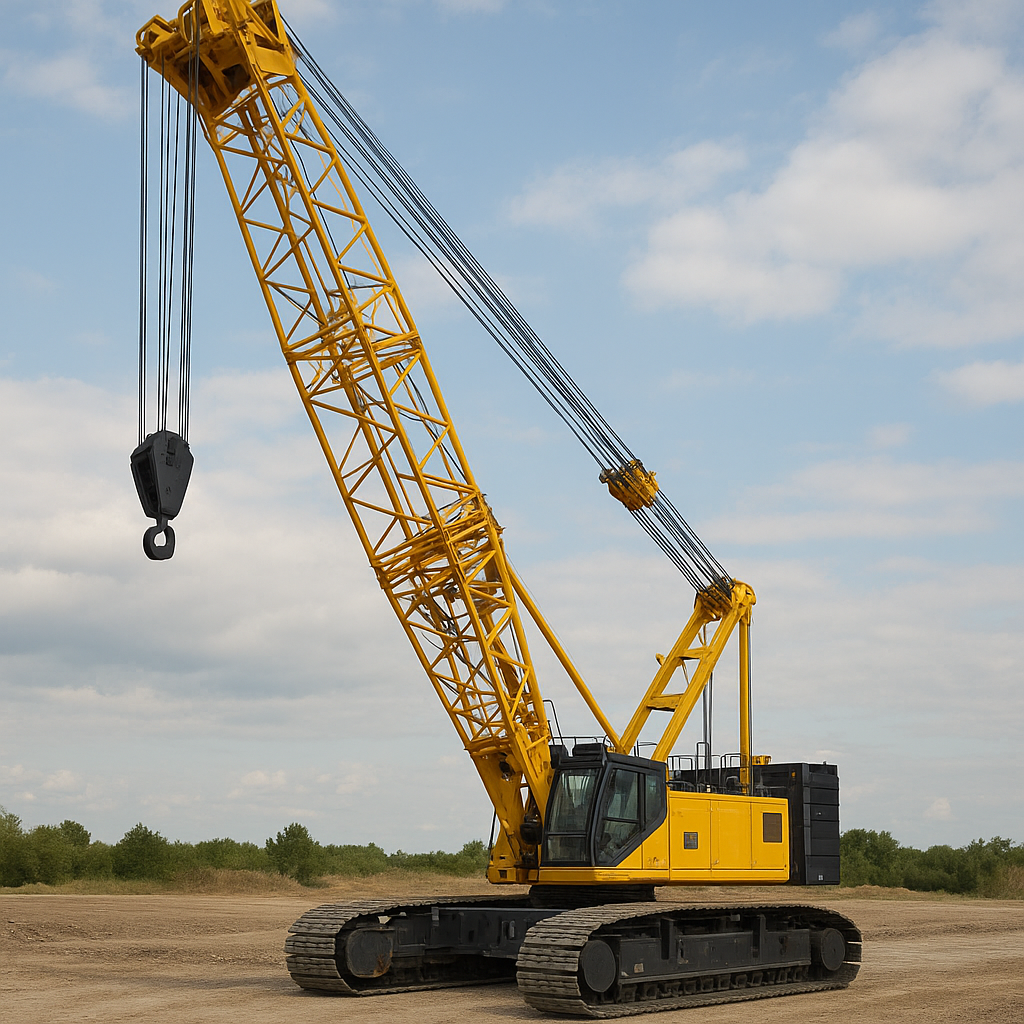
The SANY SCC9800A represents a class of heavy-duty lattice-boom SANY crawler cranes designed for extreme lifting tasks in large infrastructure, energy, and industrial projects. Combining robust mechanical systems with modern electronics and operator ergonomics, the SCC9800A is engineered to handle oversized modules, tall structures, and concentrated loads where mobility and on-site stability are critical. This article examines the machine’s design philosophy, typical technical attributes, practical applications, operational considerations, and the value it brings to large-scale construction and lifting projects.
Design and key features
The SCC9800A is built around the classic heavy crawler-crane concept: a tracked undercarriage for high mobility on-site, a lattice boom for strength-to-weight efficiency, and modular counterweight systems to adapt to different lift charts. Core design priorities are capacity, stability, transportability, and serviceability. Below are the most notable design features that distinguish this model and machines in its class:
- Crawler undercarriage — The tracked base spreads load over a large footprint, lowering ground pressure and enabling operation on softer or uneven terrain where wheeled cranes struggle.
- Lattice boom system — Offers a superior strength-to-weight ratio compared with telescopic booms, allowing very long reaches and heavy tip loads without excessive boom self-weight.
- Modular counterweight and ballast system — Counterweight blocks are added or removed to meet specific lift charts, permitting flexible configuration depending on radius and hook height needs.
- Multiple hoist winches and reeving options — Redundant hoists and versatile reeving enable high line speeds for lighter lifts and multi-line configurations for heavy lifts.
- Advanced operator cab and controls — Ergonomic cabins, proportional joysticks, and integrated load moment indicators enhance precision and reduce operator fatigue.
- Integrated safety and monitoring systems — Real-time load monitoring, anti-two-block protection, level sensors, and often telematics for remote diagnostics and fleet management.
Throughout the SCC9800A’s design, emphasis is placed on minimizing rigging and assembly time while maximizing lifting reliability. Fabrication quality, weld integrity, and component standardization aid in both on-site performance and in-service maintenance.
Typical technical specifications and performance (general guidance)
Exact specifications for an SCC9800A depend on the configuration selected (main boom length, jib options, counterweight package, winch arrangement). Manufacturers often offer multiple variants and optional packages. Below are representative figures and performance characteristics typical of cranes in this class; treat these as indicative ranges rather than absolute values, because final numbers depend on the specific build and regulatory certification.
Capacity and geometry
- Rated lifting capacity: Typically in the upper hundreds of tonnes. Machines of this size class commonly provide rated capacities in the range of several hundred tonnes up to around 800–1,000 tonnes in particular configurations.
- Main boom length: Modular lattice sections allow main-boom builds typically from 40 m up to 80 m or more, depending on section count.
- Auxiliary jib / luffing jib: Optional fixed or luffer jibs can extend tip heights and reach, often adding 20–100 m of additional reach in selected configurations.
- Maximum working radius: Depending on load and boom configuration, safe working radii may range from very short radii for maximum capacity to 40–80 m or greater for mid-range loads.
Weight and ballast
- Operating weight: The whole unit including tracks, superstructure, and minimal ballast typically amounts to many tens thousands of kilograms; fully ballasted machines can weigh several hundred tonnes on site.
- Counterweight: Modular counterweight blocks allow counterweight mass to be configured from tens of tonnes up to several hundred tonnes to meet heavy-lift charts and stability requirements.
Powertrain, winches, and speed
- Engine: Heavy crane powerplants are commonly high-torque diesel engines with outputs tailored to the machine’s hydraulic and electric requirements. Power ratings for cranes in this class commonly fall in the several hundred kW range.
- Winches: Multiple hoist winches with variable-speed electric or hydraulic drives provide flexibility; multi-fall reeving reduces line pull on the drum for the largest lifts.
- Travel speed and gradeability: Designed for slow on-site travel; gradeability and travel speed are secondary to load capacity and ground-holding performance.
Controls and electronics
- Load Moment Indicator (LMI) or rated capacity indicator with multi-curve charts.
- Stability and anti-two-block protection systems to stop unsafe motion.
- Telematics and remote diagnostics (common on modern SANY cranes) provide health monitoring, usage logging, and preventive maintenance alerts.
Note: For exact numbers such as a machine’s certified charted capacities at particular radii and boom lengths, always consult the manufacturer’s documentation or the certified load chart supplied with the crane. The certified load chart is the legal reference used during lifts.
Primary applications and sectors
Large crawler cranes like the SCC9800A are essential tools wherever very heavy modules, tall structures, or long-reach lifts are part of the work. Their mobility on tracks and the ability to assemble without a supporting foundation make them particularly suited to on-site heavy lifting across multiple industries.
- Energy sector — Power plants, heavy turbines, and particularly offshore and onshore wind-turbine erection require cranes capable of placing heavy nacelles and tower sections at considerable heights. The SCC9800A and similar cranes are often selected for onshore wind farms and construction of conventional generation facilities.
- Petrochemical and refining — Delivery and set-down of large process modules, columns, and vessels. Modular construction in refineries benefits from crawler cranes that can lift heavy skids and place them with precision.
- Heavy civil and bridge construction — Bridge girder and span installation, placement of precast concrete segments, and other infrastructure tasks where high-capacity lifts and stable positioning are required.
- Industrial plant installation — Steel mill components, press installation, and heavy machinery replacements where localized mobility and high capacities reduce the need for disassembly or complex rigging.
- Marine and port projects — Load-out of heavy modules, shipbuilding tasks, and quay-side lifts where tracked mobility can be an advantage on prepared surfaces.
- Large-scale construction and modular building — Placement of prefabricated units and heavy façade components in urban construction sites where site access constraints make crawler mobility preferable.
For many of these tasks, a crane’s value is not only in its peak capacity but in its ability to tolerate on-site conditions, reconfigure quickly for different lifts, and integrate with lifting plans that require multiple cranes or tandem operations.
Operation, transport, and site planning
Operating and moving a crane like the SCC9800A requires careful planning. Although crawler cranes are self-propelled for on-site moves, long-distance transport is typically by heavy haul trucks or special transporters. Key considerations include:
Site ground and preparation
- Ground bearing capacity must be assessed. Inadequate soils may require mats, grillages, or engineered foundations to spread loads and prevent settlement.
- Access routes must be planned for the crane’s dimensions and transport modules (boom sections, counterweights) during assembly and disassembly.
- Set-up area must be sufficiently large and level to accommodate the track footprint and counterweight laydown areas.
Transport and assembly
- Large lattice sections and heavy counterweights are transported as separate loads. Logistics planning often dominates project schedules for heavy lifts.
- Assembly may require auxiliary mobile cranes or hydraulic jacks, depending on site resources and the need for rapid build-out.
Tandem lifts and multi-crane operations
- When a single crane cannot safely perform a lift, multiple cranes may be used in tandem. This requires synchronized control systems, precise rigging, and specialist supervision to ensure load sharing and alignment.
- Load charts for tandem lifts are calculated case-by-case and are not simple multiples of individual charts; engineering analyses and lift plans are mandatory.
Safety systems and operator support
Modern heavy crawler cranes incorporate multiple safety systems that are critical for both operator confidence and regulatory compliance. These systems typically include:
- Load Moment Indicators (LMI) and rated capacity displays that prevent the operator from exceeding safe envelopes.
- Anti-two-block devices and hoist limiters to protect lines from over-travel and prevent load line damage.
- Automatic level sensors and alarms that detect unacceptable machine tilt or unstable set conditions.
- Operator-assist functions for controlled acceleration, speed limiting, and fine positioning during complex lifts.
- Telematics for remote fleet monitoring, fault diagnosis, and to log operating parameters that support preventive maintenance.
Training and certification of operators, along with comprehensive lift planning and competent-person oversight, remain the foundation of safe crane operations irrespective of electronic aids.
Maintenance, reliability, and lifecycle considerations
Reliability for a machine like the SCC9800A is the product of robust initial design, regular maintenance, and proactive parts management. Typical maintenance and lifecycle topics include:
- Routine inspections of booms and welds, especially after heavy lifts or transport events.
- Lubrication schedules for pins, bearings, and hoist components to minimize wear and unexpected downtime.
- Hydraulic and electrical system checks, including pressure tests and cable inspections.
- Track and undercarriage wear monitoring; replacement of shoes and rollers on schedule to avoid mobilization failures.
- Inventory management for critical spares such as winch drums, hoist motors, and control modules to reduce lead times.
Manufacturers like SANY often support owners through warranty programs, authorized service networks, and parts distribution to maximize uptime. Telematics and remote diagnostics further enhance uptime by enabling early detection of anomalies and efficient dispatching of technicians.
Operational economics and project value
Choosing a crane of this class is an investment decision based on project needs, mobilization costs, and lift-critical timing. Key economic considerations include:
- Mobilization and assembly costs — Heavy crawler cranes require significant logistical support; these costs can be a substantial portion of the lift budget, particularly for single-lift mobilizations.
- Efficiency and cycle times — Faster line speeds and more efficient rigging reduce per-lift time and therefore overall project time, which can justify higher rental rates for more capable cranes.
- Versatility — The ability to reconfigure boom and counterweight for multiple tasks on the same project can reduce the need for additional crane hires.
- Resale and lifecycle value — Well-maintained cranes from reputable manufacturers retain market value and can be redeployed across projects, improving return on capital.
When bidding heavy-lift projects, detailed lift studies and total-cost-of-ownership calculations are essential. In many large projects the presence of a reliable heavy crawler crane is a schedule enabler more than a mere equipment hire—it can be the difference between feasible prefabrication strategies and costly on-site assembly.
Practical examples and common lift scenarios
The SCC9800A-class cranes are commonly used for:
- Setting prefabricated modules weighing several hundred tonnes into place at petrochemical plants.
- Installing wind turbine nacelles and very tall tower segments where height and reach are critical.
- Placing heavy bridge girders and precast segments in urban bridge projects where precise positioning reduces traffic disruption.
- Plant maintenance outages that require removal and replacement of major rotating equipment such as turbines or compressors.
Each scenario requires tailored rigging plans, lift engineering, and often the use of accessories such as spreader beams, load equalizers, and specialized shackles. Collaboration with certified rigging engineers and established lifting contractors is standard practice.
Summary and conclusion
The SANY SCC9800A stands as a representative example of modern heavy crawler cranes that combine brute lifting capability with advanced control and safety features. Its principal strengths are lifting capacity, on-site mobility via the tracked undercarriage, and modularity through lattice-boom and counterweight options. Typical sectors benefiting from such a machine are energy, petrochemical, heavy civil works, and industrial plant installation. Operational success depends on careful site planning, certified lift engineering, rigorous maintenance, and competent operators supported by modern safety systems and telematics. Properly applied, a crane of this class can accelerate schedules, reduce on-site assembly, and enable construction strategies that would be impractical without high-capacity mobile lifting equipment.
For detailed, configuration-specific technical data and certified load charts for the SCC9800A, consult SANY’s official documentation or a certified SANY dealer, who can provide manufacturer-validated specifications, lifting charts for the exact configuration, and guidance on transport and assembly planning. The figures and ranges in this article are intended to provide context and practical understanding rather than replace manufacturer-supplied certainties.
)
)