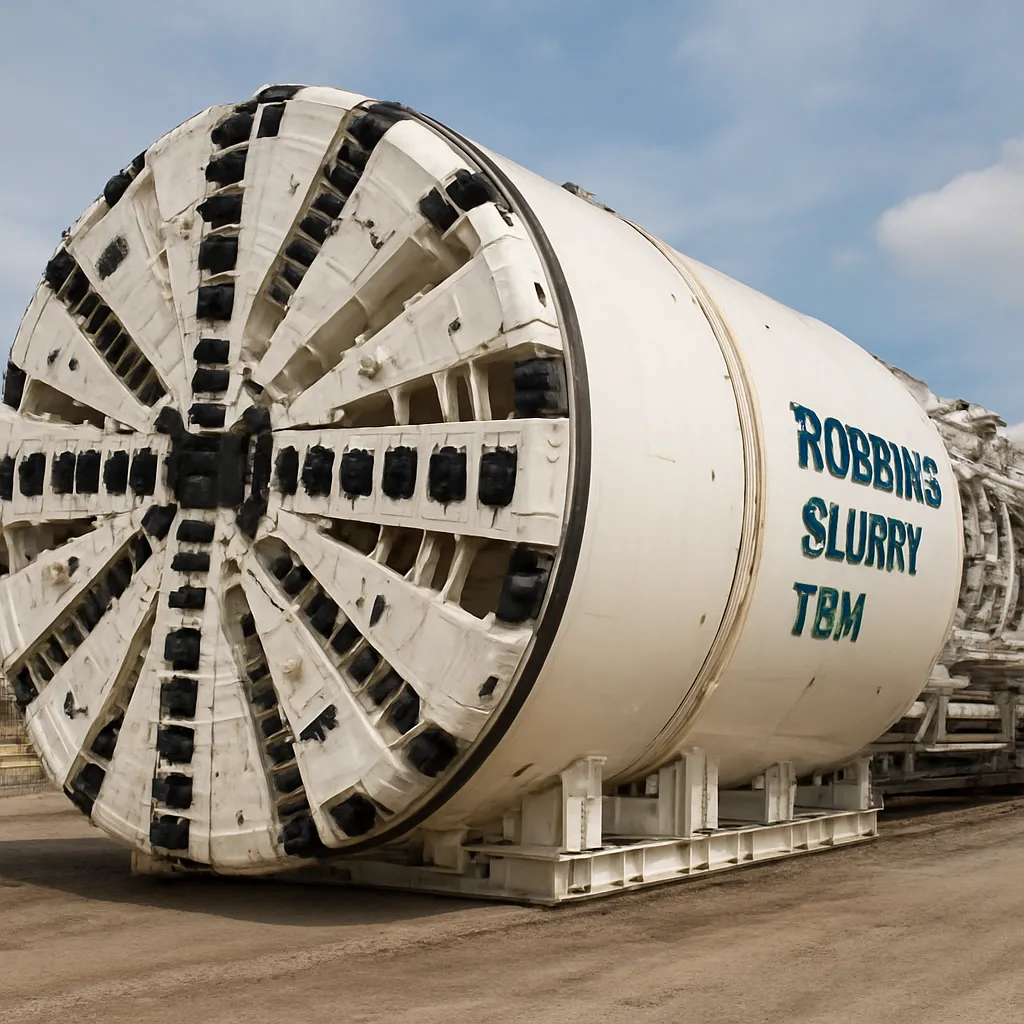
The Robbins Slurry TBM 14m is a specialist tunneling machine designed for large-diameter underground works in complex and water-bearing ground conditions. Combining a robust cutterhead and shield with a closed-circuit slurry support system, this machine is engineered to provide controlled excavation in pressuresensitive soils such as silt, sand, and mixed face geology. In the following sections we explore its design, typical applications, operational systems, logistics, safety and environmental aspects, and emerging trends in large-diameter slurry tunneling.
Design and technical overview
Basic concept
The Robbins Slurry TBM 14m is a pressurized, slurry-shield tunnel boring machine with an outer cutterhead diameter of approximately 14-meter. It uses a rotating cutterhead to detach material from the face while maintaining face stability by balancing hydraulic and slurry pressures. Excavated material is carried away in an engineered slurry medium, which protects the face and transports cuttings to a surface separation plant.
Main components
- Cutterhead and disc cutters — heavy-duty cutters or mixed-cutting tools mounted on a robust cutterhead designed to handle abrasive and variable geology.
- Pressurized shield — a sealed excavation chamber that resists external groundwater and soil pressures.
- Slurry circuit — including excavation chamber, slurry pumps, pipeline to the surface, and treatment/separation plant.
- Hydraulic thrust and steering system — jacks and actuators to push the machine forward and control alignment.
- Trailing gear — back-up gantry housing conveyors, pumps, electrical switchgear, and logistics space for lining erection and site utilities.
- Segment erector — robotic or semi-automatic device for installing precast concrete segments to form the permanent tunnel lining.
Approximate performance parameters (typical ranges)
Exact performance depends on ground conditions and project-specific configuration. Typical approximate figures for a 14m slurry TBM are:
- Outer diameter: ~14.0 m (cutterhead)
- Finished internal tunnel diameter: commonly 11–13 m depending on lining thickness
- Installed drive power: roughly 4–12 MW (varies with geology and cutterhead design)
- Cutterhead torque: from several hundred kNm up to low MNm ranges depending on gearing and motors
- Thrust capacity: up to several thousand tonnes-force distributed across multiple hydraulic jacks
- Advance rate: typically from a few meters/day in demanding mixed-face conditions up to 20–30 m/day under favorable homogeneous soils — averages often lie in the single-digit meters/day range for difficult projects
- Slurry flow rate: dependent on machine size and face conditions, usually on the order of hundreds to a few thousand m3/hour for large-diameter machines
Primary applications and project types
Water transfer and pipelines
Large-diameter slurry TBMs are commonly selected for water supply tunnels, raw water transfer, and large-diameter pipelines where uninterrupted face control under pressurized groundwater is critical. The slurry system provides stable support and enables excavation below the groundwater table with reduced risk of settlement.
Hydropower and intake/outlet tunnels
Hydropower projects often require deep intake tunnels cut through mixed alluvial and rock strata with high groundwater pressure. The Robbins Slurry TBM 14m can be configured for high-pressure slurry support and robust cutterheads to meet these challenges.
Metro and rail caverns
For urban tunneling where minimal surface settlement and safe passage beneath sensitive infrastructure are required, slurry shield TBMs are used to construct passages for metro lines or large cross-sectional corridors. A 14m machine can form single-bore twin-track tunnels or large utility passages where conventional smaller TBMs would be less efficient.
Underground caverns and plant spaces
When creating large, long underground caverns or connecting adits for underground facilities, a large-diameter slurry TBM is an option to quickly and safely excavate sizeable cross-sections in variable ground.
Operation of the slurry system and face control
Slurry medium and mechanics
Face support is achieved by a circulating slurry — typically a bentonite-based or polymer-modified suspension — that transmits hydrostatic pressure to the excavation face. The slurry cushions the face, prevents inflows and cave-ins, and transports cuttings away from the cutterhead via the slurry return line.
Slurry management and separation
At the surface, the excavated slurry is processed in a separation plant consisting of:
- Primary de-sanding using hydrocyclones
- Fine particle removal and clarification via flocculation and sedimentation
- Polymer dosing systems and centrifuges where required
- Return pumps to convey clean slurry back to the TBM
Effective slurry processing achieves high solids recovery (commonly >90–95% under optimized systems) and minimizes disposal volumes. The recovered solids are dewatered and disposed of or reused depending on project permits.
Face pressure control and instrumentation
Modern machines are equipped with an array of instrumentation to monitor:
- Slurry pressure at multiple points
- Cutterhead torque and RPM
- Grout pressures in the annulus
- Ground settlement via surface and subsurface monitoring
Closed-loop control systems allow operators to adjust slurry densities, pump rates and cutterhead parameters in near real-time to maintain stability and optimize efficiency.
Logistics, assembly and site requirements
Launch shaft and site footprint
A 14m slurry TBM requires a substantial launch shaft or portal for assembly, typically excavated to the machine height plus space for trailing gear and segment storage. Shaft diameters or box sizes are often significantly larger than the cutterhead diameter to accommodate cranes, slurry plant connections and worker access. Assembly and testing on-site can take several weeks to months depending on complexity and local constraints.
Transport and supply chain
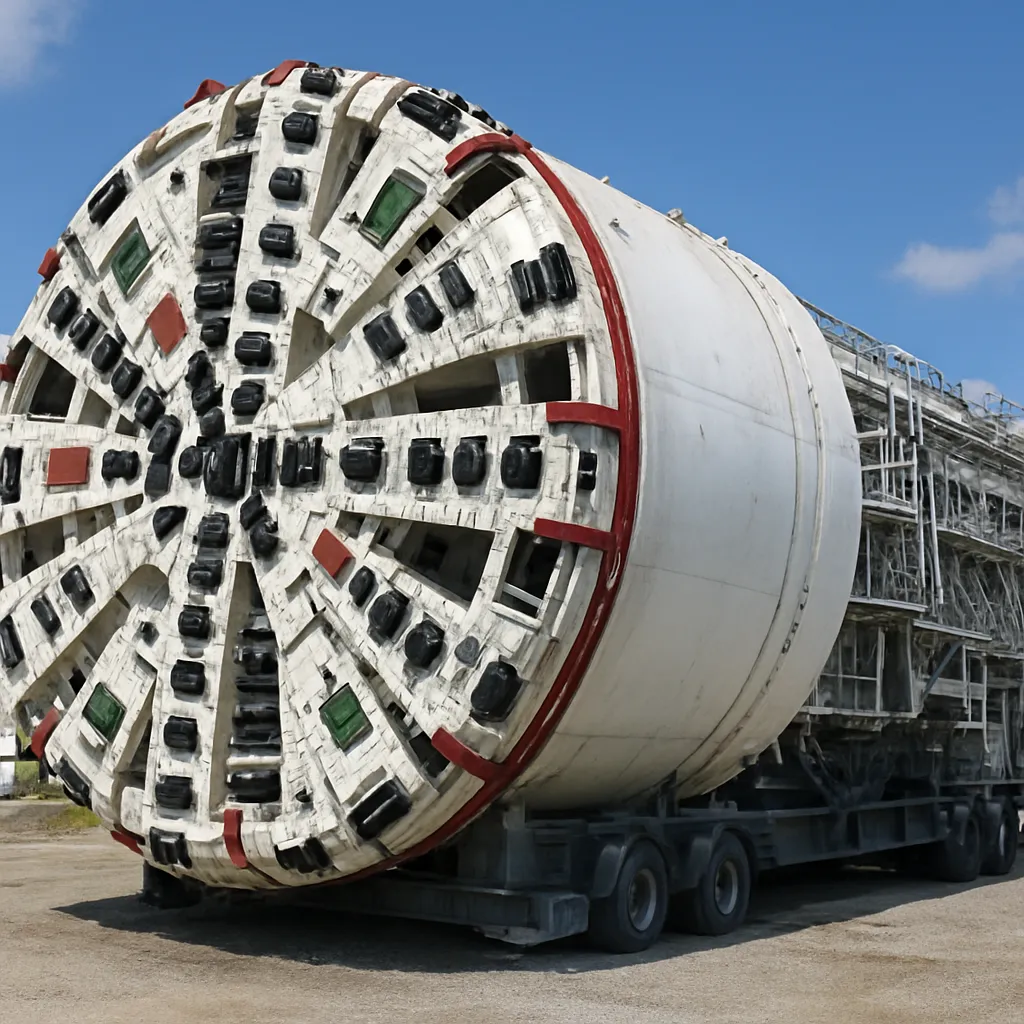
The TBM and its support systems are transported in many large modules. Logistics planning must cover:
- Heavy-lift cranes and rigging
- Road and rail permits for oversized loads
- Storage for precast segments (rings) and consumables (cutters, seals, slurry reagents)
- Power supply — often high-voltage grid connections and redundant generation capacity
Typical assembly and commissioning timeline
From delivery to launch, large TBMs can require between 2 and 6 months of site assembly, integration with slurry piping, and commissioning tests. Complex projects with difficult access or environmental restrictions may take longer.
Maintenance, cutter management and downtime
Cutter replacement strategy
Cutter wear is a major factor in operations. For large 14m cutterheads, disc cutters and pick assemblies are inspected and replaced as required through man-entry procedures in the working chamber or using remotely operated tooling where possible. An effective cutter management plan includes supplier logistics to avoid long lead times for replacement cutters.
Planned and unplanned maintenance
Planned maintenance windows are scheduled to inspect hydraulic systems, seals, slurry pumps, and electrical gear. Unplanned stoppages can be caused by severe ground conditions, slurry system upsets, or cutterhead blockages. Well-designed redundancy in slurry pumps and filtration equipment reduces downtime risk.
Safety and environmental considerations
Ground and groundwater control
One of the primary advantages of a slurry TBM is the ability to control groundwater inflow and minimize surface settlement. Continuous monitoring of slurry pressure, groundwater levels, and surface settlement is required to ensure safety of the works and adjacent structures.
Slurry disposal and environmental permits
Handling the waste stream in a compliant manner is crucial. Depending on local regulations and the geology encountered, slurry plant waste solids may need to be disposed of in licensed facilities or treated to remove contaminants. The use of environmentally benign polymers and closed-loop systems minimizes environmental impact.
Personnel safety
Working around a large slurry TBM involves high risks including confinedspace entry, heavy lifting, highpressure systems and electrical hazards. Comprehensive safety programs, confined-space procedures, and remote operation capabilities reduce personnel exposure to danger.
Advantages and limitations
Advantages
- Excellent face stability in water-bearing and granular soils
- Controlled settlement and reduced surface impacts
- Efficient for large cross-sectional single-bore tunnels (reduced need for secondary lining forms)
- High material handling capacity through the slurry pipeline
Limitations
- High initial capital cost for the machine and slurry plant
- Complex slurry management and regulatory requirements for disposal
- Logistics and access constraints for launching and assembling large units
- Performance is geology-dependent — mixed face with hard rock lenses can slow advance and increase wear
Operational case examples and statistical insights
Operational benchmarks
While project-specific rates vary, industry experience for large slurry TBMs suggests:
- Average productivity often falls between 3 and 12 meters/day for challenging mixed-face conditions;
- Peak productivity in homogeneous soft ground can exceed 20 m/day for a 14m-class machine;
- Slurry plant solids recovery rates are typically targeted above 90% to minimize waste and slurry make-up requirements.
These are generalized benchmarks — actual performance is influenced by cutterhead tooling, operator expertise, and continuous monitoring and optimization.
Known project-scale implications
Large-diameter slurry TBMs reduce the number of tunnels required in some infrastructure schemes by allowing single-bore solutions for twin-track or high-volume conduits. This can result in schedule compression and life-cycle cost savings despite higher upfront investment.
Economic considerations
Project owners should weigh the capital cost of a Robbins Slurry TBM 14m against alternatives such as multiple smaller bores, NATM, or drill-and-blast where applicable. Key economic drivers include:
- Speed of construction versus labor and material costs
- Risk reduction related to settlement-sensitive urban environments
- Long-term maintenance and operation of the tunnel (single bore may reduce interfaces)
Future trends and technological developments
Automation and digitalization
Advances in automated steering, predictive maintenance using machine learning, and remote operations are transforming TBM tunneling. Sensors across the machine and slurry circuit feed data to optimization systems that can adjust parameters to sustain high efficiency and reduce downtime.
Materials and cutting tool innovations
New alloy compositions for cutters, advanced cutterhead designs, and hybrid cutting toolsets improve wear life and enable better performance in abrasive mixed-conditions. These developments are particularly relevant for large-diameter machines where replacement is costly and time-consuming.
Environmental improvements
Improvements in slurry treatment technology, closed-loop water reuse and more benign reagents help reduce the environmental impact of slurry TBM operations. Regulations and community expectations drive continuous improvement in waste minimization.
Summary and practical considerations for contractors and owners
Choosing a Robbins Slurry TBM 14m is typically driven by project needs for a large single-bore solution in water-bearing or variable geology where face control and settlement mitigation are priorities. Owners should plan for the following practical aspects to maximize the chances of success:
- Comprehensive geological and hydrogeological investigations to define cutterhead and slurry system requirements.
- Robust logistics planning for module transport, launch shaft construction and on-site assembly.
- An experienced supply chain for cutter tooling, slurry reagents and separation plant support.
- Detailed environmental permitting and a cradle-to-grave plan for slurry waste management.
- Investment in monitoring systems and operational training to enable real-time decision making and reduce downtime.
When configured and operated correctly, a 14m Robbins Slurry TBM can be a highly effective solution for demanding large-diameter tunneling projects, offering controlled excavation, minimized surface impacts and the ability to tackle challenging groundwater conditions with high levels of operational safety and predictability.
)
)