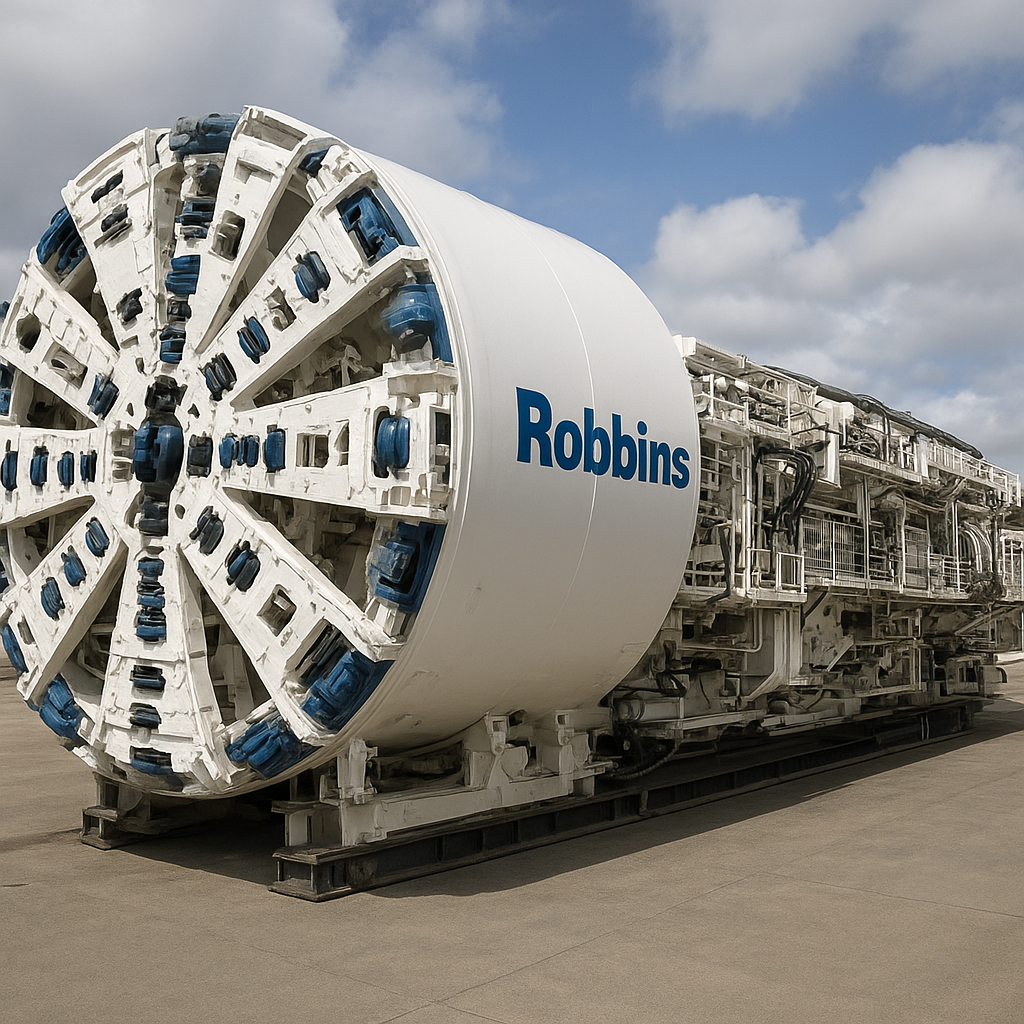
This article provides a detailed look at the Robbins Main Beam TBM, explaining its design, typical applications, operational principles and maintenance, and placing the machine in the context of modern tunneling technology. It is intended for engineers, project managers and anyone interested in the practical use of tunnel boring machines and the engineering choices that make them effective in various ground conditions.
Overview and design principles
The Robbins Main Beam TBM is a type of tunnel boring machine associated with The Robbins Company and its family of tunneling solutions. At its core the machine integrates a rotating cutting assembly with a structural main support frame—commonly referred to as the main beam—that carries the cutterhead drive, thrust cylinders and the trailing gear. The design focus is robust support of the cutterhead and conveyor under heavy loads while providing flexibility for different excavation strategies.
Key components and functions include:
- Cutterhead — the rotating face that breaks the rock or soil and controls muck production.
- Thrust and torque systems — hydraulic cylinders and drives that push the cutterhead forward and provide the rotational force necessary to cut through ground.
- Shield and tunnel support — an external shield or structural frame that protects the excavation face and provides a working platform for lining installation.
- Muck handling — conveyors, slurry systems or muck cars that remove excavated material from the face to the spoil handling area.
- Control and monitoring systems — instrumentation for torque, thrust, cutter wear, face pressure and other parameters to maintain safe and efficient operation.
The term “Main Beam” highlights the emphasis on a central structural member engineered to carry and distribute the forces generated at the cutterhead. This approach is especially valuable when integrating heavy drive systems, larger cutterheads or hybrid tools. While many TBM designs emphasize a ring or segmented rear shield, the main beam design concentrates the primary structural stiffness into a longitudinal element, which can simplify modular assembly, maintenance access and replacement of key components.
Applications and where it is used
Robbins Main Beam TBMs are used across a wide variety of tunneling projects. Their versatility makes them suitable for:
- Urban metro and rail tunnels requiring precise alignment and limited surface disruption.
- Hydropower and water conveyance tunnels where long drives and variable geology are common.
- Utility and sewer tunnels in mixed-face or soft-ground conditions.
- Mining drifts and access tunnels where robust cutterhead performance and frequent maintenance access are necessary.
- Large civil works such as road tunnels and undersea crossings when combined with appropriate sealing and slurry systems.
The machine is particularly practical where heavy duty cutting force is required and where a robust structural backbone improves reliability. In mixed-face conditions—where rock, soil and water-bearing strata may be encountered in short succession—the main beam layout simplifies the integration of additional systems such as slurry circuits, segment erectors and pressurization equipment.
Technical characteristics and typical statistics
TBMs vary widely in size and power depending on project requirements. The following figures are approximate ranges representative of modern main-beam-style TBMs and are intended as guidance rather than absolute specifications:
- Diameter range: approximately 0.8 m for small utility machines up to 19 m+ for very large caverns and hydro tunnels; many Robbins machines fall in the 3–10 m range for common metro and water projects.
- Installed drive power: roughly 100 kW for small machines up to several megawatts (often in the range of 1–20 MW) for large diameter TBMs.
- Thrust capacity: varies from a few hundred kN for compact machines to tens of thousands of kN for large main beam TBMs; thrust values are designed to match cutterhead area and expected ground resistance.
- Advance rates: highly dependent on geology—soft ground TBMs may achieve tens of meters per day in favorable conditions, whereas hard rock TBMs can range from less than 1 m/day to over 30 m/day in favorable fractured rock. Typical project averages are often in the low single-digit to double-digit meters per day.
- Cutter life and maintenance: cutter wear depends on rock abrasivity and operator strategy; cutters or disc cutters may last anywhere from a few hundred meters to several thousand meters of advance before replacement or refurbishment is required.
- Muck removal rates: matched to cutterhead production and conveyor/slurry system capacity; continuous removal is essential to maintain face stability and avoid downtime.
Operators typically size the cutterhead, powertrain and hydraulics to provide headroom for adverse conditions. Conservative design margins are common because geology can vary drastically over short distances and unexpected abrasive or blocky sections can increase wear and energy demand.
Operational considerations and best practices
Successful deployment of a Robbins Main Beam TBM requires attention to planning, instrumentation and adaptive operation:
Geotechnical investigation and pre-construction planning
Extensive site investigation reduces uncertainty. Boreholes, geophysical surveys and in situ testing inform cutter choice, segment design and support strategies. In mixed-face jobs a staged plan for face conditioning, grouting and segment erection is critical.
Face support and ground control
Face support techniques—pressurized-face systems, slurry balancing, foam or grout injection—are often integrated. For water-bearing sands and silts, pressurized systems protect the face; in competent rock, a non-pressurized open-face TBM may be preferred.
Muck handling and logistics
Efficient spoil removal is a major determinant of production. Conveyors, slurry pipelines or muck cars must be sized and routed to match the anticipated production rate. On long drives the logistics of spoil disposal and ventilation take on increasing importance.
Wear management and maintenance
Planned maintenance windows, remote monitoring for wear indicators and an organized spare-parts strategy limit downtime. Main beam designs can simplify access to critical drive components, but cutter replacement and segment handling still require careful planning.
Safety, monitoring and automation
Modern TBMs are equipped with instrumentation for torque, thrust, face pressure, cutterhead vibration and automated alarms. Increasingly, control rooms use real-time dashboards to optimize performance and react to changing ground conditions. Automation helps reduce operator fatigue and improves repeatability, but skilled personnel remain essential for troubleshooting and non-standard situations.
Maintenance, life-cycle costs and risk management
Life-cycle costs for a TBM project extend well beyond machine purchase. Considerations include mobilization and assembly, consumables (cutters, seals), power consumption, personnel, and the cost of unscheduled downtime. Risk management practices include:
- Redundant monitoring systems to detect early warning signs of component failure.
- Modular designs that allow extraction and replacement of major components with minimal schedule impact.
- Spare parts inventory for high-wear items such as cutters, seals and bearings.
- Training programs to keep operators and maintenance crews current with the machine’s systems.
Planned maintenance strategies and condition-based maintenance — driven by sensor data — reduce overall project cost by avoiding catastrophic failures and optimizing component life. Many modern TBM owners use predictive analytics to schedule interventions at optimal times.
Innovations and future directions
Tunneling technology is evolving rapidly, and Robbins-style main beam TBMs have benefited from several innovations:
- Advanced materials and improved cutter metallurgy that extend wear life in abrasive rock.
- Digital twins and enhanced monitoring platforms that simulate machine performance and predict failures.
- Hybrid machines that can switch between open-face mechanical excavation and slurry or EPB modes to handle rapidly changing ground.
- Improved segment handling and erectors integrated into the trailing gear to speed lining installation.
- Energy recovery and efficiency improvements to reduce the environmental footprint of long tunneling projects.
Automation and remote operation are becoming increasingly important for both productivity and safety. Remote diagnostics reduce the need for personnel in hazardous zones and enable rapid expert support from off-site teams.
Environmental and social considerations
Tunneling projects often take place in urban or environmentally sensitive areas, and machine selection and operation must reflect these constraints. Key considerations include:
- Ground settlement control — strict monitoring and compensation grouting help protect surface structures.
- Noise and vibration mitigation — machine design, launch/reception shafts and construction sequencing are planned to minimize community impact.
- Water and slurry management — closed-loop systems minimize discharge; treatment and disposal of spoil must meet regulatory requirements.
- Stakeholder engagement — regular communication with local communities and authorities to manage expectations and address concerns.
Practical examples of project types and expected performance
Rather than focusing on individual proprietary projects, it is useful to categorize typical outcomes for main-beam TBMs by project type:
- Urban metro tunnel: Typical diameters 4–7 m; average advance rates in good ground 8–20 m/day; primary lining installed as precast segments behind the shield.
- Water conveyance / pressure tunnel: Diameters often 3–10 m; may require slurry balance or closed-face operation; high emphasis on alignment and watertight segment joints.
- Mining and access tunnels: Diameters 2–6 m; frequent maintenance access and cutter changes; production optimized for short cycles and rapid redeployment.
These example figures are approximate and depend strongly on site-specific geology, contractor experience and the equipment configuration chosen for the job.
Conclusion
The Robbins Main Beam TBM represents a practical and flexible approach to mechanical tunnel boring when loads, cutterhead size and the need for a strong longitudinal structure dominate design choices. Its strengths lie in robust structural support, adaptability to mixed-face conditions and integration potential for modern sensors and automation. Proper pre-construction investigation, planning for muck handling and maintenance, and the adoption of predictive monitoring are central to achieving the best performance and controlling life-cycle costs.
By combining thoughtful machine selection with disciplined operational practice and modern digital tools, project teams can deploy Robbins Main Beam TBMs to build safe, efficient and low-impact tunnels across a wide range of civil and mining applications.
)
)