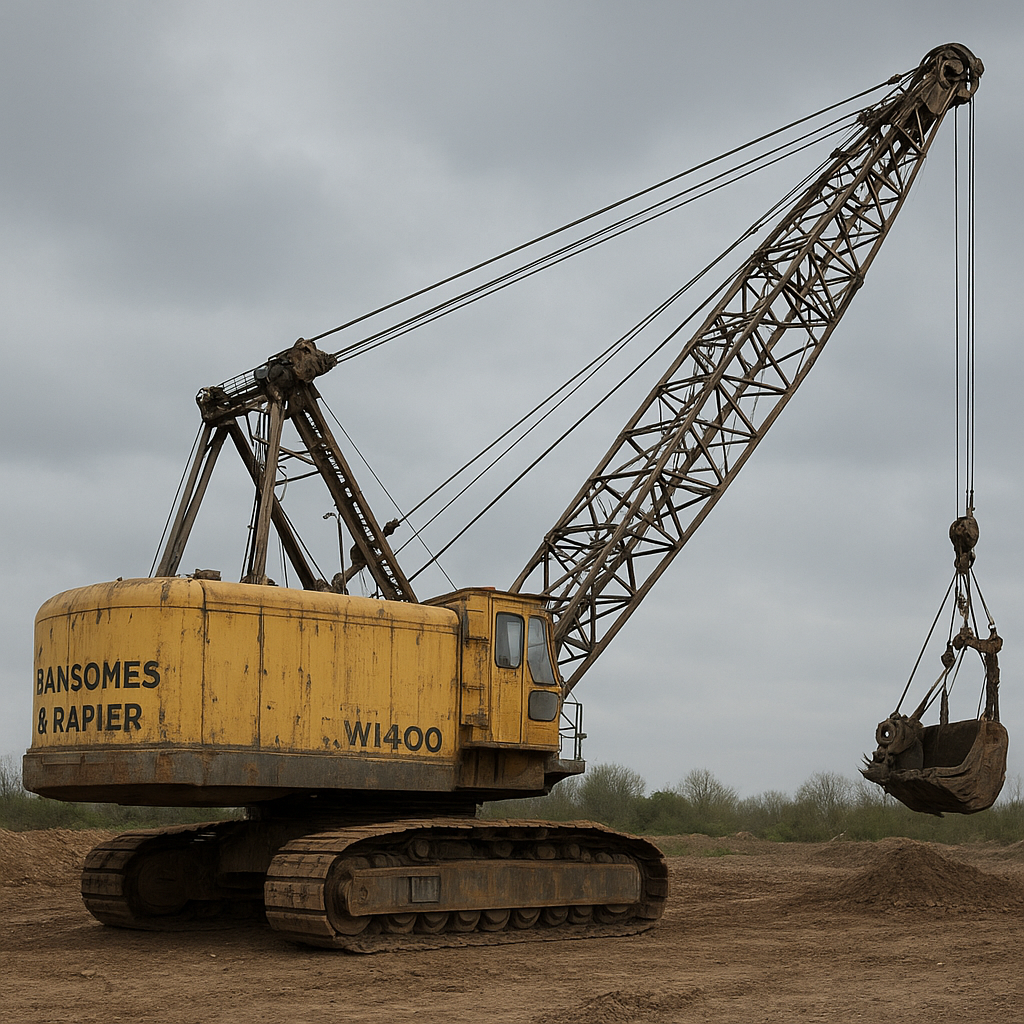
The Ransomes & Rapier W1400 dragline represents an important example of mid-20th century heavy excavation equipment, combining robust mechanical engineering with the adaptability demanded by mining and large-scale earthmoving projects. Built by the British firm Ransomes & Rapier, the W1400 and machines of its class were designed for continuous, heavy-duty operation in surface coal mines, large civil engineering schemes, and major harbor and river works. This article explores the W1400’s origins, design principles, operational roles, maintenance challenges, and broader significance to industrial history and modern earthmoving practice.
Historical context and development
The company Ransomes & Rapier, with roots in 18th- and 19th-century British engineering, produced a wide range of industrial machinery. During the post-war expansion of surface mining and infrastructure projects, demand grew for powerful, reliable excavators capable of moving large volumes of material quickly and efficiently. The W1400 emerged within this environment as a purpose-designed dragline excavator intended to provide long-reach, high-throughput digging capability while offering a degree of mobility and maintainability for use on extended campaigns.
Draglines evolved from cable-operated excavators with a simple operating principle: a large bucket is lowered by a hoist or winch, dragged across the spoil by a cable, and then lifted and swung to dump the material. Over the decades, improvements in steel, winch technology, and gearbox design allowed manufacturers like Ransomes & Rapier to scale these machines to greater capacities. The W1400 fits in the lineage of medium-to-large draglines common in the mid to late 20th century that balanced size, transportability, and cost.
Design and technical features
The W1400’s architecture follows the classic dragline layout: a stable base or chassis supporting a rotating platform (the house), a long lattice or boxed boom, a system of winches and drums controlling several cables, and a heavy-duty bucket. While exact factory publications for the W1400 are not widely digitized, key design characteristics typical of Ransomes & Rapier draglines and relevant to the W1400 include:
- Structural frame and house: a welded steel house designed to accommodate the engine room, winches, operator cabin, and counterweight systems. The house rotates on a slewing ring to enable continuous 360° operation.
- Boom: a robust lattice or box-section boom providing reach. Length options were often offered to suit different site requirements; longer booms increased reach at the cost of higher structural loads and rigging complexity.
- Bucket and rigging: the dragline bucket, controlled by drag and hoist ropes, is typically a shallow, capacious shell suited to bulk material movement rather than precision trenching. Ransomes & Rapier designed buckets with quick-release and wear-resistant liners to reduce downtime.
- Winches and powertrain: diesel engines commonly drove the hydraulic or mechanical winch systems. Some machines used electric drive arrangements where site power was available. Multiple drums controlled hoist, drag, and swing functions, often with mechanical gearboxes and brake systems engineered for heavy cyclic loads.
- Undercarriage and movement: many draglines in the W1400’s size range used crawler tracks for relocation on site, while larger models required disassembly for transport. The undercarriage had to resist substantial point loads, so track rollers, pads, and bearings featured heavy-duty specifications.
- Operator controls and ergonomics: the cabin offered visibility over the bucket path, with redundant instrumentation for safety. Mechanical linkages, hydraulic assist, or early electrical control systems were used depending on the delivery year.
In terms of performance metrics, machines of this category typically prioritized bucket fill efficiency, cycle time, and reach. While precise W1400 numbers depend on configuration and era, typical design goals included maximizing the bucket’s fill factor with given rope angles and swing radii, maintaining reasonable operating cycles (minutes per bucket cycle) and enabling extended service intervals for wear components.
Applications and industries
The primary function of the W1400 was bulk excavation. Its typical applications included:
- Surface coal and mineral mining: Draglines are historically synonymous with surface coal extraction, where their long reach enables removal of overburden in benches, often allowing a single machine to expose multiple coal horizons in a single setup.
- Large-scale civil engineering: construction of reservoirs, canal and river dredging, and harbor works benefited from draglines’ ability to move large volumes with fewer repositionings.
- Bulk earthworks in infrastructure: highway and dam construction projects used draglines where long-reach removal of material or placement of spoil was advantageous.
- Aggregate and reclamation projects: shoreline reclamation, pond dredging and beach nourishment sometimes leveraged dragline capability for sustained dredging and placing operations.
What made the W1400 appealing across these sectors was the combination of reach, continuous digging capability, and relatively straightforward mechanical systems that could be serviced in field conditions. Compared with hydraulic excavators, cable-drag systems offer exceptional simplicity for repetitive, high-volume cycles where precise bucket articulation is less critical.
Operation and productivity
Operational productivity for draglines like the W1400 depends on several interacting variables: bucket capacity and fill factor, swing radius, rope handling efficiency, cycle time, and site logistics (haul roads, spoil placement). Effective operation requires coordinated planning of benching, muck pile geometry, and fleet interactions so that the dragline’s continuous output matches the hauling system’s capacity.
Typical operational features and practices include:
- Bench design: benches are planned in widths and heights to let the dragline reach desired spoil and ore faces without frequent repositioning.
- Cycle optimization: experienced operators adjust dragline swing speed, drag-rope tension, and hoist timing to optimize fill while minimizing rope wear and spillage.
- Maintenance windows: scheduled track and rope inspections are built into operating routines. Wear parts such as bucket teeth, liners, and side plates are replaced according to condition-based schedules.
- Support systems: the dragline is often paired with haul trucks, conveyors, or dozers that shape spoil piles to improve bucket filling and reduce idle time.
Productivity statistics vary widely by site. For mid-size draglines, measured material moved per hour can range from a few hundred to several thousand cubic meters, depending on bucket size and cycle time. Because exact published figures for the W1400 are limited in accessible archives, these ranges should be viewed as typical class-level expectations rather than definitive W1400 values.
Maintenance, longevity, and modernization
One of the strengths of machines like the W1400 is the potential for long service lives when maintained. Several factors contribute to longevity:
- Simplicity of mechanical design: cable and drum systems, while heavy, are easier to inspect and repair than highly integrated hydraulic systems common in later excavators.
- Availability of spare parts: for vintage equipment, aftermarket suppliers and specialist workshops often fabricate worn components, including ropes, pins, and hydraulic pumps, extending operational life.
- Refurbishment and repowering: many older draglines undergo repowering with modern diesel engines or conversion to electric drive setups if site power allows, improving fuel economy and emissions.
- Structural life extension: booms and houses can be reinforced; wear-prone components replaced; and slewing bearings overhauled to preserve structural integrity.
Regular maintenance practices critical to safety and uptime include rope inspection and scheduled replacement, lubrication of slew and track bearings, nondestructive testing for structural cracks, and frequent checks on winch brakes and control systems. Modern upgrades sometimes add instrumentation for condition monitoring—vibration sensors, rope-tension monitors and load cells—to shift from calendar-based to condition-based maintenance.
Safety and environmental considerations
Draglines operate under significant mechanical loads and present several hazards. Safety protocols focus on preventing dropped loads, rope failures, and uncontrolled swings. Typical safety measures are:
- Restrictive exclusion zones: only necessary personnel and vehicles are permitted within defined radii of the swing and dump paths.
- Redundant braking and locking: multiple brake systems and mechanical locks reduce the risk of runaway booms or buckets.
- Rope management: regular rope inspection, proper storage and correct spooling procedures reduce abrupt failures.
- Operator training and ergonomics: experienced operators are essential; modern retrofits improve cabin comfort and visibility while adding electronic aids.
Environmental impacts are tied to the scale of earthmoving: dust, spoil displacement, and changes to local drainage. Mitigation strategies include water sprays to control dust, staged vegetation and reclamation planning, and careful pond and slope design to reduce erosion. In recent decades, environmental regulation has pushed operators to plan closure, progressive rehabilitation and to adopt machines with lower emissions, areas where refurbished W1400 units can be upgraded to meet local requirements.
Notable projects and field performance
Many Ransomes & Rapier draglines saw service in the UK, continental Europe, Africa, and Asia. They were commonly employed in coalfields and in major civil projects like reservoir excavation and harbor construction. While comprehensive, machine-by-machine records for the W1400 are not always centralized in public sources, preserved examples in industrial museums or private collections attest to their historic deployment.
Field performance anecdotes often emphasize the W1400’s ability to work continuously in harsh conditions, and its relative ease of repair compared with more complex hydraulic excavators. In pits where routine blasting left large, loose overburden, draglines like the W1400 could deliver steady, high-tonnage output with relatively low operator oversight once properly set up.
Comparisons with other excavator types
Compared with rope shovels and hydraulic excavators, draglines such as the W1400 present trade-offs:
- Advantages: long reach, simple mechanics, high throughput for repetitive stripping tasks, and often lower operating cost per cubic meter when site logistics are optimized.
- Disadvantages: limited precision, dependence on pile geometry for effective bucket filling, and decreased versatility in confined or urban sites where maneuverability and fine control are necessary.
As hydraulic excavator technology improved, particularly in the late 20th century, many operations shifted to hydraulic machines for tasks requiring versatility. Nonetheless, draglines retained niches where reach and continuous bulk movement were paramount.
Preservation, legacy, and industrial heritage
Several preserved draglines and components from the Ransomes & Rapier lineage survive in museums and as static displays, recognized for their engineering significance and role in regional industrial histories. Preserving a W1400 involves unique challenges because of the size and weight of components, but where successful, these machines provide tangible links to coal-mining communities and large-scale civil engineering eras.
The cultural legacy of machines like the W1400 includes influence on local economies, employment patterns and the built environment in areas where surface mining shaped landscapes and towns. Documenting and preserving oral histories from operators, technicians, and site managers adds human context to the mechanical story.
Conclusion and outlook
The Ransomes & Rapier W1400 dragline stands as a representative of a class of heavy machinery that powered a generation of surface mining and large earthworks. While not as globally famous as some of the largest American-built draglines, the W1400’s design philosophy—sturdy construction, mechanical simplicity and adaptability—ensured its usefulness in a variety of demanding contexts. Today, where preserved or still in limited operation, W1400 units illustrate both the technical ingenuity of mid-century engineering and the evolving challenges of maintaining and updating heavy equipment for modern environmental and safety expectations.
Selected technical and operational notes (summary)
- Machine type: cable-operated dragline excavator
- Manufacturer: Ransomes & Rapier
- Typical applications: surface mining, dredging, civil earthworks
- Key components: boom, bucket, hoist and drag winches, slewing house, crawler undercarriage
- Maintenance focus: rope condition, bucket wear parts, slewing bearing lubrication, winch brake integrity
Notes on specifications and records
Published, machine-specific technical data for the W1400 can be limited in online archives. Many mid-century equipment manuals and specification sheets remain in print archives or company records. Typical class-level statistics — such as bucket volumes, boom lengths, and engine powers — vary by configuration and site customization. For authoritative, project-level data on a particular W1400, consult preserved factory manuals, maintenance records from owners, or museum collections that hold machine documentation.
)
)