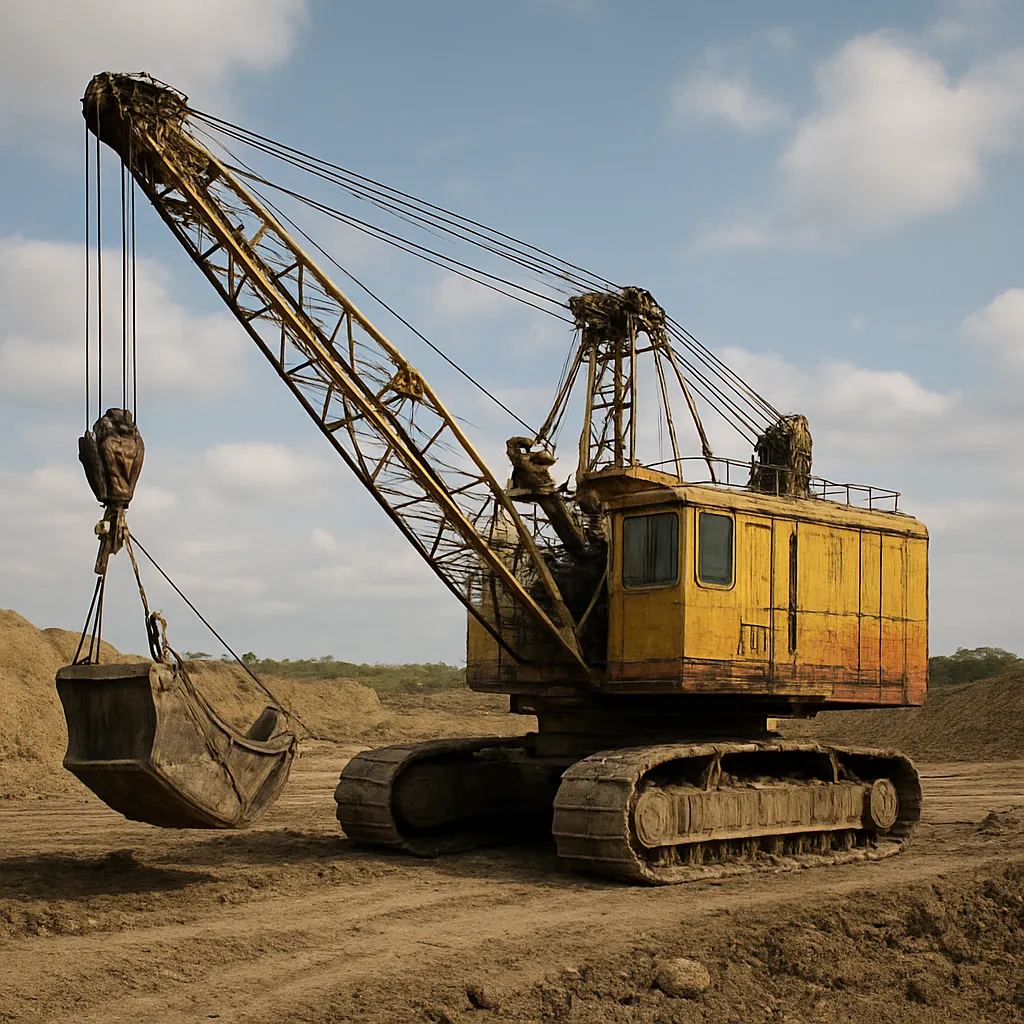
The Ransomes & Rapier W1200 dragline represents a class of large-scale, purpose-built excavation machines that have played a significant role in surface mining, civil engineering and land reclamation projects. Combining the traditional principles of cable-operated excavation with industrial-scale engineering, the W1200 and machines like it are designed to move massive volumes of material with a single pass. This article explores the machine’s origins, technical design, typical applications, operational characteristics and the broader context of dragline use. It also reviews available statistical and performance-related information where public data exists, and highlights practical considerations for deployment and maintenance.
History and development
The name Ransomes & Rapier evokes a long British engineering tradition. Founded in the 19th century and based in Ipswich, Ransomes & Rapier produced a wide range of heavy equipment including cranes, excavators and crushing plant. Over decades the company adapted to changing industrial needs, and its dragline designs became known for robust mechanical layouts and reliability in harsh mining environments.
The development of the W1200 model should be seen in the context of mid-20th century advances in electro-mechanical power systems, steel fabrication and cable technology. The W1200 and similar models evolved from earlier steam- and mechanically-driven machines into electrically powered giants with significantly higher productivity, longer booms and larger bucket sizes.
Design and key components
At its core, the dragline is a cable-operated excavator. The W1200’s major components reflect this principle and include a rotating house, an extensive boom, a large bucket, hoist and drag winches, counterweight systems, and a crawler or pedestal undercarriage. Below are the essential elements and their roles.
House and slewing system
- The rotating house contains the main drive motors, winches, operator cab and control systems. Slewing mechanisms allow the house to rotate 360 degrees or within required operational sectors.
- Electrically driven motors — often medium-voltage AC or DC systems historically — provide the torque for rotation and winch operations.
Boom and rigging
- The boom is typically a trussed steel structure, designed to resist bending under load while minimizing weight. Boom lengths for W1200-class machines vary with application but are engineered to reach excavation faces at long radii.
- Rigging includes multiple sheaves, strong hoist and drag ropes, and a system of blocks that transfer load between the bucket and winches.
Bucket and operating cycle
- The bucket of a W1200-class dragline is designed for high-volume scooping and dragging. Capacities can vary widely by configuration; the bucket is dragged across the material face by the drag line until it is filled, then hoisted and swung to the spoil area.
- Typical operating cycle phases include positioning, crowding/dragging to fill, hoisting, swinging to the dump, dumping, and returning to the face.
Power supply and drives
Large draglines such as the W1200 are normally powered by on-board electric drives fed from stationary transformers or mobile substations. Earlier models used DC systems and mechanical gearboxes; modernized units may be retrofitted with AC variable-frequency drives to improve efficiency and control.
Applications and industries served
The primary applications of the W1200 and its peers are in industries where bulk material movement is central. The machine excels when large, continuous volumes of near-surface deposits must be removed economically and efficiently.
Surface and strip mining
- Coal mining: Draglines have historically been indispensable in removing overburden to expose flat-lying coal seams. Their ability to work at long radii and to move huge volumes of overburden in a few passes makes them cost-effective in large coalfields.
- Heavy mineral sands and other soft overburden mines: The dragline is used where material characteristics allow the bucket to drag and fill efficiently.
Civil engineering and reclamation
- Harbour and canal construction: Draglines can be deployed for deepening channels, building basins and dredging within reach of their booms.
- Land reclamation and bulk earthworks: Large coastal or inland reclamation projects use draglines to redistribute material and create engineered landforms.
Infrastructure projects
- Large linear infrastructure (railway and highway embankments) can benefit from dragline excavation in preparatory works, especially where removal of large volumes of weak overburden is required.
Performance, productivity and statistics
Exact, manufacturer-certified specifications for the Ransomes & Rapier W1200 are not widely published in public domain sources. Many historic dragline models have been customized for client needs, which further complicates the provision of single definitive figures. However, typical performance metrics for machines in this class can be summarized to give a useful operational understanding.
Typical specification ranges (approximate)
- Boom length: approximately 40–90 meters (variations depend on configuration and role).
- Bucket capacity: for mid- to large-size draglines, bucket capacities commonly range from about 15 to 60 cubic meters (20–80 cubic yards); some very large machines exceed this.
- Operating weight: can vary from a few hundred tonnes for small models up to several thousand tonnes for the heaviest draglines.
- Installed power: main drive and winch power typically ranges from several hundred kW to several MW depending on size and electrical system.
- Typical cycle productivity: a W1200-class dragline could move thousands to tens of thousands of cubic meters per day depending on bucket size, cycle time and operating hours.
These figures should be treated as indicative. In practice, productivity is influenced by face conditions, crew skill, maintenance state, and site logistics.
Material handling rates and efficiency
Dragline productivity is often measured in cubic meters per hour or per shift. For example, if a dragline with a 30 m3 bucket completes 20 loaded cycles per hour under ideal conditions, theoretical hourly throughput would be 600 m3/h. Real-world rates are lower due to positioning time, weather interruptions, and other delays. Large draglines working in optimized conditions may achieve consistent daily volumes that make them competitive with fleets of hydraulic excavators and trucks over wide, shallow deposit areas.
Operational considerations and site planning
Successful deployment of a W1200 dragline requires careful planning across several domains: geotechnical, electrical supply, logistics, and environmental management.
Geotechnical and site layout
- Draglines prefer stable, shallow overburden with minimal large boulders or highly cohesive soils that impede bucket filling.
- Site layout must include sufficient spoil areas reachable by the machine without frequent repositioning. The cost and time to reposition or reassemble a large dragline are significant.
Electrical and power supply
- Continuous, reliable power is essential. Sites often install dedicated substations and switchgear sized to the machine’s peak load.
- Power interruptions can cause costly downtime and stresses on electrical drives and winch systems; modern installations include backup systems and soft-start technologies.
Logistics and support
- Transport and assembly: moving a dragline between sites is a major operation involving disassembly of the boom and house, heavy-lift cranes, and careful engineering.
- Spare parts inventory must include critical items such as rope, bearings, sheaves, and electrical components to reduce unscheduled downtime.
Maintenance, lifecycle and modernization
Maintenance is a central determinant of a dragline’s economic life. The W1200 and similar models have long service lives when properly maintained, and many machines are modernized rather than retired.
Preventive and predictive maintenance
- Routine inspections: structure, ropes, sheaves, bucket teeth and wear plates, and electrical systems.
- Condition monitoring: vibration analysis, oil and lubricant analysis, and thermal imaging of electrical systems help predict failures before they occur.
Common upgrades and refurbishments
- Electronic control upgrades: replacing legacy relay or analog controls with PLC/PLC+HMI systems for better precision and diagnostics.
- Drive modernization: retrofitting with variable-frequency drives (VFDs) and soft-start systems can improve energy efficiency and reduce mechanical stress.
- Structural refurbishment: re-boom and house refurbishments extend service life when foundation and major structural elements remain sound.
Environmental and regulatory considerations
While draglines can be highly productive, their environmental footprint and regulatory requirements are significant. Modern deployments must consider dust control, noise mitigation, groundwater management and progressive rehabilitation of disturbed land.
- Dust suppression strategies include water sprays, vegetative buffers and staged removal to minimize exposed surfaces.
- Noise from hoists, engines and structural vibration must be assessed and mitigated where mining operations are near communities.
- Proper dewatering and sediment control prevent downstream impacts; reclamation plans often require regrading and soil replacement to support future land uses.
Comparison with hydraulic excavators and truck-shovel systems
Draglines like the W1200 are often compared with hydraulic excavator-truck systems. The two approaches have different strengths and trade-offs.
- Capital intensity: draglines require large upfront capital and site preparation but typically lower operating cost per cubic meter in extensive, shallow deposits.
- Flexibility: hydraulic excavators paired with trucks offer greater mobility and flexibility for variable terrain and multiple faces, but can be more expensive in fuel and maintenance per tonne in large-scale overburden removal.
- Energy efficiency: in steady-state operations over long radii, draglines may be more energy-efficient because they eliminate the truck haul cycle for overburden placement.
Safety and workforce considerations
Operating and maintaining a W1200 requires skilled personnel. Safety protocols center on machine operation, electrical hazards, lifting and rope handling, and confined-space or elevated work on the boom and house.
- Comprehensive operator training and certification reduce human error.
- Lockout–tagout procedures and safe work permits are essential during maintenance and assembly/disassembly.
- Rescue plans and fall-protection systems are required for technicians working at height or on booms.
Notable projects and legacy
Throughout the 20th century, Ransomes & Rapier draglines contributed to major mining and civil works projects around the world. Though the W1200 as a specific model has limited widely published project attribution, machines of its class have been used in:
- Large-scale coal strip mines where continuous overburden removal was required to access multiple seams.
- Harbour deepening and reclamation works where long-reach excavation and spoil placement were advantageous.
- Infrastructure earthworks in regions where moving high volumes of material with minimal truck traffic reduced overall project cost and time.
Many historic draglines have become iconic pieces of industrial heritage. Some have been preserved in museums or as static displays to commemorate local mining histories.
Future prospects and technology trends
While the basic mechanical principle of the dragline remains unchanged, modern trends focus on improving efficiency, reducing emissions and increasing automation.
- Electrification and grid-integration: more efficient electric drives and smarter grid interactions lower energy costs and improve availability.
- Automation and remote operation: partial automation of cycle sequences and remote control reduce operator exposure to hazards and can improve consistency between cycles.
- Materials science: advanced wear materials for bucket teeth and improved rope technologies extend service intervals and reduce lifecycle cost.
Conclusions and practical guidance
The Ransomes & Rapier W1200 is representative of a class of machines that have been central to large-scale surface excavation for decades. Its principal advantages are in economies of scale, long reach and the ability to move very large volumes of material with relatively low ongoing crew requirements. Choosing a W1200-class dragline (or an equivalent machine) is most appropriate where deposits are laterally extensive, overburden is amenable to drag filling, and where a stable, high-capacity power supply and support infrastructure can be established.
Key decision factors when considering such a machine include:
- Geology and material properties at the excavation face.
- Availability of reliable high-power electrical supply.
- Ability to plan and construct large spoil placement areas reachable by the boom.
- Long-term production forecasts to justify capital expenditure.
- Maintenance capability, including access to skilled technicians and critical spare parts.
For historical and engineering enthusiasts, the W1200 stands as an example of robust industrial design grounded in the practical requirement to move mass at scale. As mining and construction practices evolve, draglines continue to find roles where their combination of reach, capacity and durability make them more than a legacy technology — they remain a competitive option in the right operational context.
Highlighted terms: Ransomes & Rapier, W1200, dragline, boom, bucket, coal, mining, excavation, capacity, maintenance
)
)