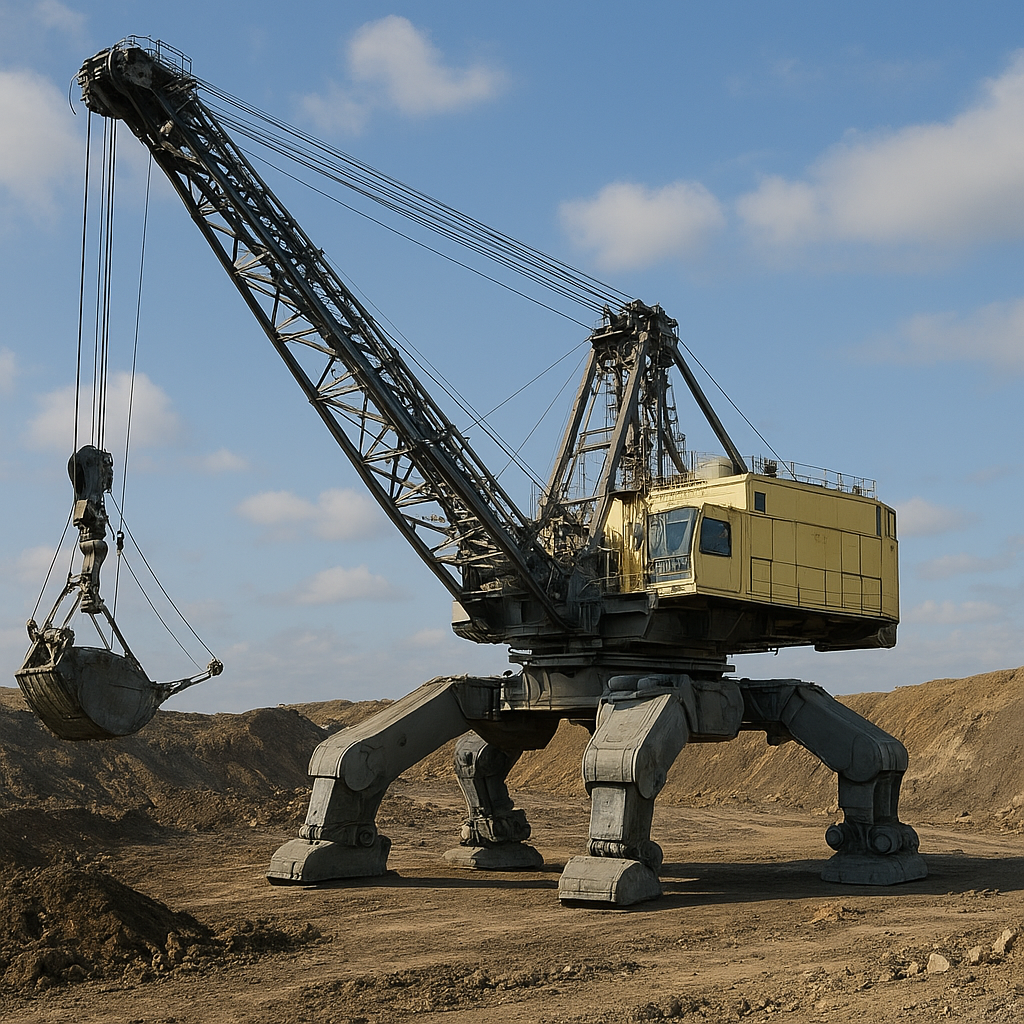
The OMZ Walking Excavator ESH 15/90 (dragline) represents a class of specialized machines designed for heavy earthmoving in challenging ground conditions. Combining a long-reach boom, cable-operated bucket and a characteristic walking undercarriage, this type of excavator is built to perform tasks that require reach, stability and low ground impact. In the following sections you will find a detailed overview of the machine’s design principles, typical applications, operational characteristics, maintenance considerations and modern adaptations. The information below emphasizes general technical and practical aspects relevant to users, engineers and planners considering the ESH 15/90 or comparable walking dragline machines.
Design and technical characteristics
The ESH 15/90 is best understood as a specialized dragline excavator with a walking chassis. Unlike crawler or wheeled excavators, walking machines use pedal-like or hydraulic lifting and stepping mechanisms to move, which reduces ground pressure and makes them ideal for soft or uneven terrain. Key components and design traits include:
- Boom: A long lattice or box-section boom provides the necessary reach. The boom geometry is optimized for deep cuts and extended radii, enabling excavation at distance from the machine base.
- Dragline system: A multi-rope cable arrangement connects the boom tip to the bucket, with separate hoist and drag winches controlling lift and pull-in. The bucket is dragged across the face and then hoisted to dump.
- Walking undercarriage: Instead of tracks, the machine uses walking pads or “shoes” that lift and advance the machine in increments. This design minimizes shear and sinking in soft soils.
- Powertrain: Typical power sources for machines of this class are diesel engines driving electric generators (diesel-electric) or direct hydraulic/diesel drives. Electrical systems provide smooth control for winches and often allow for regenerative braking on winch drums.
- Operator station and controls: Elevated cabins with good visibility are standard. Modern retrofits may include ergonomic controls, video feeds, and system diagnostics.
- Structural design: Reinforced house and pedestal to manage dynamic loads, plus counterweight systems sized to the boom geometry and bucket mass.
Because the designation ESH 15/90 appears in the model name, it is often interpreted by technicians and operators as indicating a specific capacity/size relationship (for example, a nominal class or relationship between bucket size and boom length). However, exact numeric meanings can vary by manufacturer or engineering series. Specifications for machines in this class typically vary with configuration; representative ranges for comparable walking draglines are:
- Nominal bucket capacity: ~5 to 25 m³ (varies by design and intended duty)
- Boom length (reach): ~20 to 60 m for medium-class walking draglines
- Operating weight: from ~40 to 300+ tonnes depending on size and counterweight
- Engine power: 200 to 2,500 kW for different classes (smaller walking draglines toward lower end)
- Walking step length and travel speed: incremental steps of under a meter per cycle and very low continuous travel speed measured in m/min
Note: The values above describe the typical class envelope. For planning, procurement or detailed design, always confirm the exact technical data from OMZ or the machine’s specific technical documentation.
Primary applications and operational contexts
Walking draglines like the ESH 15/90 are specialized machines chosen where conventional tracked excavators or hydraulic shovels would be less effective. The machine excels where low ground pressure, long reach and flexibility to operate on soft surfaces are required. Main application areas include:
- Open-pit mining: Removal of overburden and topsoil in strip mining operations, especially where a long reach and continuous cut pattern are advantageous.
- Peat harvesting and peatland reclamation: The walking undercarriage preserves sensitive bog surfaces while allowing movement across soft, waterlogged areas.
- Coastal and reclamation works: Construction of landfills, embankments and reclamation where shallow seabed or marshy approaches demand low ground pressure equipment.
- Trenching for pipelines and cable corridors: Draglines can be used for large-diameter trenching where reach and bucket capacity reduce the number of repositionings.
- Reservoir and canal excavation: Efficient at long-reach dredging of banks and re-profiling slopes without setting up cranes or barges in some contexts.
- Environmental remediation: Removal of contaminated soil layers in large-area interventions where access is limited and disturbance must be minimized.
- Large-scale civil engineering: Works such as levee construction, floodplain reshaping and slope stabilization, particularly in soft ground.
Compared with hydraulic excavators, the dragline method has advantages in continuous scooping over a face, which can translate into high productivity per cycle in appropriate geology. The walking mechanism allows the machine to advance on soft soils while exerting relatively low unit ground pressure, reducing the need for temporary roadways or extensive matting.
Operational performance and productivity considerations
Productivity of a walking dragline is determined by several interacting factors: bucket size, boom reach, cycle times for the hoist and drag winches, and the operator’s ability to manage cut patterns to minimize repositioning. Important operational parameters include:
- Cycle time: Efficient coordination of drag and hoist operations is critical. A well-maintained medium-class dragline in skilled hands can achieve high volumes per shift when operating against a continuous face.
- Bucket fill factor: Dragline buckets typically achieve high fill factors in cohesive to moderately cohesive materials; in very loose or rocky media, fill and penetration can be reduced.
- Depth and reach profile: Maximum effective operating depth and radius are determined by boom length and bucket geometry; planning excavation benches or sequences reduces swinging and repositioning time.
- Mobility: Walking speed is low, so job planning minimizes long transfers. For long moves, partial disassembly or transport on low-loaders is often necessary.
- Fuel and energy: Diesel-electric drives are common on larger machines and can improve energy efficiency for winch-intensive cycles; smaller diesel-hydraulic setups may use less total installed power but be less efficient in continuous high-power duty.
Typical productivity metrics are highly site-specific, but planners often measure output in cubic meters per hour or per shift. For a mid-sized walking dragline operating on suitable material, average outputs might range from several hundred to a few thousand cubic meters per shift; larger machines achieve higher absolute volumes. Because actual numbers depend on geology, bucket sizing, and operational discipline, it is best to conduct a site-specific productivity study or simulation before committing to a dragline procurement.
Maintenance, reliability and life-cycle aspects
Maintenance of an ESH 15/90-style walking dragline centers on several high-wear systems: cable and rope assemblies, winch drums and brakes, boom structural integrity, walking gear, and the power and electrical systems. Key maintenance considerations include:
- Rope and cable management: Regular inspection for wear, abrasion and internal corrosion is essential. Replacement cycles are based on running hours and observed wear patterns.
- Winch and brake systems: Overhauls of winches, drum bearings and brakes are planned maintenance items; accurate brake performance is critical for safety.
- Boom inspection: Periodic non-destructive testing (NDT) to detect fatigue cracks in high-stress areas, especially around boom foot and connections.
- Walking mechanism service: Hydraulic rams, pads and pivot pins require lubrication and inspection. Ground-contact surfaces wear and may need replacement or refurbishment.
- Powertrain and electrical systems: Diesel engines, electric generators and motor drives need scheduled servicing. For diesel-electric systems, insulation and cooling are important for motor longevity.
- Structural and paint protection: Corrosion control extends service life, particularly in coastal or peatland environments with high moisture content.
The life-cycle of a well-maintained dragline can extend for decades. Historically, many draglines have remained productive for 30–50 years with regular refits and component upgrades. While large initial capital and periodic heavy maintenance (rope changes, major overhauls) are significant, long service life and favorable unit costs per moved cubic meter often justify these investments in the right operations.
Site planning, transport and assembly
Because walking draglines are large and heavy, logistical planning for delivery, assembly and operation is crucial. Typical steps include:
- Transport strategy: Major components—house, boom sections, counterweights—are often transported separately on multi-axle lowbed trailers. Permits and route surveys for heavy transport are standard practice.
- On-site assembly: Crane capacity, rigging plans and assembly pads must be arranged. Assembly can require several days to weeks depending on site conditions and workforce.
- Foundations and mats: In very soft soils, timber or steel mats, or even temporary piled foundations, may be required for assembly and operation to distribute loads.
- Commissioning: Load tests, rope rigging and calibration of winch systems, plus operator training and functional checks before acceptance testing.
For relocation within a mine or across short distances, the walking mechanism allows the machine to advance without full disassembly. For long-distance relocations, partial disassembly and road transport are usual. Good planning reduces downtime and risk associated with moving large components through populated or environmentally sensitive areas.
Safety, operator training and ergonomics
Safety for dragline operation combines machine integrity, procedural controls and skilled personnel. Important safety and training elements include:
- Operator training: Familiarity with rope-handling, winch brake systems and dragline cut patterns is essential. Operators must be trained for normal operations and emergency procedures.
- Ground condition monitoring: Because walking machines depend on ground bearing capacity, daily checks, ground surveys and restrictions after heavy rain are important.
- Fall protection and exclusion zones: The long swing radius of the boom requires strict exclusion zones and clear signage for personnel and light vehicles.
- Rope and lifting safety: Rigging practices, regular rope inspections and adherence to rated capacities prevent catastrophic failures.
- Emergency systems: Redundant brakes, fail-safe interlocks and communication systems reduce the risk during power loss or control faults.
Modern upgrades often include improved cabin ergonomics, HVAC, electronic diagnostics and optionally semi-automated controls that reduce operator fatigue and improve repeatability of cycles.
Adaptations, accessories and modern trends
Walking draglines have evolved with incremental technology additions. Some notable trends and adaptations applicable to machines like the ESH 15/90 are:
- Hybrid and electric drive systems: Diesel-electric powertrains and battery-assisted systems to reduce fuel consumption and peak emissions in sensitive sites.
- Telematics and remote diagnostics: Real-time monitoring of winch loads, rope wear and engine performance enables predictive maintenance and fleet optimization.
- Automation: Assisted control modes for drag/hoist synchronization, auto-dumping and auto-positioning to raise productivity and safety.
- Material-specific buckets and tools: Specialized drag buckets, clamshell adaptations and cutoff attachments extend the machine’s utility to dredging or material-specific handling.
- Wear materials: Use of high-strength, wear-resistant steels and protective liners prolongs structural and bucket life.
These upgrades can significantly improve operating economics over the machine’s life and help meet increasingly stringent environmental and operational regulations.
Economic and environmental considerations
When assessing the purchase or rental of an ESH 15/90-class dragline, decision-makers should consider both economic and environmental factors:
- Capital and operating costs: High initial capital and periodic major maintenance costs must be contrasted with unit costs of earth moved. In continuous overburden removal contexts, draglines often yield competitive costs per cubic meter.
- Site suitability: The machine is optimal where soft ground, long reach and continuous face cutting reduce the need for frequent repositioning—conditions that maximize return on investment.
- Environmental footprint: Walking undercarriages reduce damage to peat and marsh surfaces compared with tracked machines, but dust, noise and potential fuel spills are concerns to be mitigated by best practices.
- Decommissioning and resale: Longevity and retrofit potential mean draglines can retain value; used-market prices depend on condition, remaining rope and boom life, and availability of spare parts.
For many operators, lifecycle modelling that includes machine availability, maintenance cost forecasts and productivity simulations is the most reliable way to justify a dragline acquisition.
Where machines like the ESH 15/90 are found and historical notes
Walking draglines have a strong presence in regions with extensive peatlands, soft ground mining and large open-pit operations. Historically, Eastern Europe and Northern Eurasia (including Russia) have developed and operated numerous walking excavator designs adapted to local geology and climatic conditions. OMZ and regional engineering firms have produced variants tailored to severe climates and remote logistics. Use cases often cited in industry reports include:
- Peat extraction operations in Northern Europe and Russia
- Strip-mining sites where long reach and minimal ground disturbance are required
- Large reclamation and canal dredging projects where shore-based reach is advantageous
Exact production numbers and fleet statistics for specific models like the ESH 15/90 vary and are typically published by the manufacturer or national equipment registries. Publicly available aggregated data for walking draglines indicate a much smaller global fleet compared to crawler excavators, reflecting their niche specialization and long service lives.
Practical recommendations for prospective users
If you are considering the ESH 15/90 or a comparable walking dragline, practical recommendations include:
- Conduct a site-specific feasibility assessment including soil mechanics, bench design and logistics planning.
- Obtain or commission a productivity simulation to estimate cubic meters per shift under local geological conditions.
- Verify availability of spare parts, qualified service engineers and rope replacements in your region.
- Plan for operator training and staged commissioning to calibrate winch settings and cut patterns for optimal performance.
- Include contingency for heavy maintenance intervals, such as rope changes and winch overhauls, when estimating operating costs.
Working closely with manufacturers or authorized dealers ensures the machine delivered suits the intended duty cycle and that after-sales support will sustain high availability.
Conclusions and outlook
Walking draglines such as the OMZ ESH 15/90 combine long reach, low ground pressure and robust dragline mechanics to solve earthmoving tasks in environments where other machines struggle. While they represent substantial capital investments and require precise logistical and maintenance planning, their robust design and potential for long service life make them ideal in the right operational contexts. Modern upgrades—electric drives, telematics and automation—are extending their utility and reducing operating costs and environmental impacts. For projects involving soft-ground excavation, peatland works, reclamation or continuous overburden removal, a walking dragline remains a powerful and often cost-effective choice.
)
)