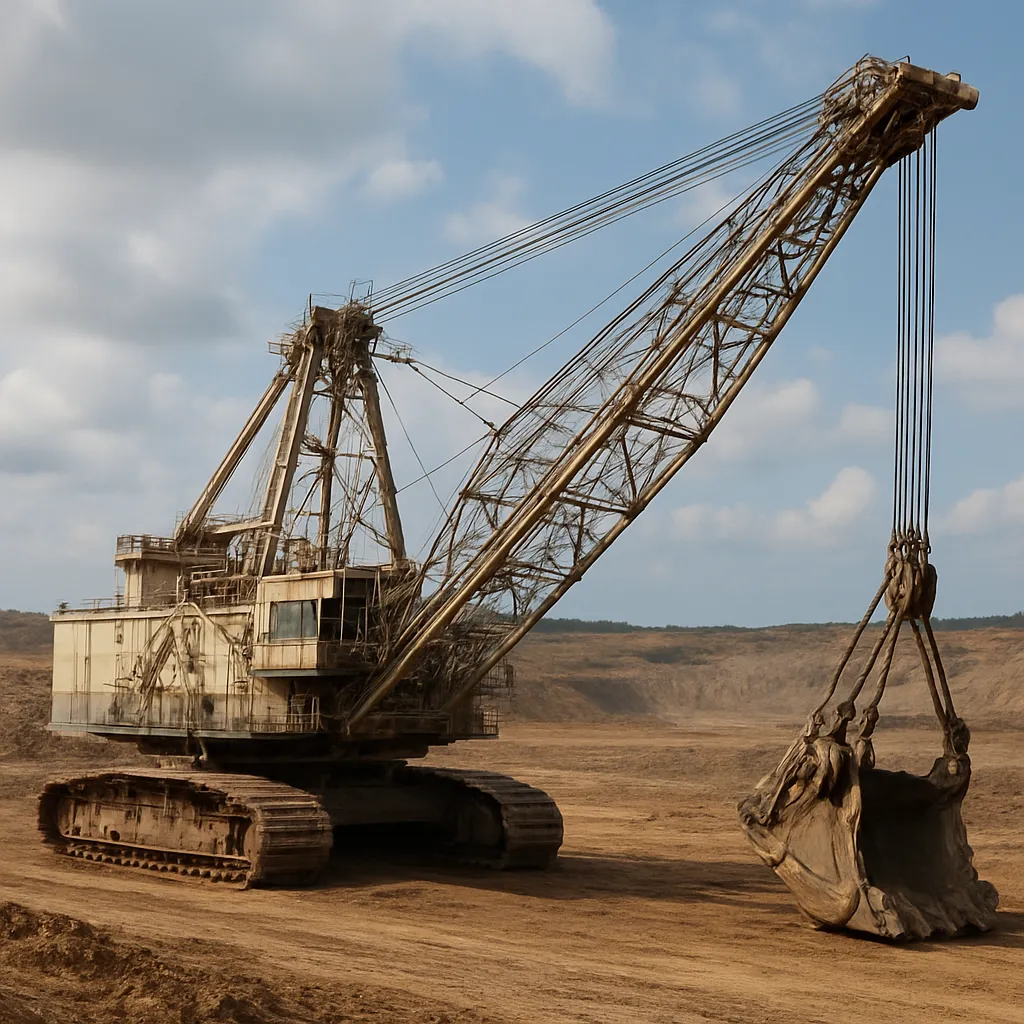
The OMZ ESH 40/100 is a heavy-duty surface mining machine from the family of large-scale dragline excavators, built to move massive quantities of overburden and loose materials in open-pit operations. Combining rugged design with straightforward mechanical systems, the model is intended to deliver long-term, high-volume performance in demanding environments. This article presents a comprehensive look at the machine’s role, technical traits, operational context, and broader significance in modern surface mining and civil engineering projects.
Overview and purpose
The OMZ ESH 40/100 belongs to a class of machines known as dragline excavators — purpose-built for removing overburden, trenching, and bulk material handling where reach and capacity are more important than precision digging. Draglines are often chosen where large horizontal reach and deep digging capability reduce the need to relocate a machine frequently. The ESH 40/100 is positioned as a robust solution for medium-to-large surface operations, particularly in geological settings where continuous removal of unconsolidated or weakly consolidated material is required.
Main roles and typical tasks
- Overburden removal in coal, lignite, and soft-mineral open-pit mines.
- Excavation for tailings ponds and landfill cell construction.
- Large-scale civil earthworks, such as harbor dredging support where land-based reach is needed.
- Stockpile reclaim and bulk handling in quarry and aggregate operations.
Because draglines specialize in bulk volumetric removal, they are less suitable for high-precision trenching or hard-rock excavation without pre-blasting. The ESH 40/100 emphasizes reach and bucket capacity over cutting power, making it ideal for layered, friable strata.
Design and technical characteristics
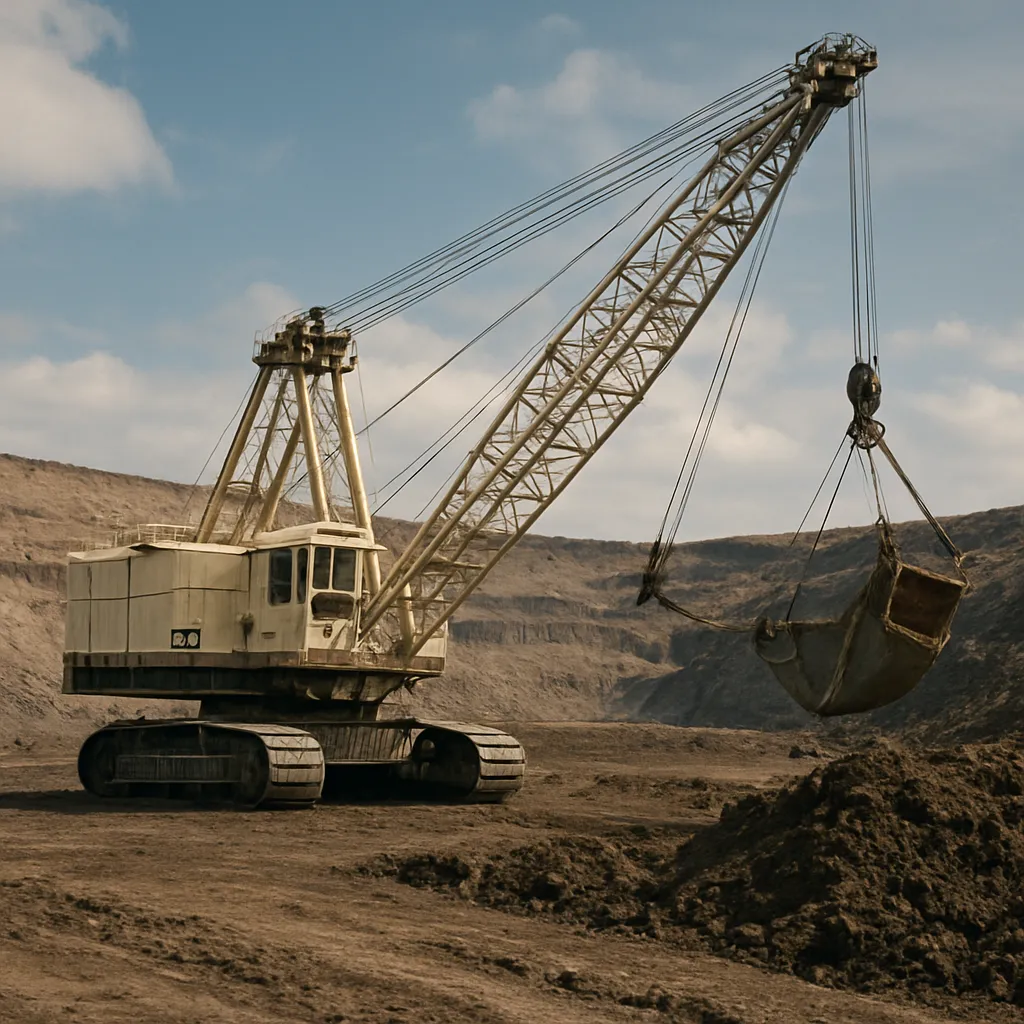
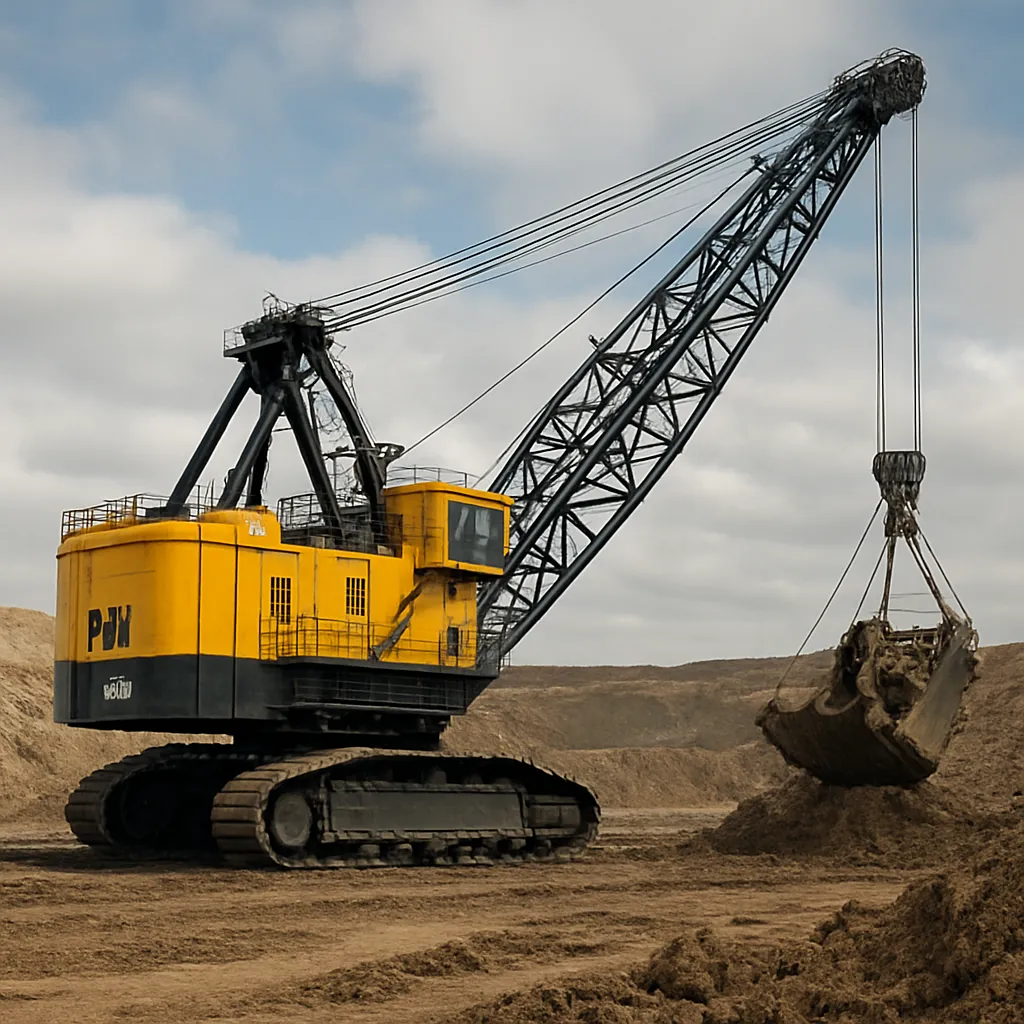
The ESH family follows a time-tested mechanical layout: a rotating base (house), a lattice boom extending the working radius, hoist and drag ropes manipulating the bucket, and an undercarriage designed for site relocation. The ESH 40/100 designation is commonly interpreted within industry naming conventions to reflect a class of performance — often indicating bucket capacity and a nominal boom or reach figure — but exact interpretation can vary by manufacturer and configuration.
Structure and key components
- Bucket system: The dragline bucket is central to productivity. For machines of this class, bucket volumes typically range from about 20 to 60 cubic meters. The ESH 40/100 is intended to operate with a bucket in the mid-to-high range of that spectrum, optimized for rapid cycle fill and dump operations.
- Boom: A lattice boom provides a long working radius with reduced self-weight. Boom length governs maximum throwing distance and digging depth — for the 40/100 class the boom is designed to allow deep-cast operations while maintaining stability.
- Rope and winch systems: Heavy-duty hoist, drag, and reeving components transmit the forces required to lift and pull large masses. The design of ropes, drums, and braking systems is critical for safety and uptime.
- Powerplant and drive: Traditional dragline drives rely on electric motors driven from a plant connection or on-board diesel-electric systems. The ESH units commonly use robust electric drive systems to deliver steady torque and controllable lifting cycles.
- Heavy-duty undercarriage and slew ring — engineered to withstand dynamic loading during operation and transport.
Performance parameters (typical ranges)
Publicly available, model-specific data for the ESH 40/100 is limited in some markets; however, for a machine in this class the following approximate ranges apply (values are indicative and depend on configuration):
- Bucket capacity: ~30–50 m³ (the “40” in the model name suggests a nominal ~40 m³ class).
- Boom length / reach: ~60–110 m, enabling deep digging up to ~20–40 m depending on geometry.
- Total installed power: ~800–3,000 kW, depending on whether power is provided by a remote electrical supply or by on-board generators.
- Operational weight: hundreds to several thousand tonnes (transportable in modular sections).
- Typical cycle time: depends on swing radius and lift — productivity measured in bank cubic meters per hour can vary widely, from a few hundred to >2,000 m³/h in optimal conditions.
These numbers should be treated as representative rather than absolute specifications. Exact figures for a delivered ESH 40/100 depend on bucket selection, boom configuration, rope reeving, and the customer’s power and control options.
Applications and operational use
Across mining and large civil projects, the ESH 40/100 is valued for its capacity to move large volumes with a single machine. The economics of using a dragline favor sites where continuous, repetitive bulk removal is required and where minimizing equipment repositioning yields savings in downtime and operational complexity.
Mining applications
- Coal and lignite surface mines: draglines are historically dominant for removing overburden ahead of continuous miners or conveyor spreads. The ESH 40/100 fits medium-to-large pit sections where its reach and capacity help maintain production rates.
- Soft mineral pits: potash, phosphate, and some clays see effective use of draglines to expose ore beds.
- Reclamation and spoil handling: draglines can place and spread spoil in reclamation operations where volume placement is more important than precise compaction.
Civil engineering and specialized roles
- Construction of levees, embankments, and lake dredging support where land-based material movement is needed.
- Harbor and channel maintenance when coordinated with marine equipment — draglines can reach into shallow waters from shore for certain dredging tasks.
- Large-scale landscaping and earthmoving projects for infrastructure development.
Operators choose the ESH 40/100 when long-term, continuous bulk removal produces lower overall cost per bank-cubic-meter compared with fleets of smaller excavators and haul trucks. The dragline’s ability to cast material beyond the bucket wheel’s reach makes it especially useful for managing spoil placement on spoil banks or dumps.
Operation, maintenance and lifecycle
Efficient operation of a dragline such as the ESH 40/100 demands experienced crews, a rigorous maintenance routine, and an operational plan that aligns dragline capability with haulage and processing systems. The machine’s simplicity of mechanical principles — rope, drum, boom — belies the complexity of keeping very large components reliable under cyclical stresses.
Daily and routine maintenance
- Visual inspection of hoist and drag ropes, reeving terminations, and sheaves to detect wear and corrosion.
- Lubrication and greasing of boom pins, slew bearings, and drivetrain components.
- Monitoring of winch drum condition, brake systems, and electrical control cabinets.
- Bucket and lip wear checks and timely refurbishment or replacement of wear parts.
Major overhauls and component life
Draglines are capital-intensive assets, and planned major overhauls extend service life for decades. A well-maintained machine can serve 20–40 years or more, with mid-life refurbishments replacing rope, motors/generators, and critical structural components. Refurbishment strategies include:
- Re-rope and sheave refurbishment every several years depending on usage hours and environmental conditions.
- Slew ring replacement or reconditioning during mid-life overhaul cycles.
- Modernization of control electronics and operator cabins to improve safety and fuel/electrical efficiency.
Lifecycle cost planning must account for long lead times on large spares and potential logistical constraints for haul-in/out of heavy assemblies. Many owners maintain agreements with OEMs or specialist rebuilders to assure availability of large components and technical support.
Safety, ergonomics and environmental considerations
Safety is a paramount concern with dragline operations given the machine’s size and the forces involved. The ESH 40/100 integrates standard safety provisions — interlocks, load control systems, and emergency braking — but safe operation requires coherent site procedures, training, and risk assessment.
Key safety aspects
- Load monitoring and anti-collision systems to prevent overloading and unintended swings.
- Exclusion zones and clear communication protocols to keep personnel away from swing radius and dumping zones.
- Fall protection and safe access systems for maintenance on high structural elements such as the boom or sheave towers.
Environmental footprint and mitigation
Compared to fleets of trucks and shovels, draglines can offer environmental advantages: fewer mobile diesel units, reduced road construction within pits, and lower dust generation in some operational modes. However, environmental considerations include:
- Noise and vibration from heavy machinery operations — mitigated via scheduling and local buffers.
- Fuel or power consumption — many draglines prefer electric drives, reducing on-site emissions if grid electricity is from low-carbon sources.
- Landscape alteration — the very purpose of a dragline is large-scale movement of earth, so reclamation planning is essential to restore post-mining landforms.
Market deployment, statistics and economic context
Detailed sales and production statistics specific to the OMZ ESH 40/100 are not always publicly disclosed, especially for sales within domestic and regional markets. However, industry trends provide context for how machines in this class are used and valued.
Global dragline fleet context
- Draglines remain concentrated in coal and surface mineral operations globally, with a significant presence in regions that historically invested in large-scale strip mining: North America, parts of Europe, Russia and the CIS, Australia, and South Africa.
- Bucket capacities across the global fleet vary dramatically, from sub-10 m³ machines used in smaller operations to giant units with buckets exceeding 100 m³ in the largest open-pit mines.
- Modern mining economics place premium value on equipment that reduces haulage distances, energy costs, and truck-shovel cycles — draglines achieve this by casting overburden away from the active face, sometimes eliminating the need for haul trucks for initial stripping.
Operational economics for owners
When evaluating the purchase or lease of an ESH 40/100, operators weigh factors including:
- Capital cost vs. life-cycle cost: large initial investment offset by decades of service.
- Production profiles: draglines excel where continuous, predictable stripping is required.
- Integration with site infrastructure: access to electrical power, space for splicing and maintenance, and earthworks plans that exploit the dragline’s long reach.
Because the ESH 40/100 is typically offered into markets where infrastructure and maintenance support are available, OMZ and its partners often provide commissioning, training, and spare-part packages to reduce risk for buyers.
Upgrades, modernization and future trends
Modernization programs can significantly extend the value of a machine like the ESH 40/100. Upgrades commonly pursued include retrofit of electronic control systems, variable-frequency drives for electric motors, enhanced rope-monitoring systems, and operator comfort improvements.
Electrification and automation
- Integration of variable-speed electric drives reduces inrush currents and improves energy efficiency.
- Remote monitoring and condition-based maintenance systems increase uptime by predicting rope wear or bearing issues before failure.
- Partial automation — automated swing limits, optimized cycle profiles, and assistive controls — improve consistency and reduce operator fatigue.
While fully autonomous draglines are not yet widespread, incremental automation fits the operational profile for large-scale, repetitive excavations and is likely to see gradual adoption where productivity and safety gains justify investment.
Concluding assessment
The OMZ ESH 40/100 represents a pragmatic, heavy-duty option in the portfolio of surface mining equipment. Its strengths lie in bulk removal capacity, long reach, and relative simplicity of mechanical design, making it a compelling choice for sites where continuous overburden stripping dominates the schedule. While public, model-specific statistics may be limited, the class characteristics — substantial bucket volumes, extended boom reach, and robust rope-and-drum systems — define the machine’s value proposition. With proper maintenance, modernization, and integration into a site’s material handling plan, the ESH 40/100 can provide decades of productive service and competitive production economics for a wide range of mining and civil earthmoving tasks.
ESH 40/100 dragline bucket boom overburden capacity productivity maintenance safety OMZ
)
)