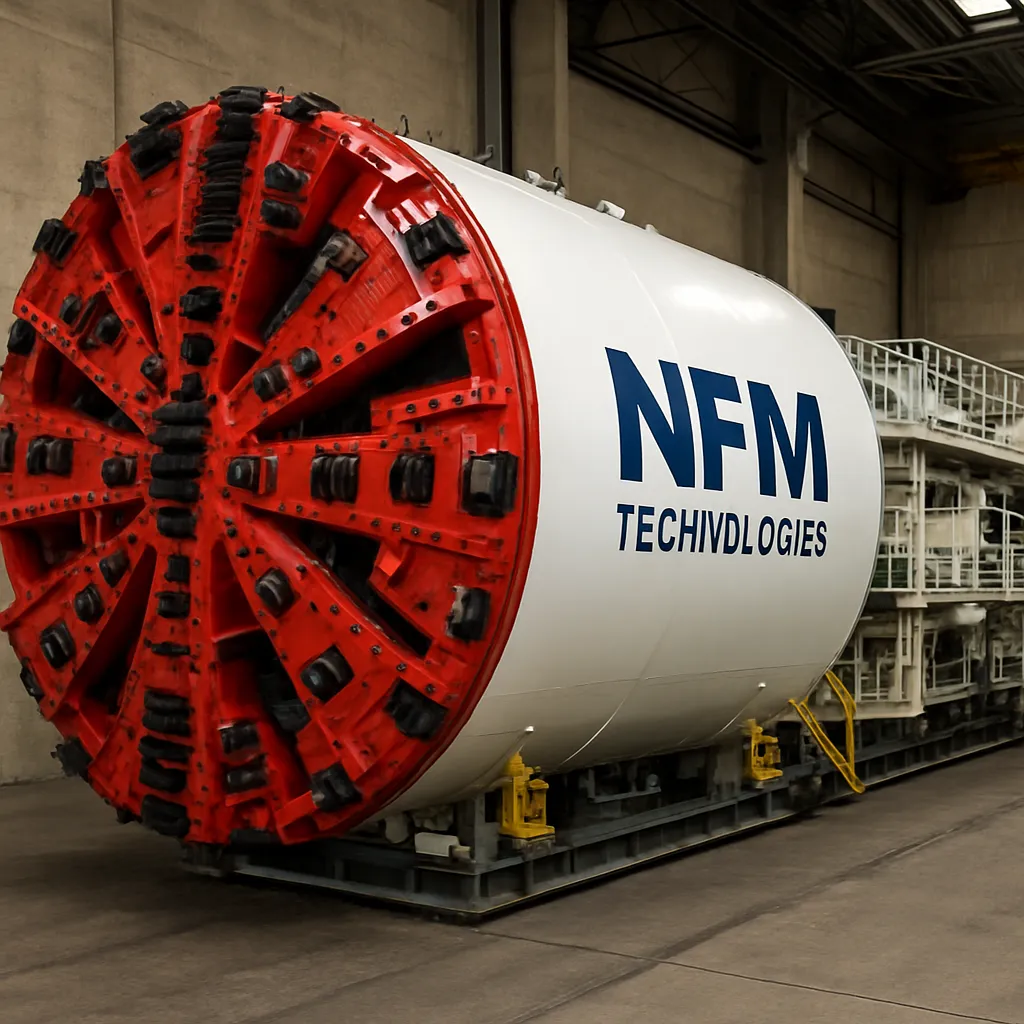
The NFM Technologies Slurry TBM represents a class of specialized tunnel boring machines designed to excavate in water-bearing and unstable granular soils where controlling face pressure and managing excavated material are critical. Combining robust mechanical design with advanced hydraulic and slurry handling systems, these machines are frequently chosen for deep tunneling under rivers, through saturated sands and gravels, and in mixed-face conditions where traditional earth-pressure-balance machines may not be optimal. This article explores the machine’s design principles, typical applications, operational systems, comparative advantages, maintenance and safety issues, and the latest developments shaping slurry TBM use in the tunneling industry.
Overview and intended applications
NFM Technologies’ slurry TBMs are engineered to excavate through challenging ground conditions where face stability must be maintained by a pressurized slurry (usually bentonite-based) rather than by soil support delivered inside the cutterhead chamber. These machines are best suited to projects that include:
- River and estuary crossings where high external hydrostatic pressures are present.
- Long water conveyance tunnels and deep utility drives passing through saturated sands and gravels.
- Urban tunneling below groundwater table where settlement control and groundwater inflow prevention are critical, such as metro and rail projects.
- Mixed-face conditions combining cobbles, boulders, and cohesive layers requiring robust cutterhead designs and variable slurry conditioning.
- Geotechnical or geologic environments with high permeability where contamination control and slurry management are required to protect the surroundings.
Compared with other tunneling methods, slurry TBMs are particularly effective where the primary technical driver is controlled face pressure and the continuous removal of fine particles without allowing uncontrolled inflow of water or ground into the tunnel.
Machine design and key components
Cutterhead and drive system
The cutterhead of a slurry TBM is a reinforced, pressure-rated structure that interfaces directly with the excavation face. It can be an open or partially enclosed design depending on site requirements. Cutterhead configurations vary by ground type: rock cutters and disc cutters for hard formations, and carbide-tipped or pick-type tools for mixed or coarse granular strata.
Main components include:
- Rotating cutterhead with replaceable cutting tools and scrapers.
- Torque and thrust systems (hydraulic or electric) sized to the machine diameter and ground conditions.
- Sealed bulkhead and stuffing boxes to maintain pressure integrity between the pressurized face and the rear of the machine.
Slurry circulation and separation plant
Critical to the slurry TBM concept is the ring of circulating slurry that supports the face and transports cuttings to the surface or separation plant. Key elements of the slurry system include:
- High-capacity slurry pumps to maintain flows between the cutterhead chamber and the surface.
- A multi-stage slurry separation plant (cyclones, de-silters, centrifuges, and filter presses) to remove coarse and fine solids from the slurry and recycle it.
- Storage and dosing systems for slurry additives such as bentonite, polymer, and pH control chemicals to condition the slurry.
Well-designed slurry separation and conditioning systems are essential to control the rheological properties of the slurry, maintain face stability and minimize environmental discharge.
Shield, segmental lining and trailing gear
The shield houses the TBM propulsion and slurry piping while protecting the trailing works. Behind the cutterhead, a segment erector installs precast segmental lining rings as the machine advances. Trailing gear contains electrical, hydraulic, and ventilation systems, plus slurry return piping to the surface plant.
Operating principles and ground support
Face support by pressurized slurry
The operational principle of a slurry TBM is to maintain the tunnel face under a column of pressurized slurry whose hydrostatic head equals or slightly exceeds the external groundwater pressure. This prevents uncontrolled inflow of water and soil particles into the face while allowing the mechanical action of the cutterhead to comminute material into a slurry stream that is transported away.
Key operational variables include:
- Slurry specific gravity and viscosity — controlled by bentonite or polymer concentration — which determine hydraulic support characteristics.
- Slurry circulation rate and pump capacity — to ensure continuous removal of cuttings.
- Face pressure monitoring and control systems — to rapidly detect and correct over-pressure or under-pressure situations.
Material transport and separation
Excavated material is mixed into the slurry and pumped through a closed circuit to the surface, where a separation plant removes solids and returns the cleaned slurry to the cutterhead. Separation typically involves:
- Coarse particle removal with screens or hydrocyclones.
- Fine particle control using flocculation and clarification stages, often aided by centrifuges or filter presses.
- Waste handling systems for dewatered solids and management of spent water in line with environmental regulations.
Advantages and limitations
Advantages
- Superior ability to control face stability under high groundwater pressures and in highly permeable soils.
- Reduced risk of ground settlement at surface compared with open-cut or poorly controlled excavation methods, a key consideration in urban areas.
- Continuous automated operation — many slurry TBMs support remote monitoring and control to optimize advance and slurry conditioning.
- Flexibility to handle mixed-face conditions by combining robust cutting tools with adaptive slurry conditioning.
Limitations
- Higher capital and operational costs relative to simpler TBM types due to the need for slurry plants, separators and complex piping.
- Specialist knowledge required for slurry chemistry, separation plant tuning and environmental compliance.
- Logistics and space demands for the surface separation plant and slurry storage, which can be challenging in constrained urban launch sites.
- Potential environmental issues if slurry discharge and spoil handling are not properly managed.
Comparison with Earth Pressure Balance (EPB) TBMs
Understanding when to choose a slurry TBM versus an EPB is essential for project success. EPB machines use the excavated soil itself (conditioned) to balance face pressure, whereas slurry TBMs use a pressurized fluid medium. Typical decision drivers include:
- Ground permeability: highly permeable sands and gravels often favor slurry TBMs because EPB faces may struggle to retain fines.
- Groundwater pressure: very high hydrostatic heads are more readily managed with slurry face support.
- Environmental constraints: contaminated ground may favor closed-circuit slurry systems to avoid spreading contamination — provided separation and treatment are suitable.
- Cost and logistics: EPB systems can be simpler and require less surface footprint but may be unsuitable for some stratigraphies.
Maintenance, safety and monitoring
Maintenance regimes
Maintenance of a slurry TBM focuses on several critical areas:
- Wear and replacement of cutting tools and cutterhead components due to abrasive soils and boulders.
- Integrity checks and servicing of face seals, pressure bulkheads, and rotary joints to prevent slurry leaks.
- Regular inspection and cleaning of slurry pumps, pipelines and separation equipment to avoid blockages and maintain efficiency.
- Lubrication and inspection of hydraulic systems and gripper or thrust cylinders.
Safety systems and monitoring
Because slurry TBMs operate with pressurized fluids and often in high-water-pressure environments, safety systems are paramount. Typical provisions include:
- Automated face pressure monitoring with alarms and interlocks to halt advance if unsafe conditions are detected.
- Redundant slurry pumps and emergency flushing systems to prevent face instability in the event of pump failure.
- Gas and oxygen monitoring in confined spaces behind the shield.
- Strict procedures for man-entry and maintenance in the cutterhead chamber and pressurized areas.
Environmental considerations
Slurry TBMs can be environmentally favorable when correctly operated, particularly for minimizing surface subsidence and protecting groundwater. Key environmental management areas are:
- Closed-loop slurry recovery to prevent discharge of contaminated water.
- Proper treatment and disposal of dewatered spoil and slurries in compliance with local regulations.
- Noise and vibration control through appropriate machine selection and site logistics.
- Careful monitoring of surface settlements and groundwater levels to detect and mitigate any unintended impacts early.
Operational performance and statistical benchmarks
While project-specific rates vary widely, some general performance benchmarks for slurry TBMs in soft ground include:
- Typical cutterhead diameters range from under 1 meter for small utilities to over 15 meters for major metro or road tunnels; many urban utility and metro projects use diameters between 4 and 10 meters.
- Advance rates in favorable soft ground are commonly in the range of 5 to 30 meters per day depending on ground conditions, machine diameter and site logistics. In difficult mixed-face or boulder-bearing ground, rates can be significantly lower.
- Slurry systems are sized to handle flow rates from tens to several thousands of cubic meters per hour depending on diameter and muck production; correct sizing is vital to avoid bottlenecks in spoil removal.
- Machine availability targets for well-operated slurry TBMs can exceed 70–80% over long drives, but this requires excellent maintenance, reliable slurry plants and robust operational procedures.
These figures are indicative and should be interpreted in the context of project-specific geotechnical conditions, supply chains and operational strategies.
Typical project examples and use cases
NFM Technologies slurry TBMs are intended for a wide range of infrastructure projects where controlled face support and slurry management are required. Typical uses include:
- High-capacity metro tunnels running below rivers and waterways.
- Deep sewer and water transfer tunnels passing beneath sensitive urban infrastructure.
- Long undersea or under-river utility crossings where direct access for open-cut is impossible.
- Projects in coastal or deltaic regions with high groundwater tables and highly permeable sediments.
In each deployment, the TBM is tailored to project-specific requirements — cutterhead tooling, slurry properties, segmental lining design, and separation capacity are all engineered to match the geotechnical and logistical needs.
Lifecycle costs and procurement considerations
When budgeting for a slurry TBM-driven project, owners and contractors should consider the following cost components:
- Initial procurement (machine manufacturing and customization) — slurry TBMs often have higher upfront costs than EPB types because of pressurized design and spare parts requirements.
- Surface slurry plant and separation equipment — this is a significant capital and operational expense that must be factored into the overall project cost.
- Consumables and reagents — bentonite, polymers, filter media and chemicals are ongoing costs tied to the length and duration of the drive.
- Spare parts and wear items — cutters, seals, and hydraulic components wear out and require replacement, sometimes at high frequency in abrasive ground.
- Logistics, disposal and environmental compliance — management of spoil and slurry waste can create substantial recurring costs depending on local regulations.
Procurement strategies often include provision for spare parts packages, commissioning assistance from the manufacturer, and long-term service agreements to maintain machine availability and optimize life-cycle costs.
Innovation and future trends
Several trends are shaping the evolution of slurry TBMs and their operational ecosystem:
- Digitalization and remote monitoring: real-time telemetry, predictive maintenance algorithms and digital twins are improving machine availability and reducing downtime.
- Advanced slurry chemistry: improved polymers and bentonite formulations enable better face support with lower environmental impact and more efficient separation.
- Hybrid cutterhead designs and tool materials: enhanced wear resistance and modular tool systems reduce maintenance intervals and allow quicker adaptation to mixed-face conditions.
- Energy efficiency: advancements in pump and drive systems reduce fuel and electricity consumption, lowering operating costs and emissions.
- Integration with automated segment handling and logistics to increase tunneling productivity within constrained launch and retrieval sites.
Selection criteria for project teams
Choosing an NFM Technologies slurry TBM for a project should be based on a careful evaluation of geotechnical data, groundwater conditions, environmental constraints and site logistics. Important considerations include:
- Quality of the ground investigation — detailed CPTs, boreholes and hydrogeologic testing are necessary to assess permeability, grain size distribution and presence of cobbles/boulders.
- Access and space at launch and reception sites for the separation plant and slurry storage.
- Local regulatory framework for slurry and spoil disposal.
- Availability of experienced operators and maintenance personnel, or the need for manufacturer-supported training and supervision.
Concluding remarks
Slurry TBMs from manufacturers such as NFM Technologies remain a core technology for challenging tunneling projects where groundwater control and face stability are dominant concerns. Their successful use depends on integrated engineering — combining robust machine mechanics, carefully designed slurry circuits, competent operational practices and rigorous environmental controls. When these elements are aligned, slurry TBMs provide a reliable method to execute complex tunnels beneath rivers, through saturated gravels and sands, and in urban environments demanding minimal surface disruption and strict settlement control. Ongoing technological improvements in slurry chemistry, digital monitoring and cutterhead design continue to expand the envelope of what can be achieved with this versatile tunneling approach.
)
)