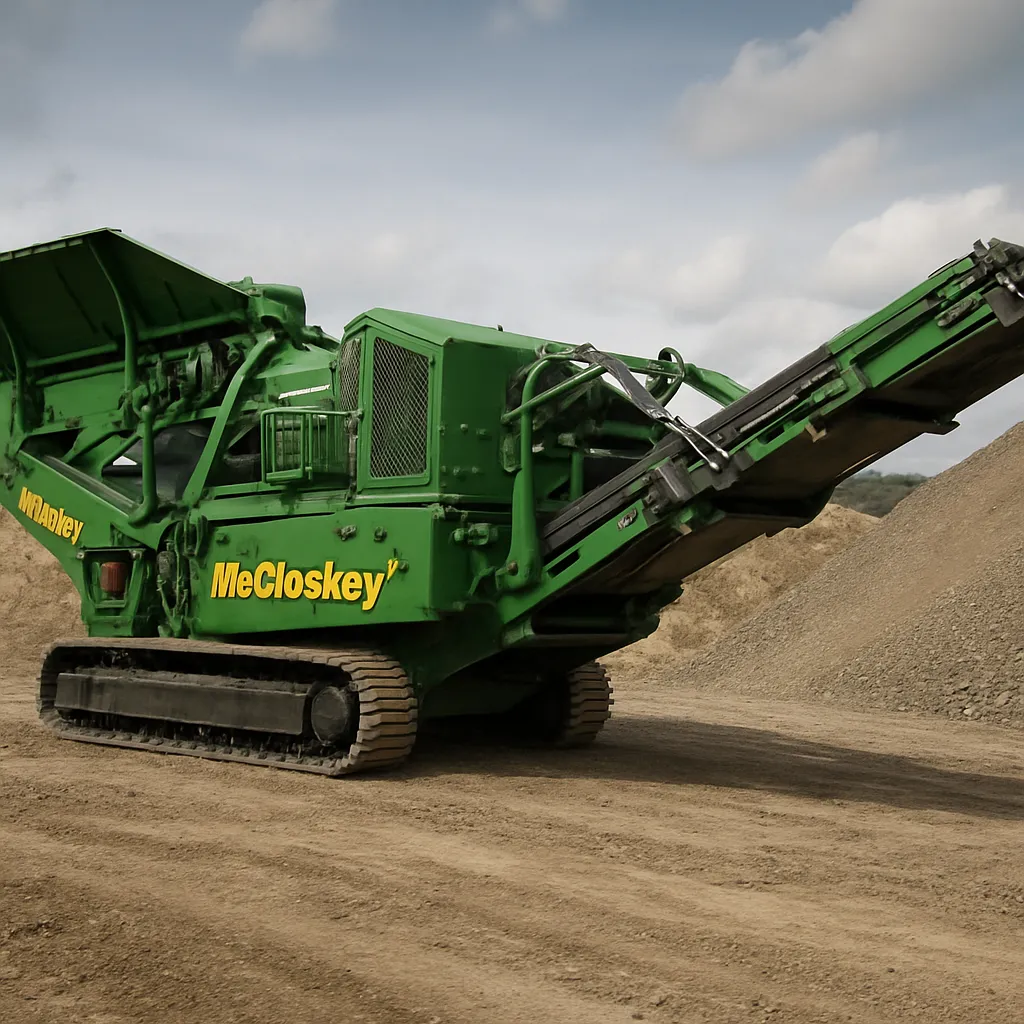
The McCloskey C4 is a compact, highly capable mobile cone crusher designed for demanding secondary and tertiary crushing applications. This article explores where the machine is best applied, highlights its main technical and operational features, offers practical maintenance and safety guidance, and provides contextual statistics and considerations for buyers and operators. Whether used in quarrying, recycling, or construction, the C4 stands out for its balance of power, portability, and adaptability.
Overview and design philosophy
The McCloskey C4 was developed to meet a market need for a transportable crusher that offers the performance of a fixed cone crusher while retaining the flexibility of a tracked or wheeled plant. Its design emphasizes rapid setup, user-friendly controls, and the ability to handle a variety of feed materials with consistent product quality. Key structural components are engineered for durability and ease of replacement, reflecting industry demand for machines that can deliver long operational hours with minimal downtime.
- Robust chassis built for road transport and on-site maneuverability
- Compact footprint for constrained sites and easier positioning
- Integrated feeding, crushing, and conveyor systems to minimize on-site assembly
- Easy access to service points for routine checks and repairs
Primary applications and industry use cases
The McCloskey C4 is versatile and finds use across several sectors. Typical applications include:
- Aggregates: Secondary and tertiary crushing in quarries producing road stone, concrete aggregate, and paving materials. The uniform particle shape produced by cone crushers makes them ideal for high-quality aggregate production.
- Mining: Crushing of hard rock and ore in small to medium-scale mining operations where mobility and quick redeployment are important.
- Construction and demolition recycling: Processing concrete, asphalt, and mixed demolition material on-site to produce usable recycled aggregate.
- Contracting: Contractors working on remote road projects, pipeline construction, or infrastructure upgrades benefit from a portable cone unit that reduces haul distances for waste material and delivers on-spec aggregate.
- Industrial minerals: Secondary sizing of minerals where precise product gradation is required.
Why cone crushing is chosen in these contexts
Cone crushers like the C4 are selected for applications where consistent particle shape, high reduction ratios, and the ability to handle abrasive, hard feed are required. They are particularly effective for producing cubical products and for tertiary crushing stages where tighter particle distribution and surface finish quality are important.
Technical features and performance characteristics
The C4 incorporates several technical elements designed to maximize throughput while minimizing operational complexity. Core design features typically include an efficient crushing chamber, hydraulic adjustment and clearing systems, and conveyors designed to reduce material tangling and dust generation.
- Feeder: A robust vibrating feeder with optional grizzly to remove fines and control feed distribution into the crushing chamber.
- Crushing chamber: Precision-engineered mantle and concave combinations allow tuning of the product curve for specific applications.
- Hydraulic controls: Rapid chamber setting adjustments and hydraulic clearing reduce downtime in clogging events.
- Conveyors: Foldable stockpile conveyors that increase portability and reduce setup time.
- Electrical and controls: User-friendly control panels, often with remote-start capability, alarms, and interlocks for safe operation.
Operators benefit from the ability to quickly change settings for different products and to respond to fluctuations in feed size or material type without lengthy downtime.
Performance and statistical considerations
Crushing performance depends on feed material, desired product size, and the settings used by operators. While exact performance figures vary by configuration, general expectations for similar mobile cone units include:
- Throughput ranges commonly fall between 100 and 350 tonnes per hour in real-world secondary/tertiary applications, depending on the material hardness, moisture content, and required product size.
- Reduction ratios often range from 3:1 to 6:1 per crushing stage, making cone crushers effective for secondary or tertiary reduction.
- Product size adjustments can typically cover fine to medium output fractions suitable for road base, asphalt, and concrete aggregates.
Note: Site-specific testing (screening analysis and feed trials) is recommended to determine precise throughput and wear rates for a particular application and material.
Operational advantages and limitations
The C4 offers multiple advantages that make it attractive to operators, yet there are practical limitations to consider:
- Advantages:
- Portability reduces transport costs and improves response time when moving between sites.
- Smaller footprint allows operation in confined pits and urban environments.
- Hydraulic automation decreases manual intervention requirements and improves safety.
- Versatility in producing a range of product sizes and shapes suitable for different markets.
- Limitations:
- Throughput is lower than large stationary cone plants; for very high-volume operations, a stationary plant may be more economical.
- Wear rates on liners and mantles depend strongly on abrasive material—operating costs can rise with highly abrasive feeds.
- Initial capital cost for a high-spec, fully mobile unit can be higher than a basic fixed installation, though lifecycle costs might favor mobility in multi-site operations.
Maintenance, wear parts, and serviceability
Maintenance planning is crucial to maximize machine uptime and control operating costs. The C4 is engineered to simplify routine tasks, but regular inspection and replacement of wear items are essential. Typical maintenance topics include:
- Wear parts: Monitor mantle and concave wear. Using high-quality manganese liners and tracking consumption patterns helps optimize replacement cycles and inventory planning.
- Lubrication: Maintain recommended oil levels and change intervals for gearbox and crusher bearings. Many modern cones include centralized lubrication points for convenience.
- Hydraulic systems: Inspect hoses, cylinders, and connections regularly for signs of wear or leakage. Replace filters as per manufacturer guidelines.
- Conveyors and drives: Check belt tracking, tensioning, and idler condition to prevent spillage and unplanned downtime.
- Electrical systems: Keep control cabinets dry and clean, monitor sensor functions, and ensure emergency stop circuits are operational.
Well-organized maintenance schedules and a stocked parts inventory can reduce mean time to repair and extend the service life of key components.
Safety, environmental and regulatory considerations
Operating any mobile crusher requires strict adherence to safety protocols and environmental best practices. Important areas to manage include:
- Dust control: Use water suppression, dust extraction, or covered conveyors where required to meet local air quality standards.
- Noise mitigation: Mobile cone crushers generate significant noise; scheduling, acoustic barriers, and remote operation can reduce noise impact on nearby communities.
- Ground and traffic safety: Ensure stable ground conditions for setup, clear machine exclusion zones, and use banksmen when moving the unit on or off transport vehicles.
- Regulatory compliance: Permits for mobile crushing often require environmental impact assessments, especially for long-term or permanent site installations.
Selection and purchase considerations
Choosing the right C4 configuration requires attention to feed characteristics, desired product types, throughput targets, and site logistics. Buyers should consider the following:
- Feed size and hardness: Ensure the crusher chamber and feed system are rated for the maximum expected lump size and abrasivity.
- Product specification: Determine whether single-pass crushing will meet product standards or whether closed-circuit screening is necessary.
- Mobility needs: Evaluate whether tracked mobility or trailer-mounted options better fit redeployment frequency and transport route constraints.
- Service network: Purchasing from a supplier with local parts and service availability reduces downtime risk.
- Resale and lifecycle value: Machines with modular parts, widely used components, and documented service history maintain higher residual values.
Economic and sustainability aspects
The economic case for a mobile cone unit such as the C4 often centers on reduced material handling, lower haul costs, and faster project completion. Specific economic factors include:
- Reduced trucking: Crushing material on-site to produce specification aggregates reduces the distance material must be hauled and can slash logistics costs.
- Lower site preparation: Minimal foundation work and rapid setup lower initial civil costs compared to fixed plants.
- Recycling value: Ability to process demolition material into saleable recycled aggregate turns a disposal cost into a revenue stream.
- Sustainability: On-site processing lowers embodied transport emissions and, when combined with electric or hybrid drives, can further reduce the carbon footprint.
Practical tips for operators
To get the most from a C4 unit, operators should follow a few practical guidelines:
- Conduct baseline feed and product testing before full-scale operation to identify optimal chamber settings and screen configurations.
- Keep a log of wear part life and operating parameters to refine maintenance intervals and predict costs more accurately.
- Train operators on hydraulic clearing and safe shutdown procedures to reduce mechanical damage from blockages.
- Use anti-spin and tramp metal protection devices if feed contains metal contamination to avoid damage to the drive system.
Conclusion and final assessment
The McCloskey C4 represents a compelling option for operators who need a balance between mobility and crushing performance. With strong features geared toward quick setup, flexible product sizing, and manageable maintenance, it suits a wide range of industries including aggregates, mining, recycling, and contracting. While throughput will not match the largest fixed plants, the cost savings from reduced transport, faster deployment, and the capability to operate in tight spaces make it an excellent choice for many projects.
For prospective buyers, perform site-specific trials, evaluate total lifecycle costs, and ensure that service and parts support are available locally. When properly applied and maintained, the C4 can be a reliable asset that contributes to productivity gains and lower operational costs.
)
)