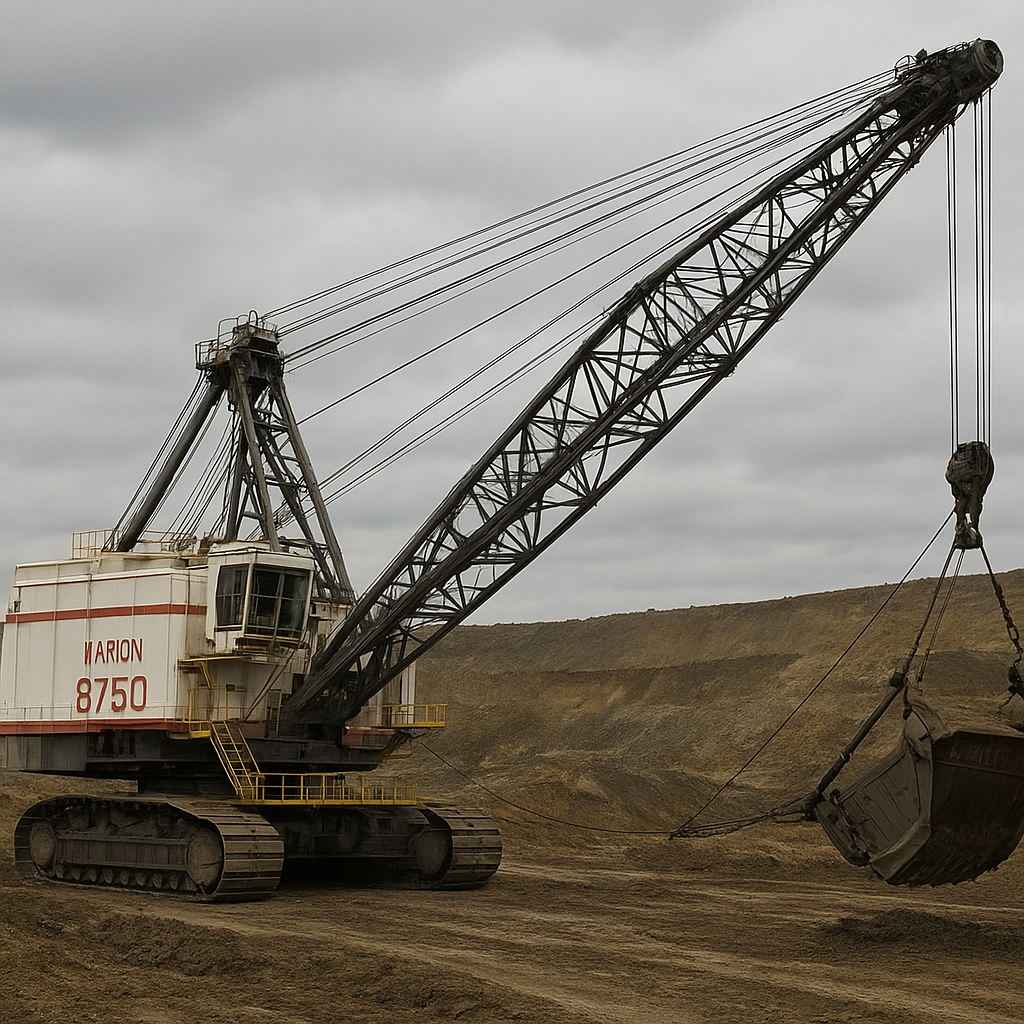
The Marion 8750 is a legendary example of the large-scale mechanized equipment that transformed surface mining in the mid-20th century. As a walking electric dragline, it combined immense digging power with a design that permitted relocation across a mine site without dismantling. This article explores the machine’s origins, technical attributes, operational roles, logistical and maintenance challenges, and its broader industrial and environmental significance. Emphasis is placed on practical information, typical specifications and real-world applications to convey why machines like the Marion 8750 remain important reference points in heavy earthmoving history.
History and development
The Marion Power Shovel Company, an American manufacturer long associated with large excavation equipment, produced a variety of passenger and industrial shovels and draglines during the 20th century. The model commonly referred to as the Marion 8750 emerged as part of a family of large walking draglines designed for surface coal and mining operations that required continuous removal of overburden over very large areas.
Development of machines like the Marion 8750 was driven by several factors: expansion of large-scale strip and open-pit mining, a need for economies of scale in coal and mineral extraction, and the availability of grid electric power at mining sites that enabled very large electrically driven machines. The Marion 8750 and comparable models were used primarily from the 1950s to the 1980s and were often the largest single-piece excavators available for many operations.
Although exact production numbers and detailed builder records for specific units are not always public, many units were sold to major mining companies in the United States, Australia and other regions with significant surface mining. Some were later scrapped, others sold second-hand and occasionally restored or preserved as industrial heritage pieces.
Design and technical characteristics
Basic configuration
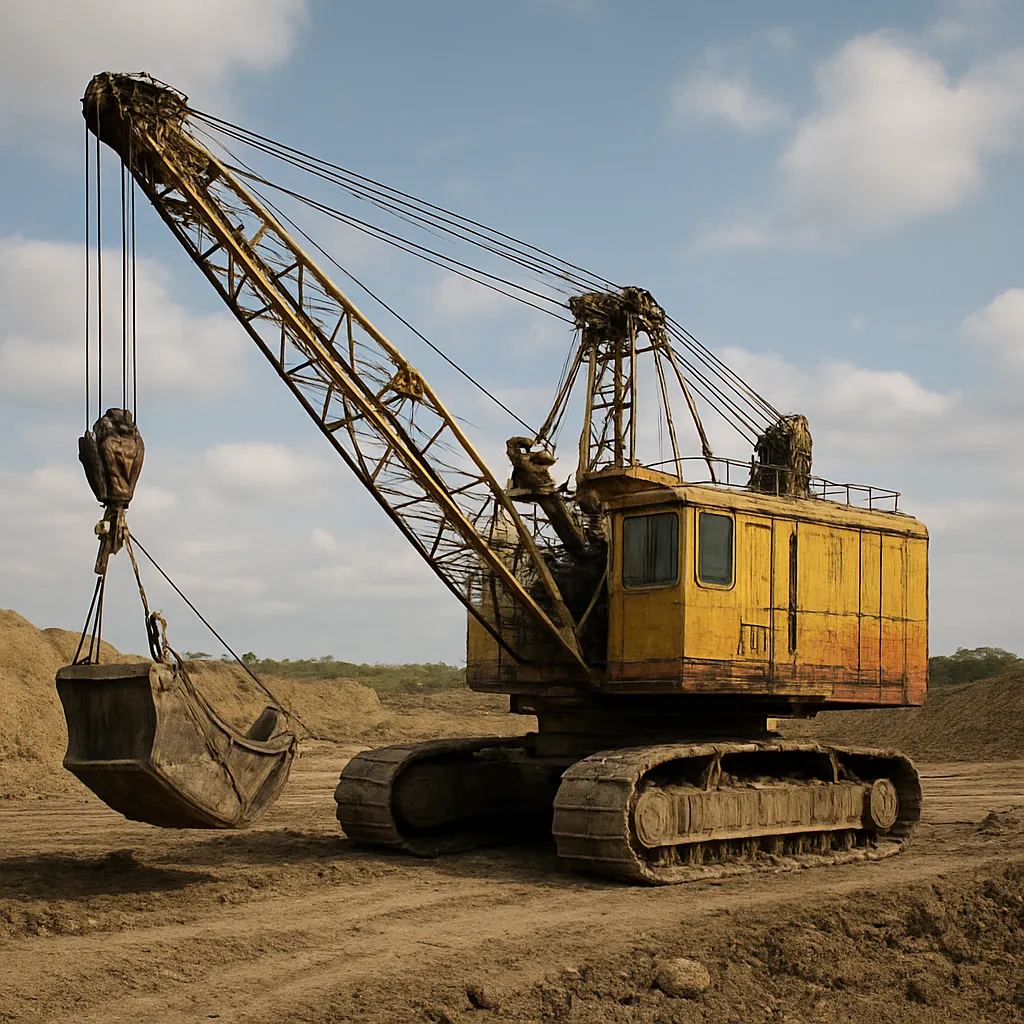
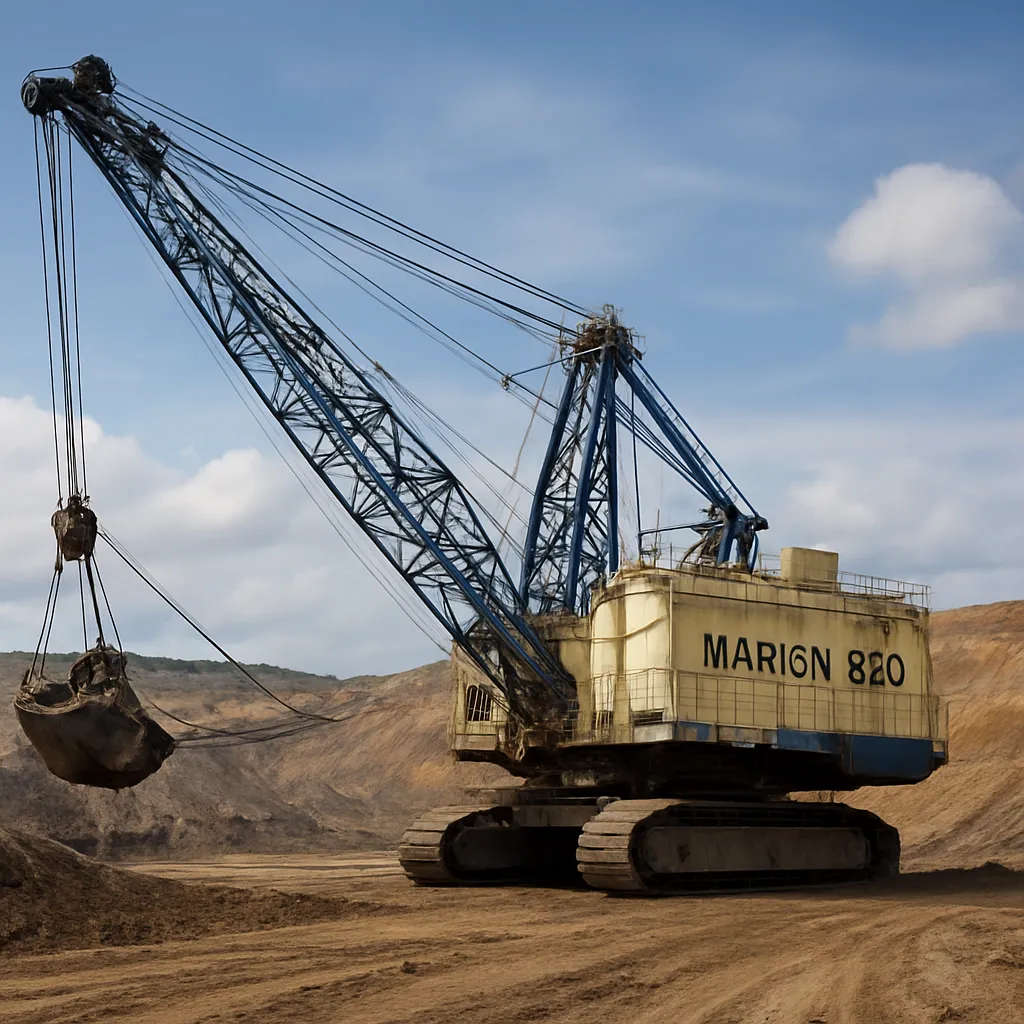
The Marion 8750 is a bucket-type dragline that typically features a tall latticework boom, a suspended series of cables and winches, and a large ground-level platform supporting electric power and the walking mechanism. The working tool is the heavy-duty bucket, which is dragged along the ground by the dragline cable to fill, then lifted and swung to a spoil location for dumping.
Key design elements include:
- Boom: a long, steel lattice boom providing reach measured in tens of meters (often well over 60–90 m in large variants), enabling a single machine to move material across a wide sweep without repositioning frequently.
- Drag and hoist cable systems: multiple winches and heavy-duty cables control bucket motion for digging, lifting and dumping.
- Walking mechanism: rather than being mounted on traditional crawlers, the machine uses a walking system—large “shoes” or pads and hydraulic/pneumatic or mechanical jacks—that lift and advance the whole machine a few feet with each step.
- Electric drive package: large electric motors, either AC or DC depending on era and customer preference, supplied by on-site power or dedicated substations. Power can be distributed through multiple motors for hoists, swing, and walking functions.
Typical specifications (approximate)
Published specifics for particular Marion dragline models vary with configuration and era; the following are representative ranges and should be read as approximate rather than exact figures for every unit:
- Bucket capacity: commonly in the triple-digit cubic-yard range for the largest models. For machines of this class, typical capacities could range from about 75 to 200 cubic yards (roughly 57 to 153 m3), depending on configuration.
- Boom length: often between 60 and 100 meters (200–330 ft) for the largest draglines, giving very large operating circles.
- Operating weight: often several thousand to tens of thousands of tonnes (many large draglines weigh in the 6,000–14,000 short-ton class range—i.e., thousands of metric tonnes), depending on counterweights and components.
- Power requirements: large draglines typically require tens of megawatts of electrical input if all functions are run simultaneously; motor ratings add up to several thousand to several tens of thousands of horsepower equivalent across all systems.
- Walking step: the walking mechanism usually advances the machine by a few meters per cycle, with travel speeds very low relative to other heavy equipment; relocation across a mine face is slow and planned.
These numbers are indicative of the class of machine to which the Marion 8750 belongs. Exact numbers for a particular chassis depend on the fitted bucket, boom length, ballast, electrical package and site-specific options.
Control and crew
Operation of a Marion-class dragline typically requires a trained operator in a cab that oversees hoist and drag functions, ground crew to coordinate movement and clearing, and maintenance staff focused on electrical, mechanical and structural systems. Typical operational personnel for a single shift might include an operator, a signal person, several electricians and mechanics, and a small team for routine lubrication and inspection. For larger operations, a maintenance department dedicates many personnel to scheduled overhauls.
Applications and operational roles
The Marion 8750 and similar large draglines were primarily designed for large-scale surface coal mining and other open-pit mineral extraction where the removal of overburden in thick seams provided economies for big machines. Their advantages and typical uses include:
- High-volume overburden removal: Draglines excel at the cyclical cut-and-dump operation needed to remove large volumes of soil and rock above coal seams or ore bodies.
- Long reach operations: The long boom enables movement of material from far inside the pit to designated spoil areas without frequent repositioning.
- Continuous production at low unit cost: By moving large volumes per bucket cycle, draglines can reduce the cost per cubic metre of overburden removed when compared with smaller machines or truck-and-shovel operations.
- Reduced ground disturbance for haul roads: Because a single dragline can cover a wide area, it reduces the need for extensive haul road systems that trucks require.
Geographically, draglines of this class were commonly deployed in the United States (Appalachian and midwestern coalfields, Powder River Basin in later years), Australia (Queensland and New South Wales coalfields), and other regions with large-scale open-pit operations. They are especially attractive where electrical power infrastructure is available and where environmental or economic factors favor fewer but larger machines.
Logistics, maintenance and lifecycle
Transport and erection
Moving a machine of this scale between sites is a major logistical operation. Because the dragline is a single, very large structure, moving between states or continents typically required partial disassembly. Components such as the boom, bucket, counterweights and superstructure might be removed and transported by rail, barge or heavy-haul truck. Reassembly at the destination called for heavy lift cranes, highly skilled riggers and detailed engineering plans. The machine’s original assembly at the factory and subsequent re-erections on site could take months.
Maintenance demands
Maintenance is one of the most significant lifecycle costs for large draglines. Regular tasks include:
- Inspection and replacement of heavy-duty ropes and cables subject to wear and fatigue.
- Lubrication and overhaul of winches, gearboxes and motors.
- Structural inspection for metal fatigue in booms, pins and joints, followed by welding or component replacement as needed.
- Electrical maintenance: large motor rewinds, switchgear upkeep, and transformer servicing.
- Walking mechanism servicing, including pads and jacks that endure tremendous loads.
Because major overhauls require considerable downtime and specialized parts, mining companies often maintain in-house shops or long-term agreements with OEMs or specialist contractors. Maintenance planning includes a mix of predictive monitoring (e.g., vibration and thermography) and scheduled preventative tasks.
Lifecycle, resale and scrapping
Many large draglines have long service lives measured in decades if properly maintained. Some machines have been resold and re-erected at different mines, extending their economic usefulness. Others were scrapped when structural fatigue, obsolescence of electrical systems, or changes in mining economics made refurbishment uneconomic. In a few cases, major components or even entire units have been preserved as museum pieces or road-side industrial monuments, celebrated for their engineering scale.
Economic and environmental considerations
Economics and productivity
Draglines like the Marion 8750 deliver economies of scale: moving very large volumes per cycle can lower unit costs of overburden removal. However, that advantage depends on consistent production, proximity to markets and the price structure for the mined commodity. Capital costs are high—purchase, site preparation, transport and erection require large upfront expenditures—so financial justification requires long-term planning and stable demand.
When compared to truck-and-shovel fleets, large draglines may reduce operating labor and fuel costs, but they require substantial electrical supply and incur concentrated maintenance costs. Modern mine design often weighs dragline deployment against fleets of hydraulic rope shovels and trucks depending on deposit geometry and local conditions.
Environmental impact
Surface mining using draglines produces significant landscape alteration because overburden is stripped to access deposits. That said, draglines can be part of an environmental management approach if used in carefully planned sequences that support progressive reclamation. Benefits and concerns include:
- Pros: fewer diesel emissions relative to equivalent truck fleets (because draglines are electrically powered), potential for efficient progressive reclamation where overburden is placed in planned terraces.
- Cons: permanent ecological disturbance if reclamation fails, large surface footprint and potential impacts on groundwater and topsoil.
Reclamation strategies and regulatory frameworks strongly influence whether dragline operations incorporate topsoil preservation, contouring, and revegetation measures. In some jurisdictions, these obligations shape the decision to use particular equipment classes at all.
Safety and training
Operating a machine like the Marion 8750 requires strict safety regimes. Heavy cables under tension, large moving masses, and limited visibility create multiple hazards. Common safety measures include:
- Strict lockout/tagout procedures during maintenance.
- Continuous rope and structural inspection programs with non-destructive testing.
- Operator training on swing control, hoist limits and emergency shutdowns.
- Ground personnel exclusion zones maintained during digging and swinging cycles.
Because the walking mechanism lifts the entire machine for movement, precise procedures to ensure stability and ground bearing capacity are vital. Degradation of walking components or unexpected ground conditions can lead to hazardous instability.
Legacy, preservation and technological evolution
The Marion 8750 represents an era when industrial scale and mechanical engineering were combined to achieve production levels previously impossible. As mining technologies evolved, some operators moved to fleets of hydraulic shovels and electric or diesel truck combinations that offer greater flexibility or lower capital intensity. Yet the dragline remains an elegant solution where its advantages align with deposit geometry and long-term operations.
Preserved draglines around the world serve as reminders of industrial heritage and engineering achievement. Even when units are scrapped, many components—massive pins, gears, and motors—illustrate the scale of heavy engineering efforts. Contemporary large excavators continue to incorporate lessons learned from dragline design: robust structural frames, redundancy in power distribution, and improved monitoring systems for predictive maintenance.
Interesting facts and operational anecdotes
- Scale: Draglines like the Marion 8750 are often compared with some of the largest terrestrial machines ever built. In function they resemble enormous pendulum excavators, and visually they are among the most iconic pieces of mining equipment.
- Walking: the walking process is slow and methodical—machines “step” forward by lifting and shifting themselves a few feet at a time, unlike tracked vehicles that continuously creep forward.
- Power: because they are electrically driven, many draglines were used in regions where a stable grid or dedicated generating capacity was present; where grids were unreliable, operators sometimes installed on-site generation facilities to feed the load.
- Longevity: a well-maintained dragline can operate for several decades; maintenance records and part replacements can extend usable life far beyond initial expectations.
- Role in reclamation: some modern mine plans use draglines to shape spoil in ways that facilitate progressive reclamation, leveraging the machine’s reach and bulk-moving capacity.
Conclusion
The Marion 8750 stands as an example of heavy industrial machinery that enabled major advances in surface mining productivity. Its combination of long reach, large bucket capacity, and the unique walking relocation method made it well suited to long-life, high-volume operations such as coal mining and large open-pit excavations. While the economics and environmental context of mining continue to evolve—and newer technologies sometimes replace very large equipment—the engineering achievements embodied in machines like the Marion 8750 continue to inform heavy-equipment design, operations, and maintenance practices. Understanding these large machines helps explain both the scale of past mining efforts and the ongoing choices mine planners make when balancing cost, productivity, and environmental obligations.
)
)