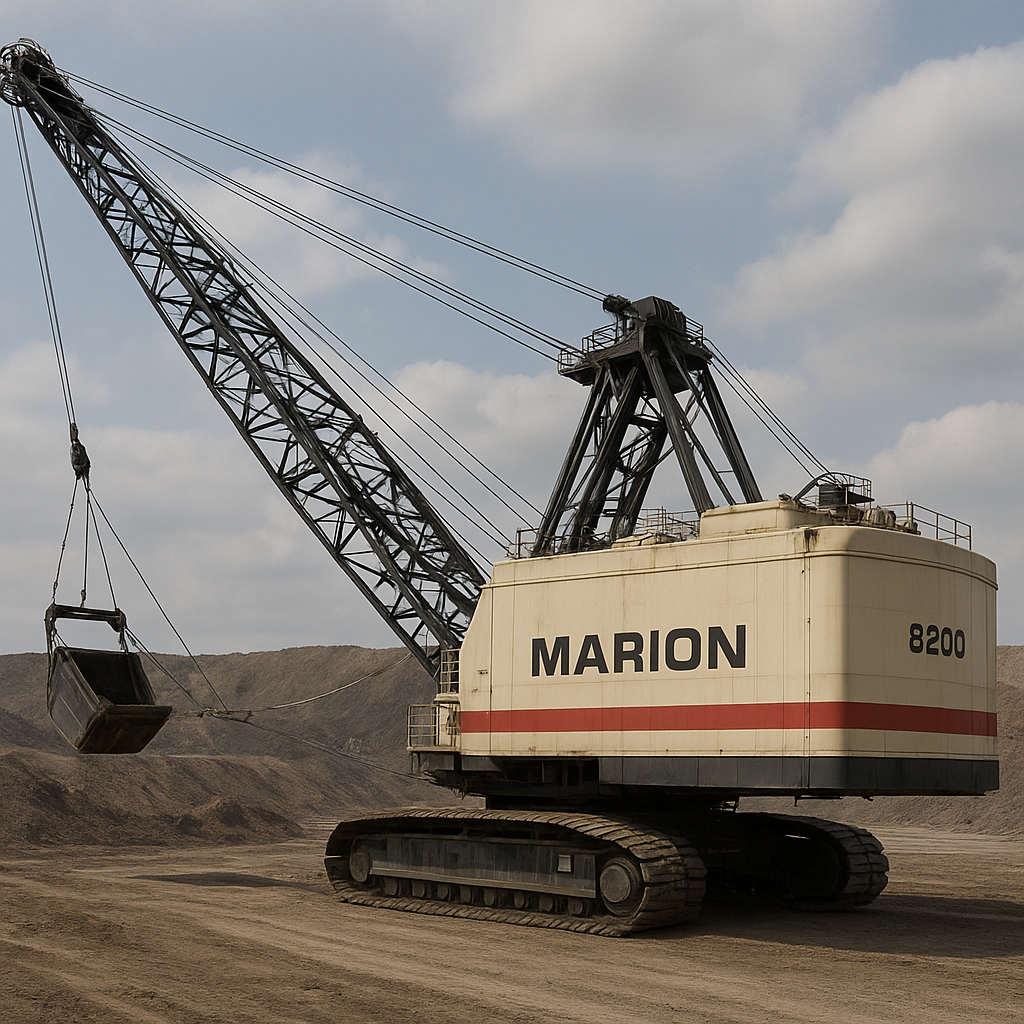
The Marion 8200 dragline stands among the most iconic and imposing machines developed for large-scale surface excavation. Designed to move enormous volumes of overburden and to expose valuable seams of mineral resources, this class of dragline has left a lasting mark on mining engineering, heavy-equipment design, and industrial heritage. In the following sections, we explore the machine’s origins, its technical anatomy, practical applications, operational statistics, and the environmental and safety considerations that surround its use. We will also cover maintenance practices and a few notable examples and legacy projects related to the Marion 8200 family.
Overview and historical context
The Marion 8200 is part of a lineage of large draglines produced by Marion Power Shovel and related manufacturers in the mid-20th century. These machines were developed at a time when demand for bulk coal, lignite, oil sands, and other surface-mined materials was rapidly increasing worldwide. The principle behind the dragline is simple but powerful: a large bucket is maneuvered by cables and a long boom to dig and transport loose material a short distance, allowing continuous removal of overburden and efficient access to the resource below.
Historically, draglines like the Marion 8200 enabled mines to expand their production capacities while reducing the need for large fleets of conventional shovels and trucks for certain operations. Their ability to excavate and deposit material in a relatively continuous cycle proved especially advantageous in extensive strip-mining operations. As a result, the Marion 8200 and similar models became staples in major open-pit coal mines, large infrastructure earthworks, and some heavy civil-construction projects.
Key components and technical design
The Marion 8200 is engineered around several fundamental subsystems. Each subsystem is optimized to handle vast loads, long duty cycles, and challenging working conditions. Below are the principal elements that define its function and performance.
Structural frame and undercarriage
The machine’s base supports the superstructure and houses the drive systems. A robust undercarriage (often crawlers) provides mobility across uneven pit floors. The structural frame must endure significant static and dynamic loads transmitted from the boom and bucket; consequently, high-strength steels and reinforced weldments are standard.
Boom and hoist system
The defining visual element is the long lattice or box-section boom, which enables the machine to reach deep into the excavation area. The hoist system—powered by large electric or hydraulic drives—raises and lowers the bucket and manages the tension in the hoist and drag ropes. Boom geometry and length determine the working envelope and maximum reach of the machine.
Bucket and rope system
The bucket, sometimes with a capacity on the order of tens to a few hundreds of cubic meters depending on configuration, is controlled by two primary cable systems: the drag rope (which pulls the bucket toward the machine) and the hoist rope (which lifts the bucket). High-strength steel wire ropes, robust sheaves, and heavy-duty anchors are essential to manage the colossal forces generated during digs.
Powerplant and controls
Power can come from large electric motors tied to grid power or from on-site diesel-electric systems in remote locations. Modernized units often incorporate advanced control systems, including electro-hydraulic drives, programmable logic controllers (PLCs), and operator interfaces that improve precision and reduce energy consumption. The control room typically houses instruments for load monitoring, rope tension monitoring, and system diagnostics.
Swing and rotation mechanisms
Swing drives allow the superstructure to rotate 360 degrees (or within a defined arc) to position the bucket for digging and dumping. These mechanisms combine heavy-duty bearings, gearboxes, and motors designed for high torque and long service intervals.
Applications and typical use cases
Draglines of the Marion 8200 class are predominantly used where large-scale, continuous excavation is required and where material needs to be moved relatively short distances. Key applications include:
- Surface coal mining: Removing overburden to expose coal seams in extensive strip mines.
- Lignite and brown coal operations: Especially in regions with very shallow, laterally extensive seams.
- Oil-sands reclamation: In certain process stages where bulk overburden or tailings must be moved.
- Civil engineering and infrastructure: Large earthworks such as harbor construction, river-shore dredging (when adapted), and subway cut-and-cover projects that require bulk material handling.
- Reclamation and environmental works: Redistribution of materials during rehabilitation of mined land, levee building, or shoreline restoration.
The dragline excels where a high-volume, low-frequency shifting of material is more efficient than repeated truck-and-shovel cycles, particularly across flat or gently sloping benches where mobility and bucket reach are maximized.
Performance, capacities, and statistics
While specific values vary between individual builds and over time due to upgrades, there are typical performance ranges associated with large draglines related to the Marion 8200 class. The following figures are representative estimates commonly found for machines of this scale:
- Bucket capacity: Ranges from tens to over a hundred cubic meters. Capacities are engineered to match the mine’s cycle time and desired tonnage per hour.
- Reach (boom length): Often between 30 and 100 meters depending on model and application—longer booms increase reach but raise structural and stability demands.
- Operating weight: Can be several thousand metric tons for the largest configurations; even smaller large-class draglines weigh in the high hundreds of tons.
- Cycle time: Typical dip-and-dump cycles may range from 30 to 60 seconds in optimized operations, translating to high hourly throughput when combined with large bucket volumes.
- Production rates: In real-world operations, an 8200-class dragline can move thousands to tens of thousands of cubic meters of overburden per day—actual numbers depend on bucket size, cycle time, and operational hours.
- Power consumption: Large electric drives consume megawatts during peak activity; energy-efficient control systems and regenerative braking can help reduce net consumption.
These machines are engineered for continuous, multi-shift operation during active mining campaigns. Their economics are driven by a low cost per cubic meter moved when compared with truck-and-shovel systems on suitable profiles.
Operational considerations, safety, and maintenance
Operating a dragline the size of the Marion 8200 requires meticulous planning, trained personnel, and rigorous maintenance strategies. Because each component carries massive loads, small defects can escalate into catastrophic failures if not detected early.
Maintenance regimes
Maintenance is both preventative and predictive. Key activities include:
- Regular rope inspections and replacements on specified fatigue schedules.
- Non-destructive testing (NDT) and ultrasonic checks of booms and structural welds.
- Lubrication and clearance checks for swing bearings and gearbox components.
- Electrical-system diagnostics and motor maintenance, particularly for large hoist and swing drives.
- Calibration of control systems and load-monitoring instruments to maintain safe working envelopes.
Safety protocols
Safety measures include exclusion zones beneath operating booms, rope-tension alarms, overload protection systems, and operator training to handle abnormal conditions. Emergency stop systems and redundant braking mechanisms are integral to preventing uncontrolled swings or drops. Safety also extends to ground stability monitoring; bench design and drainage are critical to prevent undercutting or subsidence where a heavy machine sits.
Environmental management
Dragline operations can significantly alter landscapes. Environmental management practices frequently employed alongside dragline use include:
- Progressive reclamation—reshaping and revegetating areas as they are mined to minimize exposed disturbed land.
- Water-management systems to prevent erosion and control surface runoff.
- Dust-control measures, such as spraying and covering stockpiles during high-wind conditions.
- Noise mitigation and timing constraints to reduce community impacts.
Technological evolution and modern upgrades
Although the mechanical principles of draglines have remained stable for decades, technological advances have improved safety, efficiency, and availability. Modern upgrades and retrofits for machines like the Marion 8200 include:
- Digital controls and operator-assist systems that optimize bucket-fill, depth control, and swing sequencing to reduce cycle time and wear.
- Drive system modernization using variable-frequency drives (VFDs) and regenerative systems to lower energy consumption and heat losses.
- Condition monitoring through sensors and remote diagnostics that track vibration, temperature, and rope condition to enable predictive maintenance.
- Materials upgrades, including higher-strength steels and improved fabrication techniques to extend service life and lower weight while maintaining strength.
These retrofits can extend the operational lifespan of heritage machines, improving return on capital invested in large fixed assets.
Notable examples and legacy
While individual machines have unique histories, many draglines have become emblematic of industrial heritage in mining regions. Some units are preserved as static exhibits, while others have been cannibalized for parts or scrapped when economic conditions changed. The legacy of the Marion 8200 class is seen in:
- The role these machines played in enabling large-scale strip-mining operations across North America, Europe, and other coal-producing regions.
- Contributions to engineering knowledge—lessons learned in metallurgy, structural design, rope technology, and machine control have influenced subsequent heavy-equipment designs.
- Community identity in mining towns where the machines were visual landmarks and employment anchors for generations.
Economic and logistical implications of deployment
Deploying a dragline the size of a Marion 8200 involves significant upfront capital expenditure, transport logistics, and site preparation. Typical economic and logistical factors include:
- Transport and assembly: Large components are often transported in sections and assembled on site, requiring cranes, foundation works, and time for commissioning.
- Site preparation: Bench heights and ground reinforcement must be designed to support the machine’s static and dynamic loads.
- Operational integration: Draglines must be coordinated with haulage, processing, and reclamation plans to achieve optimal material flows.
- Cost-per-cubic-meter analysis: The unit economics are favorable when the machine can operate near full capacity for extended periods—intermittent use diminishes the financial justification.
Future prospects and alternatives
The declining demand for some fossil fuels, the rise of alternative mining methods, and heightened environmental regulation have changed the market for new large draglines. However, opportunities remain:
- In regions with vast shallow deposits, draglines continue to offer unmatched productivity.
- Retrofitting older machines with modern controls and more efficient drives can be cost-effective compared with purchasing new equipment.
- Hybrid approaches pairing draglines with autonomous haulage or advanced scheduling software can further lower operating costs.
Alternatives such as truck-and-shovel fleets, conveyor-based systems, or in-situ extraction techniques will compete or complement draglines depending on deposit geometry, environmental constraints, and capital availability.
Conclusion
The Marion 8200 family of draglines represents a pinnacle of large-scale excavation engineering. With their long booms, massive buckets, and robust rope-and-hoist systems, these machines were purpose-built to move enormous volumes of earth efficiently. They reshaped landscapes and communities and spurred technological improvements across the mining sector. While modern pressures have altered the demand dynamics for new giant draglines, the machines’ advantages in suitable geological and operational settings remain compelling—especially when enhanced by contemporary control systems, energy-efficient drives, and careful environmental management. The Marion 8200 legacy is thus both technical and cultural: a reminder of an era when industrial scale and continuous operation were central to meeting global material needs.
dragline bucket boom rope hoist extraction coal efficiency maintenance payload
)
)