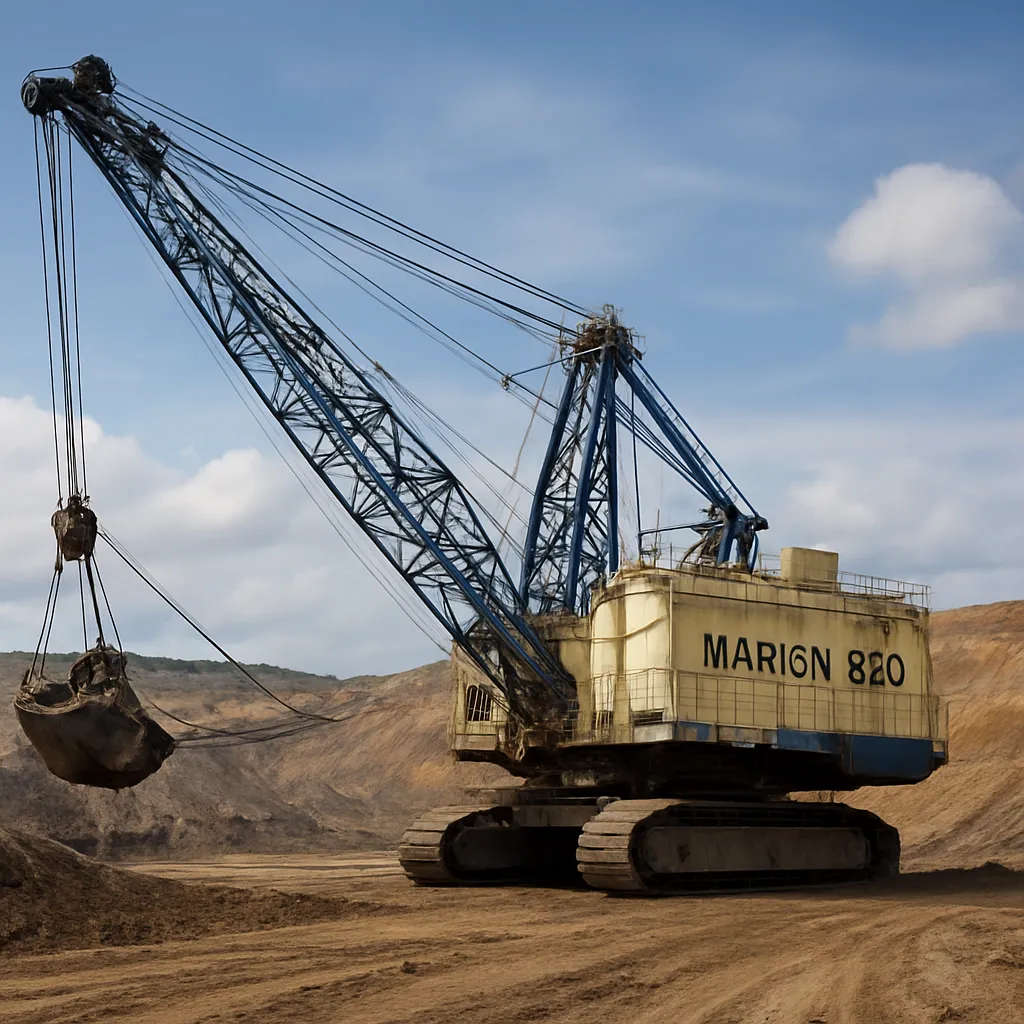
The Marion 820 is a classic example of a large-scale, cable-operated dragline used primarily in surface mining and heavy earthmoving. Designed to move enormous volumes of overburden and to expose targeted mineral seams, the Marion 820 combines the simplicity of rope-and-bucket mechanics with the robust engineering Marion Power Shovel became known for in the mid-20th century. This article examines the machine’s design, typical applications, operational considerations, environmental and economic impacts, and its place in mining history, offering technical context and practical insights for engineers, operators and enthusiasts.
Design and technical characteristics
At its core, the Marion 820 is a cable-operated excavator consisting of a large boom suspending a dragline bucket manipulated by wire ropes and winches. Unlike hydraulic excavators, draglines use gravity, rope mechanics and winch systems to drag (or “dragline”) a bucket across the surface and then lift the load for placement. The Marion 820 was engineered for long reach, high capacity and continuous operation in harsh mining environments.
Basic components
- Boom — A long lattice or plate-constructed arm that provides reach. Booms for machines in this class typically measure tens of meters long to allow extended reach into pits or spoil piles.
- Bucket — A heavy-duty steel bucket designed for abrasive material. Dragline buckets are often reinforced and can be built for capacities ranging from modest to extremely large, depending on job requirements.
- Hoist and drag winches — Electric or diesel-electric winches control the lifting and dragging of the bucket via multiple ropes and sheaves.
- Walking mechanism — Many large draglines, including those of Marion’s design lineage, use a “walking” undercarriage (cam-like feet or pads) to relocate the entire machine around the pit without traditional tracks.
- Electrical systems — Large draglines are usually powered by electric motors fed from site substations. Control panels, relays and safety interlocks govern operations.
Typical dimensions and capacities (generalized)
Exact specifications for the Marion 820 vary with configuration, era of manufacture and customer requirements. Rather than a single absolute spec sheet, operators typically selected options to optimize reach, bucket size and power. Typical ranges for draglines similar to the Marion 820 class include:
- Bucket capacity: approximately 30 m³ to over 200 m³ (roughly 40 to 260 cubic yards), depending on intended duty.
- Boom length: commonly between 40 m and 120 m (about 130 to 400 feet) for machines used in large open pits.
- Operating weight: can range from several hundred tonnes to multiple thousand tonnes for the largest machines in the class.
- Installed power: electric motors totaling several megawatts in larger configurations, while smaller setups use proportionally less.
These generalized figures reflect the broad family of Marion draglines and illustrate why the machine is chosen where high-volume, repetitive earthmoving is required.
Applications and use cases
The Marion 820 excels where large volumes must be moved quickly and economically. Its principal domain is the extraction of near-surface mineral deposits and large-scale civil earthworks.
Mining
- Coal strip mining — Draglines are particularly well suited to removing overburden in longwall and strip operations. The Marion 820’s reach allows it to remove layers of waste material and expose underlying coal seams with minimal repositioning.
- Tar sands and oil sands — In operations where large volumes of unconsolidated sands must be moved, draglines provide a cost-effective option for bulk removal.
- Iron ore and bauxite — Surface mines with wide benches and shallow depth benefit from dragline productivity for waste removal and pit development.
Civil engineering and reclamation
- Bulk earthworks — Construction of dams, large embankments and harbor dredging support can employ draglines when large quantities of material must be moved.
- Site preparation — For expansive infrastructure projects, draglines allow the fast stripping of topsoil and sand layers across broad areas.
- Mine reclamation — After primary extraction, draglines are sometimes used to recontour landscapes, backfill pits, and support revegetation by relocating spoil on a large scale.
Why choose a dragline like the Marion 820?
Draglines are selected over alternative equipment when the economics of moving vast, repetitive volumes favor rope-and-bucket systems. Advantages include high productivity per unit time, relatively low operating cost per cubic meter moved (once installed), and long service lives if well maintained. The Marion 820 was frequently chosen for projects where continuous, heavy-duty operation was required day after day.
Operation, performance and maintenance
Operating a Marion 820 requires coordination among cab operators, signalers, maintenance crews and power distribution personnel. While the basic mechanical concept is straightforward, the scale of the machine and the forces involved demand rigorous procedures.
Operational cycle
- Positioning: The dragline is accurately positioned to reach the targeted area with minimum repositioning.
- Dragging: The operator pays out the dragline and drags the bucket across the working face, filling it with material.
- Lifting: Hoist winches lift the bucket using the hoist rope and hoist drum systems.
- Swing and dump: The house swings on its turntable to a spoil pile and dumps the bucket contents.
- Repeat: The cycle is repeated continuously; efficient scheduling and sequencing maximize uptime.
Performance metrics
Key performance indicators for a dragline include cycle time (seconds per bucket fill-and-dump), bucket fill factor (how fully the bucket loads relative to rated capacity), machine uptime (percentage of scheduled operating hours available), and cubic meters moved per hour. A well-operated Marion 820 in favorable material can achieve very high hourly production, making it a cost-competitive solution for bulk overburden removal.
Maintenance demands
Maintenance is intensive and specialized. Typical tasks include:
- Routine inspection and lubrication of wire ropes, sheaves and bearings.
- Structural inspections and crack-detection on the boom and bucket hoist points.
- Electrical system diagnostics for motors, switchgear and control systems.
- Hydraulic systems (if hydraulics are used in auxiliary systems) checks and fluid changes.
- Scheduled overhaul of winches, drums and gearboxes.
Preventive maintenance and condition monitoring (vibration analysis, infrared thermography, rope monitoring) extend service life and reduce catastrophic failures. Replacement of major components — booms, buckets, or ropes — is expensive and logistically heavy, so operators emphasize predictive maintenance and spare parts planning.
Economic and environmental considerations
The Marion 820’s economics are site-specific. Capital costs are high, but lifetime productivity can justify the investment in large-scale mining operations.
Cost profile
- Capital expenditure — High initial purchase price or rebuild cost; transportation and assembly on-site add significantly to total project cost.
- Operating expense — Lower per-cubic-meter energy and labor costs compared with fleets of smaller shovels and trucks in many cases.
- Depreciation and resale — Draglines can have long service lives (decades), and well-maintained machines hold resale value in regions with ongoing large-scale mining.
Environmental impact
Dragline operations have substantial environmental footprints due to the scale of landscape disturbance. Key considerations include:
- Land disturbance — Large areas of topography are altered. Proper mine planning and progressive reclamation reduce long-term impacts.
- Dust and noise — High activity levels generate dust and noise; mitigation measures such as watering, windbreaks and operational timing help.
- Energy consumption — Although electrically powered draglines can be quite efficient per unit moved, they still consume significant power, and the source of that electricity (coal, gas, renewables) affects the overall environmental footprint.
- Reclamation potential — When combined with reclamation commitments, draglines can be part of a responsible lifecycle approach, enabling reshaping and drainage control for post-mine land uses.
Regulatory and social factors
Large draglines often operate within regulated frameworks requiring environmental impact assessments, community consultation and closure plans. Social license to operate depends on transparent planning, environmental controls and investment in local communities.
Historical context and notable examples
The Marion Power Shovel Company was a major American manufacturer of heavy excavation equipment through much of the 20th century. Their machines contributed to major infrastructure and mining projects around the world. The Marion 820 belongs to a lineage of large draglines that exemplified industrial-scale earthmoving.
Legacy and influence
- Technological evolution — Marion’s designs influenced how manufacturers approached boom engineering, winch reliability and electrical systems for continuous heavy-duty operation.
- Global deployment — Marion draglines served in North America, Australia, Europe and other regions where open-pit mining demanded high-capacity excavation.
- Longevity — Many Marion-built machines remained in service for decades, demonstrating the durability of conservative, over-engineered components.
Notable operational stories
While particular serial-numbered histories vary, operators of Marion-class draglines often share accounts of machines that worked continuously for tens of thousands of hours with proper maintenance, moved millions of cubic meters of material over their lifetimes, and were occasionally refurbished or modernized with updated electrical controls and improved safety systems.
Safety, modernization and future outlook
Safety and modernization are central to extending the operational life and viability of machines like the Marion 820.
Safety practices
- Comprehensive operator training on procedures for walk, swing, hoist and drag operations.
- Strict lock-out/tag-out for maintenance tasks on winches and electrical systems.
- Regular inspection of ropes and structural elements to prevent failures and uncontrolled drops.
- Use of modern monitoring and warning systems—camera coverage, proximity sensors and automated shutdowns—to protect personnel and equipment.
Modern upgrades and retrofits
Older draglines can be upgraded to improve reliability and efficiency:
- Retrofitting modern electrical controls and variable-frequency drives to improve motor efficiency and response.
- Installing remote monitoring systems for predictive maintenance and real-time performance analytics.
- Replacing worn components with improved metallurgy or engineering to extend life and reduce downtime.
Outlook
Although haul-truck-and-shovel operations have grown in prevalence, draglines remain competitive in certain niches—especially where continuous removal of large-area overburden is the principal activity. Advances in controls, materials and power electronics keep these machines viable. In an era of increasing attention to energy efficiency and lifecycle impacts, electrified draglines that can be powered from lower-carbon grids or integrated with renewable energy may see renewed interest as mining operators balance cost and sustainability goals.
Practical considerations for operators and buyers
Purchasing or operating a Marion 820 involves multiple strategic and operational decisions. Key considerations include:
- Site suitability — Evaluate geology, bench design and required reach. Draglines perform best where large horizontal benches and unconsolidated overburden predominate.
- Logistics — Transportation, assembly, and the footprint for the walking mechanism must be planned well in advance.
- Power supply — Reliable, high-capacity electrical supply and substations are essential; contingency power planning reduces downtime risk.
- Maintenance capability — Skilled maintenance crews, spare parts inventory and access to heavy lifting and fabrication resources are prerequisites.
- Economic modeling — Compare lifecycle costs against alternatives (truck-and-shovel, hydraulic excavators) using site-specific production forecasts.
In summary, the Marion 820 is a powerful symbol of industrial-scale excavation: a heavy, reliable, and efficient dragline solution where moving very large quantities of material is required. Its strengths lie in reach, capacity and continuous-duty performance. With thoughtful maintenance, modernization and responsible environmental management, machines in the Marion 820 class continue to contribute to large mining and earthmoving projects worldwide.
)
)