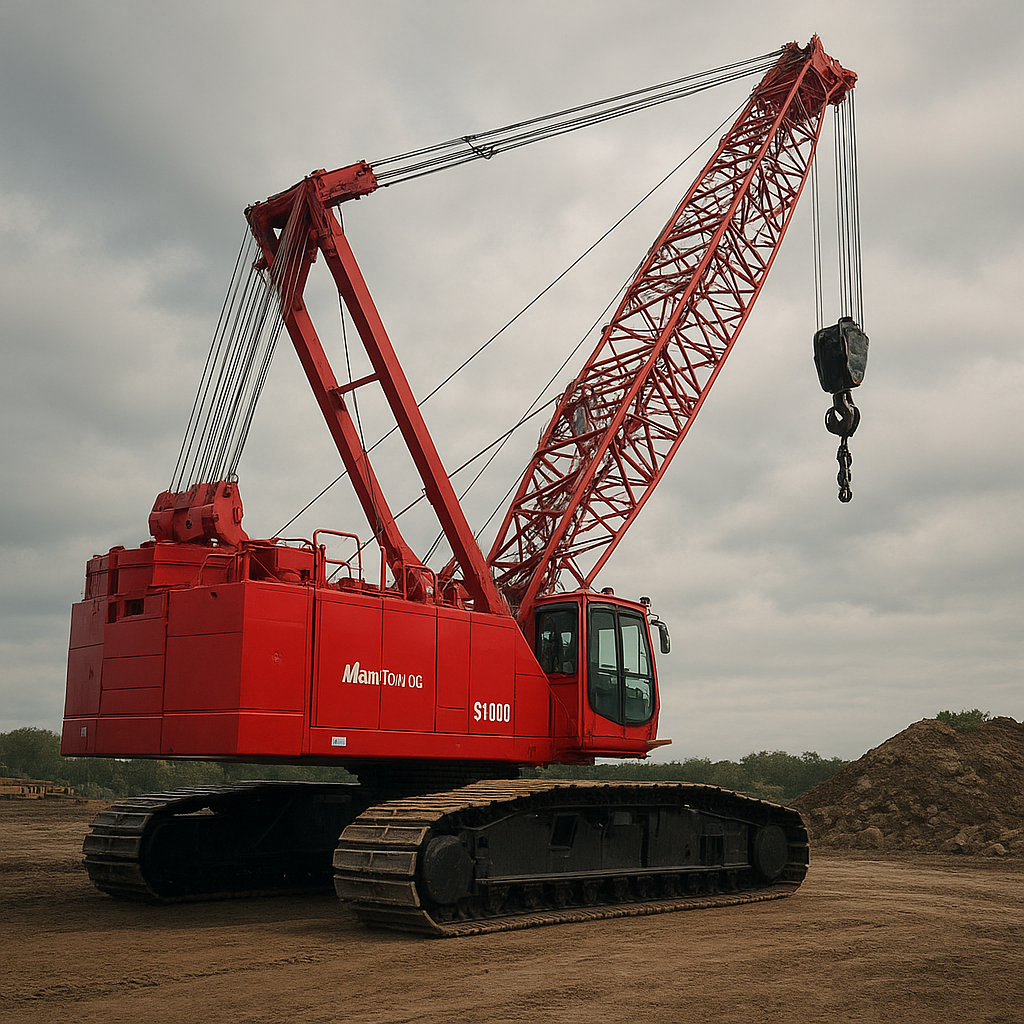
The Manitowoc 31000 is a flagship example of modern heavy-duty lattice-boom crawler cranes designed for demanding industrial and infrastructure projects. Combining modularity, advanced engineering and robust construction, the 31000 is intended to handle the most challenging heavy-lift assignments, from large-scale petrochemical module lifts and power plant components to wind-turbine installations and bridge construction. This article explores the machine’s design principles, typical applications, operational considerations and the practical data and statistics that define its performance envelope.
Overview and Context
The Manitowoc 31000 belongs to a class of large lattice-boom crawler cranes that emphasize versatility and raw lifting power. Unlike truck-mounted cranes, crawler cranes distribute weight across a tracked undercarriage, making them particularly suited for sites with uneven ground or where mobility under load is required. The 31000 is engineered to be highly configurable: different main boom lengths, jib options, counterweight packages and specialty lifting add-ons allow operators to tailor the crane to specific lifts.
Manufacturers like Manitowoc focus on three core design goals for cranes in this category: maximized rated capacity across relevant radii, ease of assembly/disassembly to control project logistics, and robust safety/monitoring systems to manage large loads. The result is a machine that is both a toolkit for complex lifts and a platform for safe, repeatable operations on large projects.
Design and Technical Characteristics
The technical architecture of the Manitowoc 31000 centers on a lattice boom and modular counterweight system mounted on a tracked undercarriage. Key elements include:
- Lattice boom: A modular lattice boom provides high stiffness-to-weight ratio, allowing very long reach while keeping deadweight relatively low. Boom sections are transported and assembled on site to achieve the required length.
- Modular counterweight system: Removable and stackable counterweights enable adjustments to the crane’s stability and load charts for different configurations. This modularity helps optimize transport and setup.
- Crawler undercarriage: Tracks distribute load and enable limited mobility on site even when carrying heavy loads. Track width and shoe size are chosen to control ground pressure and ensure safe operation on prepared pads.
- Hydraulic and electrical control systems: Modern models incorporate digital load moment indicators (LMI), anti-two block protection, and integrated telemetry/diagnostics for preventive maintenance.
- Operator cab and ergonomics: A purpose-built cab with excellent visibility and climate control is standard, along with ergonomically arranged controls and instrumentation.
Performance Envelope
Large lattice crawler cranes like the 31000 are rated to lift from a few tonnes at extreme radii to thousands of tonnes at short radii. Exact numbers depend strongly on the chosen configuration—main boom length, luffing or fixed jib options, counterweight size, and the use of auxiliary systems such as superlift or floating jib arrangements. Typical performance characteristics include:
- Maximum rated lifting capacity: generally in the range of several hundred to a few thousand metric tons, depending on configuration.
- Maximum main boom length: modular boom sections allow booms that can exceed 100 meters in many configurations; jib extensions and luffing jib systems further increase tip height.
- Transportability: the crane breaks down into many modules that can be moved by heavy transport trucks or specialized multi-axle trailers. Total transport loads for a full configuration commonly require tens of truck movements.
- Setup time: from several days to a few weeks, depending on site conditions, crane configuration, and available erection equipment or auxiliary cranes.
Applications and Typical Use Cases
The Manitowoc 31000 is optimized for projects where extremely large and heavy components must be lifted safely and precisely. Common sectors and specific uses include:
- Energy and power generation: installation of turbines, boilers, transformers and other major power plant modules. The crane’s capacity and reach are well-suited for lifting heavy components into place within confined plant yards.
- Wind energy: erection of large onshore and near-shore wind turbines, especially for next-generation turbines with very tall towers and heavy nacelles and blades. Reach and stability are crucial when lifting at heights.
- Oil, gas and petrochemical: lifting pre-assembled process modules, columns and vessels during refinery and petrochemical construction or revamp projects.
- Civil engineering and infrastructure: placement of large bridge segments, precast concrete units, and structural steel members in congested or remote sites.
- Heavy industrial: shipyard module installation, large machinery placement in factories, and other industrial heavy-lift requirements.
Because of its versatility, the 31000 is often subcontracted across different industries; a single crane can serve multiple project types over its operational life, maximizing utilization
Logistics, Transport and Assembly
One of the hidden costs of large crawler cranes is logistics. A machine the size of a 31000 requires careful planning for transportation, on-site assembly and foundation preparation. Typical considerations include:
- Transport coordination: lattice boom sections, counterweights and the crawler undercarriage are shipped as discrete loads. Depending on the final configuration, total transport movements can run into dozens of heavy-haul truck trips.
- Site preparation: a suitable crane pad or ground bearing area must be prepared to handle the concentrated loads. Ground improvement or reinforced matting may be necessary to achieve required bearing capacity.
- Erection sequence: the crane is assembled using smaller auxiliary cranes or gantries and follows a planned erection sequence that considers safety, available space and weather conditions.
- Assembly time and crew: a trained crew and supervision are required; assembly and testing may take from a few days to multiple weeks depending on complexity.
Safety, Controls and Certification
Given the scale of loads handled, safety systems and certified testing are integral. Important safety features and best practices include:
- Load moment indicators and anti-two block systems to prevent overloading and line snagging.
- Comprehensive lift planning and engineering, including lift charts that are validated for the exact crane configuration used on site.
- Regular maintenance regimes and inspections by certified technicians to keep wire ropes, sheaves and structural elements within service limits.
- Operator training and certification: operators must be experienced in large crawler crane operation and familiar with the crane’s control and safety systems.
- Compliance with local and international standards such as ISO, EN and national crane regulations; many projects also require third-party verification of crane capacity and lifting procedures.
Economic and Environmental Considerations
Owning and operating a crane like the Manitowoc 31000 represents significant capital and operational expenditure. Companies evaluating this crane weigh several factors:
- Capital cost vs. rental model: many contractors choose to rent such high-capacity cranes per project rather than purchase, since utilization rates can be intermittent.
- Operational efficiency: a crane that reduces the number of lifts or the need for multiple smaller cranes can deliver project time savings and lower total cost.
- Fuel consumption and emissions: large crawler cranes are typically diesel-powered; modern engines and drivetrains focus on improved fuel efficiency and reduced emissions, but fuel usage is still a material operational cost.
- Reuse and redeployment: modularity helps redeploy the crane across projects, improving life-cycle economics.
Case Studies and Notable Projects
Machines with the capabilities of the 31000 are frequently used in headline projects thanks to their ability to lift massive components and reach substantial heights. Typical high-profile uses include:
- Installation of heavy prefabricated modules in large petrochemical or LNG plants, where individual modules can weigh several hundred tonnes to over a thousand tonnes.
- Assembly of onshore wind farms featuring next-generation turbines with heavy nacelles and very tall towers.
- Bridge segment placement in major bridge replacement or new construction projects, where segment lifters and crawler cranes work in tandem.
In many cases, the crane is operated in tandem with other lifting equipment or supported by specialized rigging and spreader beams to distribute loads safely and precisely.
Maintenance, Lifespan and Reliability
Careful maintenance extends the lifespan of heavy crawler cranes. Typical lifecycle and maintenance points include:
- Preventive maintenance schedule: routine inspection of wire ropes, hooks, bearings, hydraulic systems and structural components is essential to prevent failures.
- Major overhauls: periodic major servicing—replacement of wire rope reeving, inspection of boom integrity and refurbishment of the undercarriage—keeps the machine in service for many years.
- Resale and residual value: well-maintained cranes retain significant value and can be reconfigured for sale or long-term rental after years of service.
Statistical and Performance Data (Typical Ranges)
Exact performance metrics vary by configuration; however, the following ranges reflect typical values for very large lattice crawler cranes similar to the Manitowoc 31000:
- Maximum rated lifting capacity: typically from several hundred tonnes up to multiple thousands of tonnes in compact-radius configurations.
- Main boom lengths: modular booms often allow main lengths exceeding 100 meters; with jibs and extensions, tip heights may be significantly higher.
- Transport requirements: full mobilization generally requires multiple heavy-haul truckloads—often in the range of tens of trailers for a full, highly counterweighted configuration.
- Assembly time: generally several days to multiple weeks depending on site constraints and configuration complexity.
- Ground pressure: track shoe size and track footprint determine ground bearing pressure; proper site preparation is essential to avoid excessive settlement.
Note: Project engineers must consult manufacturer load charts and certified engineering documents for exact capacities, radii and permissible configurations for any specific lift.
Best Practices for Project Planning
Successful use of a giant crawler crane like the 31000 depends on several planning and execution best practices:
- Early lift engineering: engage crane engineers during the design phase to optimize component weights, pick points and required crane configurations.
- Logistics simulation: model transport, assembly sequence and required staging areas to minimize downtime and unexpected costs.
- Ground preparation: design and construct crane foundations or pads to handle anticipated bearing pressures, including contingency for adjacent activities and weather.
- Safety culture: implement rigorous permit-to-lift processes, third-party lift supervision for critical lifts and continuous communication among rigging, operator and site teams.
Conclusion
The Manitowoc 31000 represents the marriage of classic lattice-boom engineering with modern controls and modular systems to meet the demands of contemporary heavy-lift projects. Its strengths lie in high rated capacity, adaptability through modular counterweight and boom configurations, and the ability to work across industries such as wind, petrochemical, power generation and civil infrastructure. While logistical and financial commitments are substantial—transport, assembly and site preparation being non-trivial—proper planning unlocks the crane’s potential to accomplish lifts that would otherwise be impractical or impossible.
When considering a crane of this class, project teams should work closely with the manufacturer and certified rigging engineers to specify the exact configuration, obtain validated load charts and plan a safe, efficient lifting campaign tailored to the project’s unique constraints.
)
)