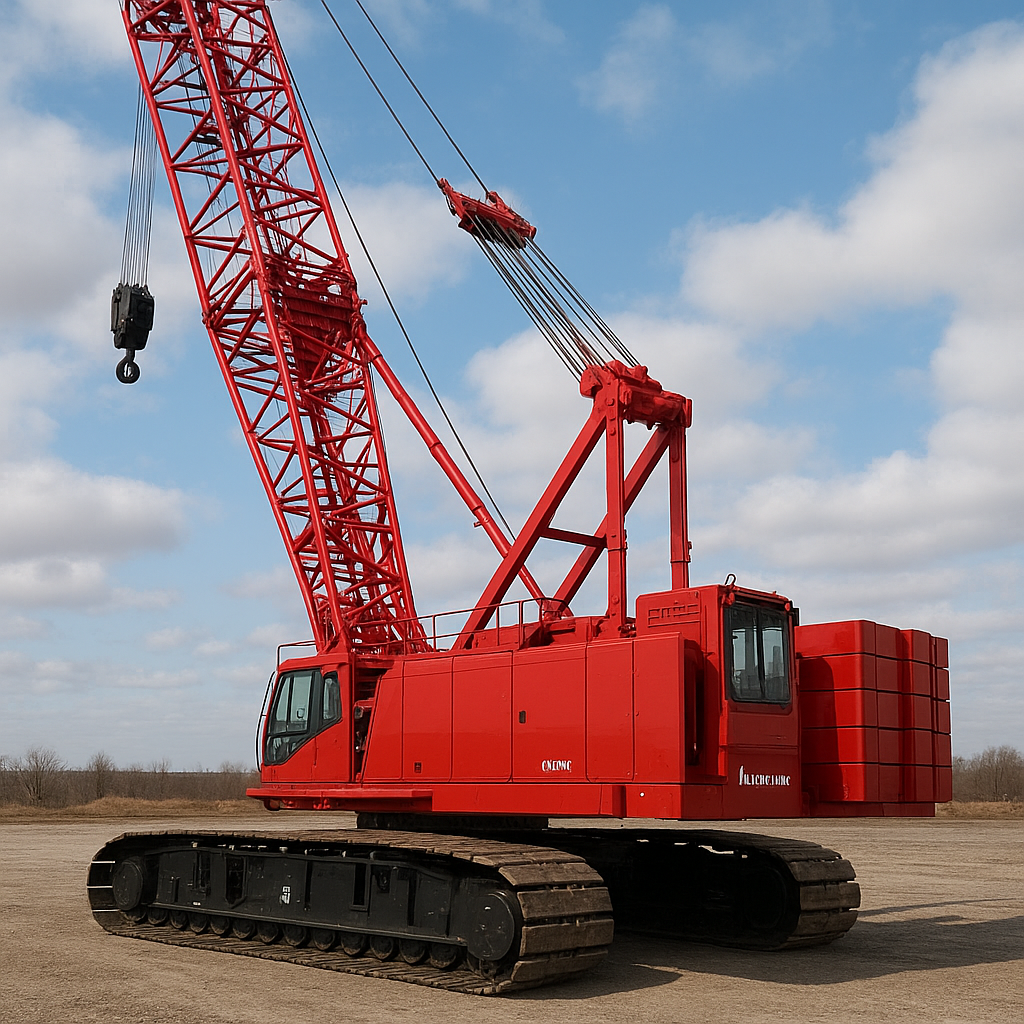
The Manitowoc 18000 is a landmark in heavy lifting equipment — a purpose-built crawler crane designed to tackle some of the most demanding jobs in construction, power generation, petrochemical, and infrastructure projects. Combining extraordinary load-handling capability with modular transportability and advanced rigging options, this model occupies a place among the class of cranes used when conventional machines cannot meet height or capacity requirements. The following article explores the machine’s design philosophy, typical technical characteristics, applications, logistics, safety and maintenance considerations, and its role in modern heavy-lift operations.
Overview and design philosophy
The Manitowoc 18000 was conceived as a heavy-duty, lattice-boom crawler crane capable of long reaches and high-capacity lifts while remaining transportable in sections for global deployment. Its design emphasis is on a balance among five core attributes: lifting capacity, reach (boom length), stability (through ballast and track footprint), modularity for transport and assembly, and operator ergonomics.
Key elements of the design include a large, box- or lattice-structured lower carriage with wide tracks to distribute loads; a lattice boom and luffing jib systems to achieve long radii and heights; and a configurable counterweight system that allows specialists to tune the crane for different lift charts. The machine’s layout typically positions power units, hydraulic modules, and winches to optimize weight distribution and serviceability.
- Modular construction — components are broken down for road transport and on-site assembly.
- High-capacity hoists — multiple drum configurations for main and auxiliary hoists provide flexibility.
- Robust undercarriage — crawler tracks and large footprint for ground pressure management.
- Advanced rigging — options for luffing jibs, fixed jibs, and load-sway control.
Typical technical characteristics and performance
Exact specifications for a Manitowoc 18000 depend on configuration (boom type, jib length, counterweight, and hoist arrangement). The model name implies a very large class of crane; in practice, machines of this family are engineered to perform multi-hundred to low-thousands of metric-ton lifts in specialist configurations.
Capacity and reach (typical ranges)
- Lifting capacity: Typically in the range of several hundred to over a thousand metric tonnes, depending on configuration. When fitted with maximum counterweight and heavy-duty blocks, these cranes can perform some of the largest on-site lifts in industrial projects.
- Boom length: Main lattice boom lengths are modular and can extend tens of meters up to several dozen meters; common long-boom combinations use main booms plus luffing or fixed jibs to achieve heights and radii needed for power plant or petrochemical modules.
- Jib options: Luffing jibs and fixed jibs increase reach and provide options for pick-and-place at height or over obstacles.
The important point is that the machine’s raw mechanical advantage comes from its large radius capability combined with configurable ballast. This means lift charts vary widely — operators and lift planners must consult manufacturer-provided charts for precise capacities at specific radii and configurations.
Powertrain, winches and hydraulics
- Power is typically supplied by diesel engine(s) sized to provide adequate performance for hoisting and travel. Machines in this class often have multiple engines or auxiliary power units to run winches and hydraulics independently.
- Hoisting arrangements include multiple drums with high-line speeds for efficient pick-and-carry operations and slow, high-torque modes for heavy lifts.
- Hydraulic systems manage slewing, luffing, and auxiliary functions, with electronic controls for fine motion and load monitoring.
Mass, footprint and ground pressure
Because these cranes are used on constrained or prepared sites, the undercarriage is designed to spread load and reduce ground pressure. The total assembled weight including ballast is significant — often measured in hundreds to thousands of tonnes — which affects crane pad design, transport logistics and the need for ground improvement in some projects.
Applications and industry use-cases
The Manitowoc 18000 excels in environments where exceptional capacity, reach or lift geometry are required. Typical industries and applications include:
- Power generation — erection of turbines, generators, condensers and heavy auxiliary equipment at thermal, hydro and nuclear power plants.
- Petrochemical and LNG — module lifts, skids, columns and other heavy process equipment in refineries and liquefied natural gas terminals.
- Heavy civil and bridge work — large-span bridge segment installation, erection of prefabricated structural elements and infrastructure lifts.
- Heavy industrial assembly — shipyards, steel plants and manufacturing plants requiring movement and installation of oversized components.
- Demolition and salvage — controlled removal of large structural elements where precision and capacity are essential.
In many of these fields, lifts are one-of-a-kind tasks that require detailed engineering studies, lift plans, and often bespoke rigging equipment. The crane’s modularity and flexible boom/jib options make it attractive to contractors who frequently face non-routine heavy-lift challenges.
Transport, assembly and site logistics
One of the defining practical considerations for the Manitowoc 18000 is how it is transported, assembled, and dismantled. Although designed for modular transport, its components are large and heavy, requiring careful planning.
Transport considerations
- Major components — crawler modules, lower frames, counterweight blocks, boom sections, and winches — are shipped on multiple trucks or special low-loaders.
- Permitting and route surveys are commonly necessary because of oversized loads. Escort vehicles and temporary road modifications may be required.
- On international projects, sea freight of disassembled modules is routine. Port handling and inland transport must be coordinated.
Assembly and commissioning
- Assembly is staged and sequenced to build the undercarriage, erect the superstructure, install counterweights, and finally step the boom and jib sections.
- Lift engineers often use small auxiliary cranes or hydraulic gantries during assembly to place heavy modules safely.
- Commissioning includes load testing, calibration of load-monitoring systems, and verification of slew and hoist performance under supervisory engineering control.
Because assembly and disassembly are time-consuming and costly, rental and project planning typically seeks to maximize the number of lifts performed per mobilization.
Rigging, lift planning and safety systems
Heavy-lift cranes like the Manitowoc 18000 require stringent lift planning, advanced rigging hardware, and comprehensive safety systems. Risk mitigation depends on three pillars: engineering, operator skill, and monitoring systems.
- Lift planning — detailed crane charts, soil and pad design, load path analysis, and contingency planning for dynamic effects (wind, shock loads) are essential.
- Rigging hardware — heavy-duty shackles, spreader beams, multi-part reeving blocks, and engineered connections prevent overloading peripheral components.
- Monitoring systems — modern cranes are fitted with load moment indicators (LMI), anti-two-block devices, wind-speed sensors, and often telematics for remote monitoring of performance and compliance.
Operational safety also emphasizes trained personnel: certified crane operators, riggers, signalers and lift engineers collaborate throughout planning and execution. Regular inspections and non-destructive testing of critical components (pins, ropes, structural nodes) are standard practice.
Maintenance, lifecycle and reliability
Maintenance of large crawler cranes is intensive but predictable when managed by experienced teams. Key maintenance areas include:
- Track and undercarriage inspections for wear and alignment.
- Wire rope condition monitoring and replacement intervals informed by load cycles and environmental exposure.
- Hydraulic and winch system servicing, including fluid analysis and filter replacement.
- Structural inspections, crack detection, and fatigue-prone area monitoring.
Crane owners often adopt condition-based maintenance supported by telematics to optimize downtime and extend service life. Given the capital cost and rental market value of such machines, maintaining availability and reliability is a major focus.
Market role, economics and rental considerations
Machines like the Manitowoc 18000 occupy a niche but critical segment of the crane market: heavyweight specialist lifts that cannot be accomplished by smaller all-terrain cranes. The economic equation for using such a crane includes mobilization/demobilization costs, hourly or daily rental rates, and crane pad or ground improvement expenses.
- Rental market — rental houses price these cranes based on mobilization distance, project duration, number and complexity of lifts, and the level of technical support provided.
- Project economics — on projects with very large modules or components, using a single high-capacity crane can be more economical than splitting lifts among smaller units or performing complex multi-crane tandem lifts.
- Lifecycle value — because these machines depreciate over long intervals and retain value for specialized work, they are often part of long-term rental fleets and invested in by large crane companies focused on heavy industries.
Case studies and representative projects
While specific project details depend on client confidentiality and logistics, common representative uses include:
- Installation of turbine-generator sets at hydroelectric plants — lifting and placing multi-hundred-tonne rotors and generator casings into foundations or support frames.
- Module lifts for LNG plants — hoisting complete process modules or gigantic columns onto foundations, often requiring precise placement at height with minimal tolerance for error.
- Bridge segment erection — handling precast segments weighing hundreds of tonnes and installing them on piers with careful alignment.
These kinds of projects highlight the capabilities of the machine in environments where precision, capacity, and reliability are all mandatory.
Operator environment and human factors
The operator cab and controls are designed to give visibility, ergonomic comfort, and precise response. Modern heavy cranes increasingly employ:
- Ergonomic cabs with climate control and adjustable seating for long-duration lifts.
- Electronic control systems with creep modes for fine hoist and slew adjustments.
- Integrated displays providing load charts, LMI readouts, camera feeds (for blind spots), and diagnostic messages for faster troubleshooting.
Human factors are large contributors to safe outcomes; good communication protocols, fatigue management, and team coordination are crucial for complex lifts.
Environmental and regulatory considerations
Large cranes operate under regulatory oversight related to lifting operations, emissions, noise, and transportation of oversized loads. Environmental considerations include: minimizing ground disturbance, containing hydraulic fluid spills, and limiting noise during night operations. Compliance with local permitting and transport regulations is part of every mobilization.
Summary and concluding observations
The Manitowoc 18000 is emblematic of high-capacity crawler cranes: engineered to solve the most challenging heavy-lift problems with a combination of modularity, structural robustness, and rigging flexibility. Its principal value lies in enabling lifts that would otherwise be impractical, unsafe, or far more costly using smaller equipment or complex multi-crane arrangements.
Key takeaways:
- These cranes are chosen when projects demand exceptional lifting capacity and reach.
- Transport and assembly logistics are significant and must be planned early.
- Detailed lift engineering, strict safety systems, and experienced crews are essential for successful operations.
- Maintenance, condition monitoring, and lifecycle planning preserve asset value and availability.
In modern heavy industries — power, petrochemical, infrastructure and marine construction — machines in the class of the Manitowoc 18000 remain indispensable tools for moving the very largest components safely and precisely. Their presence on a project frequently signals a complex scope of work where engineering excellence and logistical coordination converge to achieve high-stakes lifts.
)
)