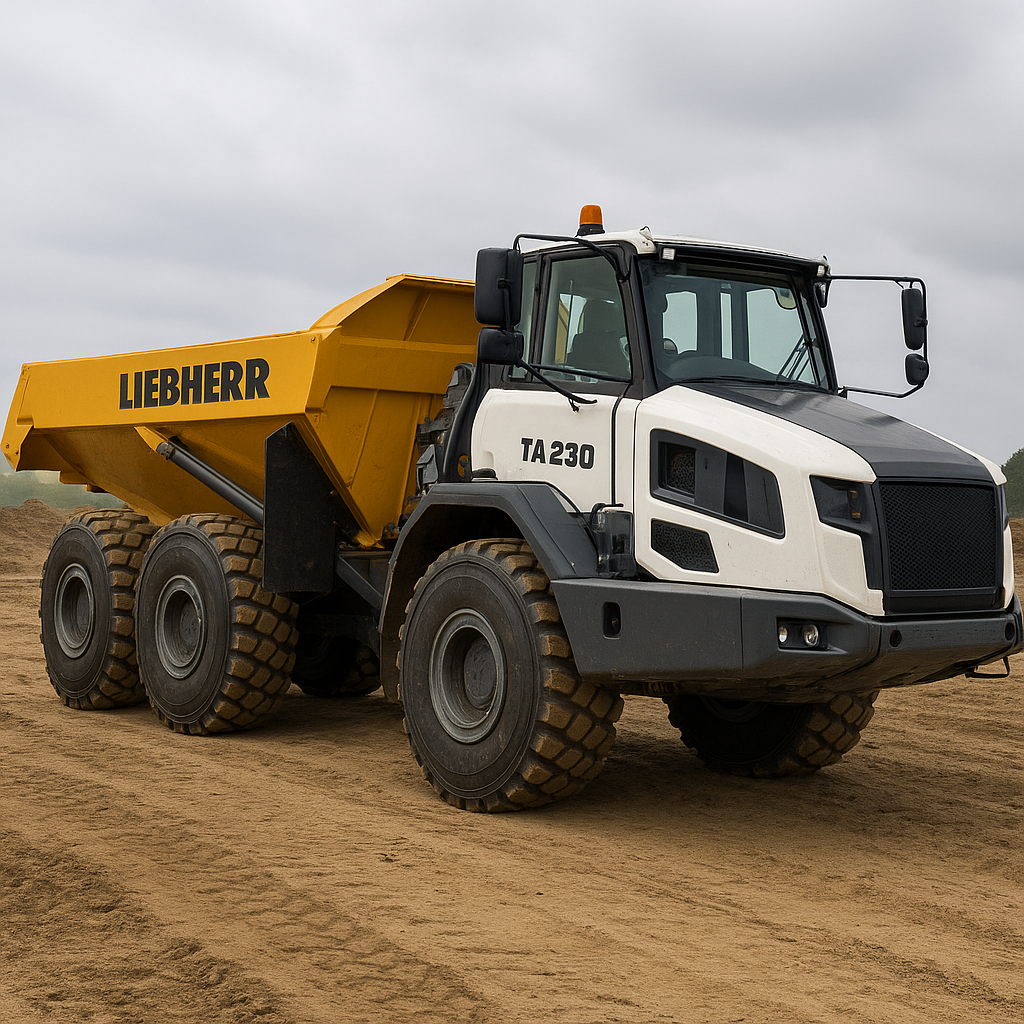
The Liebherr TA 230 articulated truck is a versatile heavy-duty machine designed for demanding off-road hauling tasks in construction, quarrying, mining and infrastructure projects. Combining an articulated chassis for superior maneuverability with a rugged dump body and powerful drivetrain, the TA 230 aims to deliver reliable performance, operator comfort and manageable operating costs across a variety of working environments. This article explores the machine’s characteristics, typical applications, technical aspects, performance data (where available), and practical considerations for operators and fleet managers.
Overview and key features
The Liebherr TA 230 is part of Liebherr’s range of articulated trucks engineered for the efficient transport of loose material over rough, unpaved terrain. The architecture of the TA 230 centers on an articulated steering joint which provides better steering angle, shorter turning radius and improved traction compared with rigid dump trucks when working on slopes, in tight haul roads or across uneven ground. This design makes the TA 230 particularly well suited to tasks that require frequent directional changes, confined operating spaces and variable underfoot conditions.
Key attributes of the TA 230 include a robust frame and dump body, high ground clearance, heavy-duty axles, and an advanced suspension system designed to balance load stability and ride comfort. The cab is built for operator visibility and ergonomics, often featuring climate control, adjustable seating and modern instrument clusters. On many units, telematics and fleet-management systems are available to monitor machine health, utilization and fuel consumption remotely, allowing fleet managers to make data-driven decisions.
Typical highlights of the model are its combination of maneuverability, payload capability in the mid-tonnage class, and configuration flexibility through optional bodies, tires and equipment packages. The TA 230 aims to offer a balance between durability for heavy use and fuel efficiency to contain operating costs.
Typical applications and industries
The TA 230 is used across a broad set of industries and job sites where off-road hauling of materials is required. Common applications include:
- Quarrying and aggregate production — moving blasted rock, gravel and sand from the face to crushers or stockpiles.
- Construction and earthmoving — transporting excavated material, fill, and topsoil on building sites, large civil works and dams.
- Mining and pit operations (small to medium scale) — hauling waste rock, overburden and ore between working benches and processing zones.
- Road building and infrastructure — carrying material for base layers, asphalt plants and roadside embankments.
- Landfill and recycling — moving refuse and cover material where articulated steering and traction are beneficial.
- Forestry and pipeline construction — operations on temporary roads and challenging terrain where flexibility matters.
Because of its articulation and traction characteristics, the TA 230 excels where route geometry is complex (switchbacks, narrow corridors) or the hauling route changes frequently, such as in staged quarry benches or segmented construction sites. It is also chosen when lower axle loads and better distribution of weight are required to protect haul roads and minimize maintenance.
Performance, specifications and statistics
Exact factory specifications can vary by region and configuration. Model numbering convention for many articulated trucks frequently reflects the payload class, and the TA 230 generally sits in the low- to mid-20-tonne nominal payload category. Below are representative technical figures and performance ranges commonly associated with machines in this class; these should be treated as approximate and may differ for specific TA 230 variants or market configurations.
Representative specifications
- Nominal payload: typically around 23 tonnes (approximate; model designation indicates the class).
- Operating weight (empty): approximately 28–36 tonnes depending on body and options.
- Gross vehicle weight (loaded): often in the range of 50–60 tonnes.
- Engine power: commonly in the range of 200–300 kW (approx. 270–400 hp), depending on emission stage and market.
- Top speed (road): typically around 40–55 km/h with safety-limited maximums for loaded travel.
- Fuel consumption: highly dependent on duty cycle, but heavy operations typically range between 15–35 L/h as a broad working estimate.
- Dump body capacity: nominal struck or heaped volume typically in the range of 10–14 m³ depending on material density and body design.
- Gradeability: able to handle steep working gradients (often >25%) when properly loaded and with traction aids engaged.
Performance in the field depends heavily on application specifics such as material type (density and abrasiveness), haul distance, road condition, climate and operator technique. Fuel consumption and cycle times vary most with payload utilization and idle time. For shorter, high-frequency haul cycles, effective payload utilization and minimized idle reduce fuel per tonne moved, improving productivity and reducing cost per delivered tonne.
Engine and drivetrain
The TA 230 is typically powered by a turbocharged diesel engine matched to a robust drivetrain and transmission capable of converting engine torque into tractable power for full-load starts, grade working and continuous operation. Drive components include heavy-duty axles, limited-slip or locking differentials (optional), and large-diameter drive tires suited to off-road conditions. Modern variants may incorporate engine and aftertreatment packages that meet regional emissions standards (e.g., Stage V / Tier 4 final), which can affect power output curves and maintenance needs.
Telematics and data
Liebherr offers telematic solutions on many machines enabling remote monitoring of location, hours, fuel consumption, machine faults and service intervals. Systems such as LiDAT (Liebherr telematics) provide fleet managers with reports that aid planning, preventive maintenance and uptime optimization. Typical on-board sensors monitor engine hours, hydraulic pressures, body position and temperatures, helping to diagnose faults before they cause major downtime.
Design details, cab and operator features
Operator comfort and safety are central to the TA 230 design. The cab layout prioritizes visibility to the dump body and immediate work area, with large glazing and well-positioned mirrors. Ergonomic seating, adjustable controls and a clear instrument cluster reduce operator fatigue during long shifts. Climate control (heating and air conditioning) is standard or widely available as an option to maintain productivity in harsh climates.
- Ergonomic, adjustable seat with integrated safety restraints.
- ROPS/FOPS-certified cab architecture for rollover and falling-object protection.
- Clear sightlines to the front, sides and dump body, often enhanced with optional rear-view cameras and obstacle-detection alarms.
- Simple, logical control layout for transmission, differential locks and body tip functions to reduce operator learning time.
- Optional audio, navigation and telematics displays for better connectivity and jobsite coordination.
Features such as a low-effort steering column, joystick-style body controls and automated transmission modes help both novice and experienced operators maintain consistent production. Additionally, the cab is usually mounted with isolation from the frame to reduce vibration and noise, contributing to operator comfort and longer shifts with less fatigue.
Maintenance, reliability and lifecycle costs
Life-cycle economics are critical for fleet owners. The TA 230 is engineered with serviceability in mind: accessible daily service points, modular components and provision for centralized lubrication simplify routine maintenance. Typical maintenance considerations include engine oil and filter intervals, driveline inspections, brake adjustment, hydraulic system checks and undercarriage inspections for wear items such as tires and bushings.
Operational reliability is improved through features such as heavy-duty cooling packages (for high ambient temperatures), enhanced filtration for dusty environments and optional guarding for vulnerable components. Proactive maintenance aided by telematics alerts can significantly reduce unplanned downtime and associated costs.
Key cost drivers and mitigation strategies:
- Fuel costs — optimize by matching engine power and drive mode to load, minimize idle time and train operators in fuel-efficient driving techniques.
- Tire wear — choose tires suitable for ground conditions and maintain proper inflation; rotating tires can extend service life.
- Wear parts — regular inspection and timely replacement of brake components, suspension bushings and hydraulic hoses prevents cascading failures.
- Resale value — documented service history and fitted telematics can preserve asset value at trade-in time.
Technical innovations and optional equipment
Liebherr often offers modular options to tailor the TA 230 to specific jobsite needs. Optional equipment enhances machine versatility and safety and may include:
- Different bed configurations: standard steel dump body, rock body with wear plates, high-capacity bodies and specialized bodies for low-density material.
- Tailgate options: controlled tailgates for improved material retention and safety when dumping.
- Telematics and fleet management packages for remote diagnostics and efficiency tracking (e.g., LiDAT).
- Cold-weather packs with battery warmers, hydraulic preheating and insulated fuel systems for reliable start-up in subzero environments.
- Optional camera systems, proximity sensors and automatic braking interlocks to improve safety.
- Centralized lubrication and remote grease points to reduce service time.
- Automatic or programmable traction and transmission modes to match terrain and cycle requirements.
Advances in drivetrain control enable features such as load-sensing hydraulics and optimized shift logic to enhance both performance and efficiency. Manufacturers are also exploring electrification pathways (hybrid assist systems, fully electric drivelines) for articulated trucks; while full electrification of mid-size ADTs like the TA 230 is not yet widespread, hybrid and battery-assisted solutions are increasingly part of long-term product roadmaps to reduce emissions and improve fuel economy.
Operational best practices and safety
To maximize productivity and longevity of the TA 230, fleet operators and site supervisors should adopt best practices focused on planning, operator training and maintenance:
- Design haul roads with appropriate gradients, bench widths and turning radii to take advantage of the truck’s articulation and minimize unnecessary braking and direction changes.
- Ensure proper tire selection and inflation and adjust tire pressure for load and terrain to protect tires and improve fuel economy.
- Train operators on load distribution, how to avoid partial loading patterns that increase wear, and correct dumping techniques to reduce stress on the body and hinge components.
- Implement pre-shift inspections that include fluid levels, lighting, brake function, body hinges and safety systems—record defects and repair promptly.
- Use telematics data to optimize route planning, reduce idle time and schedule preventive maintenance during non-productive hours.
- Follow manufacturer guidelines for maximum payloads and avoid overloading, which reduces tire life, increases fuel consumption and risks structural fatigue.
Safety systems such as ROPS/FOPS cab certification, seat-belt interlocks, audible reversing alarms and vision aids should be standard on site. Additionally, implementing traffic-management plans and designated loading/unloading zones reduces the risk of collisions and improves cycle efficiency.
Transport, logistics and fleet integration
Transporting an articulated truck between sites requires attention to dimensions, permits and proper loading onto low-bed trailers if road travel exceeds permitted escort-free limits. The TA 230 may be driven on public roads if legal in the jurisdiction, but manufacturers and fleet operators commonly move machines between long-distance sites using specialized transport to minimize wear and regulatory complications.
Fleet integration considerations include choosing matching duty cycles for trucks and loaders to avoid bottlenecks: the number of haul trucks required depends on haul distance, loader cycle time and material density. Modeling typical cycle times and payload utilization yields better capital deployment decisions; tools integrated into fleet telematics often provide simulation modules and productivity reports to guide acquisitions and redeployment.
Environmental and regulatory considerations
Modern TA 230 variants are configured to meet prevailing emission standards through engine upgrades and exhaust aftertreatment systems (diesel particulate filters, selective catalytic reduction, and other technologies). Compliance not only ensures regulatory conformance but often improves fuel efficiency and reduces particulate and NOx emissions. Some regions offer incentives or procurement preferences for lower-emission fleets, making it worthwhile to consider higher-tier engine packages or retrofit options when purchasing or upgrading machinery.
Noise, dust suppression and responsible fuel handling are additional environmental priorities on many sites. Proper maintenance of air-filtration systems and well-managed washdown facilities minimize environmental impact and improve component longevity.
Comparisons and positioning in the market
The TA 230 competes with other mid-class articulated trucks from global manufacturers. Its main selling points are typical Liebherr traits: focus on build quality, attention to serviceability, and integration with on-board telematics and service networks. Buyers often evaluate machines in this class based on:
- Payload-to-operating-weight ratio and effective payload utilization.
- Fuel efficiency and total cost of ownership rather than bare purchase price alone.
- After-sales support, parts availability and regional service networks.
- Operator comfort and ease of maintenance to reduce lifecycle costs.
When choosing equipment, owners should consider operating environment (dusty quarries vs. wet, clay-based sites), typical haul distances and material types. In many cases, slightly larger trucks with higher payloads may be more efficient on long-haul routes, while mid-sized machines like the TA 230 offer superior agility and lower per-cycle fuel consumption on short-haul, high-cycle operations.
Conclusion
The Liebherr TA 230 articulated truck is a capable mid-class hauler designed for the rigors of off-road material transport. With a focus on robustness, operator comfort and configurable options for diverse site conditions, it serves a wide range of industries including quarrying, construction, mining and waste management. While exact technical specifications vary by configuration and market, the TA 230 typically represents a payload class in the low- to mid-20-tonne range with engine and drivetrain packages optimized for a balance of power and efficiency. Effective use of telematics, proper maintenance, and operator training can significantly enhance productivity and lower lifecycle costs. For buyers and fleet managers, matching the TA 230 to site-specific haul profiles and investing in appropriate options (bodies, tires, telematics) will yield the best returns in uptime and total cost of ownership.
)
)