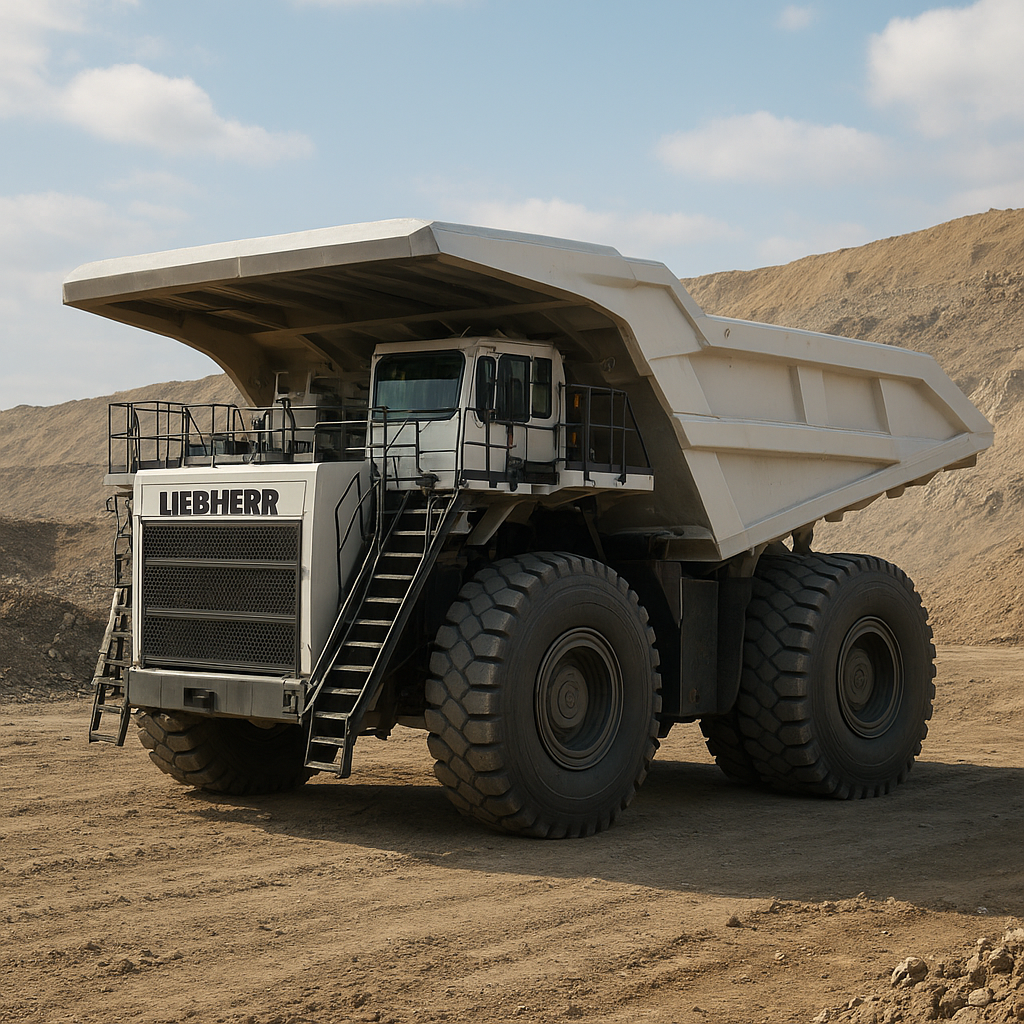
The Liebherr T 284 is a member of the ultra-class family of rigid-frame haul trucks developed for large-scale surface mining operations. Designed to move very large volumes of material efficiently and reliably, the T 284 represents Liebherr’s approach to combining heavy-duty mechanical design with modern control, safety and maintenance systems tailored for harsh mining environments. This article examines the machine’s general characteristics, typical applications, operational advantages, and the business and technical considerations that make such trucks central to modern open-pit mining fleets.
Technical overview and design principles
The Liebherr T 284 is engineered as an ultra-class haul truck intended for continuous, high-tonnage duty in surface mining. While specific factory configurations can vary by customer and region, the T 284 adheres to core design philosophies typical of Liebherr’s heavy-equipment range: robust structural components, modular systems for easier service, and integration of advanced electronics for monitoring and control.
Platform and structural design
- The T 284 uses a rigid-frame chassis built from high-strength steel sections and cast nodes where loads concentrate. This frame emphasizes longevity under repetitive high-cycle loads and simplifies repairs through replaceable wear elements.
- Body and dump-box geometry are optimized for rapid load cycle times and controlled material discharge, with wear liners and stepwise service access points to reduce downtime.
- Axles and wheel-end components are sized for ultra-class loads and are designed for compatibility with a variety of tire sizes commonly used in the >300-ton payload class.
Powertrain and driveline
In the ultra-class haul truck category, manufacturers commonly offer diesel mechanical, diesel-electric, or diesel-hydraulic drivetrains. The T 284 is positioned to deliver reliable tractive effort and efficient power transfer across variable loading conditions. Key attributes of its drivetrain and related systems include:
- High-torque power delivery to handle steep ramps and heavy payload starts.
- Robust cooling and filtration systems to maintain engine health in dusty, hot environments.
- Options for electronic controls that manage torque, gear selection, and anti-slip logic to protect driveline components and optimize cycle times.
Cab, ergonomics and operator support
Operator comfort and visibility are vital for both productivity and safety. The T 284’s cab layout typically integrates:
- Ergonomically designed seating, controls within easy reach, and climate control to reduce fatigue during long shifts.
- Advanced display systems providing real-time machine status, fuel consumption, diagnostics, and fleet telematics integration.
- Safety features such as ROPS/FOPS compliance, rear-view and side cameras, obstacle-detection sensors, and automated alarms.
Applications and operational roles
The Liebherr T 284 is primarily applied in large-scale open-pit mining operations where continuous and predictable material movement is essential. Its design suits the following scenarios:
High-volume ore and waste haulage
Ultra-class haul trucks like the T 284 are used to transport blasted ore from the pit to primary crushers, stockpiles, or processing plants, and to move overburden and waste material to spoil areas. Their large payloads reduce the number of cycles required to move a given volume, which benefits mines with long haul routes and continuous production targets.
Integration into high-productivity fleets
The T 284 is deployed alongside hydraulic shovels, electric rope shovels, and wheel loaders of matching capacity. Efficient pairing of shovel bucket size and truck payload is critical: when matched correctly, a fleet including T 284-class trucks can achieve optimal truck-shovel productivity, lowering cost per tonne and improving overall mine throughput.
Specialist roles and custom configurations
Depending on mine-specific needs, fleet managers can order trucks with custom options: enhanced filtration for coal operations, cold-climate packages for arctic mines, or specialized paint and corrosion protection for high-humidity environments. Trucks may also be configured with integrated payload weighing systems, autonomous-ready control kits, or additional safety packages.
Performance, productivity and statistics
Exact performance numbers vary with configuration, tires, payload class and operating environment. Instead of a single universal figure, it is useful to frame the T 284’s capabilities within the wider ultra-class category:
- The T 284 is targeted at the >300-ton payload class typical for ultra-class trucks; this class reduces haul cycles and supports large shovel match-ups.
- Top speeds and cycle times depend on grade, haul-road condition and gross vehicle weight; ultra-class trucks typically operate in the 30–60 km/h range empty and at reduced speeds loaded on ramps.
- Fuel consumption for ultra-class trucks is high in absolute terms but improves per tonne moved as payload size increases; fuel-efficiency gains often come from optimized gear ratios, engine management systems and reduced idle time.
When evaluating productivity most mines look at truck availability, effective payload utilization and cycles per shift. Typical performance metrics include:
- Payload utilization — ratio of actual payload delivered to rated payload, an important indicator of loading accuracy and shovel-truck matching.
- Availability — percentage of scheduled production time the truck is operational; high availability correlates strongly with robust maintenance regimes and condition monitoring.
- Cost per tonne — aggregated measure including fuel, maintenance, tires, labor and capital costs; improved cycle efficiency and lifecycle durability reduce this key metric.
Maintenance, lifecycle management and total cost of ownership
Ultra-class haul trucks such as the Liebherr T 284 represent high capital investment; lifecycle planning and proactive maintenance are central to realizing a competitive total cost of ownership (TCO).
Preventive and condition-based maintenance
- Routine preventive maintenance schedules target fluid changes, filter replacements, wear part inspection and wheel-end service.
- Condition-based monitoring, using onboard sensors and telematics, enables early detection of component degradation (for example, monitoring oil analysis for gearbox or engine issues and vibration analysis for bearings).
- Modular subsystems and accessible service points are designed to reduce mean time to repair and limit lost production hours.
Tire management and costs
Tire expense is a major operating cost for large haul trucks. The T 284’s wheel-end geometry and weight distribution are engineered to optimize tire life, but actual wear depends on haul-road maintenance, payload management, and driving practices. Many operations implement tire-management programs with regular inspections, retreading strategies, and fleet-level tire rotation to stretch service life.
Refurbishment and second-life considerations
As trucks age, rebuild programs can refurbish frames, replace driveline components, and recondition cabs to extend operational life at a fraction of purchasing new machines. Such rebuilds require careful assessment of structural integrity, especially for ultra-class trucks exposed to repeated heavy loads.
Safety, automation and technology integration
Safety and technology integration are major themes for modern mining trucks. The T 284 typically incorporates systems that address both:
- Active safety — including collision avoidance systems, speed-governing on steep grades, automatic park-braking when a fault is detected, and enhanced visibility via cameras and radar sensors.
- Operator assistance — features like automated gear selection, hill-hold systems, and fatigue monitoring improve safety and reduce operator errors.
- Fleet automation readiness — many mining trucks are delivered with provisions for semi-autonomous or fully autonomous operation; these include redundant braking, steering control interfaces and data links compatible with mine fleet automation platforms.
Telematics and data-driven operations
Integration with mine telematics platforms allows continuous monitoring of location, fuel use, cycle times, and machine health. Data analytics can identify bottlenecks, optimize dispatching, and predict maintenance needs, improving both safety and productivity.
Environmental considerations and fuel strategies
Environmental performance of ultra-class haul trucks is a growing focus. Operators and manufacturers are taking steps to reduce greenhouse gas emissions and local pollutants while maintaining productivity:
- Engine management systems reduce fuel consumption by optimizing power delivery and reducing idle time.
- Aftertreatment systems (DOC/DPF/SCR) limit NOx and particulate emissions, which is increasingly important as regulations tighten.
- Lifecycle analyses often drive decisions about refurbishment versus replacement; extending service life through rebuilds can be environmentally preferable to frequent replacement.
- Electrification pathways — from hybrid diesel-electric drivetrains to trolley-assist systems and battery-electric trucks — are being evaluated industry-wide. The T 284 platform can be integrated into electrified haulage strategies depending on site-specific infrastructure and economics.
Economic impact and fleet planning considerations
Deploying the Liebherr T 284 or any ultra-class truck is a strategic decision with wide operational consequences. Key considerations include:
- Capital allocation — large trucks require substantial upfront investment, but reduce per-ton transport costs at high throughput levels.
- Shovel-truck matching — optimal pairing between shovel bucket size and truck payload is essential to avoid under-loading or excessive waiting times.
- Road and pit design — haul-road gradients, curve radii, and ramp designs must support the safe and efficient operation of ultra-class vehicles.
- Human resources — operator training, maintenance crew skill levels, and remote operations control center capabilities affect utilization and safety.
Comparisons and market position
In the global market, the T 284 competes with other ultra-class trucks from manufacturers offering payloads in the >300-ton range and above. Buyers typically compare machines on metrics such as payload capacity, fuel efficiency per tonne, lifecycle cost, service network availability, and technological compatibility with the mine’s automation or electrification roadmap.
While exact specifications vary, choosing a truck like the T 284 often hinges on the total ecosystem a manufacturer can provide: local support and parts availability, digital fleet management solutions, refurbishment programs, and the ability to customize the machine to the mine’s environmental and operational needs.
Conclusion: where the T 284 fits in modern mining
The Liebherr T 284 is a purpose-built solution for high-capacity surface mining. It serves operations where moving very large quantities of material with fewer vehicles improves efficiency and reduces unit costs. With an emphasis on durability, operator ergonomics, integrated safety features and readiness for modern telematics and automation, the T 284 exemplifies how ultra-class haul trucks remain central to large-scale mining productivity. Operators considering such trucks must evaluate site-specific factors — haul distances, shovel matches, road profiles, fuel and maintenance strategies — to fully realize the advantages these machines can deliver.
Liebherr T 284 payload mining haul truck efficiency safety maintenance automation telemetry operator comfort
)
)