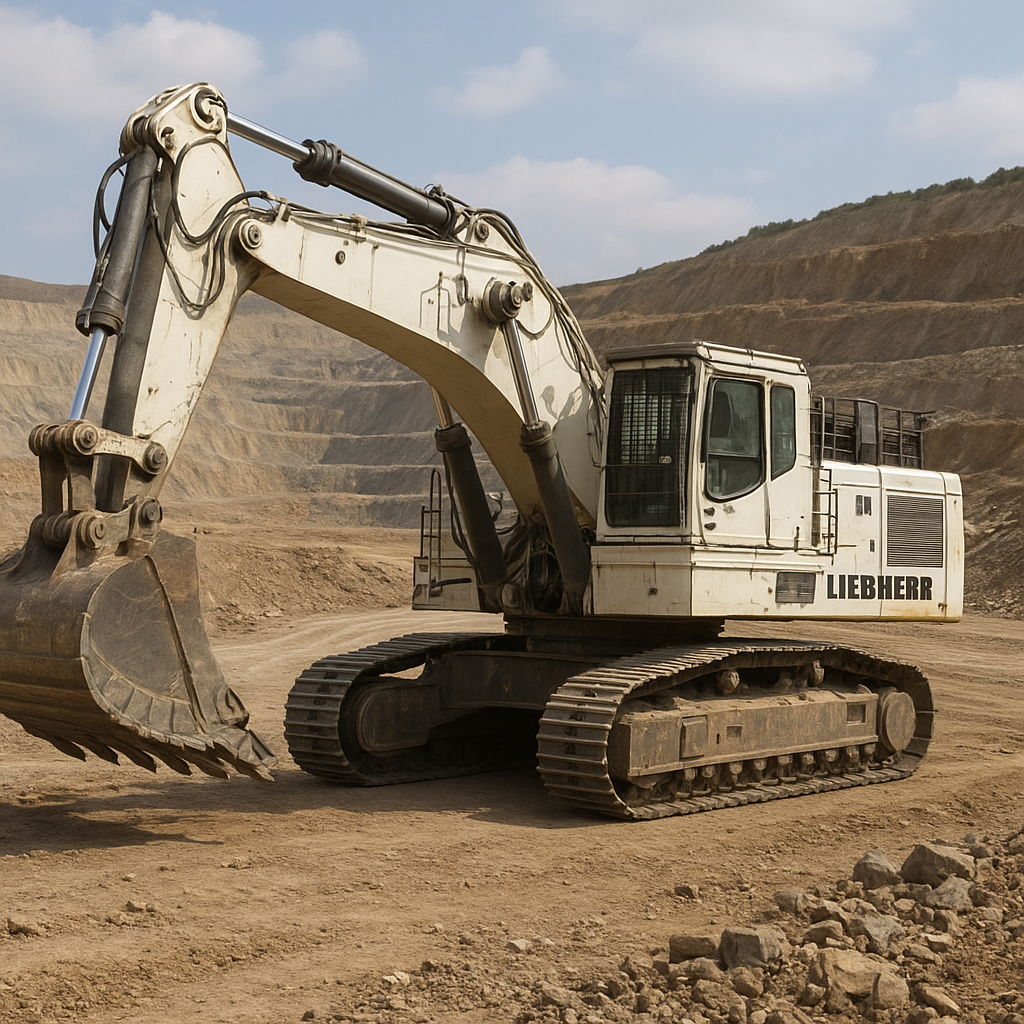
The Liebherr R 996 B is a heavy-duty, large-class hydraulic mining excavator designed for demanding open-pit mining and heavy earthmoving operations. Combining robust mechanical design with modern electronic controls and telematics, the machine is intended to deliver high productivity, long-term reliability and efficient operation across a variety of mining environments. This article explores the machine’s design, typical applications, technical characteristics, operational considerations and broader impacts on mining operations.
Overview and design philosophy
The Liebherr R 996 B continues Liebherr’s tradition of producing large, reliable excavators for the global mining market. Built around a rigid, modular frame and a powerful powertrain, the excavator is engineered to withstand continuous heavy-duty cycles in open-pit mine sites. The basic design priorities are durability, serviceability, operator comfort and energy efficiency, enabling long service lives and strong fleet availability.
Main design elements
- Heavy-duty undercarriage and superstructure constructed to handle large loads and intensive duty cycles.
- A robust hydraulic system with components sized for high flow and pressure, optimized for both power and precise control.
- Modular attachment options — including a range of buckets, rippers and specialized tools — to match material types and loading profiles.
- Ergonomic cab with modern controls, climate control and safety features designed to reduce operator fatigue and improve concentration over long shifts.
- Integrated telematics and diagnostic systems to support fleet management, predictive maintenance and remote troubleshooting.
These components are combined to provide a machine that can be adapted for loading large haul trucks, removing overburden, or performing secondary digging and stockpile work depending on mine requirements.
Applications and typical use cases
The R 996 B is primarily intended for heavy open-pit mining operations and large-scale civil earthworks. Typical applications include:
- Loading of large rigid-frame haul trucks in surface mining operations — coal, iron ore, copper, bauxite and other commodities.
- Overburden removal in multi-bench mines, where high bucket fill factors and cycle efficiency are critical.
- Primary and secondary excavation in interventions that require high breakout forces and stable boom performance.
- Rehandling and stockpile reclaim tasks on large mine sites or port terminals.
- Heavy civil projects — dam construction, large-scale earthmoving or infrastructure works that need sustained high production.
In each of these roles the R 996 B offers a combination of large-quantity material handling and precise hydraulic control, making it suitable both for bulk material movement and for tasks where controlled digging and placement are necessary.
Technical characteristics and performance (typical figures)
Machine specifications vary with configuration, attachments and customer requirements. The following are representative figures commonly associated with large mining-class hydraulic excavators in this segment; specific values for a particular R 996 B should be confirmed with Liebherr or an authorized dealer.
Representative specification ranges
- Operating weight: approximately 700–1,050 tonnes depending on configuration and counterweight options.
- Bucket capacity: commonly in the range of 18–37 cubic metres for standard digging buckets; larger or smaller buckets are available for specific duties.
- Engine power: diesel power units in the general range of 1,400–2,400 kW, compliant with contemporary emissions standards (e.g., Stage V / Tier 4 Final depending on market).
- Maximum reach and digging depth: typical maximum reach to ground level in the range of 20–25 metres, digging depths of around 9–12 metres, depending on boom and stick configuration.
- Hydraulic system flow/pressure: high-flow, high-pressure systems designed for continuous heavy-duty operation and quick cycle times.
Performance in the field is highly dependent on boom/stick geometry, bucket fill factor, rock hardness or material density, truck matching and operator skill. For well-matched fleets and favourable geology, hourly production figures for machines in this class can often exceed several thousand tonnes per hour. Typical fleet planning uses conservative production rates to match shovel cycles with truck dispatching and to maintain optimal availability.
Fuel consumption, emissions and efficiency
Fuel efficiency in heavy mining excavators is a major focus for operators seeking to control operating costs and reduce environmental impact. The R 996 B incorporates a mixture of mechanical and electronic controls, hydraulic optimizations and intelligent engine management to improve fuel economy during typical duty cycles.
- Advanced engine management and variable hydraulic flow control reduce unnecessary fuel use during low-load periods.
- Regenerative hydraulic techniques and optimized pump control — where fitted — help recover energy during certain motion sequences.
- Compliance with modern emissions regulations (Stage V/Tier 4 Final where applicable) reduces particulate and NOx output, and many engines are designed to be serviceable with low-sulfur diesel fuels used worldwide.
Operators report that fuel consumption per tonne of material moved decreases when excavators are well-matched to truck sizes and when cycle times are minimized via optimized shovel-truck interactions. Efficient loading, proper bucket sizing and preventive maintenance all contribute to lower lifecycle fuel consumption.
Maintenance, uptime and lifecycle management
Long-term economics for large mining excavators are driven by lifecycle cost, which includes initial purchase, maintenance, fuel, parts and downtime. Liebherr designs machines like the R 996 B to be serviceable in mining conditions with accessible wear parts and modular components that can be replaced or serviced in situ.
Key maintenance features
- Modular components such as pumps, swing motors and electronic control units that can be exchanged to minimize downtime.
- Robust wear liners and tooth systems for buckets, with readily available replacement parts.
- Automated or semi-automated central lubrication systems to ensure critical joints receive consistent lubrication.
- On-board diagnostics and telematics (e.g., LiDAT or similar Liebherr fleet monitoring systems) for remote performance tracking and predictive maintenance planning.
Typical availability targets for well-maintained mining excavators are in the range of 90–95% uptime; achieving this requires structured maintenance schedules, rapid parts supply and trained maintenance crews. The expected operational life for a large excavator in a mining fleet can be a decade or more, with major rebuilds or component overhauls extending serviceable life to 15–25 years depending on usage intensity.
Operator environment and safety
Liebherr places emphasis on operator comfort and machine safety. The cab design and control layout aim to reduce operator fatigue while improving visibility and control precision. Important features include:
- Certified ROPS/FOPS cab protection along with energy-absorbing seating and multi-zone climate control.
- Ergonomically arranged joysticks and user interfaces incorporating clear diagnostics and alerts.
- Large glazed surfaces and optional camera systems for improved visibility to loading areas and truck paths.
- Integrated safety systems that can include speed limiters, swing-lock interlocks, and zone protection to prevent unsafe machine movements near personnel or other equipment.
Comprehensive operator training and site-specific safety procedures remain essential. Even with advanced protections, human factors — such as communication between operator and truck drivers — are critical for safe and efficient operation on busy mine sites.
Economics and fleet optimization
Choosing an excavator like the R 996 B requires analysis of both short-term productivity and long-term cost. When integrated into a properly matched fleet, the machine can provide high hourly throughput, but the overall economics depend on several factors:
- Matching bucket capacity to truck body volumes to minimize truck waiting and minimize partial loads.
- Balancing capital cost versus expected production — larger excavators reduce equipment count but increase individual unit cost and complexity.
- Fuel and maintenance budget planning based on duty cycles, material hardness and local operating conditions.
- Availability of local service support, spare parts logistics and access to skilled technicians for major overhauls.
Financial models often use KPIs such as cost per tonne, uptime percentage, and maintenance hours per operating hour to compare fleet options. Modern telematics and predictive analytics can improve these KPIs by enabling condition-based maintenance and optimizing machine dispatching.
Case studies and real-world performance insights
While specific site results vary, reported case studies for excavators in this class typically highlight improvements in truck loading efficiency, reduced cycle times and lower overall unit operating costs when switching from smaller machines or less well-matched fleets. Typical benefits observed in practical deployments include:
- Higher fill factors and quicker truck loading due to larger bucket volumes and greater breakout force.
- Reduced number of machines needed for a specific hourly throughput target, simplifying fleet management and logistics.
- Improved safety record when cab ergonomics, visibility enhancements and integrated safety interlocks are combined with thorough operator training.
For mines operating in harsh climates or with abrasive materials, attention to wear parts and cooling system integrity is commonly cited in site reports as a key factor in maintaining consistent production rates.
Environmental considerations and future trends
Mining equipment manufacturers and operators are under increasing pressure to reduce greenhouse gas emissions and improve sustainability. For models like the R 996 B, several trends and options are relevant:
- Engines designed to meet the latest emissions standards (Stage V / Tier 4 Final) and to run on cleaner fuels where available.
- Electrification and hybridization: while total-electric ultra-class shovels and rope shovels are used in certain operations, diesel-hydraulic machines remain prevalent. Hybrid configurations or electrically powered drive systems (where site power infrastructure allows) are increasingly investigated to lower onsite diesel consumption.
- Use of biodiesel blends or renewable fuels in regions where permitted and validated for engine warranties.
- Lifecycle assessments and circular economy approaches for component refurbishment, remanufacturing of engines and hydraulic components, and materials recycling.
As grid power availability and battery/energy-storage technology evolve, future iterations of large mining excavators may incorporate greater electrification and energy recovery capabilities, further reducing CO2 footprints for major mining operations.
Comparisons and competitive positioning
Within the large hydraulic excavator market, the R 996 B competes with machines from other major manufacturers offering machines in similar size classes. Competitive differentiation is commonly based on:
- Reliability and mean-time-between-failure (MTBF) figures derived from field experience.
- Service network coverage and parts availability in key mining regions.
- Telematics and digital tools for fleet management and predictive maintenance.
- Initial capital cost versus expected lifecycle operating cost.
Operators typically perform detailed total-cost-of-ownership evaluations, often supplemented by trial periods or site demonstrations to validate productivity and fuel consumption under local conditions.
Operational recommendations and best practices
To maximize the value of a large mining excavator such as the R 996 B, experienced operators and site managers recommend the following best practices:
- Carefully select bucket geometry and size to match the target haul truck fleet and the material’s characteristics to maximize fill factor.
- Use telematics and condition monitoring systems to move from reactive to predictive maintenance, reducing unexpected downtime.
- Invest in operator training programs focused on fuel-efficient operating techniques, cycle optimization and safety procedures.
- Maintain robust spare parts inventories for high-wear items (teeth, pins, bushings) to avoid prolonged stoppages in remote areas.
- Synchronize shovel and truck management to minimize truck idling and waiting times, which improves overall fleet productivity.
Summary and outlook
The Liebherr R 996 B represents a class of large hydraulic excavators engineered for high-production, heavy-duty mining environments. Its strengths lie in a combination of robust mechanical design, modern hydraulic and electronic control systems, and features that support operator comfort and machine uptime. While exact specifications and performance figures depend on configuration and site conditions, machines in this class are capable of delivering very large hourly throughputs when integrated into optimized fleets.
Looking ahead, trends such as increased electrification, stronger telematics-based maintenance regimes and heightened focus on lifecycle sustainability will continue to shape the evolution of mining excavators. For mine operators, selecting and deploying a machine like the R 996 B requires careful planning around bucket-truck matching, maintenance strategy and site-specific operating practices to achieve the best balance of productivity, cost and environmental performance.
Key words highlighted: excavator, mining, bucket capacity, durability, serviceability, hydraulics, fuel efficiency, LiDAT, operator comfort, safety.
)
)