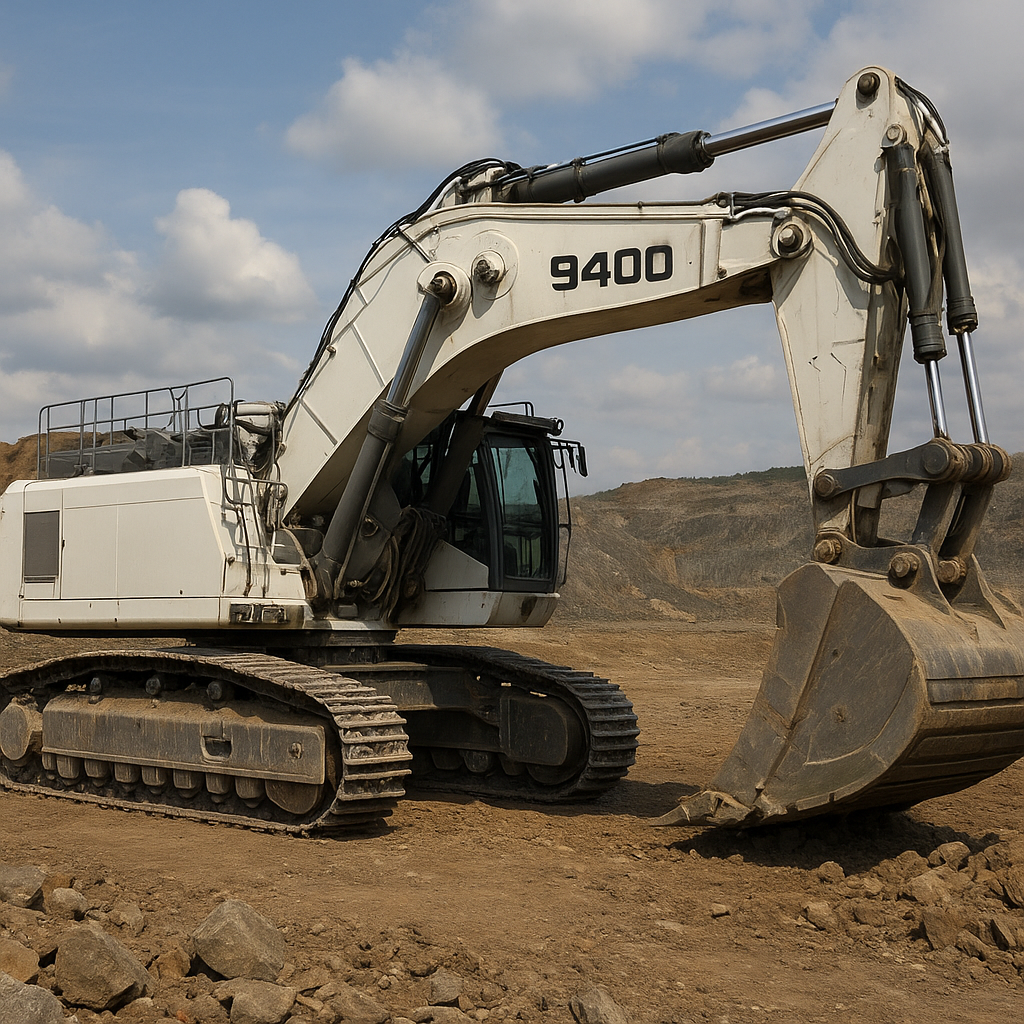
The Liebherr R 9400 is a large-scale hydraulic machine designed for demanding surface mining and heavy earthmoving tasks. Built with a focus on high productivity, robust reliability and operator-oriented features, it is part of Liebherr’s family of mining excavators that serve the global extractive industries. This article describes the R 9400’s design, typical applications, performance characteristics, maintenance considerations and market positioning, and provides commonly cited technical ranges and operational statistics where available.
Design and technical overview
The R 9400 is engineered as a purpose-built, heavy-duty hydraulic excavator for continuous operation in the harsh environments of open-pit mines and large quarries. Its structural design emphasizes a rigid, modular undercarriage and an upperworks that allow for efficient installation of large hydraulic and electric components. Key design priorities include simplified access to service points, heat management for extended duty cycles, and component standardization to reduce downtime.
Hydraulics, powertrain and components
At the heart of the machine is a high-capacity hydraulic system intended to deliver consistent cycle performance under large loads. The R 9400 typically uses multiple axial-piston hydraulic pumps, proportional control electronics and heavy-duty hydraulic cylinders for boom, stick and bucket movements. Power can be provided by large diesel engines combined with hydraulic drive systems; some configurations and markets also favor diesel-electric architectures or hybrid arrangements where feasible to improve efficiency.
- Boom and stick: Heavy-duty box-section steel booms and sticks are designed for repeated high-stress cycles and to minimize deflection under load.
- Buckets and attachments: The excavator can be fitted with a variety of buckets (standard, rock, and high-capacity) and specialized attachments such as hydraulic breakers, grabs and quick-couplers to broaden its operational envelope.
- Cooling and filtration: Enhanced cooling packages and robust filtration systems are integrated to maintain performance in dusty, hot mine environments.
Operator environment and controls
The cab environment is designed for long-shift comfort and operational efficiency. Modern R 9400 cabs include ergonomic seating, climate control, sound suppression, and intuitive control layouts. Many machines are equipped with integrated telematics, performance monitoring dashboards and optional semi-automated functions to assist the operator and optimize productivity. Safety features such as comprehensive visibility aids, camera systems and fall-protection designs are common.
Applications and operational roles
The primary mission profile for the R 9400 is in large-scale mining operations where the excavator’s duty cycle and hydraulic power can be fully utilized. Typical applications include:
- Loading haul trucks: The R 9400 is used to load large-capacity off-highway haul trucks and articulated dump trucks, forming a central part of the material handling chain in open-pit mines.
- Stripping overburden: Its ability to move massive volumes of overburden material quickly makes it suited to initial site clearing and continued stripping operations.
- Ore and waste handling: With specialized buckets and wear packages, it can handle abrasive ores and waste rock.
- Quarrying and large-scale civil works: Beyond mining, the R 9400 can be deployed in large quarries and earthworks projects where high hourly production is required.
Matching the R 9400 to site logistics is essential. The excavator is typically paired with haul trucks in a similar capacity class, and cycle times must be tuned to truck loading and material characteristics. Because of its scale, the R 9400 is most economical where continuous, high-volume operations justify its acquisition and operational costs.
Performance, productivity and efficiency
In raw terms, the R 9400 is designed to deliver high per-hour material displacement while minimizing unproductive time. Practical measures of its effectiveness include bucket fill factor, cycle times, truck turnaround, and fuel consumption per tonne moved. Modern R 9400 deployments emphasize improved fuel efficiency through intelligent hydraulic control, optimized power curves and load-matching systems.
- Cycle optimization: Electronic control systems can be configured to limit hydraulic flow to the exact requirement for shovel motions, reducing unnecessary fuel use and component wear.
- Payload matching: Selecting a bucket size that achieves a good fill factor for the matched haul truck fleet is crucial to maximizing productivity and minimizing truck waiting times.
- Telematics and analytics: Remote monitoring platforms provide data on fuel burn, operating hours, bucket cycles and maintenance alerts — enabling predictive maintenance and performance benchmarking.
Productivity metrics in the field depend heavily on material type, operator skill, bucket selection and site layout. In high-density, easily shovelled material, the R 9400 can complete more tonnes per hour than smaller excavators, but exact figures vary by job. When comparing machines, mines often look at tonnes per litre of fuel and total cost per tonne moved over the equipment lifecycle.
Specifications and notable statistics
Specifications for large mining excavators like the R 9400 often vary by configuration, supplier options and regional market. The following ranges represent commonly reported values for machines in this performance class; actual R 9400 figures should be confirmed with the manufacturer or local dealer for specific configurations.
- Bucket capacity: Typical mining buckets for excavators in this class range from about 25 to 45 cubic meters, depending on material and bucket design.
- Operating weight: Machines of comparable size usually have operating weights in the range of approximately 200 to 300+ tonnes in standard configurations; variations occur with added counterweights and attachments.
- Engine and power: Installed engine power for large hydraulic mining excavators often falls within a broad band suitable for continuous heavy duty; powertrain and hydraulic system design are tuned to achieve the required digging forces and cycle times.
- Production potential: Hourly production is highly dependent on site factors but can reach hundreds to thousands of tonnes per hour in favorable conditions when matched with appropriate truck fleets and bucket sizing.
- Truck matching: The R 9400 is typically matched to haul trucks of large capacities (often several dozens of tonnes payload or more) to leverage its loading capability.
Note: Exact manufacturer figures (engine type, horsepower/kW, maximum digging reach and depth, swing torque, hydraulic system flow rates, etc.) should be referenced from Liebherr’s official documentation or the local sales representative for the model variant offered in a given market.
Maintenance, reliability and lifecycle costs
Maintenance strategies for the R 9400 focus on reducing downtime and extending component life in abrasive and heavy-duty environments. Key considerations include:
- Planned preventive maintenance: Regular inspections of boom and stick pins, hydraulic hoses, pumps and tracks (or undercarriage components) are scheduled in line with operational hours and working conditions.
- Wear component management: Buckets, teeth, side cutters and lip edges are subject to significant wear; keeping an effective inventory of wear parts and using appropriately hardened materials reduces replacement frequency.
- Modular components: Designs that allow for rapid replacement of pumps, motors or filters help speed repairs and lower downtime costs.
- Remote diagnostics: Telematics systems often enable early detection of anomalies, allowing interventions before failures occur and optimizing parts ordering.
From a lifecycle cost perspective, factors such as fuel consumption, parts replacement rates, operator training and resale value play an essential role. Mines perform total cost of ownership analyses comparing upfront purchase price against expected productive life, parts cost, downtime risk and service coverage.
Safety, regulations and environmental considerations
Large excavators operate under strict mine safety regimes. The R 9400 is designed with multiple safety elements to meet regulatory and operator expectations:
- Visibility and detection: Cameras, blind-spot monitoring and proximity detection systems help prevent collisions with personnel and equipment.
- Access and egress: Safe walkways, ladders, and anti-slip surfaces are provided to reduce the risk of falls during maintenance and operation.
- Emissions and noise: Engine emissions controls and optional exhaust after-treatment systems help meet local environmental standards; modern cab insulation reduces noise exposure for operators.
- Fuel and spill prevention: Designs incorporate fuel containment and routing to minimize spill risk and simplify spill response if necessary.
Environmental stewardship is increasingly important for mine operators. Efficient machines that reduce fuel use and greenhouse gas emissions per tonne moved contribute to broader sustainability goals. Electrification of mine powertrains and site-wide electrification strategies can further reduce local emissions when grid or onsite renewable power is available.
Market positioning and comparisons
The R 9400 occupies a segment of the market where scale, robustness and continuous operation are key differentiators. When compared to competitor models from other major manufacturers, buyers typically evaluate:
- Productivity per hour: Measured in tonnes moved and cycle times relative to total cost.
- Fuel economy: Consumption per productive tonne under comparable working conditions.
- Service and dealer network: Availability of parts, field service capability and local support have a critical impact on uptime.
- Adaptability: Ability to fit various buckets and attachments and to be deployed in different mining tasks.
Beyond raw capability, Liebherr emphasizes integrated systems — combining machine design with telematics, parts and service agreements — to deliver predictable performance and cost profiles across a fleet.
Automation, digitalization and future trends
The mining industry is rapidly adopting automation and digital tools to optimize productivity and safety. The R 9400 can be part of this trend through:
- Telematics integration: Fleet management platforms allow coordination across loading and hauling cycles to minimize idle time and improve truck matching.
- Assisted operation: Features such as automated shovel positioning, swing limits and payload estimation help operators achieve consistent results.
- Remote and autonomous operation: While full autonomy has complex regulatory and operational requirements, remote control and semi-autonomous functions are increasingly common in modern mining fleets to improve safety in hazardous zones.
Looking forward, the industry trend towards electrification, renewable-powered sites and advanced predictive maintenance will influence future iterations of large excavators. Machines that can integrate with electrified energy systems or offer hybrid drivetrains will have an edge in mines targeting lower lifecycle emissions.
Operational considerations before acquisition
Potential buyers evaluate several operational factors prior to acquiring an excavator like the R 9400:
- Site material and geology: The abrasiveness, density and fragmentation characteristics of the material dictate bucket design and expected wear.
- Truck fleet compatibility: Ensuring the excavator’s bucket size and loading envelope match the haul truck fleet is critical to avoid under- or over-capacity matching.
- Transport and assembly: Large excavators may require disassembly, specialized transport and onsite reassembly; logistical planning and costs must be included in procurement decisions.
- Training and local support: Operator training, maintenance crew capabilities and proximity of parts depots influence effective deployment and total operating cost.
Engaging with the manufacturer or authorized dealer to run site-specific studies (including material handling trials and fuel consumption simulations) is a best practice before committing to purchase.
Concluding perspective
The Liebherr R 9400 represents a class of large hydraulic excavators tailored to meet the high demands of modern surface mining and heavy quarrying operations. With a focus on durability, serviceability and integration with digital tools, it is built to deliver consistent productivity where scale and continuous operation are paramount. While exact technical specifications vary with configuration and model year, the machine’s role is clear: to move large volumes of material reliably and efficiently as part of a coordinated fleet. Proper matching with site logistics, operator training and a robust maintenance program are essential to achieve the best lifecycle value from this type of investment.
)
)