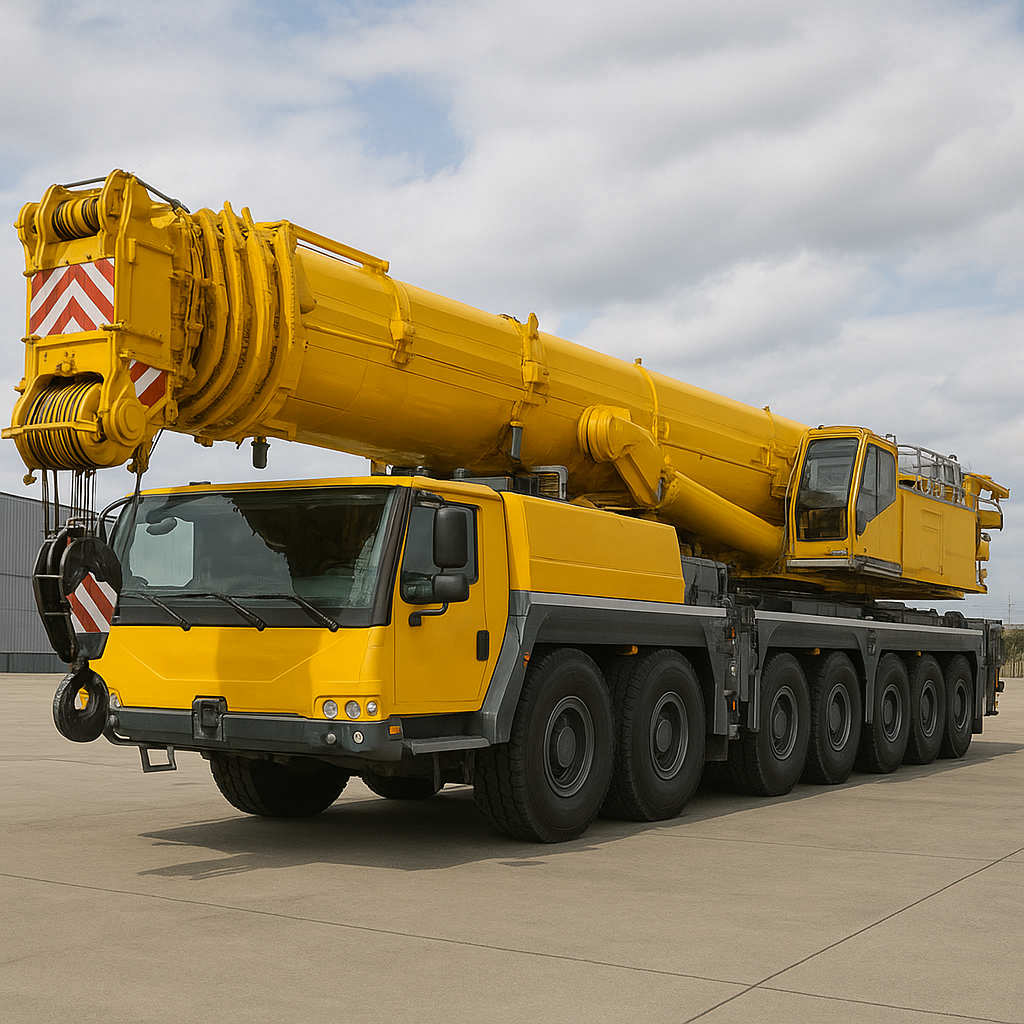
The Liebherr LTM 1750-9.1 is a flagship in the category of modern all-terrain mobile cranes, designed to combine exceptional lifting power with road-going mobility and versatile boom configurations. This machine addresses many of the logistical and technical challenges of heavy lifts in demanding environments, from large-scale construction and power generation projects to wind farm erection and industrial maintenance. In the following sections, you will find a detailed look at the crane’s design, capabilities, practical applications, operational features, and market considerations, supported by approximate technical figures where available.
Overview and basic characteristics
The LTM 1750-9.1 is a high-capacity telescopic mobile crane produced by Liebherr that occupies the upper tier of the manufacturer’s all-terrain range. Its model designation reveals two key facts: the machine is designed around a maximum theoretical lifting capacity class of 750 tonnes and it rides on a 9-axle carrier. These two elements—substantial rated capacity and multi-axle road chassis—are central to its role as a mobile heavy-lift solution for projects requiring both large capacity and the ability to travel on public roads between sites.
Key features that define the LTM 1750-9.1 include a powerful, multi-section telescopic boom, modular lattice jib options for high-reach or heavy-radius lifts, advanced electronic control systems, and an emphasis on reducing set-up time and transport complexity. Liebherr optimized the crane for both on-site flexibility and long-distance travel, enabling a single unit to undertake jobs that previously required multiple specialized cranes or extensive assembly of lattice cranes.
Design and technical features
Boom and lifting system
The machine’s primary lifting element is a telescopic boom that delivers a high degree of reach and quick extension. In practical terms, the telescopic sections allow operators to change boom length rapidly without the need for substantial on-site assembly. Where extreme height or radius is required, the LTM 1750-9.1 can be fitted with lattice jib extensions and luffing jib arrangements, increasing tip height and working radius substantially. These combinations make the crane suitable for jobs from heavy component placement to tower erection.
The crane is engineered to combine lift power with precise control. Electronic load moment limiting, fine-controlled hydraulic systems, and Liebherr’s crane control architecture permit accurate positioning under variable load and wind conditions. The machine benefits from modern hydraulics and computer-aided load management to keep lifts within safe operating envelopes.
Chassis, mobility and outriggers
The 9-axle carrier provides legal road mobility in many jurisdictions while distributing axle loads to comply with transport regulations. The carrier is robust enough to carry substantial counterweight on board, which reduces the need for separate ballast transport. In addition to the chassis design, the outriggers and support system are a key innovation: Liebherr’s patented VarioBase system allows flexible outrigger placement and adjusts the crane’s permissible load charts according to actual support geometry. This translates directly into faster set-up and more usable lifting capacity on constrained sites.
Drive, emissions and efficiency
Mobility and drive systems are optimized for long-distance travel and jobsite maneuvering. Engines and power units meet modern emissions regulations in most markets and are designed to balance fuel economy with the hydraulic power demands of heavy lifting. Liebherr’s assistance systems—such as automatic engine management and optional fuel-saving modes—improve operational efficiency. Some machines are offered with features branded as ECOdrive or similar, aiming to reduce fuel consumption during repositioning and non-lifting operations.
Performance data and typical technical statistics
While exact configurations change load charts and figures, certain baseline performance indicators are generally associated with this model series. The most widely cited statistical and specification highlights include:
- Nominal main crane capacity class: 750 tonnes (capacity depends on boom and counterweight configuration).
- Carrier configuration: 9-axle chassis for optimized transportability and axle load distribution.
- Telescopic boom: multi-section boom with rapid extension; typical maximum lengths depend on option packages but generally allow long reach when paired with lattice jib extensions—operators commonly report main boom lengths in the mid tens of metres up to very long configurations when combined with extension sections (exact lengths vary by configuration and country-specific options).
- Lattice jib options and auxiliary jibs: modular and often custom-configurable to achieve very high tip heights or long radii.
- Outrigger footprint management: VarioBase permits flexible support geometry and improved usable capacities on constrained footprints.
- Control systems: advanced load-moment and stability monitoring, computerized load charts, and operator assistance systems for safer lift execution.
Because Liebherr supplies a range of equipment options and counterweight packages, the crane’s exact rated capacities at specific radii are supplied in the manufacturer’s load charts for each configuration. For planning purposes it is essential to consult the precise load chart corresponding to the machine’s on-site setup.
Applications and industries
The LTM 1750-9.1 is used wherever exceptionally heavy or high lifts must be accomplished without the logistical complexity of assembling a large lattice crane. Typical applications include:
- Wind turbines: transportable heavy-lift cranes like the LTM 1750-9.1 are often selected for erecting modern turbine towers, nacelles, and blades—especially on sites where multiple turbines are installed and rapid mobilization between locations is required.
- Power plant and energy sector projects: installation and maintenance of heavy generators, transformers, and reactor components.
- Petrochemical and refinery installations: module lifts, exchange of heavy vessels, and maintenance tasks that require controlled heavy handling in constrained industrial yards.
- Bridge and infrastructure construction: placing pre-fabricated bridge spans, viaduct sections, and heavy precast elements.
- Shipyards and offshore assembly: lift-out and installation of large ship components and handling of heavy subsea modules in dockside facilities.
- Heavy civil engineering and modular building: craning large prefabricated modules, plant installations, and demolition/seismic retrofit operations where heavy items must be carefully placed.
Operational considerations and safety features
Large-capacity mobile cranes require meticulous planning and specialized crews. The LTM 1750-9.1 comes equipped with multiple systems that support safe and efficient operation:
- Electronic load-moment indicators and computerized load charts for the exact configuration and outrigger placement in use.
- Wind and overturn protection logic integrated into lifting controls to alert operators and limit permissible operations under hazardous conditions.
- Remote-control options and operator cabins designed for visibility, ergonomics, and fine control for precision lifts.
- Redundant hydraulic and monitoring systems to preserve control when transitioning between boom sections or when using auxiliary jibs.
- Maintenance-friendly component access and onboard diagnostics to speed servicing intervals and reduce downtime.
Safe operation also depends heavily on site surveying, ground preparation, and traffic coordination. The crane’s transportable design reduces setup time relative to equivalent lattice systems, but thorough engineering assessments remain mandatory: ground-bearing capacity must be established, outrigger pads sized, and pick points, slings, and lifting appliances certified for the specific loads.
Transport, set-up and logistics
One of the main advantages of the LTM 1750-9.1 lies in its ability to travel between jobs with minimal disassembly. The 9-axle carrier is engineered to comply with many local road regulations and to reduce the number of escort vehicles and special permits required for transport. Key logistic considerations include:
- On-board counterweight and modular ballast systems that minimize separate loads to be moved by truck.
- Multi-axle steering and driveline features that facilitate maneuvering at site entrances and in tight yards.
- Rapid boom extension and retraction reduce set-up time, while the modular lattice jib components are designed for efficient assembly when longer reach is required.
Despite these efficiencies, large-capacity cranes still require permits in most countries, and transport planning is necessary to navigate bridges, narrow roads and height restrictions. Many operators and rental companies provide route surveys and transport logistics planning as part of the service package.
Ownership, rental market and economics
Given its high acquisition cost and specialized role, the LTM 1750-9.1 is frequently purchased by large rental firms and specialist lifting contractors rather than by small construction companies. Rental markets benefit from the crane’s versatility: a single unit can serve a range of clients across sectors, improving utilization. Economic considerations typically include:
- High capital cost but broad application scope, increasing potential utilization across projects.
- Operational cost factors including fuel, maintenance, transport, and certified crew wages.
- Depreciation and lease/rental revenues strongly influenced by regional infrastructure investment cycles (for example, wind farm build-outs or large infrastructure programs).
For large rental companies, the LTM 1750-9.1 can be an anchor asset that enables winning contracts for the largest lifts. Its on-road mobility reduces the need to break down heavy components and reassemble on site, improving turnover between jobs.
Maintenance, lifecycle and operator training
Proper maintenance and qualified operators are essential to keep performance and safety levels high. Typical maintenance programs include scheduled hydraulic servicing, structural inspections (especially of the boom sections and lattice components), and periodic non-destructive testing where required by regulations. Manufacturer training programs and certified operator courses enhance safety and reduce the risk of costly incidents.
Because of the crane’s sophistication, lifecycle costs are significantly affected by adherence to OEM-recommended maintenance schedules. Spare parts for hydraulic pumps, control electronics, and structural components must be managed proactively in fleets to avoid lengthy downtime during peak project seasons.
Notable projects, case examples and usage trends
While individual project details vary by region, cranes in the 700–800 tonne class have been instrumental in a number of high-profile sectors:
- Wind farm construction in areas with frequent relocations between turbine bases—high mobility reduces assembly time and overall project schedule.
- Large petrochemical module lifts where a combination of high capacity and long reach is required to place fully assembled process modules.
- Bridge span placement and heavy infrastructure module setting in urban environments where restricted footprint benefits from the machine’s flexible VarioBase support.
Market trends point toward continued demand for mobile cranes that deliver high capacity with quick set-up times, particularly where environmental constraints, tight schedules and multiple lift locations favor road-going units over permanently erected lattice cranes.
Summary and practical advice
The Liebherr LTM 1750-9.1 represents a class of mobile crane that balances extreme lifting capacity with significant on-road mobility and operational flexibility. Its combination of a powerful multi-section telescopic boom, modular lattice jib options, advanced control systems and versatile support technology such as VarioBase makes it suitable for the most demanding lifts across industries like renewable energy, heavy industry, infrastructure and shipbuilding.
For project planners and lifting contractors considering the LTM 1750-9.1, practical recommendations include engaging early with a specialist lifting engineer, consulting the exact manufacturer load charts for the intended configuration, arranging for transport route surveys, and ensuring certified operators and maintenance plans are in place. Attention to these factors will maximize safety, efficiency and return on investment.
Overall, the LTM 1750-9.1 is a workhorse for heavy lifting tasks that require both power and mobility, and it continues to be a preferred option where complex lifts must be executed reliably and with minimal downtime.
)
)