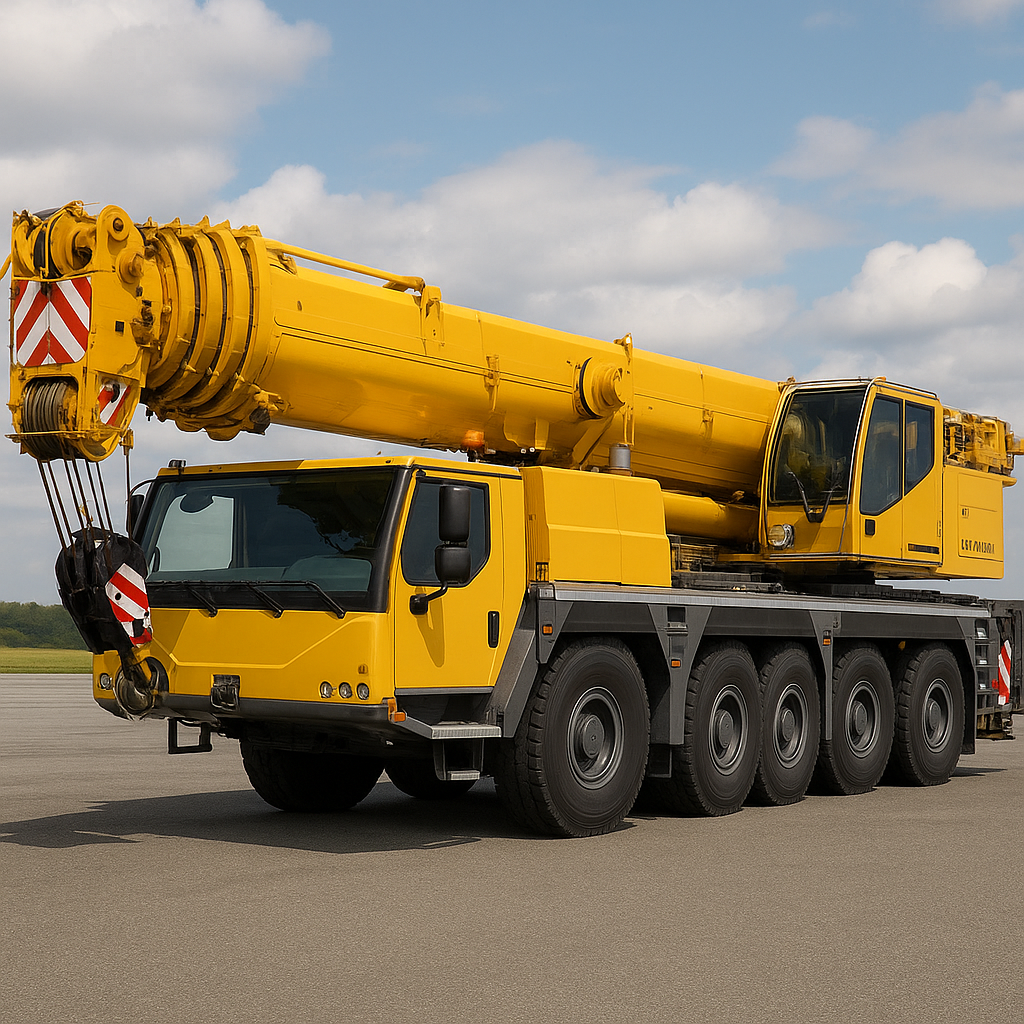
The Liebherr LTM 1250-5.1 represents a class-leading solution in the world of heavy lifting: a highly mobile, powerful and versatile all-terrain crane designed to combine road-going performance with the lifting capability normally associated with larger stationary machines. This article explores the machine’s design, typical applications, operational features, logistical considerations and maintenance aspects. It also highlights technical characteristics and practical examples that illustrate why this model is widely chosen for complex lifting tasks across industries.
Overview and role in modern lifting operations
The Liebherr LTM 1250-5.1 is an all-terrain mobile crane built to deliver high lifting capacity together with the flexibility of rapid relocation on public roads. Manufactured by Liebherr, a global leader in construction machinery, this model is part of the company’s series of five-axle mobile cranes that balance on-road mobility and robust lifting performance. The machine is especially valuable where site access, road travel and significant lifting capacity must be combined.
The typical users of the LTM 1250-5.1 include crane rental companies, civil contractors, energy sector operators, industrial maintenance teams and heavy transport contractors. It is frequently selected for complex lifts where site conditions restrict the use of crawler cranes or where a faster, single-platform solution is preferred.
Design and technical features
The LTM 1250-5.1 integrates a range of engineering solutions to provide a compact transport profile and extensive lifting capability. The machine’s architecture reflects Liebherr’s focus on combining mobility, safety and operational versatility.
Chassis and mobility
- The crane rides on a multi-axle carrier designed for road travel and on-site maneuverability. As a five-axle machine it strikes a compromise between the road-legal dimensions of smaller cranes and the capacity of larger units.
- Mobility features include robust steering systems for multiple axles, brake and suspension systems tuned for both transport stability and site performance, and an overall chassis engineered to meet road regulations in many markets.
Superstructure and lifting gear
- The crane is equipped with a multi-section telescopic boom that provides rapid extension and retraction, enabling flexible reach ranges without the need for assembling a lattice mast for many operations.
- For high-tip or long-reach applications the machine can be fitted with lattice or fixed jibs, extending the working envelope and enabling lifts at greater heights and radii.
- The slewing system, winches and hydraulic components are engineered to deliver precise load control and efficient hoisting cycles.
Outriggers and site stability
One distinctive capability of Liebherr cranes is the ability to set outriggers at variable positions while maintaining safety limits. The LTM 1250-5.1 typically offers advanced outrigger control systems that allow asymmetric deployment where site constraints demand it. Systems such as Liebherr’s VarioBase (or equivalent control features) enable the operator to maximize safe load capacity based on real outrigger positions rather than fixed diagrams.
Operator ergonomics and control systems
- Modern control and crane management systems provide real-time load moment indicators, operational limits, and safety interlocks, improving both efficiency and safety on complex lifts.
- The crane features ergonomically arranged cabs with clear instrumentation for driving and for crane operation, together with optional remote-control capabilities on some variants to aid visibility and precision during challenging lifts.
Performance and specifications
The defining headline figure for the LTM 1250-5.1 is its maximum rated lifting capacity. While exact configuration-dependent figures vary with boom length, counterweight setup and use of jibs, several nominal characteristics are consistent:
- Lifting capacity: The crane is rated in the 250-tonne class, making it suitable for very heavy loads while remaining road-mobile.
- Axle configuration: Five-axle carrier for a balance of on-road legal dimension and load-bearing capability.
- Telescopic boom reach: The crane’s telescopic boom provides a long, continuously adjustable reach adequate for most heavy lifting tasks without additional mast elements; optional jibs extend tip heights and working radii.
Exact numerical values for boom length, maximum hook height and counterweight mass depend on the factory configuration and optional packages. Typical configurations for cranes in this class include:
- Telescopic boom lengths that allow main boom reach adequate for many industrial and construction lifts.
- Modular counterweight systems enabling a trade-off between transport weight and on-site lifting capacity.
- Auxiliary jibs and inserts for specialized tasks such as wind-turbine erection or high-lift installations.
When planning a lift with the LTM 1250-5.1, operators always refer to the manufacturer-supplied load charts that specify permitted loads for every boom length, radius and outrigger position. These charts are the legal and safety reference and vary with the crane’s exact configuration.
Typical applications and industries
The LTM 1250-5.1 serves across a broad spectrum of industries because of its versatility and capacity.
Wind energy
Onshore wind turbine erection and maintenance are common applications. The crane’s lifting capacity and reach—when combined with specialized jibs and rigging—allow it to lift nacelles, hubs and tower sections. Its road mobility reduces setup time between turbine locations within a wind farm.
Construction and civil engineering
In building and bridge construction the crane is used for placing prefabricated elements, lifting concrete formwork, steel girders and heavy plant equipment. Its ability to operate on-site with limited assembly makes it suitable for urban projects with constrained access.
Industrial and plant maintenance
Refineries, petrochemical plants and manufacturing facilities often require heavy lifts for rotating equipment, heat exchangers, transformers and modules. The LTM 1250-5.1 can perform complex lifts in confined yards where a crawler crane would be cumbersome or require extensive dismantling.
Heavy transport and module handling
For the loading and unloading of heavy modules, offshore components and precast concrete elements, rental companies deploy this crane to provide the necessary lift capacity while keeping mobilization times and road permits manageable.
Operation, safety and lifting best practices
Safe operation of the LTM 1250-5.1 centers on adherence to load charts, correct outrigger placement, and thorough lift planning. Key aspects include:
- Comprehensive risk assessment and lift plan for each lift, including ground-bearing capacity checks and traffic management during transport and setup.
- Strict compliance with the crane’s load moment limits and use of manufacturer software and onboard systems to validate permitted configurations.
- Qualified personnel: certified crane operators, riggers and signalers who understand dynamic effects, rigging rules and tag-line control.
- Use of appropriate lifting accessories, spreader beams, slings and shackles rated well above the expected working loads.
Modern cranes include diagnostics, alarms and load moment limitations that prevent unsafe operations. These systems significantly reduce human error but depend on accurate input and responsible use by the crew.
Transport, setup and site logistics
One of the LTM 1250-5.1’s strengths is the convenience of transport compared to larger lattice-boom cranes. Typical logistical considerations include:
- Road permits: Because it is a multi-axle mobile crane, many configurations are road-legal without special escort depending on regional regulations; oversize loads or additional counterweights often require permits.
- Setup time: The crane is designed for relatively quick setup with hydraulically controlled outriggers and boom extension systems; modular counterweights do require handling but are optimized for quicker assembly.
- Site preparation: Adequate ground bearing, outrigger pads and traffic control are required to ensure safe operation. The ability to partially retract outriggers in tight spaces or use asymmetric outrigger patterns can be a decisive advantage.
Maintenance, lifecycle and operating economics
Operational reliability and lifecycle cost are critical for rental companies and end users. The LTM 1250-5.1 is designed with maintenance accessibility and durability in mind.
- Routine maintenance intervals cover engine servicing, hydraulic system checks, winch and rope inspections, slewing gear servicing and structural inspections for the boom and chassis.
- Availability of parts and technical support from Liebherr’s global network reduces downtime. Periodic overhauls of key systems extend productive life.
- Depreciation, utilization rates and hire day rates drive the economic calculus for owning versus renting. Machines with versatile capacities and broad applicability typically achieve higher utilization and better return on investment.
Market context and typical statistics
In the market for mobile cranes, the 200–300 tonne class is a strategic segment: cranes in this bracket can replace larger, more expensive crawler cranes for many tasks while remaining flexible. The LTM 1250-5.1, with its roughly 250 tonnes of rated capacity and five-axle transport configuration, sits squarely in this segment and appeals to clients needing high capacity with road mobility.
Statistical observations in the rental and construction markets include:
- Machines in the 200–300 t category are often among the most frequently rented for heavy industrial and infrastructure projects.
- Fleet owners report that versatility and shorter mobilization times increase annual utilization compared to larger crawler cranes, improving overall economics.
- Sectors such as energy (including wind and power plant installation), heavy civil construction and petrochemical maintenance consistently demand mobile cranes with this capability.
Specific sales numbers and fleet counts vary by region and year. Major crane manufacturers continue to invest in all-terrain models that offer improved fuel efficiency, operator comfort and digital load monitoring—features that influence procurement decisions and secondary-market values.
Notable advantages and limitations
Advantages
- Liebherr engineering and support network—strong aftermarket and parts availability in many countries.
- Blend of high capacity and road mobility reduces need for separate transport equipment and speeds project schedules.
- Flexible boom and optional jibs make the crane suitable for a wide range of tasks: from wind turbines to heavy industrial modules.
- Advanced control systems enhance precision and safety during complex lifts.
Limitations
- Despite its mobility, the machine still requires careful planning for transport permits and on-site setup, especially when using maximum counterweights or extended jibs.
- In very restricted or soft-ground sites, crawler cranes with lower ground pressure might be preferable.
- Maintenance and specialist servicing require investment in trained personnel and tooling to keep the crane operating at peak performance.
Case studies and examples of use
Operators worldwide have used the LTM 1250-5.1 for varied projects that illustrate its strengths:
- Erection of medium to large wind turbines where the crane’s boom and accessories lift nacelles and hub assemblies while rapidly moving between turbines on public roads.
- Bridge component placement in urban infrastructure projects where road-legal transport and compact setup reduce traffic disruption and site occupation time.
- Industrial plant turnarounds and maintenance lifts where heavy equipment such as heat exchangers and turbines need reliable, controlled lifts in constrained yards.
Final observations
The Liebherr LTM 1250-5.1 remains a compelling choice for those seeking the intersection of heavy lifting capacity and road mobility. Its role in sectors such as energy, construction and industrial maintenance is supported by robust design, advanced safety and control systems, and modular configurations that allow operators to optimize the crane for specific tasks. While exact specifications and performance limits must always be verified against manufacturer documentation for each configuration, the LTM 1250-5.1 stands out as a versatile and reliable machine for demanding lifting operations.
For planning any lift, the critical next steps are to consult the official load charts, engage certified rigging and lifting professionals, and prepare a comprehensive lift plan that accounts for ground conditions, transport logistics and safety requirements.
)
)