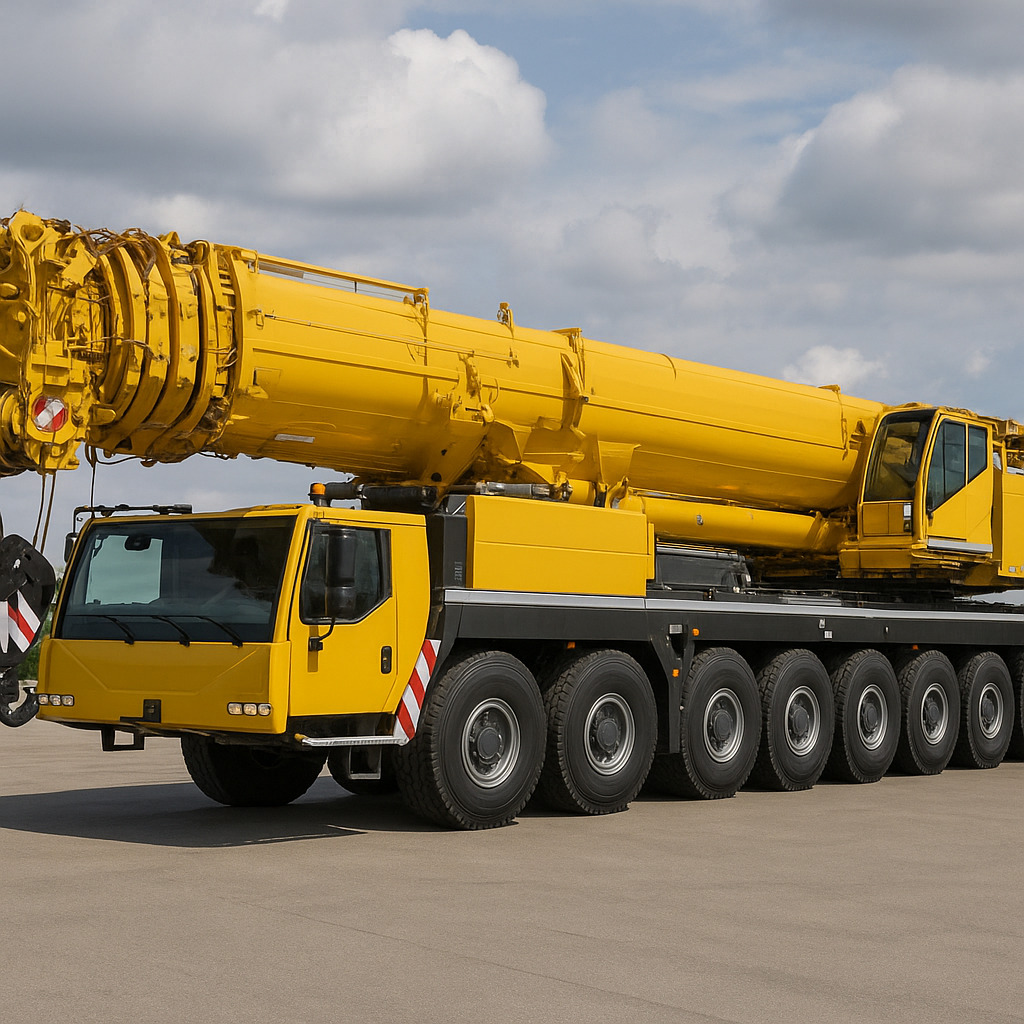
The Liebherr LTM 11200-9.1 is widely regarded as one of the most impressive examples of modern heavy mobile lifting technology. Combining a long, multi-section telescopic boom with a high-capacity carrier and advanced control systems, this machine fills a niche between conventional mobile cranes and large lattice crawler cranes. In this article we examine the machine’s design, typical uses across industries, operational and logistical considerations, safety and maintenance aspects, and its place in the market. We also highlight key technical characteristics and practical performance notes that make the LTM 11200-9.1 a sought-after asset for heavyweight lifting projects.
Overview and technical highlights
The LTM 11200-9.1 is a flagship product from Liebherr that stretches the limits of what is possible with a self-propelled telescopic crane. As a nine-axle all-terrain carrier-mounted crane, it is designed to move between sites on public roads while retaining the capability to lift extremely heavy loads on site. The model name itself signals core attributes: the “11200” identifies the crane’s class centered on the 1200 tonnes maximum nominal lifting capacity, while “9.1” denotes the nine-axle carrier configuration and a specific generation of the design.
Key design features
- Telescopic boom: The crane is fitted with a multi-section telescopic boom that reaches up to around 100 m in its main configuration. This enables fast, flexible reach adjustments without the need to assemble long lattice booms.
- Superstructure and carrier integration: The superstructure houses the winch systems, hydraulic equipment and operator cab; it is integrated with a robust nine-axle carrier that offers road mobility and on-road transportability for heavy components.
- VarioBase and support technology: Like many modern Liebherr cranes, the LTM 11200-9.1 benefits from an advanced outrigger support control system that allows safe lifting on variable outrigger configurations and non-uniform ground conditions.
- Control and safety systems: The crane uses Liebherr’s computerized control and monitoring systems (LICCON family) for crane control, load moment limiting, and diagnostics, improving both safety and precision.
- Counterweight and ballast systems: Modular counterweight blocks allow the crane to be configured to the lifting task while optimizing transport loads and on-site assembly time.
Performance characteristics
At short radii the LTM 11200-9.1 can handle extremely heavy lifts — the machine’s nominal top capability is 1200 tonnes. As with any crane, capacity falls with increased radius; the long telescopic boom provides extensive reach, but heavy lifts at large radii typically require lattice jibs or supplemental rigging. The crane’s design emphasizes a balance between raw lifting power and the practicalities of road transport, quick setup and flexible boom configurations.
Applications and industries
The LTM 11200-9.1 is engineered for projects that require a combination of very high lifting capacity, long reach and mobility. It is typically specified where heavy modules or components must be lifted and placed with high precision, often in constrained sites where the advantages of a telescopic boom and road mobility are decisive.
Primary application areas
- Wind energy: installation of heavy nacelles and complete tower sections, particularly for onshore sites with large components or where road access is available but space for crawler cranes is limited.
- Power generation and electrical infrastructure: lifting large transformers, turbine components, and heavy generator parts during installation or replacement works.
- Petrochemical and process plants: erection of heavy process modules, columns and pressure vessels where precise positioning is required and site access can be challenging.
- Bridge and civil engineering: placement of large pre-cast bridge segments, gantry components and other heavy civil structures where both reach and lifting power are needed.
- Shipbuilding and offshore: handling of large ship sections in shipyards and lifting of heavy offshore modules when environmental or logistical constraints favor a mobile telescopic solution.
- Industrial relocations and heavy haul installations: plant moves involving large machinery and equipment.
Because the LTM 11200-9.1 is road-capable, it is often the crane of choice when a heavy lift must be performed without the time and cost of assembling a crawler crane on site. Many projects benefit from its ability to travel long distances between sites in a comparatively short timeframe, bringing a powerful lifting asset to installations that previously would have required multiple machines or an on-site crawler.
Operation, setup and logistics
Working with a mega-capacity mobile crane involves detailed planning and coordination. The LTM 11200-9.1 is designed to reduce on-site assembly time relative to large lattice crawler cranes, but its complexity and mass still demand careful logistical preparation.
Transport and mobilization
- Carrier movement: The nine-axle carrier allows on-road travel, but route surveys, bridge capacity checks and permits are typically required for moving such a heavy machine. Steering systems on multiple axles reduce turning radii and distribute loads to comply with regulations.
- Counterweight transport: Counterweight modules are often transported separately and must be staged and installed on site. The modular counterweight design helps optimize transport loads and reduces the number of heavy trailers required.
- Assembly time: Compared with a lattice crawler crane, setup is faster because the main telescopic boom does not require extensive erection. However, deploying the necessary counterweight and outriggers, and assembling any lattice jibs, still requires a well-coordinated crew and equipment.
On-site setup and lifting process
- Outrigger placement and VarioBase: Use of the VarioBase system allows safe lifting under asymmetric outrigger configurations, which is useful where space or ground conditions are constrained.
- Load charts and electronic monitoring: Operators use computerized load moment limiting and the crane’s onboard software to select the correct configuration, boom length and counterweight for each lift. This reduces risk and optimizes lifting angles and capacities.
- Rigging and auxiliary gear: For very long reaches or special lifts, lattice jib sections, swingaway jibs and auxiliary hoists are employed. Specialized rigging techniques are common for heavy, irregular loads to control swing and prevent torsion.
- Crew requirements: A typical heavy-lift operation includes a certified crane operator, signalpersons, riggers, a lift supervisor or engineer and often surveyors and ground preparation crews.
Safety, maintenance and economics
Large telescopic mobile cranes like the LTM 11200-9.1 require rigorous safety practices and planned maintenance to remain productive and compliant with regulations. Their capital and operating costs are high, but their ability to perform lifts that would otherwise require multiple machines or specialized equipment often justifies the investment.
Safety systems and procedures
- Electronic limitations and interlocks: LICCON-based controls and load moment indicators prevent operations that exceed safe limits for the selected configuration.
- Redundancy: Critical hydraulic and control systems are designed with redundancy and fault detection to reduce risk of uncontrolled movements.
- Ground preparation: Proper ground bearing capacity and outrigger pads are critical. Geotechnical assessment and the use of load distribution mats are common practices.
- Operational planning: Heavy lifts are planned with detailed lift plans, risk assessments, exclusion zones and emergency procedures. Communications protocols and weather monitoring are part of the standard operating routine.
Maintenance and lifecycle costs
Maintenance for a machine of this class covers engines, transmissions, hydraulic systems, winches, boom mechanisms and electronic controls. Scheduled inspections, hoist rope replacements, and hydraulic system servicing are routine. Because these cranes work under heavy cyclic loads, fatigue monitoring and structural inspections are important to detect early signs of wear or damage. Economically, rental rates or purchase decisions for an LTM 11200-9.1 are influenced by the frequency of heavy-lift projects, transport logistics costs, and the availability of trained crews.
Performance data and industry statistics
Some of the most-cited figures associated with the LTM 11200-9.1 include the crane’s maximum nominal capacity of 1200 tonnes and its main telescopic boom length of approximately 100 m. It is mounted on a nine-axle carrier to meet the demands of road transport regulations while providing a high-axle-count chassis for distribution of weight and improved mobility. The crane is often used worldwide for the heaviest mobile lifting tasks and is part of a specialized fleet segment; production volumes for such ultra-heavy mobile cranes tend to be limited compared with lower-capacity models, reflecting demand, cost and the niche role they fulfill.
In practice, load charts are the authoritative guide for any lift. At short radii (single-digit metres) the crane approaches its maximum capacity, while at extended radii the allowed load reduces significantly. For example, while the theoretical top capacity is 1200 tonnes at very small radii under ideal setup, practical field lifts in the 200–800 tonne range at moderate radii are common. The exact numbers depend on counterweight, boom length, outriggers and any jib extensions.
Comparisons and market position
The LTM 11200-9.1 occupies a special niche between standard mobile cranes and the very large lattice crawler cranes. Compared with crawlers, the LTM 11200-9.1 offers:
- Faster mobilization on public roads (no need for crawler assembly or heavy transporters for the crane body).
- Better suitability for projects where road access to the lift site is possible and rapid redeployment is desired.
- Easier boom extension and retraction for multiple lifts in tight schedules.
However, lattice crawler cranes still hold advantages in certain scenarios:
- Lower ground pressure and better stability for extremely heavy lifts over soft ground, as crawlers distribute weight over a large footprint.
- Potentially higher capacities for specific lifts when using massive lattice booms and fixed foundations.
Overall, the LTM 11200-9.1 is typically selected where the combination of telescopic reach, high lifting capacity and road mobility creates operational or financial benefits not achievable with other crane types.
Case studies and real-world usage
While specific project data varies by operator and confidentiality restrictions, typical case studies illustrate the crane’s strengths. Examples include lifting heavy power plant transformers into position where site access was restricted, erecting wind turbine nacelles and entire tower sections without the need for on-site crawler assembly, and installing large pre-cast bridge segments where precise placement at height was required. In many of these projects, the alternative would have involved multiple cranes, longer project times, or significant temporary road or ground modifications.
Operators report that the machine’s telescopic boom reduces the time spent assembling boom sections on site, and that advanced load monitoring systems decrease planning uncertainty. The modular counterweight design and the crane’s mobility also reduce the number of heavy-haul movements and associated permit costs for multi-site projects.
Operator training and certification
Because of the complexity and potential hazards of mega-lift operations, specialized training and certification are essential. Operators must be familiar with LICCON controls, multi-part rope reeving, telescopic boom management, outriggers and VarioBase operation, and the interplay between boom geometry, counterweights and load charts. Supervisors and lift planners also need training in rigging design, lift plan creation, and regulatory compliance for transport and site operations.
Conclusion
The Liebherr LTM 11200-9.1 represents a class of mobile cranes in which exceptional lifting power is combined with the practicality of road mobility and telescopic boom convenience. Its principal selling points are high nominal capacity (up to 1200 tonnes), long telescopic reach (approximately 100 m), and sophisticated support and control systems such as VarioBase and LICCON. These features make it particularly valuable in wind energy, power generation, petrochemical, bridge construction and shipbuilding projects where heavy modules must be moved and installed precisely and quickly.
Although expensive to purchase and operate, the LTM 11200-9.1 often delivers cost savings through faster setup, reduced need for auxiliary cranes, and fewer transport-related constraints. For project owners and crane operators facing exceptionally heavy or complex lifts, this crane remains one of the most capable and flexible mobile solutions available.
)
)