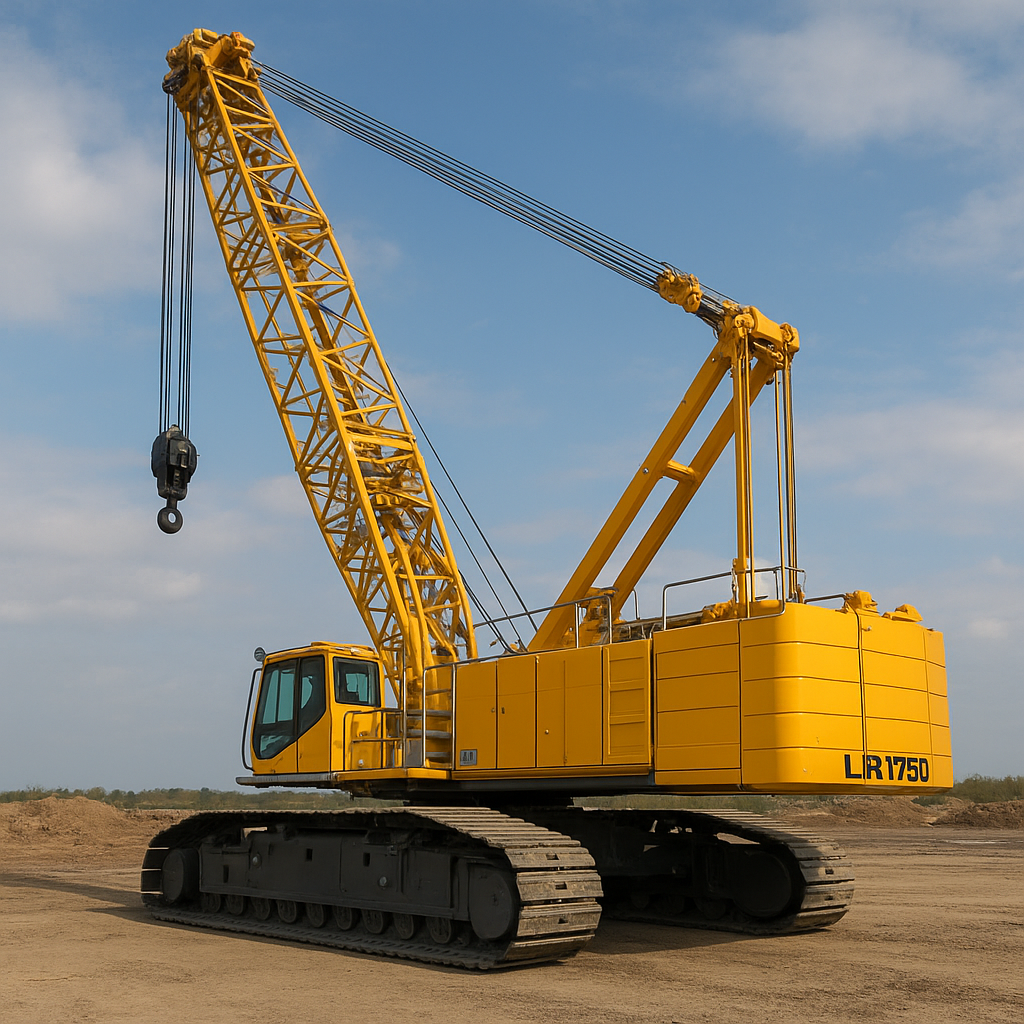
The Liebherr LR 1750 is a robust and versatile lattice-boom crawler crane designed for heavy lifting tasks in a wide range of industries. Combining proven mechanical design with modern control and safety systems, the LR 1750 is used where high capacity and mobile on-track performance are required. This article explores the machine’s construction, technical characteristics, typical applications, logistics of transport and assembly, operational best practices, and the commercial and environmental considerations that make the LR 1750 a common choice for large-scale projects.
Overview and design philosophy
The LR 1750 is part of Liebherr’s line of large crawler cranes intended for heavy civil, industrial, and infrastructure work. At its core, the LR 1750 follows a classic lattice-boom crawler architecture: a tracked undercarriage for excellent ground contact and mobility on site, a modular lattice boom system that allows flexible reach and capacity combinations, and a modular counterweight and superstructure system to adapt to diverse lifting tasks. The machine’s design emphasizes stability, modularity, and ease of assembly, enabling operations in constrained environments and on challenging soils.
Key design traits that distinguish the LR 1750 include:
- Modular lattice-boom sections and jibs for configuring reach and height.
- A powerful hoist system and pulley arrangements enabling efficient load control.
- Onboard systems for monitoring load, radius, and structural stresses to ensure safe operation.
- Track systems and outriggers engineered to distribute loads reliably across soft or uneven ground.
Typical technical specifications (indicative)
Exact specifications for the LR 1750 vary with the model revision, the chosen counterweight package, boom and jib configuration, and auxiliary equipment. The figures below are indicative and intended to give a realistic picture of machine capability; for exact numbers consult Liebherr documentation or the crane supplier.
Indicative specification summary
- Lifting capacity: up to approximately 750 metric tonnes in optimal configuration (maximum capacity depends on boom/jib setup and radius).
- Main boom: modular lattice sections enabling main boom lengths typically ranging from around 30 m to over 80 m (configurable).
- Jib options: folding or fixed lattice jibs commonly extending reach to 100 m+ when required.
- Maximum radius: operational radius varies; heavy lifts are performed at shorter radii, while long-radius lifts sacrifice capacity.
- Hoist and load line: multiple drum and reeving configurations to suit heavy lifts or higher-speed operations.
- Engine power: diesel engines sized to provide sufficient drawbar pull and power for hoists and travel; power ratings typically in the high-hundred to low-thousand kW class depending on auxiliary systems.
- Operating weight: highly variable depending on counterweights and undercarriage; can range from a few hundred tonnes to well over 1000 tonnes for fully equipped configurations.
- Transportability: modular design allows breakdown into truck-sized components for transport; crawler sections, boom sections, counterweight blocks and superstructure modules are sized for road and rail logistics.
Note: The LR 1750 is offered in different variants and configurations, and newer series may incorporate updated electronics and telematics. Always verify with a supplier for certified load charts and machine-specific parameters before planning lifts.
Applications and industries
The LR 1750 is frequently selected for tasks that combine heavy capacity and site mobility. Typical sectors and applications include:
- Infrastructure and civil engineering — bridge erection, major concrete segment handling, and construction of elevated structures.
- Power and energy — installation of heavy turbine components at thermal or hydroelectric plants, and groundwork for power stations.
- Wind energy — erection of tower sections and nacelles for onshore wind farms (especially where heavy components require short travel and robust foundations).
- Oil, gas, and petrochemical — installation of heavy process modules, columns, and reactor sections in refineries and petrochemical plants.
- Ports and marine construction — quay crane maintenance, lifting and placement of heavy fenders, access platforms and large precast elements.
- Decommissioning and heavy industrial moves — dismantling heavy equipment, relocating large machines within plants, and loading/unloading heavy cargo.
Because of its versatility, the LR 1750 can operate in confined sites where wheeled or larger crawler cranes might be impractical, and its track mobility reduces the need for expensive crane pads or extensive ground preparation.
Transport, assembly and site logistics
One of the LR 1750’s advantages is its modularity. Even though the crane can be very heavy when fully equipped, it is designed to be broken down into components that match common transport limitations.
Transport considerations
Typical transport logistics include:
- Superstructure and counterweight modules shipped on heavy haul trailers.
- Track sections and undercarriage elements transported separately to reduce axle loads.
- Lattice boom sections and jibs shipped in lengths manageable by road transport (often using special transport permits for oversized loads).
Operators and logistics planners will prepare weight distribution plans, route surveys, and local permitting to move large components. Where rail or water transport is available, these modes often reduce cost and simplify oversized movements.
Assembly and erection
Assembly is typically executed using auxiliary cranes or smaller crawler cranes to lift boom sections, counterweights, and superstructure components into place. Key steps include:
- Positioning the undercarriage and leveling the site.
- Assembling the superstructure on or off the chassis, depending on site constraints.
- Sequentially installing main boom sections and jibs, followed by rigging of hoist lines and pulleys.
- Placing counterweights according to the planned lift charts to achieve required stability and capacity.
- Performing system checks, calibration of load monitoring systems and safety interlocks prior to first lift.
Efficient assembly reduces downtime and project risk. Modern LR series cranes often incorporate design choices that speed assembly, such as fewer bolts per joint, captive pins, and guidance features to align sections quickly and safely.
Operation, control systems and safety
Contemporary LR 1750 cranes are equipped with electronic control systems that enhance safety and precision. These include:
- Load Moment Indicators (LMI) and overload protection systems to prevent unsafe lifting conditions.
- Operator displays showing real-time information on radius, boom angle, load, and allowable capacities based on current configuration.
- Remote diagnostics and telematics in many modern units to monitor engine health, hydraulic performance, and service intervals.
- Advanced hoist control and multi-drum coordination for complex lifts where simultaneous motion is required.
Operator skill remains crucial: understanding load charts, wind effects, ground bearing capacities and rigging best practices are non-negotiable for safe operation. Typical safety practices involve:
- Thorough lift planning, including rigging diagrams, lift paths and contingency plans.
- Ground bearing analysis and cribbing design to ensure the undercarriage and outriggers distribute loads safely.
- Taglines and controlled runways to avoid uncontrolled load swing.
- Environmental monitoring for wind, lightning and other hazards that can force suspension of lifts.
Maintenance and lifecycle costs
Heavy crawler cranes are substantial investments, and lifecycle management is key to maximizing uptime and minimizing cost. Maintenance considerations include routine inspection of lattice boom members for fatigue and cracking, track and undercarriage care, hoist drum and wire rope inspection, hydraulic system maintenance, and engine servicing.
Predictive maintenance, based on telematics and sensor data, improves availability by allowing service before failures occur. Typical lifecycle strategies include:
- Planned major service intervals for engines and hydraulic power units.
- Regular non-destructive testing (NDT) on critical structural components.
- Proper storage and corrosion protection for components between projects.
- Training and certification programs for operators and maintenance crews to prolong mean time between failures.
While initial acquisition can be costly, resale values for well-maintained large crawler cranes remain strong in the market where demand for heavy lift capability is persistent.
Case studies and practical examples
Examples of the LR 1750’s typical work underline the machine’s capabilities:
Bridge segment lifting
In bridge construction projects, LR 1750 cranes are used to lift large precast concrete segments weighing several tens to hundreds of tonnes into place. The crane’s ability to travel on tracks and reposition without dismantling reduces the number of cranes required and shortens project timelines.
Power plant module installation
At power and industrial facilities, heavy modules and pressure vessels are moved and installed by LR 1750 units. Their controlled hoisting and accurate placement capabilities are critical when aligning heavy components to millimeter tolerances during installation.
Port and quay operations
For port infrastructure upgrades, LR 1750 cranes manage quay wall elements, fenders and heavy launching structures. Their track mobility on temporary mats allows them to work close to water edges while reducing ground preparation costs.
Economic and environmental considerations
When choosing a large crawler crane like the LR 1750, owners and contractors weigh capital cost, operating cost, mobilization/demobilization expenses, and environmental impact.
Cost drivers
- Mobilization: Transporting and assembling the crane can be a major portion of a project’s crane-related expense.
- Fuel consumption: Heavy diesel engines and hoist operations can consume significant fuel during long projects.
- Operator and crew costs: Skilled operators, riggers and supervisors help ensure efficient and safe operations.
Environmental impact and mitigation
Projects increasingly adopt measures to reduce emissions and site disturbance, including:
- Using modern engines with improved fuel efficiency and emissions controls.
- Optimizing lifts to reduce idling and unnecessary repositioning.
- Employing sited fuel storage and transfer practices that minimize spills and environmental risk.
- Reusing and recycling counterweights and cribbing where possible to reduce material waste.
With careful planning and the use of newer machines and telematics, it is possible to reduce the carbon footprint associated with heavy lifting operations while maintaining project productivity.
Choosing the LR 1750: decision factors
Selecting the LR 1750 for a project depends on several factors:
- Lifting requirements: maximum weight, radius, and frequency of heavy lifts.
- Site conditions: ground bearing capacity, access constraints and the need for on-track mobility.
- Logistics: transport routes, assembly resources and available auxiliary crane support.
- Project timeline: time available for assembly and disassembly, and whether a faster setup yields net savings.
- Budget and lifecycle cost: comparing purchase vs rental, and estimating running costs.
For very heavy single lifts, higher-capacity cranes may be considered; for numerous medium-weight lifts the LR 1750 often represents an optimal balance between capacity and mobility.
Operator training and certification
Given the complexity and risks associated with heavy lifting, operator competency is essential. Training programs for LR class cranes typically cover:
- Understanding and reading load charts for various configurations.
- Rigging practices for different types of loads and slinging arrangements.
- Maintenance basics and pre-shift inspections to detect early signs of wear.
- Emergency procedures and communication protocols for multi-crane lifts.
Employers should ensure operators hold appropriate licenses and undergo regular re-certification, while project planners should provide time for pre-lift rehearsals and toolbox meetings to align teams and mitigate hazards.
Conclusion
The Liebherr LR 1750 occupies an important niche among heavy crawler cranes by offering a robust combination of lifting capacity, modularity, and site mobility. It is well-suited to bridge construction, energy projects, port works and heavy industrial applications where large loads must be moved precisely and reliably. While final specifications vary with configuration, the LR 1750’s design emphasizes safe and efficient operation through electronic monitoring, modular transportable components and proven structural engineering.
Project planners, operators and procurement managers who consider the LR 1750 should evaluate lifting needs, site constraints, logistics and lifecycle costs carefully. Proper planning, skilled crews, and modern maintenance practices ensure that the crane delivers maximum value across the varied heavy lifting challenges it was built to solve.
)
)