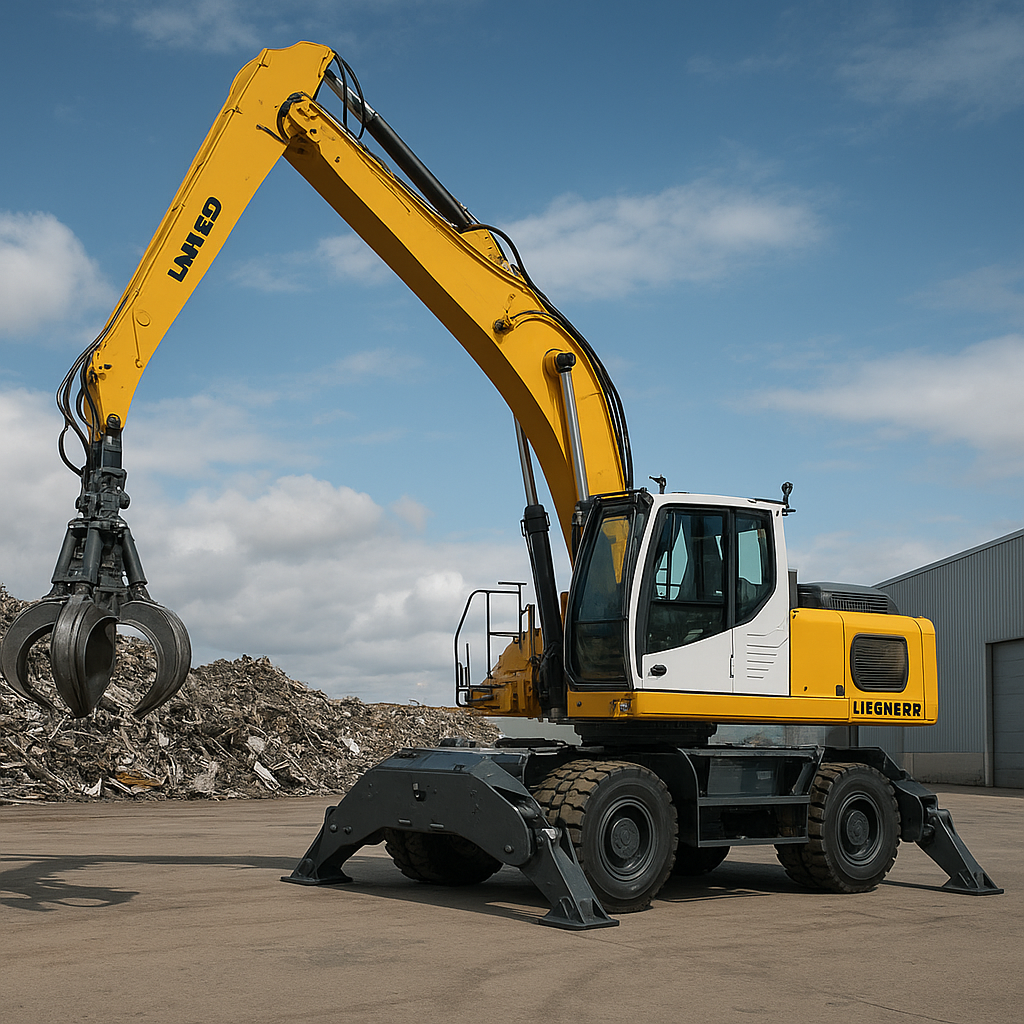
The Liebherr LH 150 is a versatile heavy-duty Liebherr material handler designed for demanding tasks in ports, recycling yards, scrap handling, and other bulk-material applications. Combining a robust undercarriage, purpose-built long-reach boom systems and a hydraulics package tuned for precision and power, the LH 150 balances strength with operational finesse. This article explores the machine’s design philosophy, typical uses, available configurations, performance and maintenance considerations, as well as the safety and economic aspects that make it a common choice for companies working with bulk materials and heavy-duty loading tasks.
Design and technical overview
The LH 150 is built around a core concept: deliver reliable, continuous handling performance in environments where uptime and safe, efficient material flow are critical. At the heart of the machine are components and design choices that prioritize reach, stability and hydraulic responsiveness.
The chassis is available in different undercarriage options depending on the intended operating environment. A tracked base provides stability and low ground pressure for uneven terrain and port environments, while wheeled or gantry-mounted bases are possible for applications requiring mobility on paved surfaces. The counterweight and boom geometry are engineered to maximize lifting capacity at working radii typical for material handling operations.
The long-reach boom and stick combinations allow for extended operating envelopes. Standard reach configurations for this class of machine typically range from roughly 9 to 15 meters, depending on the exact boom and stick fitted. This enables operators to handle large piles, reach into holds or transfer material across hatches without frequent repositioning. The boom structure is designed to resist torsional stress and minimize deflection, which improves bucket or grapple control at full extension.
Power and hydraulics are tuned for sustained loading cycles. Engines used in this segment often meet current emission standards (Stage IV/Stage V depending on market and model year) and are sized to provide a balance between torque for continuous loading and fuel economy during long shifts. Typical engine power for machines in the LH 150 class is commonly in the mid-hundred kilowatt range, with hydraulic systems incorporating variable-displacement pumps, priority circuits for swing and boom control, and oil cooling systems sized for heavy duty duty cycles.
Operator station design is another cornerstone. The cab offers panoramic visibility, climate control, vibration isolation and ergonomic controls to reduce fatigue during long shifts. Optional features often include rotating cabs for 360-degree visibility, camera systems for blind-spot reduction and advanced joystick controls with programmable response curves for different attachments.
Typical applications and industries
The versatility of the LH 150 makes it suitable across multiple industries. Its most common roles include:
- Port handling: loading and unloading bulk commodities like coal, ores, agricultural products and containers from ships and barges. The machine’s reach and precision make it ideal for ship hold and quay work.
- Scrap and recycling yards: moving, sorting and loading scrap steel, ferrous and non-ferrous materials, where specialized grapples and magnet attachments increase productivity.
- Timber and forestry yards: handling logs and wood products with purpose-built grapples or saw attachments. The LH 150’s stability and reach facilitate stacking and processing of timber.
- Waste-to-energy and transfer stations: processing mixed waste streams and loading incineration or processing equipment.
- Bulk materials handling: managing aggregates, fertilizers, grains and other loose commodities at terminals and stockyards.
- Industrial sites: feedstock handling, brownfield clean-ups and heavy lifting tasks where controlled, repeated movements are required.
Each application drives specific attachment choices and machine setups. For example, port work often emphasizes long reach and high-cycle hydraulic performance, while scrap handling prioritizes heavy-duty structures, reinforced swing gear and powerful hydraulic torque to manipulate dense bundles of metal.
Attachments and configurations
One of the LH 150’s strengths is its compatibility with a wide range of attachments, which transform the base machine into a multi-role asset. Attachments commonly used include:
- Hydraulic grapples — available in single or multi-tine configurations tailored for scrap, timber or general bulk handling.
- Clamshell buckets — ideal for precision bulk loading and unloading in ports, and for managing loose materials.
- Demolition shears and grabs — for recycling and dismantling operations.
- Electro-magnets — used in scrap yards and steel mills to pick and sort ferrous materials quickly.
- Buckets and scoops — for moving granular materials and aggregates.
- Specialist tools — such as log grapples, multi-function tools or quick coupler systems that reduce downtime between attachment changes.
Attachment selection affects hydraulic flow demands and counterweight requirements. For heavy magnet or large grapple operations, additional counterweight or stability packages may be recommended. Quick couplers and hydraulic circuits can be factory-fitted or retrofitted to enable rapid attachment swaps, increasing overall fleet flexibility.
Performance, fuel use and productivity
Performance of the LH 150 is judged by cycle time, load moved per hour and fuel consumption under typical operating loads. While exact numbers vary by attachment, material density and operator skill, machines of this size are designed to deliver high throughput in continuous operations.
Cycle time optimization relies on hydraulic responsiveness, boom geometry and operator ergonomics. The hydraulics are typically configured to provide smooth but powerful control over boom, stick and swing functions, allowing precise placement and reduced spillage during transfers. In high-throughput port applications, the combination of reach, swing speed and attachment fill factor determines the effective tons-per-hour the unit can move.
Fuel consumption is a key operational cost. Modern iterations of machines in this class often include features for better fuel economy, such as engine-management strategies, hydraulic load-sensing systems and idle-shutdown functionality. Typical fuel consumption for similar material handlers ranges broadly depending on workload — from lower-consumption levels during light sorting to significantly higher consumption under continuous heavy loading. Operators and fleet managers often see fuel usage in the range of tens of liters per hour for sustained high-load operations, but specific consumption depends on duty cycle and attachment.
Productivity gains can be achieved not only through raw machine power but also via operator training, match of attachment to task, and optimized site layouts. Machine telematics and fleet-management systems offer additional productivity benefits by tracking machine hours, fuel use, idling, diagnostic codes and operator behavior to identify improvement opportunities.
Maintenance, uptime and lifecycle management
Uptime is critical where material handlers are an integral part of continuous supply chains. The LH 150 is designed with serviceability in mind: ground-level access to routine maintenance points, modular hydraulic circuits, and robust component protection help minimize downtime.
Key maintenance areas include hydraulic system health (oil cleanliness and filter replacement), engine servicing (oil, filters and emission-control components), undercarriage wear components for tracked variants, and regular inspection of boom pins and wear surfaces. Scheduled greasing of pivot points and adherence to manufacturer-recommended service intervals prolong component life. Many operators use maintenance contracts or OEM service plans to ensure predictable costs and high availability.
Condition monitoring tools, such as oil-analysis programs and vibration monitoring, enable predictive maintenance. Telematics systems allow remote monitoring of machine health indicators and can proactively alert service teams to abnormal conditions, reducing unexpected failures. Lifecycle management also includes planned component overhauls (e.g., swing gear, pump replacements) timed to fit into production calendars to avoid disruptive downtime.
Safety and operator features
Safety is a primary design consideration for material handlers given the combination of heavy loads, long reach and complex site conditions. The LH 150 typically incorporates structural safeguards like ROPS/FOPS-certified cabs, reinforced windows, and protective guards around hydraulic lines and key components.
Operator visibility is maximized through cab placement, large glazing areas and optional 360-degree cameras or mirror packages. Electronic aids commonly available include load moment indicators (LMI), overload protection, swing-lock systems to prevent uncontrolled motion, and programmable travel limits to restrict boom movement in hazardous zones.
Ergonomics contribute to safety by reducing fatigue-related errors. Features such as adjustable joystick controls, climate control, ergonomic seating and low-vibration mountings keep operators alert during long shifts. Training and certification programs are essential complementary measures: even the most advanced machine needs a skilled operator to meet safety and productivity goals.
Environmental and economic considerations
Modern material handlers are increasingly developed with environmental impact in mind. Engines conforming to the latest emissions standards and fuel-saving hydraulic systems reduce air pollution and operating costs. Additionally, quieter operation and reduced vibration are important for urban or port-adjacent sites that must meet community noise regulations.
From an economic standpoint, the initial acquisition cost of an LH 150-class machine is balanced by its long-term productivity and durability. When configured correctly for the task and supported by disciplined maintenance and telematics, these machines offer strong lifecycle value. Resale values remain stronger when machines have documented service histories and telematics-backed usage records.
The total cost of ownership is influenced by factors such as fuel consumption, maintenance regimen, parts availability and attachment compatibility. Leasing, rental and long-term hire are common strategies to align asset cost with project timelines, while trade-in and refurbishment programs help companies refresh fleets without full replacement costs.
Market presence, fleet integration and statistics
The LH 150 sits in a competitive field of medium-to-large material handlers produced by several global manufacturers. Within ports, scrap yards and bulk-handling terminals, machines in this class are widely used due to their balance of reach and power. Fleet operators often standardize on one or two machine sizes (e.g., small, medium — LH 150 class, and large) to simplify training, attachments and logistics.
Many operators report measurable performance improvements after replacing older excavator-based handlers with dedicated material handlers such as the LH 150. Typical benefits include higher throughput per shift, improved operator comfort and lower downtime from purpose-built attachment integration. While specific statistics vary by site, case studies from similar deployments have documented double-digit percentage improvements in tons moved per shift when machines and attachments are optimized for the job.
Industry-wide, demand for specialized material handling equipment is influenced by global trade volumes, scrap recycling rates and infrastructure investment. Growth drivers include port expansion projects, increasing emphasis on recycling and circular-economy initiatives, and upgrades to energy-from-waste and materials-processing facilities. These trends support steady demand for robust and efficient material handlers that can operate continuously under heavy duty cycles.
Operational best practices and tips
To get the most from an LH 150, consider these practical recommendations:
- Match attachments to tasks precisely. Over- or undersized grapples and buckets reduce fill factors and increase cycle times.
- Use telematics to monitor idling and fuel-use trends, then coach operators on techniques that reduce unnecessary consumption.
- Schedule preventive maintenance during low-production windows and keep a stock of commonly used wear parts to minimize repair lead times.
- Equip the cab with visibility aids and ensure operators receive regular refresher training on load handling and safety systems.
- Periodically reassess counterweight and stability packages as attachments or frequent working radii change.
Conclusion
The Liebherr LH 150 class material handler is a flexible, purpose-built machine well suited to the rigors of port operations, scrap and recycling yards, timber handling and a variety of bulk-material contexts. Its strengths lie in long reach, robust hydraulics and attachment versatility, all supported by ergonomic cab design and modern safety systems. While exact technical figures vary by configuration and model year, operators can expect a balance of solid lifting ability, continuous-duty hydraulics and features focused on uptime and fuel efficiency. With proper attachment selection, operator training and proactive maintenance, an LH 150 can be a cornerstone asset that increases throughput, reduces cycle times and contributes positively to a company’s operational and environmental goals.
)
)