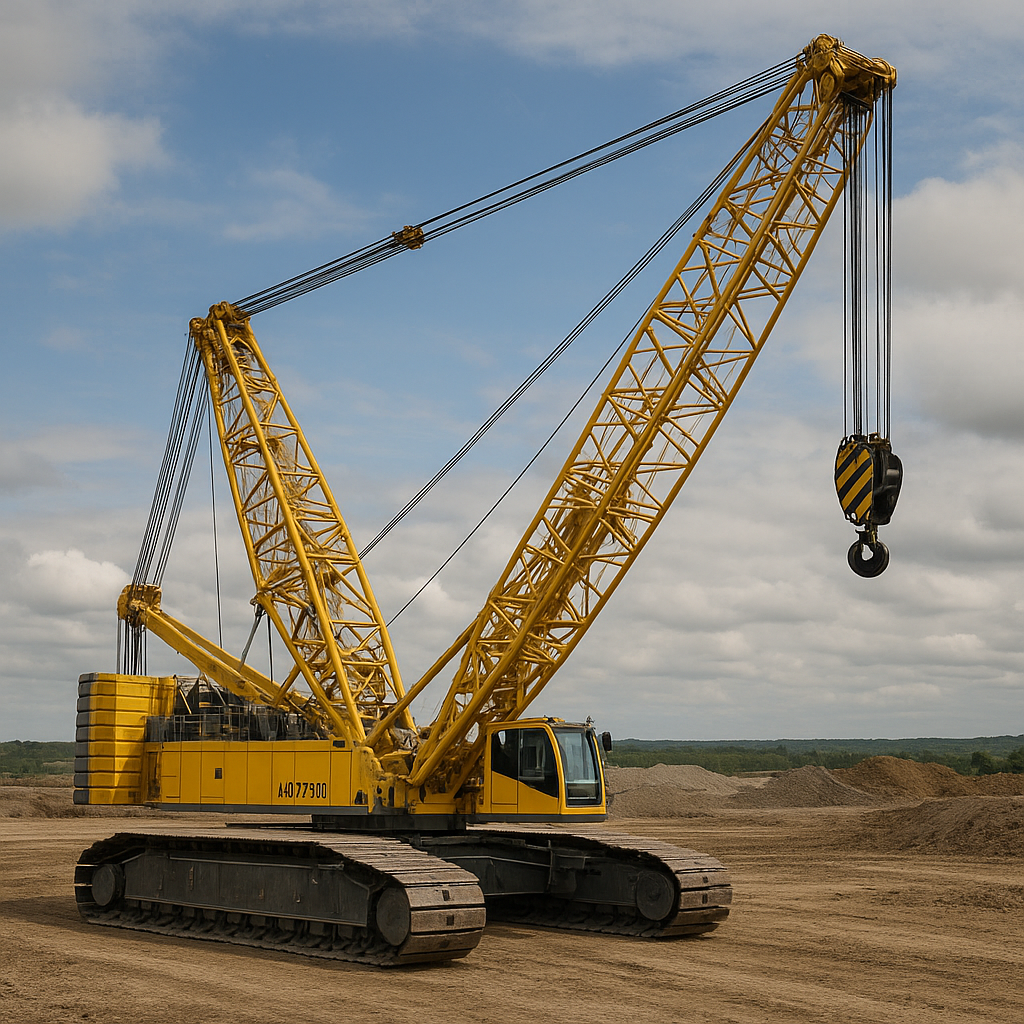
The Liebherr LG 1750 is a heavy-duty lattice boom crawler crane widely used where very large lifts, high stability and off-road mobility are required. This article describes the machine’s design principles, typical applications, technical characteristics and operational considerations. It also highlights logistical, safety and environmental factors that contractors and engineers should consider when specifying the LG 1750 for complex lifting jobs.
Overview and design philosophy
The LG 1750 is part of Liebherr’s series of large lattice-boom crawler cranes engineered for heavy lifts and demanding site conditions. Its design emphasizes modularity, transportability in sections, and on-site flexibility. The lattice boom provides a high strength-to-weight ratio and allows for very long boom and jib combinations, which are critical when lifts require both reach and capacity.
The core design features that distinguish this class of crane include a large, ballast-adjustable counterweight system, robust undercarriage with wide tracks for ground pressure distribution, and a powerful hoisting system. Together these features allow the crane to deliver high lifting capacity while maintaining controlled, stable operation in varied ground and wind conditions. The modular approach makes it possible to configure the crane for a wide range of lifts: short, heavy picks; high, lower-capacity placements; and long-reach operations using heavy jibs and luffing arrangements.
Typical technical characteristics and performance
Exact specification depends on configuration (main boom length, jib type, counterweight arrangement and hoist gear), but the LG 1750 class of machines generally provides a top rated capacity in the order of several hundred tonnes. The following outlines typical performance and engineering attributes to help you understand what the crane can deliver on site.
Capacity and reach
- Rated capacity: commonly cited maximums for the LG 1750 series are in the range of several hundred tonnes up to around 750 tonnes in certain configurations. Actual capacity at any given radius depends on boom and counterweight configuration.
- Boom lengths: lattice main boom lengths are modular and can be assembled to achieve very long reaches. Depending on the setup, tip heights with main boom and jib combinations may extend tens of metres to well over 100 metres.
- Jib types: luffing jibs and fixed jibs can be combined with the main boom to increase reach while managing capacity trade-offs. This modular jib system allows precise tailoring of reach vs. capacity for the lift at hand.
Hoist and powertrain
- Hoisting equipment includes powerful main winches and auxiliary hoists with precise load control systems. Multiple rope reeving and drum capacities ensure efficient heavy lifts.
- Powertrain: the machine usually uses high-performance diesel engines coupled with hydraulic systems to drive hoists, slewing gearbox and travel motors. Engine power and emissions may vary with market and configuration.
Undercarriage and stability
- Tracks: wide, heavy-duty tracked undercarriages distribute load and permit operation on soft or uneven ground; track gauge and assembly can be adapted to site needs.
- Counterweight: a large, often modular counterweight system makes it possible to increase capacity at given radii. Counterweight must be transported and installed according to the manufacturer’s sequence to meet rated charts.
Controls and monitoring
- Modern electronics provide load moment limiting, automatic cutouts, and diagnostics. These systems help maintain safety and reduce operator workload while ensuring the crane remains within rated performance envelopes.
- Operator cabs are ergonomically designed with visibility and control placements that support precise maneuvering during complex lifts.
Applications and industry uses
The LG 1750 is selected for projects requiring exceptional lifting capability or extended reach. Its combination of capacity and mobility lends itself to a broad set of heavy-lift applications across multiple industries.
Power generation and utilities
- Installation of large power plant modules, boilers, turbines and transformers. The crane’s ability to lift very heavy components and position them precisely makes it ideal for thermal and hydroelectric plants.
- Wind energy: erection of heavy nacelles and long turbine components at onshore wind farms, particularly during the installation of multi-megawatt turbines where tandem lifts and large lifting gear are required.
Petrochemical and process industries
- Module lifting and placement for refineries and petrochemical complexes—these environments often require lifts of prefabricated process units weighing hundreds of tonnes.
- Maintenance and turnaround activities where heavy equipment must be removed or installed in constrained layouts.
Bridges, civil structures and infrastructure
- Bridge girder placement, erection of large structural members and heavy prefabricated sections. The extended reach options of the LG 1750 allow it to work over obstacles and water.
- Large culvert, pipeline and heavy concrete segment handling where controlled, high-capacity lifts are needed.
Heavy industry and shipbuilding
- Shipyards and fabrication yards use the crane for hull modules and heavy machinery installation.
- Industrial plant assembly and relocation of heavy machine tool stations or press components.
Transport, assembly and site logistics
One of the strengths of the LG 1750 design is logistical flexibility: although it is a very large crane, it is engineered to be transported in modules and to assemble on site with predictable procedures. Planning and coordination are essential to minimize downtime and ensure safety during assembly and disassembly.
Transport considerations
- Because of modularity, the boom sections, counterweights, crawler frames and superstructure are typically shipped on multiple trailers. Weights and dimensions must comply with local transport regulations and often require permits and route surveys.
- Transport planning should include laydown space for components, crane assembly area and capacity for auxiliary cranes or erection aids that will be used to assemble the LG 1750 on site.
Assembly sequence
- Assembly normally begins with the crawler undercarriage and final drive installation, followed by the superstructure and hoist systems.
- Counterweight blocks are installed in a prescribed order and amount to allow safe erection of the main boom and jibs. Temporary ballast and supports may be required depending on ground conditions.
- Assembly often uses smaller mobile cranes or auxiliary lifting devices and can require several days to weeks depending on site access and required lifting configuration.
Ground preparation and crane pads
- Because the machine delivers large ground loads even with wide tracks, properly prepared crane pads and ground reinforcement are essential. Ground assessment and engineering prevent settlement and tipping during heavy lifts.
- Uniform bearing pressure and proper drainage around the pad reduce the risk of uneven settlement during prolonged operations.
Operational best practices and maintenance
To achieve reliable, long service life and safe operations with the LG 1750, consistent maintenance and adherence to operational best practices are mandatory. The machine’s complexity requires trained personnel for both operation and upkeep.
Operator training and certification
- Operators should be certified for large lattice crawler cranes and familiar with the specific load charts and electronic monitoring systems of the LG 1750.
- Rigging crews must follow approved lift plans and use certified lifting gear sized for the load and configuration. Communication protocols (radio, signals) and emergency procedures must be clearly established.
Routine maintenance
- Daily checks include hoist and hook inspection, wire rope condition, hydraulic leak detection, and track/tension inspection.
- Periodic maintenance covers engine service, gearbox and hydraulic system fluid changes, slew bearing inspection, and non-destructive testing (NDT) of structural components where fatigue is a concern.
Diagnostic systems and remote support
- Modern variants may incorporate remote diagnostics and telematics that monitor engine hours, system pressures, faults and usage patterns. These systems help schedule preventive maintenance and reduce unscheduled downtime.
- Firmware updates and manufacturer support services ensure compliance with safety advisories and can improve operational efficiency over the machine’s lifecycle.
Safety, regulatory and environmental considerations
Large crawler cranes like the LG 1750 operate in the highest safety class for lifting equipment. Regulatory compliance, comprehensive risk assessment and mitigation measures are mandatory for every lift.
Safety systems and certifications
- Load moment indicators, anti-two-block protection, overload cutoffs and redundant braking systems reduce risk during lifts. Safety interlocks prevent operation outside certified load charts.
- Compliance with national and international standards (for example, EN, ISO directives and local occupational safety regulations) is necessary, and operators must maintain documentation and inspection records.
Environmental footprint
- Fuel consumption for large diesel engines is significant during hoisting and travel operations. Efficient job planning, minimized idling and combined lifts can reduce overall fuel use.
- Emissions controls and tier-compliant engines help reduce local air pollution. Some operators pursue retrofits or use lower-sulfur fuels to meet strict site requirements.
Economic and project planning considerations
Choosing the LG 1750 for a project involves balancing cost, schedule, and technical capability. While its upfront cost and transport logistics are substantial, the crane’s lifting power can reduce the number of lifts and overall project time when matched with the right tasks.
When to choose a heavy crawler crane
- If a single heavy or complex component needs to be maneuvered into place with minimal intermediate handling, a large crawler crane can be the most economical solution despite higher mobilization costs.
- When site terrain prohibits the use of large wheeled cranes or when very long reach is required without ground anchors, the crawler configuration and modular boom of the LG 1750 offer distinct advantages.
Cost drivers
- Transportation and permit costs depend on route, number of heavy loads and any required police escorts or night moves.
- Assembly/disassembly time and the need for auxiliary cranes or blade-type dozers to prepare crane pads add to project costs.
- Rental rates and ownership costs are influenced by market demand, availability of local service support, and the machine’s operating hours.
Case examples and notable use scenarios
Across industries, the LG 1750 has been deployed in projects where alternative lifting solutions would be less practical or more expensive. Representative scenarios include:
- Installation of heat-recovery steam generators in power plants where module weights and spatial constraints require a high-capacity, precise lift.
- Erection of long-span bridge girders where the crane must work from an off-site embankment and reach across a waterway or highway.
- Placement of prefabricated refinery modules where the combination of weight and confined staging area prevents using multiple smaller cranes.
Final remarks on selection and planning
Selecting a crane like the LG 1750 should be driven by a detailed lift study: evaluate maximum loads, radii, boom/jib geometry, site constraints and ground bearing capacity. Early involvement of lifting engineers, crane suppliers and transport specialists reduces the risk of costly changes during execution.
When correctly specified and deployed, the LG 1750 delivers a combination of high capacity, adaptable reach and robust site mobility that makes it a compelling choice for the most demanding lifting assignments. Its modular design and modern control systems contribute to operational efficiency and long-term reliability, while rigorous adherence to maintenance and safety protocols ensures predictable performance over many years.
)
)