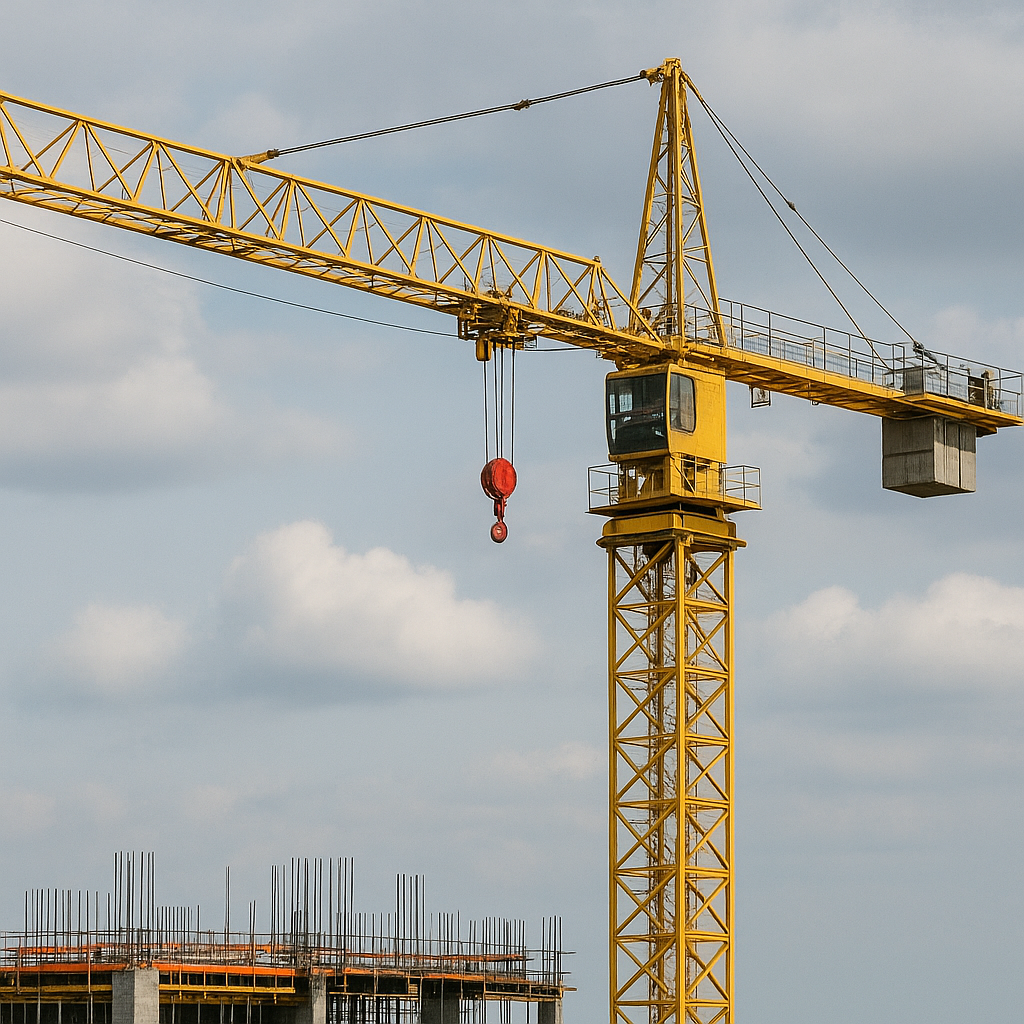
The Kroll K-10000 is presented in some industry circles as a heavy-duty tower crane model suited for large construction and industrial lifting tasks. Whether used in urban skyscraper projects, heavy civil works, or industrial plant assembly, such cranes combine vertical reach, horizontal span and lifting power to handle complex loads safely and efficiently. This article examines the machine’s design concepts, typical applications, operational characteristics, safety and maintenance practices, and purchasing considerations. Because manufacturer-specific public data for the Kroll K-10000 are limited in widely accessible sources, parts of the technical discussion use typical ranges and comparable-class benchmarks to give a realistic picture of expectations for a crane of this designation.
Design and Technical Overview
The structural architecture of the Kroll K-10000 follows conventional tower crane design principles: a vertical mast (tower), a slewing unit at the top, a horizontal or luffing jib, a counter-jib for balance, a cab or remote-control systems for the operator, and a counterweight system. Key design priorities are maximizing reachable footprint, optimizing torsional stiffness of the mast, and ensuring safe load-handling dynamics.
- Mast and modular sections: Tower cranes in this class generally use modular mast sections that bolt together, allowing tailoring of height to project requirements. Sections often include internal ladders and service platforms for inspection.
- Slewing unit and rotation: The slewing ring and gearbox enable 360° rotation. High-quality slewing units are designed for continuous operation under high moment loads and are typically grease- or oil-lubricated with sealed bearings.
- Jib and material selection: The jib is usually a lattice structure (triangular or square) to achieve high stiffness at reduced weight. Materials are high-strength structural steel with protective coatings for durability.
- Counterweight and balance: The counter-jib houses the counterweight, which can be concrete or steel blocks. Proper distribution of counterweight is crucial for reserve stability and maximum lifting envelope.
- Powertrain and controls: Drives for hoisting, trolleying and slewing are typically electric motors with variable frequency drives (VFDs). Modern units include PLC-based control systems with diagnostics, fault logging and configurable speed profiles.
Applications and Typical Use Cases
The Kroll K-10000 — or cranes of similar class and capability — are versatile assets on medium to large projects where combinations of height and span are required along with meaningful lifting capacity. Typical applications include:
- High-rise construction: placing precast elements, steel beams, facade panels and concrete buckets at various heights.
- Industrial plant construction: lifting heavy equipment like heat exchangers, compressors, pressure vessels and modules into position.
- Civil engineering and bridge construction: supporting the assembly of segments, falsework and formwork for large spans.
- Wind farm and tower erection: installing tower sections and nacelles where a balance of reach and precision is required.
- Port and logistics operations: occasional use for on-dock heavy lifts where fixed crane installations offer advantages over mobile alternatives.
Beyond construction, tower cranes of this caliber are often rented for specific project phases. Their modularity allows transport in standard truck loads and on-site assembly tailored to the project’s height and radius requirements.
Operational Performance and Typical Specifications
Because model-specific verified specifications for the Kroll K-10000 are not always publicly documented, the following figures are presented as representative ranges for tower cranes in the same performance class. These numbers should be treated as indicative benchmarks rather than definitive manufacturer data.
- Maximum rated load: Typical heavy tower cranes of similar class often feature a maximum rated load in the range of 8 to 25 tonnes at short radii, with considerably lower capacities at maximum jib extension.
- Jib length: Jib or boom lengths commonly range from 40 to 80 meters for large tower cranes, with some variants offering modular jibs to extend beyond 80 meters.
- Freestanding height: Freestanding heights can range from 30 to 80 meters depending on mast section configuration; tying the mast into the building structure can allow installation heights over 200 meters in staged assemblies.
- Working radius: Effective working radius is typically 40–80 meters, with capacity diminishing as radius increases.
- Hoist speed and rope: Hoist speeds vary by gear ratio and motor selection; many cranes offer multiple speed ranges for precision and fast travel. Wire rope diameters and drum capacities are chosen to maintain safety factors required by standards.
- Power requirements: Electric drive versions commonly operate on three-phase supplies at voltages typical to the region (for example 400–600 V), with installed power in the range of 50–150 kW for main drive systems, depending on configuration.
- Counterweight mass: Counterweights may vary from several tonnes to dozens of tonnes depending on maximum moment and jib length; modular counterweight design allows adjustment for specific lift profiles.
For procurement decisions or critical lifting plans, always refer to the exact load charts provided by the manufacturer or rental company based on the specific configuration, radius and height conditions.
Safety Systems and Operational Best Practices
Safety is paramount in tower crane operations. Modern cranes such as the Kroll K-10000 class include multiple passive and active safety features to prevent overloads, collisions and tipping. Key elements include:
- Load moment indicators (LMI): Real-time monitoring of applied moment vs. rated capacity, often with audible/visual alarms and automatic cutout if limits are exceeded.
- Overload protection: Electrically or mechanically locked systems that prevent hoist motion when exceeds safe limits.
- Anemometer and wind monitoring: Wind speed sensors that alert or automatically stop operations when environmental limits are surpassed.
- Anti-collision systems: Coordinate multiple cranes at the same site using zone control or positional interlocks to prevent boom interference.
- Emergency descent and braking: Redundant braking systems on hoists and slewing drives to secure loads in power-loss scenarios.
- Remote diagnostics and telematics: Increasingly common, providing health monitoring, usage logs and predictive maintenance data to reduce downtime and improve safety.
Operational best practices include daily pre-shift inspections, documented load planning, zone establishment around the crane swing area, proper radio communications between the operator and signalers (riggers), and adherence to local regulatory standards (CE marking, EN standards in Europe or ANSI/ASME equivalents elsewhere).
Maintenance, Inspection and Lifespan
Planned and preventive maintenance is critical to maximize availability and safe lifecycle operation of a tower crane. For a crane like the Kroll K-10000, maintenance protocols typically involve:
- Daily checks: Visual inspection of ropes, sheaves, safety devices, operator cab instruments and walkways.
- Weekly/monthly servicing: Lubrication of slewing ring, gearboxes and ropes; checking of anchor bolts and structural connections.
- Periodic comprehensive inspections: NDT (non-destructive testing) of welds and critical points, detailed gear and brake inspections, electrical system checks and testing of safety interlocks — often at 6 or 12 month intervals depending on local regulations.
- Major overhauls: Replacement of heavily stressed components such as wire ropes, hydraulic cylinders, and gear sets may be required every few years based on hours of operation and load history.
Typical service life for a well-maintained tower crane can be 20 years or more. Component replacement and modernization (upgrading controls, adding anti-collision or telematics modules) can extend useful life and improve safety and efficiency. Insurance and regulatory requirements often mandate documentation of all inspections and repairs.
Economic Considerations and Total Cost of Ownership
Acquiring a tower crane is a significant capital decision. Lifecycle costs include purchase or rental, transport and assembly, operator labor, maintenance, insurance, inspections and disposal or resale. Some economic considerations:
- Purchase vs rental: Rental is common for single-project use or phased work. Purchase makes sense for fleet operators or contractors with continuous usage.
- Assembly and disassembly costs: Large cranes require specialized crews and auxiliary equipment for erection and dismantling; these costs are often underestimated in project budgets.
- Downtime risks: Reliability and access to spare parts affect utilization rates. Modern control and diagnostics can reduce unscheduled downtime.
- Fuel/electric costs: Electric drives generally lower operational energy costs compared to diesel alternatives and are increasingly favored for urban and low-emissions projects.
Decisions should be based on a detailed cost-per-hour or cost-per-tonne-lift analysis for the project lifecycle rather than simple upfront pricing.
Environmental and Site Planning Factors
Site planning for tower crane operation must consider footprint, noise, emissions and local community impact. Key aspects include:
- Foundation and anchoring: The base must be designed for the expected overturning moments and local ground conditions, often requiring reinforced concrete pads or tie-in points to existing structures.
- Noise and emissions: Electric cranes reduce local emissions and noise compared with diesel-driven temporary cranes. Site curfews may limit working hours and affect project schedules.
- Transport logistics: Modular design facilitates road transport; however, stage planning for delivery and on-site storage is essential to avoid delays.
- Urban integration: In dense urban areas, planning for crane swing zones, pedestrian safety, and load drop zones is crucial to prevent incidents and community disruption.
Comparison to Other Crane Types and Alternatives
Tower cranes such as the Kroll K-10000 offer distinct advantages and limitations compared to other lifting options:
- Mobile cranes: Mobile all-terrain or lattice boom cranes offer faster setup and mobility, but often less vertical reach or a smaller permanent footprint at high elevations.
- Gantry and portal cranes: These are suitable for specific horizontal lifting tasks (ports, yards) but lack the vertical reach required for tall buildings.
- Heavy lift crawler cranes: These offer exceptional lift capacity and flexibility for very heavy or unusual lifts, yet are less efficient for repeated high-elevation placement across many floors over long project durations.
Choice depends on lift profile, project duration, site access and cost optimization. For continuous vertical work on tall structures, tower cranes often remain the most efficient option.
Procurement and On-Site Implementation Tips
When procuring or contracting a model like the Kroll K-10000, follow these guidelines:
- Obtain detailed load charts for every anticipated radius and height and have engineering review for multi-crane interaction, especially on crowded sites.
- Confirm availability of spare parts, technical support and certified technicians in your region.
- Plan for certified lifting plans and method statements, including rigging plans and fall protection strategies.
- Integrate crane assembly into the project schedule early to avoid sequence delays; erection often requires coordination with structural milestones to provide tie-in points.
- Insist on documented commissioning and functional testing, including all safety systems, before live lifting operations.
Future Trends and Technological Developments
Tower crane technology continues to evolve, and future enhancements relevant to the Kroll K-10000 class may include:
- Advanced telematics and predictive maintenance: Improved sensors and analytics will reduce downtime by predicting component failures before they occur.
- Autonomous and semi-autonomous functions: Assisted positioning systems, automated hoist control for repetitive lifts, and remote operation for hazardous environments.
- Energy efficiency improvements: Regenerative drives and integration with on-site renewable energy installations to lower operating costs and carbon footprint.
- Enhanced safety via AI: Real-time vision and sensor fusion to detect personnel in swing zones and automatically restrict movements.
Conclusion
The Kroll K-10000 designation evokes a high-capacity, adaptable tower crane intended for demanding construction and industrial tasks. While specific public statistics for this exact model may be limited, industry practice and comparable-class benchmarks provide a clear view of what to expect: modular mast systems for configurable height, substantial jib spans for wide working radii, meaningful load capacity at short radii, and a suite of modern safety and control systems. Optimal use of such a crane depends on rigorous planning, professional operation, scheduled maintenance, and attention to site-specific constraints. For any critical lifts or procurement, consult the manufacturer’s official load charts, technical documentation and certified engineers to ensure safe and efficient deployment.
)
)