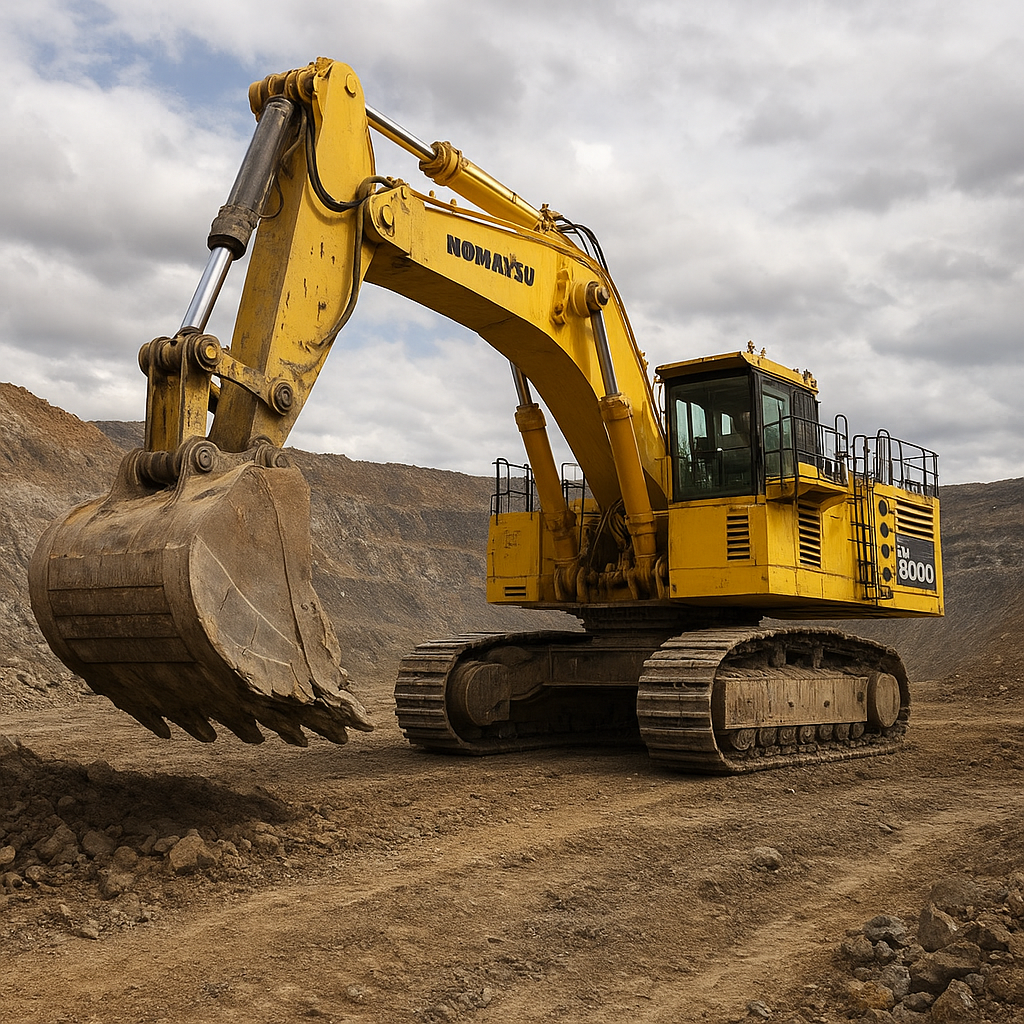
The Komatsu PC8000-11 represents one of the pinnacle achievements in modern surface mining equipment. Designed to handle the heaviest excavation tasks in open-pit operations, this machine combines enormous physical capacity with advanced systems for efficiency, safety, and lifecycle management. Below are detailed insights into its design, applications, operational characteristics, and other notable information that mining professionals and equipment enthusiasts will find valuable.
Design and technical overview
The Komatsu PC8000-11 is a large hydraulic mining excavator built for continuous, heavy-duty operation. As a flagship model in Komatsu’s ultra-class excavator range, it focuses on maximizing material handling per pass while providing durability in the most demanding mining environments. Core engineering goals include structural strength, hydraulic efficiency, and serviceability for long-term reduced downtime.
Structure and major components
- Frame and house: The upper structure is engineered to distribute loads across a robust frame and reinforced deck, enabling the excavator to absorb the stresses of high-frequency digging and loading cycles.
- Boom, arm and linkage: These components are built from high-tensile steels with optimized geometry to balance digging reach, lift capacity, and durability. Wear-resistant surfaces and replaceable wear parts extend component life under abrasive conditions.
- Hydraulic system: A high-flow, variable-displacement hydraulic system delivers the power necessary for rapid bucket fill, swing, and crowd operations while incorporating energy recovery and control features for smoother, more efficient cycles.
- Undercarriage: Heavy-duty track frames, large-diameter rollers, and reinforced track shoes are designed for stability and long life on rough pit floors.
- Engine and cooling: The machine is normally powered by one or more high-output diesel engines with advanced cooling systems sized for continuous heavy loads in hot climates; engines meet regional emissions regulations where applicable.
Key specifications (typical ranges and notes)
Komatsu publishes configuration-specific data for its machines. Exact values for the PC8000-11 depend on bucket choice, stick and boom configurations, and optional equipment. Typical figures for ultra-class excavators in this category are given as ranges to illustrate scale:
- Operating weight: approximately 700–800 tonnes (700,000–800,000 kg) depending on configuration.
- Bucket capacity: common bucket sizes for this class range from 30 to 52 m³ (cubic meters), with specialized buckets (e.g., rock or coal) selected to match material properties.
- Engine power: gross power in the range of 1,800–2,800 kW (2,400–3,800 hp) depending on tuning, number of engines (some installations may use multi-engine arrangements), and emissions stage.
- Reach and digging depth: boom and arm combinations yield significant reach—digging reaches and heights are configurable to match loading patterns and truck dimensions.
Note: Because Komatsu offers custom options for different mines and regions, owners should refer to OEM specification sheets for precise numbers for a particular machine.
Typical applications and operational roles
The PC8000-11 is purpose-built for large-scale open-pit mining operations. Its scale and power make it suitable for a number of specific roles within a mine’s material handling chain.
- Loading ultra-class haul trucks: The PC8000-11 is optimized to load very large haul trucks (e.g., payloads of 200–400 tonnes and larger). Bucket sizes and lift heights are selected to match truck body capacities and to reduce fill cycle times.
- High-production stripping: During overburden removal the excavator can move large volumes of low- to medium-density material efficiently, particularly when combined with appropriately sized buckets and optimized cycle times.
- Ore handling and blending: For high tonnage ore movement and creating blend stockpiles, the machine’s continuous-duty systems and sizeable buckets enable sustained throughput.
- Support for shovel-truck fleets: As part of a coordinated mining fleet, the PC8000-11 contributes to minimized truck waiting times and improved pit scheduling by delivering consistent, high-volume loading.
Typical productivity metrics (illustrative)
Productivity depends heavily on bucket selection, material density, cycle time, operator skill, and site logistics. To illustrate:
- If a bucket capacity is 40 m³ and the material bulk density is 1.6 t/m³, the theoretical payload per pass is ~64 tonnes. At an achieved cycle rate of 120 cycles per hour (an aggressive benchmark for large excavators in an optimized setup), the theoretical hourly throughput would be 7,680 tonnes/hour. Operational realities (swing time, truck positioning, fragmentation, fill factor) typically reduce this number, so a practical average might be 2,500–6,000 tonnes/hour depending on conditions.
- For higher-density rock or larger buckets, hourly tonnes moved can exceed these figures, while for heavy, sticky clays or poor fragmentation the realized productivity will be lower.
These calculations are illustrative and intended to show how bucket size and density influence output. Actual productivity should be validated by on-site performance data.
Technology, safety and operator features
Modern Komatsu mining machines incorporate a suite of technological and safety systems designed to enhance uptime, operator comfort, and site compliance.
Telematics and fleet management
- Remote monitoring: Komatsu’s telematics platforms (such as KOMTRAX and integrated fleet systems) provide real-time diagnostics, utilization data, fuel consumption trends, and maintenance alerts to fleet managers.
- Data-driven maintenance: Predictive maintenance routines are enabled by sensor data and trend analysis, allowing proactive replacement of wear parts and scheduling of service during planned downtimes.
Operator environment
- Cab ergonomics: Large, quiet cabs with climate control, adjustable seats, and joysticks reduce operator fatigue. Visibility improvements, camera systems, and proximity sensors enhance situational awareness.
- Control systems: Proportional joystick controls, electronic monitoring screens, and customizable machine response settings allow operators to optimize productivity for different tasks.
Safety systems
- Collision avoidance and cameras: Multi-angle cameras, radar, and proximity detection systems help reduce the risk of incidents in congested pit environments.
- Lockout and fail-safe systems: Safety interlocks for maintenance and remote shutdown capabilities are standard practice in ultra-class mining excavators.
- Fire suppression: Automatic and manual fire suppression options are typically available to meet mine safety regulations.
Maintenance, total cost of ownership and lifecycle considerations
Maintenance planning and lifecycle cost management are central to maximizing the value of a PC8000-11. Because these machines represent major capital investments, mines focus on minimizing downtime and controlling maintenance expenditure.
Key maintenance strategies
- Condition-based maintenance: Using sensor data from hydraulic systems, structural strain gauges, and engine health monitors to schedule interventions when needed instead of fixed intervals.
- Wear part management: Proactive replacement of bucket teeth, side cutters, shoe assemblies, and other high-wear components to prevent secondary damage.
- Modular component replacement: Engine, hydraulic pump, and electrical module designs that permit faster swap-out reduce mean time to repair (MTTR).
Total cost of ownership (TCO) factors
- Acquisition cost: Purchase price varies with options; ultra-class excavators represent multimillion-dollar investments. Financing, tax treatment, and resale value all affect lifecycle economics.
- Fuel consumption: Fuel is a large component of operating cost. Optimized hydraulic systems and operator training can substantially reduce fuel per tonne moved.
- Parts and labour: Availability of OEM parts, local service infrastructure, and ease of remote diagnostics influence maintenance expenses.
- Machine utilization: Higher utilization lowers cost per tonne moved but accelerates wear; balanced planning aims for high uptime with predictable maintenance windows.
Comparisons, market position and competitors
The PC8000-11 competes with other manufacturers’ ultra-class excavators such as the Hitachi EX8000 series and the Liebherr R 9800, as well as large rope shovels from manufacturers like Caterpillar and Bucyrus (now part of Caterpillar). Choice among machines often hinges on:
- Bucket and truck match: Compatibility with the mine’s fleet of haul trucks is a crucial determinant—matching bucket size to truck body volume is key for cycle efficiency.
- Operating environment: For some operations, rope shovels remain preferred for extreme abrasion or when predictable fragmentation favors shovels’ face-digging method. For others, hydraulic excavators offer greater versatility and mobility.
- Lifecycle services and support: OEM service networks, parts availability, and training packages sway procurement decisions.
Environmental and regulatory considerations
Large mining equipment has significant environmental impacts. Manufacturers and operators mitigate these through technology choices and operational practices.
- Emissions compliance: Engines are configured to meet regional emissions standards (Tier 4/Stage V and equivalents in many markets). After-treatment options and engine tuning are part of regulatory compliance strategies.
- Noise and dust management: Sound-insulated cabs, mufflers, and dust suppression systems help mines meet local environmental permits and community expectations.
- Energy efficiency: Hydraulic system optimization, intelligent control, and sometimes electrification of ancillary systems contribute to lower fuel consumption per tonne moved.
Practical considerations for procurement and operation
When planning to acquire and operate a PC8000-11 or similar ultra-class excavator, mine planners should consider:
- Fleet integration: How the excavator will fit into the pit’s haul-cycle, truck sizes, and dig face layout.
- Site preparation: Ground bearing capacity, access roads, and turn radii appropriate for the machine’s size and weight.
- Operator training and human factors: Skilled operators and maintenance technicians are essential for realizing the machine’s potential and reducing preventable failures.
- Spare parts inventory: Critical spares for engines, hydraulic pumps, and undercarriage components should be stocked or rapidly available to avoid long downtimes.
- Lifecycle planning: Consideration of mid-life rebuilds or component overhauls can extend the machine’s productive life for decades in many operations.
Interesting facts and market notes
- The PC8000-11 belongs to a class of machines designated as “ultra-class” hydraulic excavators—these are some of the largest mobile hydraulic shovels in the world and are engineered specifically for high-throughput open-pit mining.
- Operators often select bucket geometry and tooth systems for specific fragmentation patterns. This customization is a major factor in achieving high fill factors and reduced cycle times.
- Komatsu and other OEMs increasingly offer digital twins, remote diagnostics, and integration with mine planning software so that machine performance can be modeled and optimized before field deployment.
- In many large mines, a single PC8000-class excavator can be central to achieving daily tonnage targets, making uptime and predictable performance a strategic priority.
Summary
The Komatsu PC8000-11 is a purpose-built, ultra-class hydraulic excavator aimed at mines that require very high-volume earthmoving and ore handling capabilities. Its combination of massive structural design, advanced hydraulics, and modern telematics/safety features make it well suited to loading ultra-class haul trucks, performing high-production stripping, and supporting continuous mining operations. While exact specifications vary by configuration and customer requirement, the PC8000-11 exemplifies the engineering trade-offs mines accept to achieve top-tier productivity: large initial capital expense in exchange for substantially higher per-hour material movement capacity, integrated systems for predictive maintenance, and operator-focused controls and safety systems.
When considering this class of machine, operators and procurement teams should focus on matching bucket size and digging geometry to truck capacity and pit logistics, preparing a robust maintenance and spare parts plan, and leveraging available telematics to optimize lifecycle performance and reduce total cost of ownership.
)
)