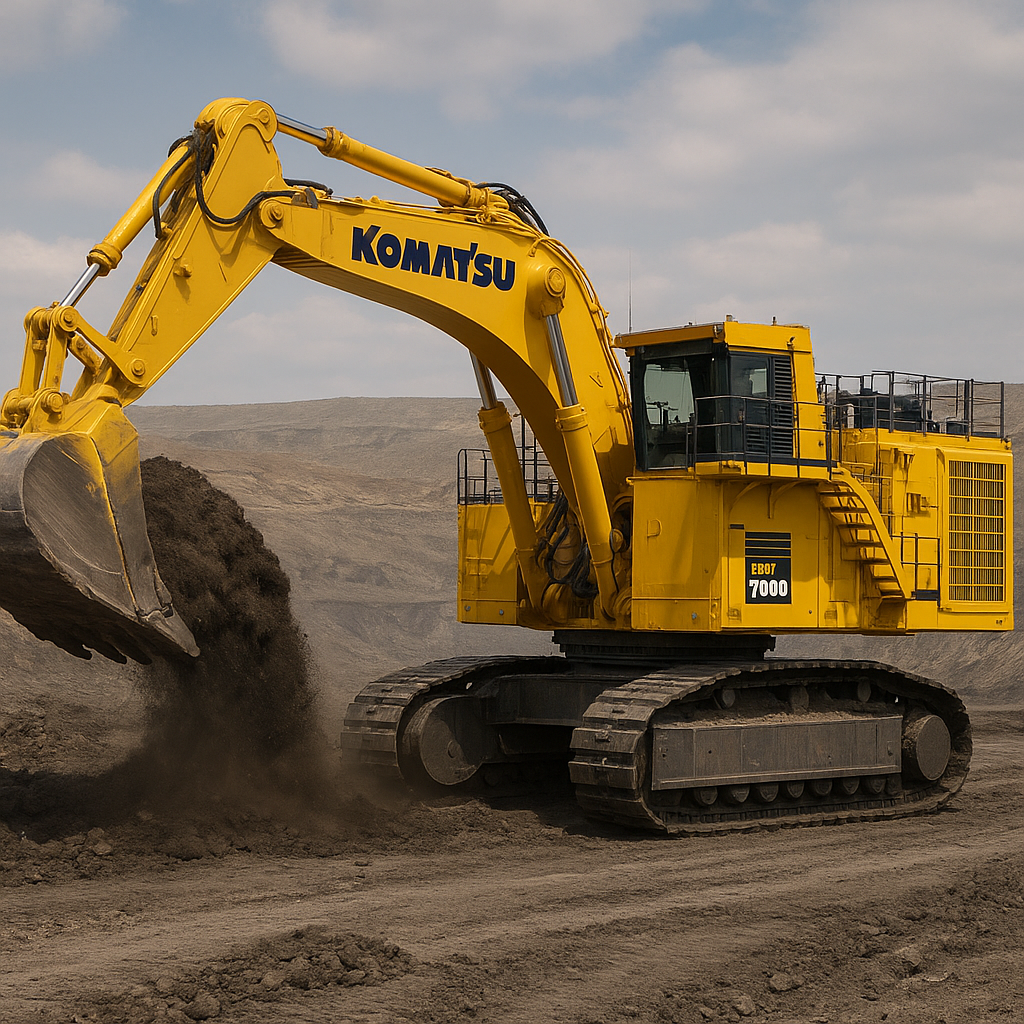
The Komatsu PC7000 is a name that resonates in the world of heavy earthmoving and surface mining. Built to tackle some of the most demanding bulk excavation tasks on the planet, this machine represents a class of giant hydraulic excavators designed for continuous, high-volume production. In this article we examine its typical uses, technical characteristics and operational considerations, as well as practical insights into maintenance, transport, economics and environmental impact. Whether you are an operator, mine planner, fleet manager or simply interested in large-scale machinery, this overview will provide useful context and data to understand what makes the PC7000 an influential machine in modern mining.
Design and technical characteristics
The Komatsu PC7000 series is part of Komatsu’s lineup of purpose-built hydraulic mining excavators. These machines are engineered for maximum durability, large-scale material handling and long operating cycles. Their design priorities include structural strength, hydraulic power, robust undercarriage, and systems that allow continuous operation in harsh environments.
Size and structure
- The PC7000 is a large-class hydraulic excavator, typically used for open-pit mining and heavy-duty quarrying. Its structure features a heavy-duty lower frame, reinforced boom and stick, and purpose-built attachments capable of handling very high stress loads.
- Operating weight varies with configuration and attachments; typical ranges for machines in this class are in the order of tens to hundreds of tonnes. Exact weight depends on boom length, counterweight and bucket selection.
Powertrain and hydraulics
- Komatsu equips large excavators with powerful diesel engines tuned for continuous high-load operation. These engines include advanced cooling systems, fuel delivery and emissions control appropriate for the era of manufacture and local regulatory requirements.
- The machine’s hydraulic system is sized to provide rapid bucket cycle times while maintaining control and stability at full loads. Key hydraulic components are typically overspec’d for enhanced longevity under mining duty cycles.
- Fuel efficiency and power management features are often present to optimize cycle productivity versus operating cost, including load-sensing hydraulics and electronic engine governors.
Bucket and payload
- One of the most critical specifications is bucket capacity. For the PC7000 class, buckets are usually designed in the multi-cubic-meter range to enable large scoops per cycle. Bucket geometry, lip design and wear protection are chosen to match material density and wear conditions at the site.
- Payload per cycle and cycle times directly influence hourly production. Mining configurations focus on maximizing the balance between bucket size and truck payload to optimize shovel-truck match.
Typical specifications and statistical ranges
Specifications vary across model years and custom configurations. The following are typical ranges for machines in this scale rather than guaranteed values for every PC7000 unit. For precise numbers consult the machine’s serial-specific documentation.
- Engine power: often in the range of several thousand kW (multiple hundreds to over a thousand horsepower depending on the model and measurement unit).
- Bucket capacity: commonly several cubic meters up to tens of cubic meters depending on mining application and bucket type.
- Operating weight: typically tens to hundreds of tonnes, heavily influenced by the chosen configuration.
- Cycle time: depends on bucket size and hydraulics; optimizing cycle time is essential for meeting hourly production targets.
Applications and operational roles
The Komatsu PC7000 is optimized for high-production mining environments. Its primary use cases include removal of overburden, ore loading into haul trucks, stockpile reclaim, and other large-material handling tasks. The machine’s adaptability makes it suitable for a variety of mining and civil operations when large volumes of material must be moved quickly and safely.
Open-pit mining
- In open-pit metal and coal mines, the PC7000 frequently operates as the primary loading shovel, filling large haul trucks in high-throughput circuits. It is matched with truck fleets to achieve a target tonnes-per-hour throughput for stripping or ore excavation.
- Key operational considerations include selecting the correct bucket size to match truck payload, cycle efficiency, and maintaining face access and bench stability.
Quarries and large civil projects
- For large quarries and infrastructure projects that require bulk material movement (e.g., dam construction, large earthworks), the PC7000 can be an efficient option where continuous digging and loading are required.
- In civil projects, the machine’s emphasis is less on top-tier production but on long service life and efficient excavation of large volumes.
Support roles and secondary tasks
- When fitted with alternative attachments, such as hydraulic breakers, shears or specialized buckets, machines of this size can also assist with secondary tasks like demolition, rock breaking and primary crushing feed operations.
- Support roles demand careful attachment selection and operator training to maintain safety and productivity.
Productivity, fleet integration and matching
Achieving target production requires more than a powerful excavator; it demands integration into a holistic mining system. The PC7000’s productivity is largely defined by bucket-truck matching, cycle efficiency and uptime.
Shovel-truck matching
- One of the most important operational decisions is selecting haul trucks that complement the PC7000’s bucket size. Over- or under-matching leads to wasted cycle efficiency or truck underutilization.
- For example, a large bucket may suit 200–300 tonne haul trucks in some operations, while different material densities or operational constraints may require different truck sizes.
Cycle optimization
- Operators and mine planners work to minimize non-productive time in the digging cycle: approach, fill, swing, dump and return. Quick and smooth hydraulic cycles, precise operator control and minimized truck waiting are key.
- Advanced systems such as on-board monitoring, telematics and automated digging aids can further boost effective productivity by reducing variability and providing performance feedback.
Uptime and availability
- Maintenance strategies—both preventive and predictive—directly impact machine availability. Planned inspections, scheduled component replacement, and vibration/sensor monitoring help reduce unexpected downtime.
- Parts logistics and skilled technician availability are major considerations for remote sites; common practice is to maintain a local inventory of wear parts and critical spares to keep turnaround times low.
Maintenance, inspection and lifecycle management
Large excavators like the PC7000 require disciplined lifecycle management to protect capital investment and ensure safe, reliable operation. Maintenance practices emphasize wear part management, structural inspection, hydraulics care, and engine health monitoring.
Wear components and preventive replacement
- High-wear items such as bucket teeth, cutting edges, adapters, pins and bushings must be regularly inspected and replaced when wear limits are reached. Using high-quality wear materials and implementing a wear-monitoring program extends component life.
- Regular undercarriage inspection is essential to avoid catastrophic failures. Track chain, rollers, idlers and sprockets should be inspected and adjusted per manufacturer recommendations.
Fluid and filtration management
- Hydraulic fluid health is critical—contamination or degradation leads to reduced efficiency and accelerated component wear. Scheduled fluid and filter changes, along with fluid cleanliness monitoring, are standard.
- Engine oil, coolant and fuel filtration also demand routine attention, especially in dusty or hot environments common to mining.
Structural and safety inspections
- Regular structural inspections—examining booms, sticks, frame welds and counterweights—identify fatigue cracks or deformation before they grow into unsafe conditions.
- Operator cab safety systems, emergency egress, fire suppression units and fall protection must be checked and maintained to comply with site safety standards and local regulations.
Transport, assembly and logistics
Given the machine’s size, transport and assembly are significant logistical tasks. Components may be shipped in modules and assembled on site. Planning must account for heavy-lift cranes, transport permits and route surveys for oversized loads.
- Site access roads, crane capacity, and laydown areas must be prepared in advance to receive large components.
- Disassembly and reassembly for relocation require experienced crews and a controlled plan to preserve component integrity and safety.
Safety and operator considerations
Operating a large mining excavator demands highly skilled crews and rigorous safety management. Because the PC7000 class moves vast quantities of material, the consequences of mistakes can be severe; therefore, multiple layers of procedural and technological controls are employed.
Operator training and ergonomics
- Intensive operator training focuses on cycle efficiency, hazard recognition, proper bucket filling techniques and safe interactions with haul trucks and other site traffic.
- Cab ergonomics, visibility aids, cameras and proximity sensors reduce operator fatigue and improve situational awareness in large-scale excavations.
Ground control and bench stability
- Geotechnical input on bench design and stability is crucial. Excavator positioning, dig angles and working near berms demand strict protocols to prevent bench collapse or ground failures.
- Regular geotechnical monitoring, including slope instrumentation and visual inspections, complements machine operations to maintain a safe work environment.
Environmental and economic impacts
Large hydraulic excavators influence both the environmental footprint and the unit economics of a mining operation. Their energy use, emissions and site impacts must be balanced against the economic benefits of high productivity.
Fuel consumption and emissions
- Diesel engines powering machines of this size consume significant fuel. Fuel management programs, engine tuning and newer emission-compliant engine options help mitigate environmental impacts and reduce operating cost per tonne.
- Many operators use telematics and fuel monitoring to identify inefficient cycles or idling and implement operator coaching to reduce fuel burn.
Reclamation and site restoration
- Planning for eventual reclamation is an integral part of modern mining; use of large excavators must be coordinated with progressive rehabilitation activities and minimizing disturbance footprints where practicable.
- Noise and dust control systems—such as water sprays, enclosed cabs with filtration and acoustic mitigation—help reduce community and ecological impacts.
Technology, telematics and automation trends
The PC7000 and machines like it are increasingly integrated with digital systems to enhance reliability, safety and productivity. Modern fleets use telematics, predictive maintenance tools and automation to optimize performance.
- On-board sensors and telematics transmit operating parameters, idle time, fuel consumption and fault codes to fleet managers for real-time decision-making.
- Predictive maintenance algorithms analyze vibration, temperature and performance trends to forecast component failure, enabling parts replacement on a planned schedule rather than reactive repairs.
- Automation and semi-autonomous controls can assist operators with repeatable hoisting cycles, swing damping and optimized digging patterns; fully autonomous operation is a growing research and deployment area in some mining regions.
Economic considerations: acquisition, operating cost and resale
Purchasing and operating a PC7000-class excavator is a major capital commitment. Decisions are based on expected throughput, life-of-mine plans and total cost of ownership.
- Initial acquisition cost depends on specification and customization; leasing or long-term contracts are common alternatives to outright purchase for project-based operations.
- Operating costs include fuel, maintenance, parts, specialized transport, and skilled labour for operation and repair. These costs are often expressed as cost per tonne moved and used in mine planning to compare equipment options.
- Residual value and resale depend on maintenance history, hour meter reading, and condition of wear components. Machines with strong maintenance records and documented service history command higher resale values in the used-equipment market.
Conclusion
The Komatsu PC7000 is a representative example of heavy hydraulic excavators engineered for demanding mining operations where scale, durability and continuous production are paramount. While exact specifications change with model year and customer configuration, the core strengths are clear: large bucket capacities, powerful engines and hydraulics, robust structure and systems designed for integration into high-throughput mining fleets. Success with a machine of this magnitude depends not only on its inherent capabilities but also on careful alignment with haulage fleets, disciplined maintenance practices, skilled operation and sound site planning. For any operation aiming to move large volumes of material efficiently, understanding how to utilize and support machines like the PC7000 is essential for achieving production and cost targets while maintaining safe and environmentally responsible operations.
)
)