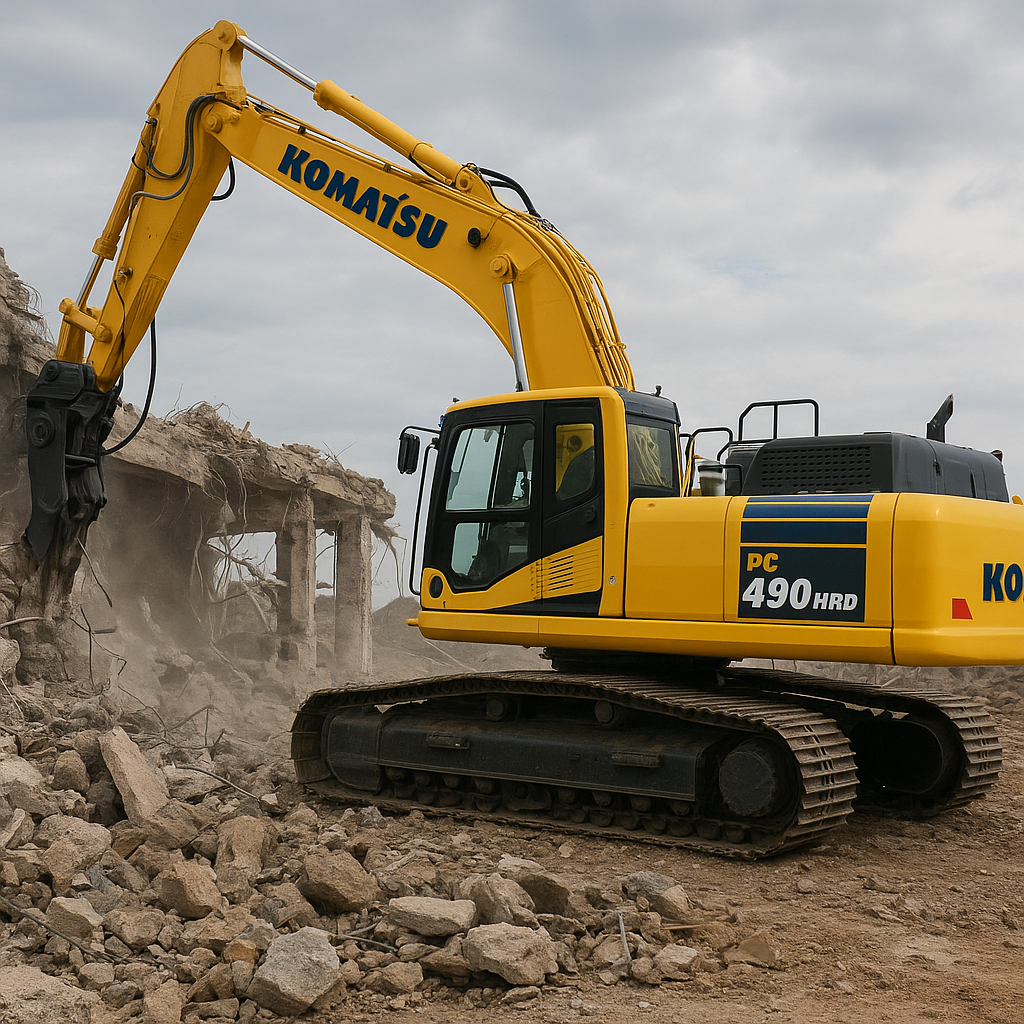
The Komatsu PC490HRD-11 is a heavy-duty demolition excavator purpose-built to tackle complex dismantling tasks in urban and industrial environments. Combining reinforced structures, advanced hydraulics and a range of dedicated demolition attachments, this machine is engineered to deliver controlled, efficient and safe demolition work. The following article examines the machine’s design, typical applications, operational features, maintenance and economic factors, and offers practical guidance for contractors evaluating or operating a high-reach demolition excavator like the PC490HRD-11.
Design and construction for demolition
Demolition-specific excavators differ from general-purpose machines in several important ways. The Komatsu PC490HRD-11 incorporates design elements intended to maximize durability, reach and operator control while minimizing downtime and safety risks. Key structural features include a reinforced undercarriage and house, specialized booms and arms, and a tailored counterweight system to stabilize the machine when fitted with long reach or heavy attachments.
Reinforced structure and stability
- Reinforced boom and arm sections are heat-treated and strengthened at high-stress points to withstand the dynamic forces of demolition tools such as crushers and shears.
- Strengthened undercarriage components (track frames, idlers, sprockets) are often fitted or specified to handle higher loads and abrasive debris typical of demolition sites.
- Counterweight options are configurable: additional counterweight packages improve stability for high-reach work, while compact configurations reduce machine footprint for confined urban sites.
Hydraulics and control systems
A demolition-focused hydraulic system delivers high flow and controlled, predictable response to the myriad of hydraulic tools used in dismantling structures. Key hydraulic design considerations include:
- High-flow hydraulic circuits with low-pressure return filtration and dedicated lines for attachments.
- Proportional valve control and advanced electronic mapping that let operators fine-tune force, speed and attachments’ operational modes.
- Auxiliary hydraulic couplers that facilitate quick attachment changes and support for high-pressure tools (e.g., pulverizers, shears).
Typical applications and use cases
The PC490HRD-11 is predominantly used where controlled demolition, selective dismantling or high-reach access is required. It is frequently chosen for jobs where ordinary excavators would be unsafe or inefficient. Typical use cases include:
- High-rise building demolition — dismantling upper stories with reduced ground-level impact and noise.
- Industrial plant dismantling — removing steelwork, conveyors, tanks and concrete structures in brownfield redevelopment.
- Bridge and infrastructure deconstruction — selective removal of spans or parapets where precision is required.
- Urban and confined-site demolition — controlled piece-by-piece removal near remaining structures, utilities and pedestrians.
- Material handling and sorting — with grapples or sorting systems the machine can assist in separating rebar, concrete and recyclable materials on-site.
Performance and key specifications (typical values and ranges)
Exact specifications for a demolition variant like the PC490HRD-11 depend on configuration, optional packages and regional model differences. The values below reflect typical ranges for excavators in the 40–50 tonne demolition class and known characteristics of Komatsu’s PC490-series machines. Users should confirm precise numbers with Komatsu publications or a local dealer before procurement.
- Operating weight: typically in the range of 45,000–55,000 kg depending on boom, counterweight and attachment setup.
- Engine power: commonly around 250–300 kW (approximately 335–400 HP) for the PC490-class powerplant.
- High-reach heights: demolition booms and arm combinations can extend from ~10 m for short-reach to 20–30 m or more for specialized high-reach packages; exact reach depends on boom/arm geometry.
- Hydraulic flow: auxiliary hydraulic flow rates for attachments are typically in the range of 200–400 L/min at variable pressures depending on pump configuration.
- Bucket/breakout force: when configured as a standard excavator, breakout forces may be in the 200–300 kN range; however, demolition tools produce different effective forces and stresses.
- Fuel efficiency: modern engines with electronic control and ECO modes reduce fuel burn compared to earlier generations; fuel consumption varies heavily by duty cycle and attachment.
These figures are intended as orientation rather than exact metrics. Demolition configurations add weight and alter stability and reach characteristics; therefore, machine planning should always incorporate the particular boom length, attachment mass and required working envelope.
Attachments and tooling for demolition tasks
A demolition excavator is only as versatile as the attachments it carries. The PC490HRD-11 can be equipped with a wide variety of tools that transform it from a high-reach dismantler to a material handler, crusher or shear operator. Common attachments include:
- Hydraulic shears — for cutting structural steel, rebar and pipework. Available in rotating and fixed styles.
- Hydraulic pulverizers and crushers — for breaking reinforced concrete into handleable fragments and separating rebar.
- Hydraulic breakers — for heavy concrete and rock breaking; commonly used at lower reach positions.
- Sorting grapples and orange-peel grapples — for material handling, sorting and loading demolition waste.
- Quick couplers and rotation systems — allow rapid switching and orientation control of attachments to speed cycles.
- Demolition buckets and shearing attachments — specialized buckets combine digging and cutting capabilities for certain tasks.
Attachment selection must consider hydraulic flow, pressure compatibility, weight and center of gravity impacts on stability. Many operators opt for rotating couplers and tilt rotators to increase flexibility at height.
Operator safety and cab considerations
Safety is paramount on demolition sites. Machines like the PC490HRD-11 include features to protect the operator and surrounding personnel:
- ROPS/FOPS-protected cab with optional demolition screens and wire mesh to shield against falling debris.
- High-visibility glazing and camera systems for improved situational awareness when working near structures and ground crews.
- Operator-assist systems such as load limiting, camera-aided swing-zone monitoring and fault diagnostics.
- Ergonomic controls and HVAC to reduce fatigue and maintain concentration during long shifts.
Many demolition contractors also add external safety enhancements: platform walkways for service access, emergency egress systems for high-reach booms, and specialized lighting for night shifts. Training and certification for operators remain critical: the best machine mitigates risk, but operator competence defines safe performance.
Maintenance, durability and total cost of ownership
Demolition work is punishing on equipment. Key maintenance and lifecycle factors for a PC490HRD-11 include component wear rates, filter and fluid change intervals, and ease of access for service. Considerations that influence uptime and total cost of ownership:
- Wear parts and undercarriage — frequent inspection and scheduled replacement of track components, rollers and sprockets reduce the risk of unscheduled downtime.
- Hydraulic system care — clean hydraulic fluid, proper filtration and monitoring of cylinder rod seals prolong attachment life and prevent contamination-related failures.
- Preventive maintenance programs — OEM-backed service plans and telematics (remote monitoring) help detect issues early and optimize service intervals.
- Attachment lifecycle — demolition tools are high-wear; planning for rotation, refurbishment and rebuilds of shears and pulverizers is crucial to cost control.
Komatsu models often come with telematics packages (e.g., KOMTRAX) that provide real-time health monitoring, fuel consumption metrics and location data. These systems help managers improve utilization and schedule proactive maintenance, reducing overall ownership costs.
Productivity, metrics and planning
Productivity for demolition projects is a function of machine capability, attachment selection, operator skill, and site logistics. Useful productivity metrics include cycle times for common tasks (cut, lower, reposition, load), material throughput (m³/hour), and fuel consumption per ton of demolished material. While site-specific results vary widely, some practical benchmarks:
- With suitable attachments, a dedicated demolition excavator in the PC490 class may process several dozen to a few hundred tonnes of concrete per day under optimal, continuous-working conditions.
- Cycle times are heavily influenced by reach and weight of material; high-reach dismantling is slower than ground-level crushing but reduces need for scaffolding and demolition management on the ground.
- Fuel efficiency can often be improved by employing engine idle-shutdown, ECO hydraulics modes, and operator coaching; savings of 10–20% are commonly achievable compared to unmanaged operations.
Estimating project timelines requires factoring in attachment changeover times, debris segregation for recycling, traffic and noise limitations in urban sites, and regulatory permits. Detailed pre-job planning that models reach envelopes and load paths will reduce surprises and speed the work.
Environmental and regulatory considerations
Demolition work intersects with environmental regulations concerning dust control, noise, waste handling and hazardous materials (asbestos, lead-based paint). Machines like the PC490HRD-11 contribute to compliance through lower-emission engines and easier dust suppression integration:
- Emission standards: modern Komatsu engines meet current regional emission regulations (Tier 4 Final / Stage V in many markets), reducing NOx and particulate emissions compared with older units.
- Dust control: water spray systems can be mounted or used from grapples to minimize airborne particles during cutting or crushing.
- Waste segregation: using sorting grapples and on-site processing reduces landfill disposal and increases recycled material recovery (concrete, steel).
Contractors should maintain documented procedures for hazardous material identification and removal prior to heavy demolition. A controlled approach minimizes environmental fines and improves community relations in urban projects.
Procurement, rental and resale considerations
Deciding whether to buy, lease or rent a PC490HRD-11 depends on project frequency, duration and capital availability. Key financial points:
- Short-term intensive projects often favor rental: lower upfront cost, access to the latest spec machines and support services from rental houses.
- Long-term fleet additions can justify purchase with predictable utilization; owning may reduce per-hour costs if uptime and maintenance are managed well.
- Resale value on demolition machines can remain strong when machines have documented maintenance histories and low hours because rental and contractor markets value ready-to-work units.
When procuring, always verify the machine’s configuration for intended tasks: does it include the necessary counterweight, boom configuration and hydraulic flow for your preferred attachments? Also check warranty coverage for demolition-specific wear parts.
Practical tips for operators and site managers
- Plan the reach envelope and stability margins before attaching high-reach booms; use load charts specific to your machine and attachment setup.
- Maintain a clear communication plan and exclusion zones for ground crews; falling debris is the primary hazard in demolition.
- Pre-separate utilities and hazardous materials to avoid surprises and regulatory delays.
- Rotate operators and schedule breaks to reduce fatigue, especially during precision dismantling at height.
- Keep a supply of wear parts (teeth, pins, seals) and trained service personnel on-call to minimize downtime during critical phases.
Conclusion and final considerations
The Komatsu PC490HRD-11 represents a class of purpose-built demolition excavators tailored for demanding dismantling jobs where reach, control and durability matter. With reinforced structure, powerful hydraulics, versatile attachment compatibility and modern operator-assist systems, such machines balance productivity with safety. Exact performance and specification figures vary by configuration—especially boom length, counterweight and attachment choices—so purchasers and operators should validate numbers with official Komatsu documentation or a local dealer.
For contractors undertaking complex demolitions, the most important factors are matching machine configuration to the task, investing in proper attachments, enforcing safety and environmental controls, and maintaining a disciplined service program to keep the excavator productive over its lifecycle. When those elements are combined, a demolition excavator like the PC490HRD-11 becomes not just a powerful tool, but a central asset that improves speed, reduces risk and can increase the recyclability and salvage value of demolition projects.
Komatsu PC490HRD-11 in demolition roles emphasizes the interplay of reach, robustness and operator control. If your projects require high-reach dismantling, selective deconstruction or efficient on-site processing, a properly specified machine in this class is a compelling solution.
)
)