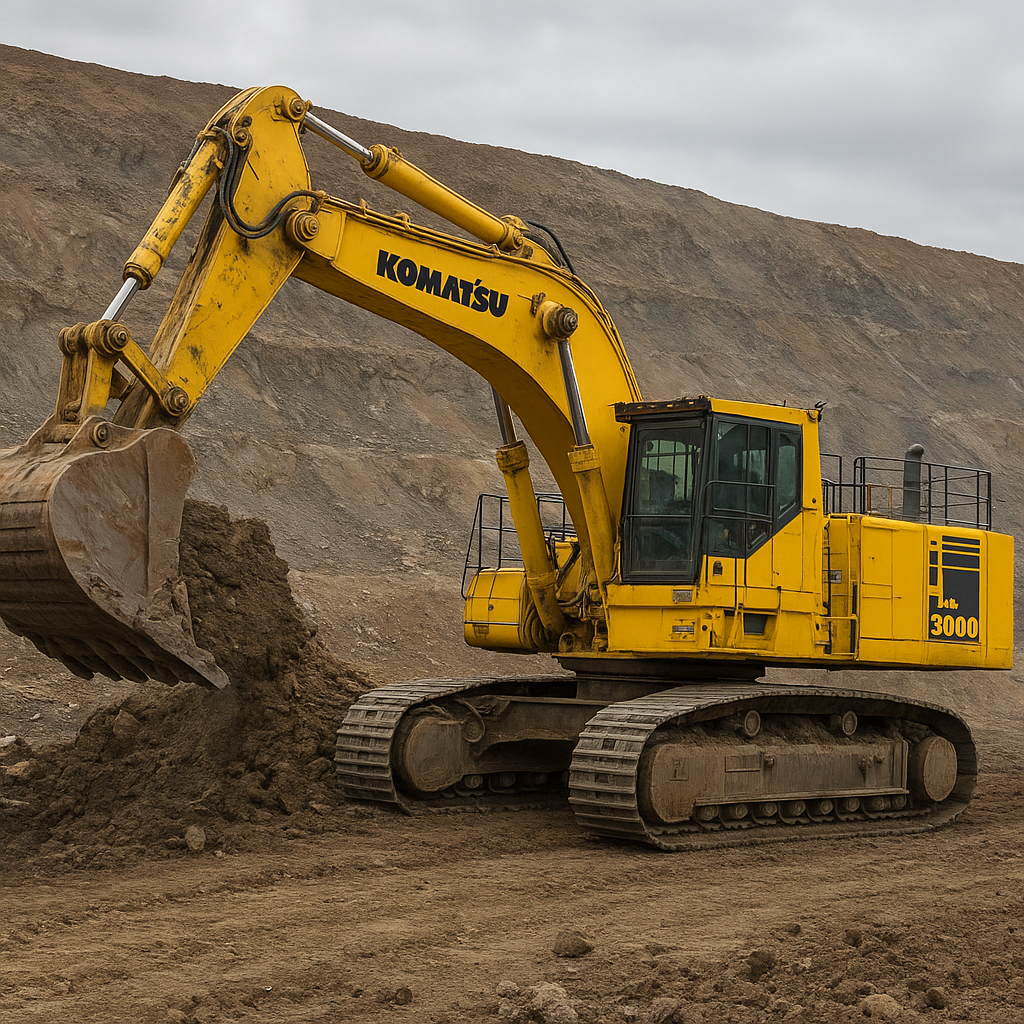
The Komatsu PC3000-6 is a flagship heavy-duty hydraulic excavator designed for the rigors of large-scale mining and high-production earthmoving. Built to move enormous volumes of material efficiently and reliably, this machine combines rugged mechanical components with advanced hydraulic and electronic control systems to serve the most demanding open-pit and quarry operations. The following article describes the machine’s main characteristics, typical applications, performance considerations, maintenance practices and real-world operational context.
Overview and development
The Komatsu PC3000-6 belongs to Komatsu’s line of ultra-class hydraulic excavators, engineered primarily for the mining industry. Over the evolution of the PC3000 series, Komatsu focused on increased durability, improved hydraulics and more intelligent onboard systems to reduce total cost of ownership while boosting productivity. The PC3000-6 is frequently configured as a shovel-style dipper or a giant hydraulic excavator with an array of bucket sizes and arm configurations tailored to specific mine plans and material characteristics.
As a purpose-built mining excavator, the PC3000-6 targets operations where continuous high-volume loading onto large haul trucks is required. Its role complements other heavy mining assets such as rigid-frame haul trucks, large wheel loaders, and conveyor systems. The machine is engineered to maximize cycle efficiency, reduce downtime and simplify maintenance in remote and harsh environments.
Key technical characteristics
The Komatsu PC3000-6 is characterized by a combination of massive structural components and advanced control technologies. While exact specifications vary by market and configuration, typical technical highlights include:
- Operating weight: Varies by configuration and attachments; commonly in the range of 180 to 240 metric tons depending on undercarriage, counterweight and bucket selection.
- Bucket capacity: Configurable from approximately 12 to 28 cubic meters (m3) for hydraulic excavator buckets, with special-purpose dipper capacities available for particular cycles and material types.
- Engine power: High-output diesel engines tailored for mining; typical net power ratings are often in the range of roughly 1,000 to 1,800 kW depending on emissions package and regional engine variants.
- Hydraulic system: High-flow, high-pressure closed-center systems with variable-displacement pumps to provide efficient power delivery and smooth, responsive control of boom, arm and bucket cycles.
- Digging force: Boom and arm forces are engineered to match large bucket loads and abrasive conditions, typically delivering very high breakout and crowd forces for tough rock and overburden removal.
- Undercarriage and travel: Robust crawler undercarriage designed for stability during heavy lifts and for traversing ramp gradients typical of open-pit benches.
- Control and monitoring: Integrated electronic control systems with machine monitoring, diagnostic functions and telematics options such as Komatsu’s fleet management systems.
Because Komatsu offers multiple configurations, prospective owners and mining engineers commonly work with factory or dealer teams to optimize the PC3000-6 configuration for the specific orebody, bench height, truck fleet and loading strategy. Choices in bucket type (rock, coal, or general-purpose), boom length, stick geometry and counterweight have major impacts on productivity and fuel consumption.
Typical applications and operational roles
The PC3000-6 finds its principal use in open-pit mining environments where high hourly production is essential. Common applications include:
- Primary loading of large rigid-frame haul trucks (100–400 tonne classes) in bench operations.
- Overburden removal where large volumes of waste must be stripped quickly to expose ore.
- Ore loading in high-throughput pits, supporting downstream crushing and conveying circuits.
- Quarrying where consistent, high-capacity loading improves quarry productivity and reduces unit costs.
- Heavy civil projects such as dam construction or large earthworks where sustained bulk movement is required over long periods.
In mining fleets, the PC3000-6 often works in close coordination with large haul trucks. Matching bucket size and payload to truck capacity is a critical optimization: too-small buckets increase cycle counts, while too-large buckets can lead to uneven load distribution, truck overloading or inefficiencies. Fleet sizing studies typically assess payload densities, bench layout, cycle times and truck availability to determine the ideal excavator-truck pairing.
Performance metrics and productivity considerations
Assessing PC3000-6 productivity involves a number of interdependent parameters. Machine configuration, operator skill, material characteristics and bench layout all influence hourly production. Key factors include:
- Bucket fill factor: Real-world fill ratios (how completely a bucket is filled on each pass) often determine effective payload more than nominal bucket volume.
- Cycle time: Including dig, swing, dump and return; improved hydraulics and operator techniques can reduce cycle times significantly.
- Truck matching and queuing: Truck arrival patterns and dispatch systems profoundly affect excavator productivity—idle time waiting for trucks can be a major production loss.
- Material density: Heavier materials increase payload mass per m3 and influence wear rates, while abrasive, hard rock increases consumption of wear parts and impacts downtime.
To give practical perspective without implying universal values, consider an illustrative scenario: with a 16 m3 bucket, a material density of 1.6 t/m3 gives an approximate payload of 25.6 tonnes per pass. If effective cycle times average 45 seconds, theoretical production would be roughly 2,048 tonnes per hour (25.6 t × 3600 s / 45 s). In practice, queueing losses, variability in fill factor and maintenance interruptions reduce this theoretical maximum. Typical sustained production rates therefore depend heavily on site logistics but can frequently fall in the range of several hundred to a few thousand tonnes per hour for machines of this class.
Fuel consumption, emissions and environmental performance
Fuel consumption for ultra-class excavators is influenced by load factor, cycle characteristics and engine tuning. Typical hourly fuel use for machines in this size class can range from tens to over a hundred liters per hour under heavy continuous operation. Modern engine packages aim to balance power delivery with fuel efficiency while meeting regional emissions regulations (Tier/Stage levels). Komatsu offers engines and after-treatment systems designed to meet these standards while implementing strategies to reduce fuel burn, such as load-sensing hydraulics and optimized power modes.
Environmental considerations in selecting and operating a PC3000-6 include spill containment for large fuel and hydraulic reservoirs, noise management at the pit edge and dust suppression strategies during loading. Many operators integrate water sprays, dust collection systems and best-practice traffic controls to reduce environmental impacts associated with high-volume excavating.
Maintenance, lifecycle management and telematics
Maintenance planning is a critical element of achieving low cost per tonne. Komatsu and dealers emphasize scheduled maintenance intervals, condition monitoring and component life tracking. Important elements include:
- Wear components: Buckets, teeth, adapters and cutting edges, which are typically replaced frequently depending on abrasive conditions.
- Hydraulic systems: Regular oil and filter changes, hose inspections and monitoring of hydraulic pressures to avoid catastrophic failures.
- Undercarriage: Track shoes, rollers and sprockets require inspection and periodic replacement, and they constitute a major maintenance cost on crawler machines.
- Engine and drivetrain: Predictive maintenance based on oil analysis, thermographic inspections and vibration monitoring helps reduce unplanned downtime.
Komatsu’s telematics platforms, often known by dealer-specific names such as Komtrax, provide remote monitoring of operating hours, fuel consumption, idle time, fault codes and location. These systems enable fleet managers to optimize maintenance scheduling, verify utilization and proactively address component health issues. Lifecycle cost analyses often show that initial machine cost is only a portion of total ownership expense; maintenance, fuel and downtime typically drive long-term cost per tonne metrics.
Safety features and operator environment
Modern mining excavators incorporate numerous safety and ergonomic features to protect operators and ground personnel. Typical elements include:
- High-visibility cabs with wide glazing and optional camera systems to minimize blind spots.
- Rollover and falling-object protective structures (ROPS/FOPS) for operator protection in severe conditions.
- Ergonomically designed operator stations with adjustable seats, climate control and controls positioned to reduce fatigue.
- Integrated operator-assist systems such as swing lockouts, anti-two-block features and overload alerts to prevent unsafe operations.
- Access platforms, ladders and handrails designed to facilitate safe entry and exit for routine inspections and maintenance.
Safety planning for PC3000-6 operations includes enforced exclusion zones during swing arcs, spotter usage for truck loading, and rigorous lockout/tagout procedures during maintenance. Given the machine’s size and mass, human factors and procedural controls are as important as mechanical safeguards.
Real-world examples and operational data
While production statistics vary widely by site, some general patterns emerge from industry practice. Sites operating ultra-class excavators like the PC3000-6 often report:
- High hourly payload capacities when machines are closely matched with truck fleets and when queuing is minimized.
- Wear part replacement cycles that are heavily dependent on material abrasivity—soft overburden may reduce wear dramatically compared with hard, interbedded ore.
- Fuel efficiency improvements of 5–15% over older machines when leveraging modern power-management systems and operator training.
Case studies compiled by OEMs and mining contractors frequently emphasize the importance of integrated planning: selecting the correct bucket size, optimizing bench layout, and implementing advanced dispatch systems can significantly increase effective utilization and reduce unit costs. For example, improving shovel-truck matching to reduce waiting times by 10–20% often translates to proportional gains in tonnes moved per hour without any hardware changes.
Upgrades, refurbishments and resale considerations
Given the high capital cost of ultra-class excavators, many mining companies evaluate mid-life rebuilds or refurbishments to extend service life at a lower cost than new replacement. Typical refurbishment programs address the following:
- Reconditioning of major structural welds and linkages.
- Replacement of undercarriage assemblies and reconditioning of final drives.
- Engine overhauls or replacement with updated, emissions-compliant power units.
- Upgrading of hydraulic components and implementation of newer control systems for improved diagnostics and efficiency.
Resale values for well-maintained machines remain significant. Secondary market demand is driven by mines in growth regions, expansions of existing pits, and contractors who prefer refurbished machines for certain projects. Effective documentation of maintenance history and telematics records often supports higher resale prices and faster asset turnover.
Design trends and future developments
Looking forward, the evolution of machines like the PC3000-6 follows broader trends in mining equipment: electrification, autonomy, and data-driven optimization. Some relevant directions include:
- Hybrid and electric powertrains: Interest in hybrid systems and fully electric drive components aims to reduce fuel consumption and emissions, particularly in operations with available low-carbon electricity.
- Autonomous and semi-autonomous operation: Remote operation and supervisory autonomy reduce exposure of personnel to hazardous environments and can increase utilization by enabling continuous shift operation without operator fatigue constraints.
- Advanced materials and coatings: New wear-resistant materials and surface treatments extend the life of buckets and structural components, improving lifecycle economics.
- Enhanced telematics and AI-based analytics: Predictive maintenance and optimization algorithms will further reduce downtime and refine fuel and cycle efficiency.
OEMs and mine operators are actively testing and fielding technologies that support these trends. Integration of such technologies into the PC3000 platform or its successors can yield meaningful improvements in sustainability and cost efficiency.
Summary of practical considerations for buyers and operators
When evaluating the Komatsu PC3000-6 for purchase or deployment, key decision factors include:
- Careful selection of bucket size and arm geometry to match the target haul truck fleet and material characteristics.
- Investment in telematics and operator training to maximize the machine’s productive hours and to reduce fuel consumption.
- Comprehensive maintenance planning that incorporates predictive diagnostics and ready access to parts for high-wear items.
- Site planning to minimize truck queuing and to optimize dig faces for sustained bucket fill factors.
For large mining operations, the PC3000-6 represents a strategic asset that can deliver high throughput when integrated into well-engineered fleet and pit designs. With appropriate configuration, maintenance discipline and operational controls, the machine contributes to lower unit costs and improved project timelines.
Additional practical notes
Owners typically benefit from close collaboration with Komatsu dealers for lifecycle support, hydraulic tuning and parts planning. The priorities of uptime, safety and energy efficiency are central to achieving favorable economics over decades of service.
Across all these topics, the Komatsu PC3000-6 stands out as a purpose-built example of engineering for large-scale material movement: combining heavy structural durability, powerful hydraulic systems and modern control technologies to meet the rigorous demands of contemporary mining operations.
Komatsu PC3000-6 mining excavator bucket capacity operating weight engine power hydraulic system productivity reliability
)
)