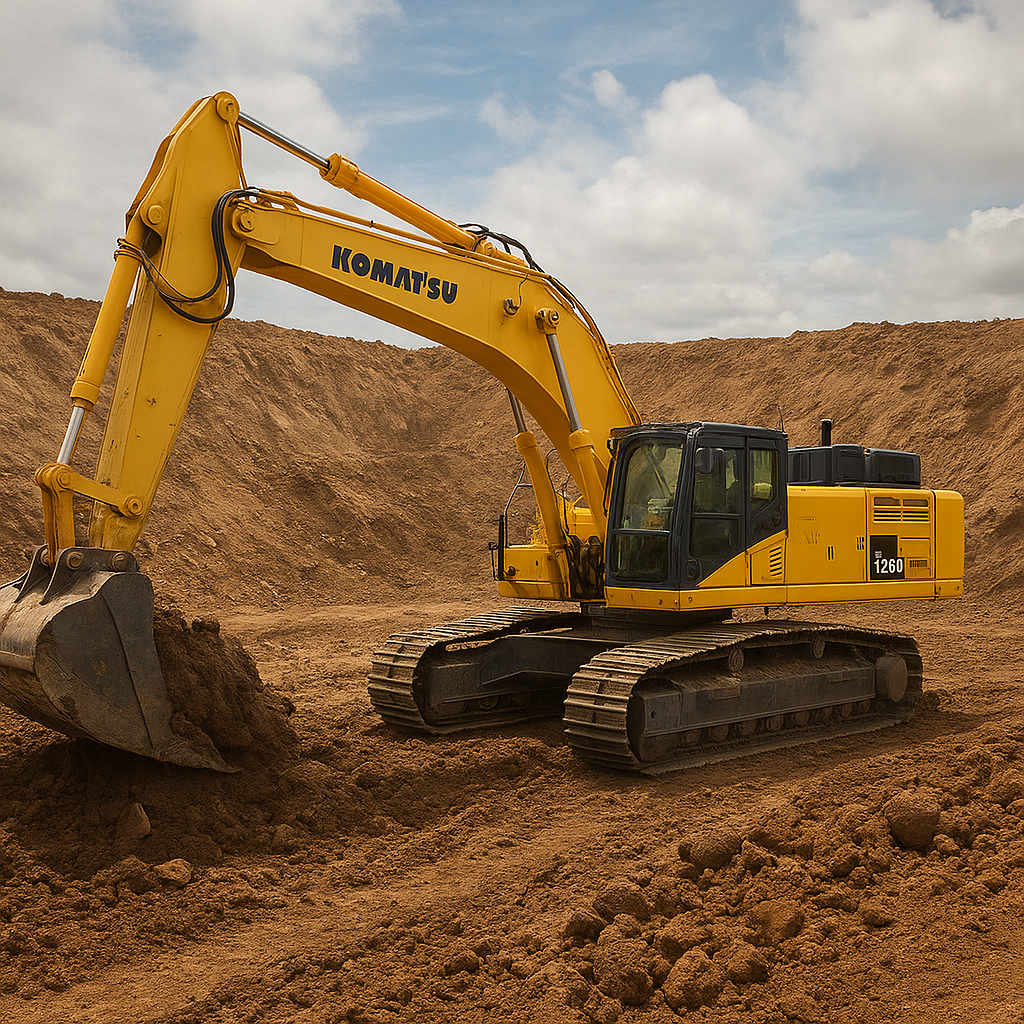
The Komatsu PC1250 series represents a class of large, heavy-duty hydraulic excavators designed for the most demanding earthmoving, mining and construction tasks. Built to combine raw power with advanced control systems and durability, the PC1250 is commonly found on projects where productivity, uptime and operator comfort directly impact the bottom line. In the following sections, we explore the machine’s design, typical applications, technical characteristics and real-world considerations for owners and operators.
Overview and design philosophy
At its core the Komatsu PC1250 is a reflection of modern excavator engineering: an emphasis on hydraulic efficiency, structural strength and systems integration. The model number indicates its position in Komatsu’s lineup as a large-class machine intended for heavy excavation and loading. Over successive generations Komatsu has updated the PC1250 with improvements to the engine, hydraulic circuits, electronic controls and operator environment to meet stricter emissions regulations while boosting productivity.
Komatsu engineers focus on providing machines that minimize downtime and lifecycle cost. Key elements of this philosophy include robust structural components, modular systems for easier maintenance, and the use of telematics to remotely monitor machine health. The PC1250’s design balances raw digging force with the need for precision and fuel-conscious operation — characteristics that make it adaptable across a broad range of industries.
Typical applications and industries
The PC1250 is used where scale and continuous high output are required. Typical applications include:
- Open-pit mining — loading large haul trucks and selective material handling.
- Quarrying and aggregate production — breaking, loading and stockpile management.
- Heavy civil engineering — deep trenching, foundation excavation and river works.
- Port and bulk material handling — managing commodities such as coal, ore and aggregates.
- Large-scale site preparation — clearing and mass excavation for infrastructure projects.
- Demolition and recycling — when fitted with specialized attachments like hydraulic breakers, shears or pulverizers.
Within these sectors the PC1250 excels when continuous productivity and robust duty cycles are essential. Its capacity to operate with heavy buckets, grapple or specialized rock attachments makes it a versatile asset on multi-year projects.
Key technical characteristics
The exact specifications of the Komatsu PC1250 vary by model generation and market configuration, but several common characteristics define the class. Below is an indicative summary of the kinds of figures contractors can expect (figures are approximate and vary by specific model and attachment):
- Operating weight: typically in the range of about 110,000–125,000 kg (110–125 tonnes).
- Bucket capacity: often between 3.5 and 8.0 m3 for standard digging and loading buckets; larger capacities are used for lighter-density materials.
- Engine power: depending on stage and configuration, gross engine power commonly falls in a broad range suitable to heavy excavation — engines are tuned for torque rather than top speed.
- Hydraulic system: high-flow, variable-displacement pumps with load-sensing controls to match flow to demand and reduce fuel consumption under partial loads.
- Reach and digging depth: long-boom and standard-boom variants available to suit different applications; maximum reach and depth are optimized to match bucket sizes and undercarriage configuration.
- Undercarriage: heavy-duty tracks and reinforced rollers designed for prolonged operation in abrasive and impact-prone environments.
Modern variants also integrate advanced emission-control systems to meet regional regulations (for example, EU Stage V, EPA Tier 4 Final). Exhaust aftertreatment typically combines selective catalytic reduction (SCR) and diesel particulate filters (DPF), while engine control strategies reduce fuel consumption without sacrificing performance.
Performance features and productivity enhancers
Komatsu equips PC1250 machines with multiple technologies aimed at maximizing output and reducing operating cost per ton. Important systems include:
- Advanced hydraulic controls that optimize pump output and valve timing for smoother, faster cycles and lower fuel use.
- Automatic idle and eco modes to limit fuel consumption during non-productive times and light-load cycles.
- Komtrax telematics — Komatsu’s remote monitoring system — which provides data on fuel use, machine hours, idle time, fault codes and location, enabling predictive maintenance and fleet optimization.
- Payload management systems (where fitted) that assist operators in loading trucks to target weights, reducing underloading and ensuring compliance with haul road weight limits.
- Operator-assist functions — such as multi-camera systems, ride-control for smoother loading, and electronic work modes — reducing cycle times and operator fatigue.
These features combine mechanically robust construction with electronics-driven optimization, so the PC1250 can deliver a consistent throughput in tough conditions.
Attachments and configuration flexibility
A major factor in the PC1250’s versatility is the range of attachments available. Depending on project needs, a PC1250 can be fitted with:
- Large rock and general-purpose buckets sized for the material density and loader/haul truck profiles.
- Hydraulic breakers for secondary fragmentation and trenching in rock environments.
- Rippers for breaking compacted ground.
- Grapples and clamshells for bulk material handling and sorting.
- Shears and pulverizers for demolition and recycling applications.
- Quick couplers enabling fast changes between tools to improve utilization.
Configuration choices — such as long-arm versus standard arm, track gauge and counterweight options — allow operators to tune the machine for specific tasks, improving both safety and efficiency.
Operator comfort, safety and controls
On machines of this scale, operator environment significantly impacts productivity and safety. Komatsu addresses this through:
- Ergonomic cab design with adjustable seating, low-noise insulation and climate control for long shifts.
- Visibility aids — standard and optional camera systems, mirrors and blind-spot mitigation — crucial when working around trucks and support equipment.
- Robust safety features such as ROPS/FOPS-certified cabins, emergency shut-offs, and anti-slip access points for routine maintenance.
- Electronic assist systems that reduce human error, e.g., overload alarms, swing priority modes and diagonal movement monitors.
These aspects help reduce fatigue, lower the risk of accidents and improve consistent machine operation across shifts and operators.
Maintenance, serviceability and lifecycle management
Large excavators like the PC1250 are expensive capital items; therefore easy serviceability and fleet management directly influence ownership costs. Komatsu’s approach includes:
- Accessible service points — wide access doors and grouped service points cut daily inspection and maintenance time.
- Modular components — engines, hydraulic pumps and major subassemblies designed for exchange and rebuildability.
- Automated lubrication options to ensure consistent grease distribution to pins and bushings, prolonging undercarriage life.
- Telematics-driven maintenance using Komtrax data to schedule preventive service, reducing unscheduled downtime.
- Aftermarket parts and rebuild programs — Komatsu and third-party providers offer remanufactured components and rebuild kits to extend asset life at lower cost than replacement.
Well-executed maintenance programs can significantly extend service intervals for major components and maintain resale value.
Environmental and emissions considerations
Compliance with emissions regulations is a key consideration for heavy equipment used in regulated markets. Komatsu equips modern PC1250 variants to meet the applicable regional standards through technologies such as SCR, DPF and advanced engine management. Environmental considerations also include:
- Fuel efficiency measures — hydraulic system optimization and engine control to reduce liters per hour under typical duty cycles.
- Noise reduction — acoustic design in the engine compartment and cab to meet site limits and improve operator comfort.
- Recycling and disposal — guidelines for recycling hydraulic oil, filters and other wear parts at end-of-life.
For contractors operating in sensitive environments or under stringent local regulation, choosing a PC1250 configured to the correct emissions stage is essential.
Economic and operational considerations
The value of a PC1250 to a contractor is measured not just by purchase price but by how efficiently it moves material over its life. Key economic factors include:
- Fuel cost per hour — large excavators consume significant fuel; operational strategies and matching bucket size to truck capacity reduce cost per ton.
- Productivity per shift — a well-configured PC1250 can materially reduce the number of cycles and machines required on large projects.
- Resale and secondary market — Komatsu machines often retain strong resale value when well-maintained and equipped with telematics history.
- Fleet utilization — applying telematics to reduce idle time and improve scheduling increases return on investment.
Operators should balance initial acquisition (purchase vs rental), ongoing operating costs and expected project duration when planning to deploy a PC1250.
Real-world performance and statistical benchmarks
Precise performance figures depend on configuration, soil conditions and operator skill; however, some practical benchmarks help estimate capability. In heavy mining and quarry settings, a PC1250-class machine is typically paired with haul trucks of 80–150 tonne capacity and can achieve high-volume loading cycles. Typical expectations include:
- Cycle times — optimized loading cycles as low as 20–40 seconds for a full swing load in ideal conditions when matched correctly to truck size and bucket capacity.
- Fuel consumption — average fuel burn widely ranges with duty but heavy-loading scenarios can see dozens of liters per hour; careful operation modes can reduce consumption by up to 10–20% compared to constant full-power operation.
- Availability — with proactive maintenance and telematics-guided service, fleet availability percentages in excess of 90% are achievable for well-managed operations.
Komatsu’s Komtrax data across fleets often shows that machines with consistent preventive maintenance and operator training deliver the best lifecycle economics. Exact numbers and case studies are available through Komatsu dealers and industry white papers for specific project types.
Buying considerations and lifecycle options
When procuring a PC1250, consider the following to ensure alignment with project requirements:
- Match bucket size to haul trucks to avoid underloading or excessive cycle times.
- Choose emission stage appropriate for local regulations and future-proofing against stricter standards.
- Evaluate telematics and warranty packages — they often reduce long-term costs through monitoring and dealer support.
- Consider rental or short-term leasing for projects where machine needs are temporary or uncertain.
- Plan for operator training to ensure safe, efficient operation and to extract maximum productivity.
Used market options can offer cost-effective access to the PC1250 class, but buyers should verify maintenance history, wear items, undercarriage condition and telematics logs.
Future developments and market trends
The heavy excavator segment continues to evolve. Trends that influence machines like the PC1250 include:
- Greater electrification and hybrid systems aimed at reducing fuel consumption and emissions in certain applications.
- Advanced telematics and AI for predictive maintenance, autonomous or semi-autonomous operation and optimized worksite logistics.
- Materials and wear technologies that extend component life in abrasive environments.
- Modular attachment systems that reduce changeover time and improve versatility.
Komatsu and competitors invest in research and development to integrate these trends while maintaining the structural and hydraulic robustness required for heavy-duty work.
Summary
The Komatsu PC1250 series represents a powerful and flexible solution for heavy excavation, mining and bulk-handling operations. With a focus on durability, serviceability and integrated electronics, these machines can deliver high throughput when configured and operated correctly. Key advantages include robust structural design, advanced hydraulic and engine controls, and telematics-enabled lifecycle management. Contractors evaluating a PC1250 should consider their material types, truck pairings, emissions requirements and maintenance capabilities to ensure the machine delivers the expected productivity and economic return.
Highlighted keywords: Komatsu, PC1250, excavator, hydraulic, bucket, operating weight, engine power, Komtrax, productivity, efficiency.
)
)